Best Talent Acquisition Software with AI Voice Screening

Dialflo: AI Voice Agent
June 12, 2026
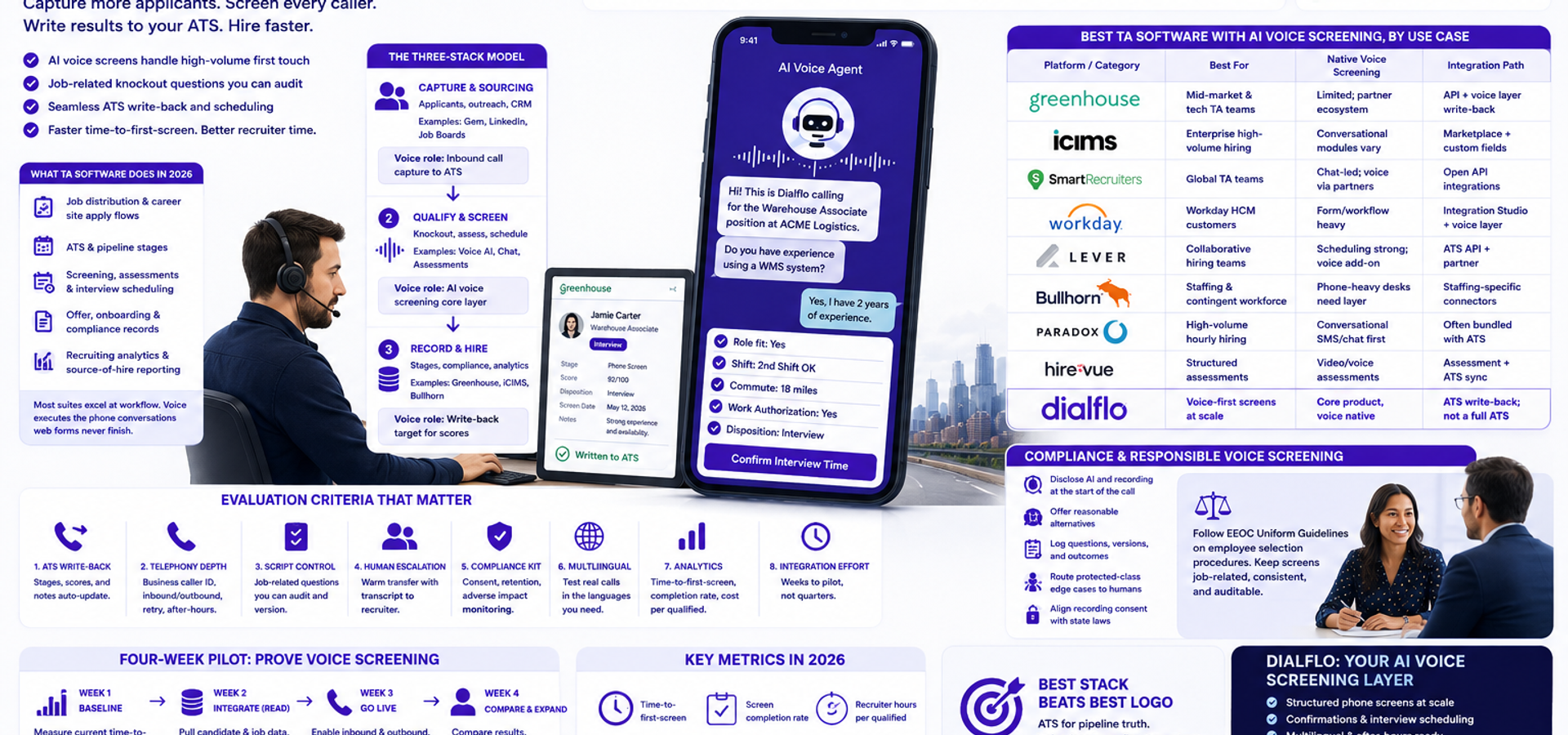
Your careers site captures applications. Your recruiters still spend mornings returning voicemails, re-asking the same knockout questions, and manually typing screen notes into the ATS. If you are comparing talent acquisition software for 2026, the RFP probably lists sourcing, scheduling, and analytics, but the bottleneck is often voice: high-volume first screens that web forms never finish.
This guide covers the best talent acquisition software with AI voice screening options by use case, not a fake leaderboard, plus how voice layers integrate with ATS platforms, what compliance requires, and a four-week pilot plan. For AI recruiting context, start with artificial intelligence in recruitment and how AI agents are transforming recruiting.
What talent acquisition software does in 2026
Talent acquisition software spans the hire funnel:
- job distribution and career site apply flows
- applicant tracking (ATS) and pipeline stages
- screening, assessments, and interview scheduling
- offer, onboarding handoff, and compliance records
- recruiting analytics and source-of-hire reporting
Most suites excel at database and workflow, not live phone throughput. LinkedIn's Future of Recruiting reports rising AI adoption as teams chase speed and recruiter capacity. SHRM recruiting benchmarks continue to show long time-to-fill, often while requisition load per recruiter climbs.
What AI voice screening adds (and what it is not)
AI voice screening runs structured phone conversations: role fit, availability, commute, certifications, pay band, work authorization, and interview scheduling, with outcomes written to the ATS. It is not a replacement for final interviews or human judgment on edge cases.
Contrast with other screening modes in how AI applicant screening works and automated screening software for staffing agencies. Voice fits when candidates call in, prefer phone over forms, or volume makes recruiter-first-screen impossible.
Three-stack model: capture, screen, record
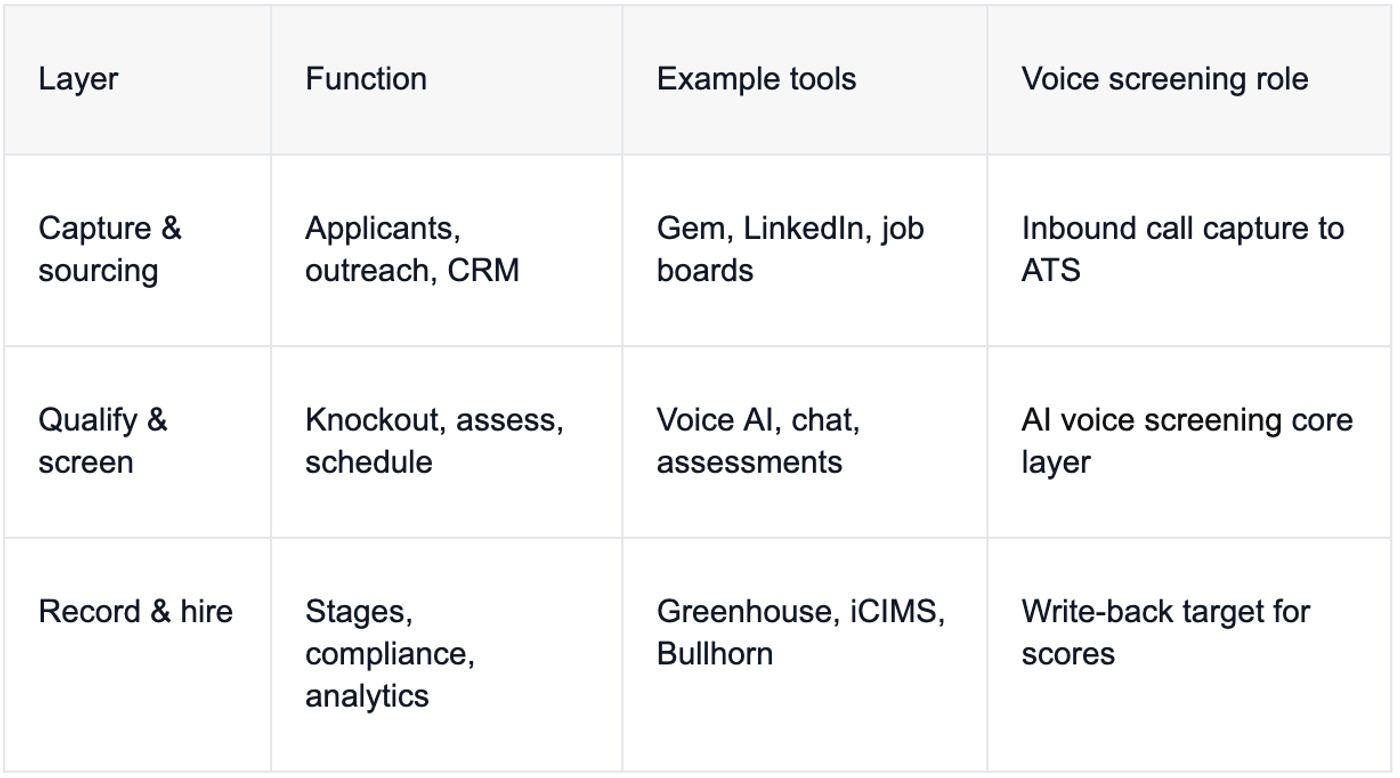
CRM angle: candidate relationship management systems. Agent comparison: AI agents for recruitment compared.
Best talent acquisition software with AI voice screening, by use case
No single platform wins every segment. Below is how leading options map to 2026 buying scenarios. Validate with a pilot on your req types, not a generic ranking.
Greenhouse
- Best for: Mid-market and technology-focused corporate talent acquisition teams
- Native voice screening: Limited, typically supported through partner integrations
- Integration path: API integrations with voice screening platforms and ATS write-back
iCIMS
- Best for: Enterprise organizations with high-volume hiring needs
- Native voice screening: Conversational hiring features vary by subscription tier
- Integration path: Marketplace integrations and custom ATS fields
SmartRecruiters
- Best for: Global talent acquisition teams
- Native voice screening: Primarily chat-based, with voice capabilities through partners
- Integration path: Open API integrations
Workday Recruiting
- Best for: Organizations already using Workday HCM
- Native voice screening: Workflow and form-centric recruitment processes
- Integration path: Workday Integration Studio combined with voice screening solutions
Lever (Employ)
- Best for: Collaborative hiring teams
- Native voice screening: Strong scheduling capabilities with voice screening available via add-ons
- Integration path: ATS APIs and third-party screening partners
Bullhorn
- Best for: Staffing agencies and contingent workforce recruitment
- Native voice screening: Phone-centric recruiting workflows often require an additional voice layer
- Integration path: Staffing-specific connectors and integrations
Paradox (Olivia)
- Best for: High-volume hourly and frontline hiring
- Native voice screening: Primarily conversational SMS and chat experiences
- Integration path: Frequently bundled with enterprise ATS platforms
HireVue
- Best for: Structured candidate assessments and enterprise hiring
- Native voice screening: Strong focus on video and voice-based assessments
- Integration path: Assessment platform integrated with ATS systems
Dialflo (Voice Layer)
- Best for: Phone-first candidate screening at scale
- Native voice screening: Core platform capability with native voice interactions
- Integration path: ATS write-back integrations; functions as a voice layer rather than a full ATS system
Staffing-specific ATS depth: ATS for staffing agencies compared and AI in staffing. Cloud TA overview: cloud-based recruitment software.
When to add AI voice screening to your TA stack
Voice screening pays back fastest when:
- inbound applicant calls exceed recruiter answer capacity
- hourly or field roles need shift, commute, and cert checks by phone
- web screen completion rates are under 50% on mobile-heavy cohorts
- time-to-first-screen stretches beyond 24–48 hours on hot reqs
- multilingual first-touch is required but recruiter coverage is thin
Skip or defer if hiring is low-volume executive search with white-glove touch, see hire candidates faster with AI tools for mixed funnel tactics.
Evaluation criteria for talent acquisition software + voice
- ATS write-back: Stage, disposition, scorecard fields update automatically, not CSV exports.
- Telephony depth: Business caller ID, inbound/outbound, after-hours, retry on no-answer.
- Script control: Job-related knockout questions you can audit and version.
- Human escalation: Warm transfer with transcript to recruiter on edge cases.
- Compliance kit: Consent, recording retention, adverse impact monitoring hooks.
- Multilingual: If your workforce requires it, test real calls, not demo slides.
- Analytics: Time-to-first-screen, completion rate, cost per qualified candidate.
- Integration effort: Weeks to pilot, not quarters, see integrate recruiting software with existing systems.
Build vs buy for voice infrastructure: build vs buy voice AI stack. Conversational design patterns: conversational services use cases.
Compliance: voice screening in regulated hiring
AI voice screening must stay job-related and consistent. The EEOC uniform guidelines on employee selection procedures frame validation and adverse-impact awareness for assessment tools. Practical guardrails:
- disclose that an AI system may conduct or record the screen
- offer reasonable alternatives where required
- log questions, versions, and outcomes for audit
- route protected-class edge cases to human review
- align recording consent with state two-party laws
Interview design support: generate interview questions from job descriptions with AI and interview intelligence and candidate performance.
Four-week pilot: prove voice screening before enterprise rollout
Week 1: Baseline one req type
Measure time-to-first-screen, screen completion, and recruiter hours per hire on warehouse, retail, or call-center reqs, whatever is highest volume.
Week 2: ATS integration read path
Pull candidate record, job metadata, and stage rules. Run parallel screens, recruiter vs voice AI, on sample cohort.
Week 3: Live voice screens with write-back
Enable outbound and inbound. Humans on warm transfer. Track completion and no-show into scheduler.
Week 4: Compare and expand
If time-to-first-screen drops and quality holds, add reqs or languages. If completion stalls, fix scripts, not more tools.
High-volume hiring events: open interviews near me today, voice AI can answer applicant calls during walk-in windows. Analytics layer: recruitment analytics software. ML context: machine learning in recruiting. Future org models: agentic hiring organization.
Metrics that matter in 2026
- time-to-first-screen (apply to completed knockout)
- screen completion rate (started vs finished)
- recruiter hours per qualified candidate
- interview show rate after voice screen
- cost-per-hire on pilot reqs vs baseline
- candidate NPS on screen experience (short pulse survey)
Sourcing still matters, voice does not fix weak top-of-funnel: candidate sourcing services and AI sourcing.
Where Dialflo fits
Dialflo is not full talent acquisition software, it is the AI voice screening execution layer: structured phone screens, confirmations, and scheduling with ATS write-back. Pair Dialflo when your ATS manages the pipeline but phones are where candidates stall.
Explore recruiting voice workflows on dialflo.ai, especially if 2026 hiring plans assume instant first touch your desk cannot staff manually.
FAQ: Talent acquisition software and AI voice screening
What is talent acquisition software?
Tools for sourcing, ATS, screening, scheduling, offers, and hiring analytics.
What does AI voice screening do?
Runs structured phone knockout screens and syncs outcomes to your ATS.
ATS-native or separate voice layer?
Separate layer when phone volume and telephony depth are the bottleneck.
Is voice screening legal?
Yes with job-related questions, disclosure, consent, and human review paths.
How fast to pilot?
Often four weeks on one high-volume req type.
How does Dialflo help?
Voice-native screening layer with ATS write-back, see dialflo.ai.
Closing: best stack beats best logo
The best talent acquisition software with AI voice screening for 2026 is the combination your candidates will actually complete, ATS for pipeline truth, voice for phone-first throughput, humans for final judgment. Pick platforms that integrate in weeks, measure time-to-first-screen honestly, and keep compliance auditable from day one.
Evaluating TA stack upgrades? Start with AI in recruitment, then see how Dialflo handles the voice screens your reqs already need.


