Conversational Services: What They Are and Use Cases

Dialflo: AI Voice Agent
May 6, 2026
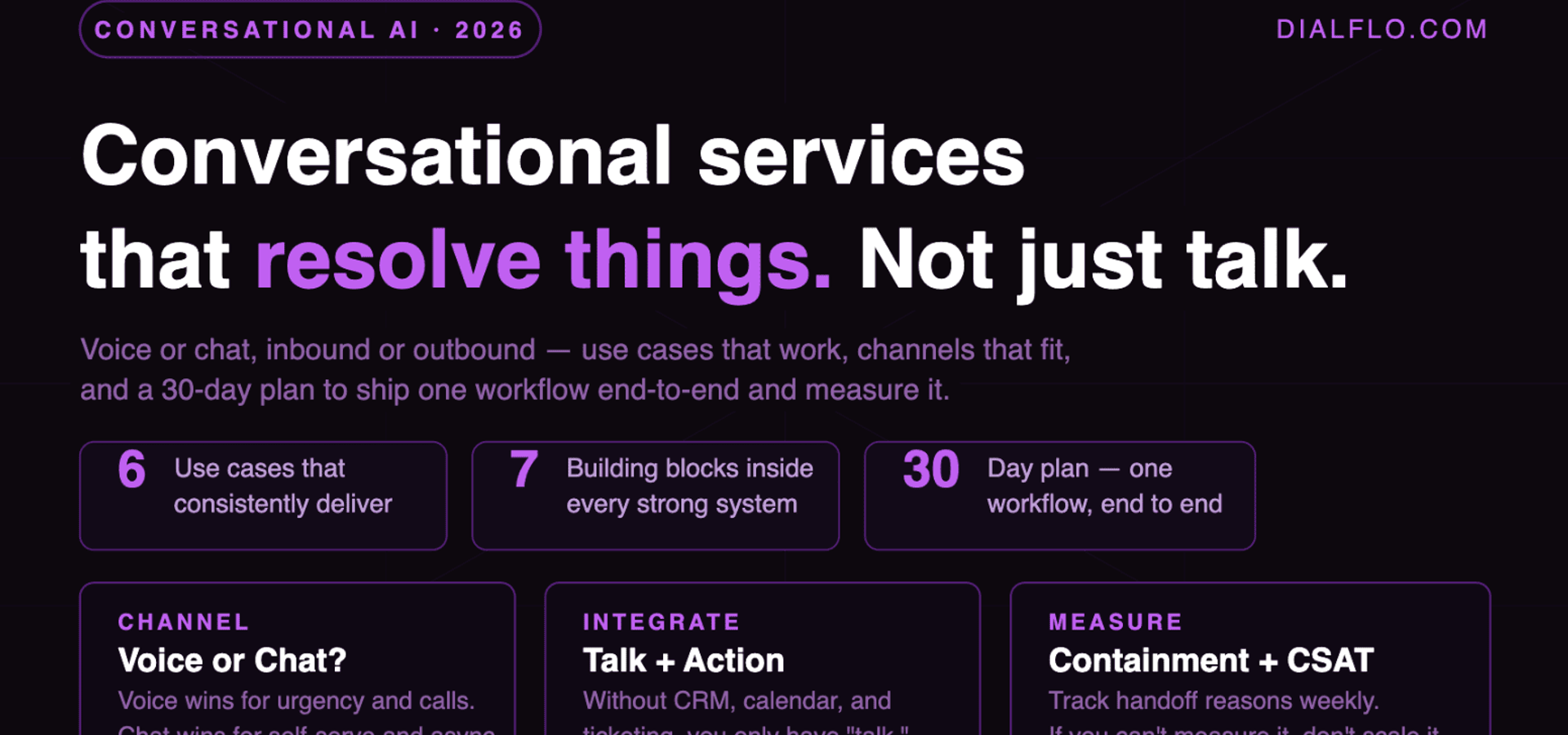
Conversational services succeed when they reduce friction for users and remove repetitive work for teams, without trapping people in a dead-end bot loop.
Conversational services are the tools and capabilities that let customers (or employees) interact with a business using natural conversation, voice or chat, to get answers and complete tasks. Think: checking order status, scheduling an appointment, troubleshooting a device, qualifying a lead, or routing a support request to the right team.
What’s changed in the last few years is that conversational systems aren’t just “FAQ bots.” With better speech recognition, improved natural language understanding, and safer integration patterns, conversational services can now handle real workflows, especially when you design them as systems (not standalone bots) with guardrails, analytics, and a clear handoff to humans.
This guide breaks down what conversational services are, what’s inside them, the use cases that reliably work, how to measure ROI, and the pitfalls that make people hate “bots.” For voice-first workflows (where calls still matter), we’ll also reference Dialflo as an example of a conversational service built around phone calls.
What are conversational services?
At a practical level, conversational services are conversation-powered product features. They sit on top of your existing systems (CRM, ticketing, scheduling, payments, knowledge base) and provide a natural interface for users to navigate those systems.
Gartner defines a chatbot as a domain-specific conversational interface that runs in an app, messaging platform, social network, or chat solution. That definition is helpful because it highlights scope: most conversational services start narrow and expand as confidence grows. See: Gartner glossary: Chatbot.
IBM’s explanations are also useful for distinguishing levels of sophistication: basic chatbots vs more capable virtual agents that combine NLP with search and automation (RPA/integrations). See: IBM: What is a chatbot? and IBM: What is a virtual agent?.
How conversational services work (the building blocks)
A solid conversational service is more than a language model. It’s a pipeline of capabilities that makes conversation safe, useful, and measurable.
1) Channel layer (voice, chat, messaging)
Where the conversation happens: phone calls, web chat, WhatsApp, in-app chat, SMS, or social messaging.
2) Speech (for voice): ASR + TTS
Automatic speech recognition (ASR) converts speech to text; text-to-speech (TTS) speaks back. Voice quality and latency matter, especially for call center experiences.
3) NLU (intent + entities)
Natural language understanding identifies what the user wants (intent) and extracts details (entities), like order number, date, city, or plan type.
4) Dialog manager (the “conversation brain”)
This controls the flow: what question to ask next, when to confirm details, and when to escalate. Great dialog design is what prevents frustrating loops.
5) Knowledge retrieval
FAQs and policy answers usually come from a knowledge base. Retrieval is where you want accuracy and citations, not creative responses.
6) Tooling and integrations (the real power)
This is where the conversational service becomes useful: creating a ticket, checking shipment status, scheduling an appointment, updating a CRM field, taking a payment, or confirming identity. Without integrations, you only have “talk,” not “service.”
7) Analytics and QA
You need conversation analytics: containment rate, handoff reasons, drop-offs, top intents, and failure modes. Otherwise, you can’t improve.
Use cases that consistently work
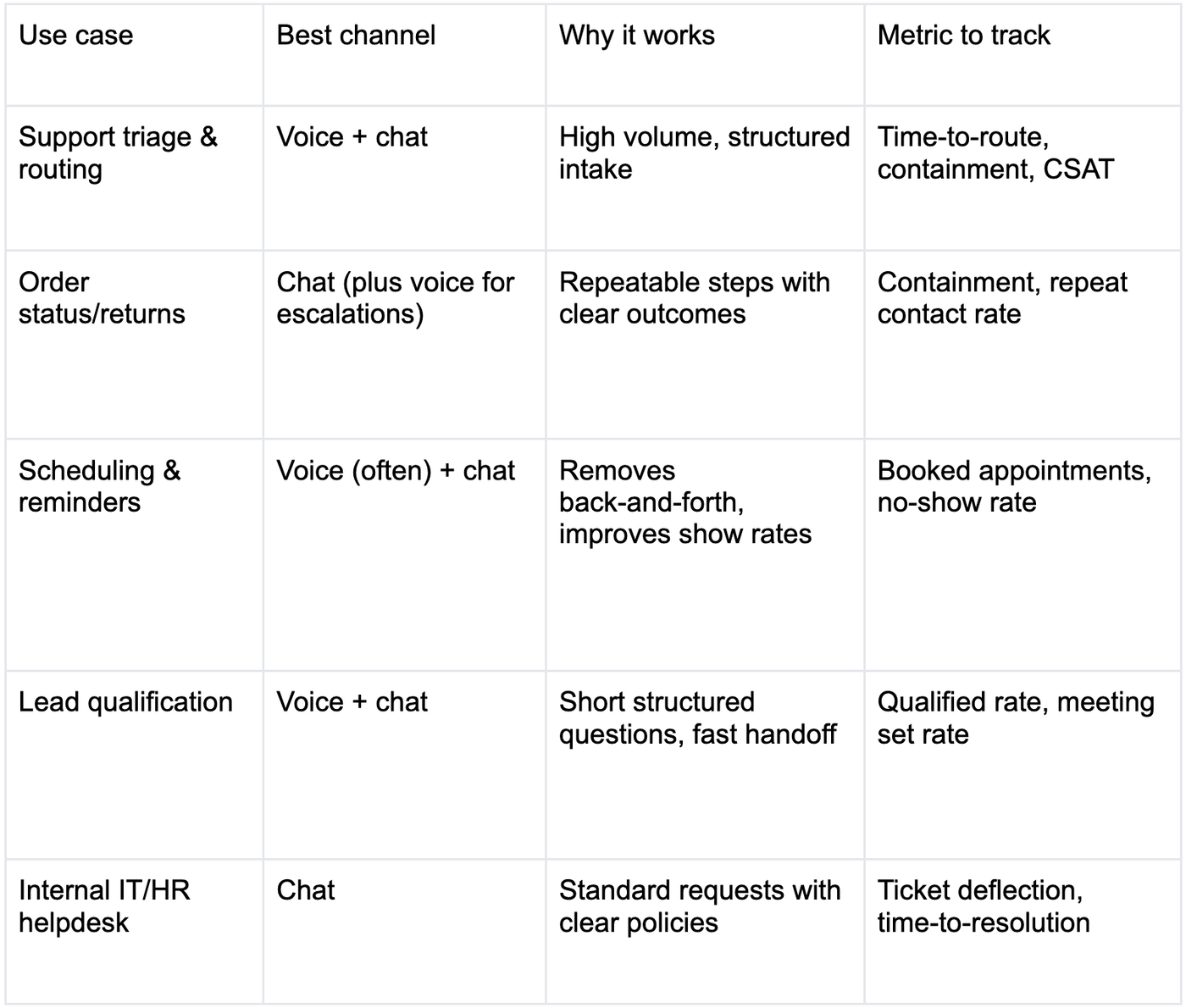
Not every conversation should be automated. The best use cases have (1) high volume, (2) repeatable steps, and (3) a clear success definition. Here are the categories that repeatedly deliver value.
1) Customer support triage and routing
Start with: “What do you need help with?” Then capture the minimum details and route to the right queue. Even if the system doesn’t resolve the issue, faster routing reduces handle time and improves experience.
2) Order status, delivery updates, returns, and refunds
These are perfect for conversational services because the workflow is structured: identify customer → find order → present status/options → take action (return label, pickup, refund timeline).
3) Appointment scheduling and reminders
Scheduling is a high-impact conversational workflow because it removes back-and-forth. Voice is especially powerful here because it handles “call me back” behavior and can confirm details in one shot.
4) Lead qualification and inbound sales
Conversational services can ask a few structured questions (industry, size, budget, urgency) and then either schedule a meeting or route to the right sales rep. The key is to keep it short and respectful.
5) Collections, renewals, and follow-ups
Reminders, payment links, policy explanations, and “talk to an agent” handoffs can be done through conversation, especially when the message content is tightly controlled.
6) Internal helpdesk (IT/HR ops)
Password resets, policy questions, tool access requests, and ticket creation are high-volume and repeatable. Internal conversational services often see faster adoption because teams already know the context and constraints.
Voice vs chat: how to choose the right channel
People often assume chat is cheaper and voice is old-school. In reality, channel choice depends on user behavior and urgency.
Voice works best when:
- users already call (phone is the default channel)
- the issue is urgent (delivery failure, appointment changes)
- users are on the move and don’t want to type
- your customer base spans many languages or low typing comfort
Chat works best when:
- the issue is simple and self-serve
- users want asynchronous replies
- you have strong knowledge base coverage
McKinsey notes that next-generation IVR and automation can materially reduce live-agent calls and improve satisfaction when designed well, reinforcing that voice isn’t “obsolete,” it just needs modern design. See: McKinsey: The contact center crossroads and McKinsey: Why IVR still matters.
Comparison: conversational services by use case
How to implement conversational services (a 30-day plan)
Most failures happen because teams start too broad. A better approach is to ship one workflow end-to-end and measure.
Week 1 , pick one workflow. Choose a single use case with clear success (e.g., “schedule an appointment,” “check order status,” “create a support ticket”). Define success metrics and your escalation rules.
Week 2 , design the conversation. Write the dialog in plain language. Keep it short. Add confirmations for critical details. Define fallbacks and “talk to a human” triggers.
Week 3 , integrate. Connect to the system of record (CRM, calendar, ticketing). If integrations aren’t ready, don’t fake it, ship a smaller flow that still works.
Week 4 , QA and launch. Test for edge cases, accents/languages (for voice), and failure modes. Launch to a small percentage, monitor transcripts, and tune weekly.
The biggest risks (and how to avoid them)
Risk 1: Dead-end loops. Always provide an escape hatch: a human handoff, a callback, or a ticket.
Risk 2: Privacy and consent (especially voice). Be explicit about recording and data usage, follow regional laws, and minimize sensitive data capture.
Risk 3: Hallucinations. For policies, pricing, and compliance topics, prefer retrieval-based answers and constrained outputs.
Risk 4: Accessibility gaps. Offer alternatives (DTMF, email, human agent) for users who can’t use the conversational channel.
Where Dialflo fits: conversational services for phone calls
Dialflo provides AI voice agents, one form of conversational service, designed for phone-first workflows. Teams use voice agents to answer inbound calls, capture structured information (intent, details, eligibility), and help with scheduling and follow-ups. If your bottleneck is missed calls or slow call-backs, voice automation can compress time-to-first-touch without replacing your CRM or helpdesk system.
FAQ: conversational services
What are conversational services?
They are capabilities that let people interact with a business through natural conversation (voice or chat) to get answers and complete tasks, typically combining NLU, dialog management, integrations, and analytics.
Are conversational services the same as chatbots?
Chatbots are one type of conversational interface, usually domain-specific. Conversational services is broader and can include virtual agents, voice IVR, agent assist, and cross-channel orchestration.
What are the best use cases to start with?
Start with high-volume, repeatable workflows: ticket intake, order status, appointment scheduling, lead qualification, and internal helpdesk requests. Pick one and measure for 30 days.
How do you measure ROI?
Measure containment/deflection, time-to-resolution, cost per contact, CSAT, and for sales flows: qualified rate and meeting set rate. Track handoff reasons to improve weekly.
What are the biggest risks?
Poor UX loops, privacy/consent issues, hallucinations on policy topics, and accessibility gaps. Mitigate with human fallbacks, constrained knowledge answers, careful logging, and inclusive design.
How does Dialflo relate to conversational services?
Dialflo is a conversational service for voice calls: AI voice agents that can answer, screen, schedule, and follow up. See dialflo.ai for current capabilities.
Closing: the best conversational service is the one that resolves something real
Conversational services shouldn’t exist to impress stakeholders. They should reduce friction for users and remove repetitive work for teams, while keeping guardrails for privacy, accuracy, and escalation. Start with one workflow, ship it end-to-end, measure, and expand only when the system earns trust.