Retell AI Pricing vs Dialflo Pricing (India + US Scenarios)

Dialflo: AI Voice Agent
May 8, 2026
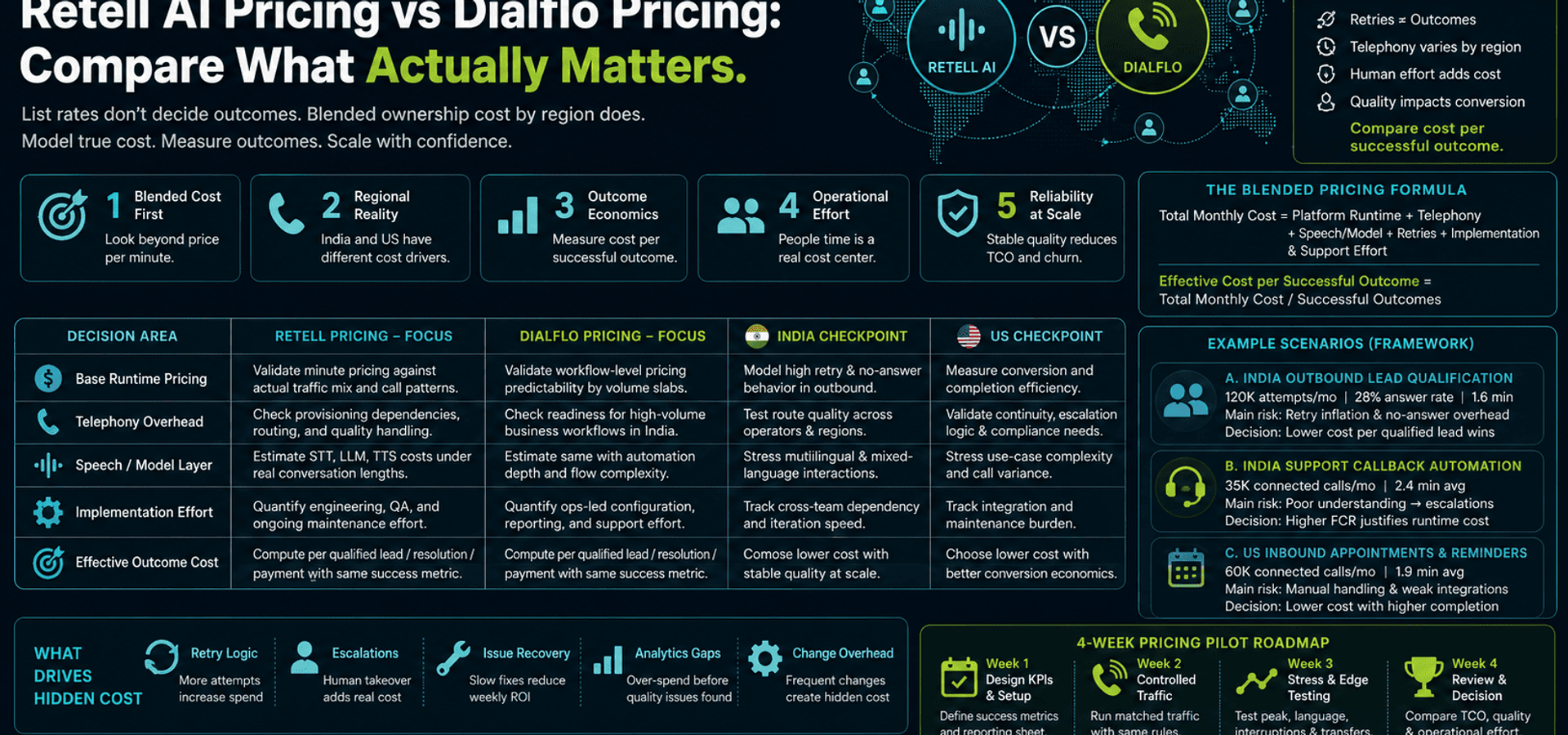
For voice AI buyers, pricing decisions should be based on blended ownership cost by region, not only platform list rates.
Retell AI pricing vs Dialflo pricing is one of the highest-intent buying comparisons in voice AI right now. But most teams compare the wrong numbers. They compare visible plan rates and ignore hidden cost layers that appear in production: retries, telephony dependencies, model usage, incident handling, and the people effort needed to keep workflows stable. That is why a platform that looks cheaper in week one can become more expensive by month two.
This guide gives a practical side-by-side framework for India and US scenarios. We are not trying to crown a universal winner. We are answering a more useful question: for your operating model, which platform gives better total cost and better reliability at scale? If you run inbound support, outbound qualification, appointment reminders, collections, or verification calls, this is the pricing lens you should use before signing an annual plan.
Why list pricing is not enough
In voice AI procurement, visible pricing is only one layer of cost. Real spend is shaped by call behavior and operations design. Procurement teams that only evaluate list rates miss three realities:
- Call attempts are not equal to successful outcomes. Retries and no-answer loops raise effective cost.
- Telephony behavior varies by geography. Number setup, routing, and quality impact both spend and conversion.
- Human effort is a cost center. If your team needs constant supervision and manual QA, ownership cost increases.
So when comparing Retell AI pricing vs Dialflo pricing, always move from “price per minute” to “cost per successful outcome.” That one change prevents most bad vendor decisions.
The blended pricing formula every buyer should use
Use this formula in your vendor sheet:
Total monthly cost = platform runtime + telephony + speech/model charges + retry/no-answer overhead + implementation and support effort
Effective cost per successful outcome = total monthly cost / successful outcomes
Define successful outcome based on your use case:
- Sales: qualified lead or booked demo
- Support: resolved request without human escalation
- Healthcare: confirmed appointment
- Collections: committed or completed payment
This is the only fair way to model Retell AI pricing vs Dialflo pricing across India and US deployments.
India scenario: what changes pricing outcomes
India buyers should model pricing differently from US buyers because operations conditions are different. Common factors that affect effective spend:
1) Outbound-heavy workflows with retry dependence
Many India deployments rely on outbound campaigns. That means no-answer rates and retry policies have a direct impact on bill size. If your dial plan is aggressive, a “low minute rate” can still lead to high campaign cost.
2) Multilingual and mixed-language interactions
Calls often include mixed language and regional accents. If recognition accuracy drops, call duration rises, outcomes drop, and supervision cost goes up. This affects the real cost of ownership in both Retell-like and Dialflo-like evaluations.
3) Telephony operations and route quality variance
Route behavior can vary by region and operator. Poor routing creates failed or low-quality minutes that still consume budget. India teams must validate telephony performance in production-like traffic, not just sandbox tests.
4) Business-side manageability
If non-technical teams cannot manage routine workflow changes, engineering becomes a bottleneck. Slow iteration creates hidden cost in labor and delayed revenue outcomes.
For these reasons, Retell AI pricing vs Dialflo pricing in India should be validated using live call samples over multiple weeks.
US scenario: what matters most
US teams may face fewer number provisioning bottlenecks in many cases, but pricing complexity still exists. Major drivers in US scenarios include:
1) Scale economics by team maturity
Developer-heavy teams may optimize costs with deep configuration and custom tuning. Operator-led teams may prefer faster deployment and lower maintenance burden even if base rates are similar.
2) Compliance and call policy context
Certain industries need stricter workflows and auditability. If compliance requirements increase implementation complexity, total ownership cost rises regardless of headline pricing.
3) Conversion economics, not runtime economics
For US growth and support teams, the best platform is often the one with better conversion or resolution efficiency, even if call runtime cost is slightly higher. Outcome quality can dominate minute-level cost differences.
In short, US buyers also need a blended model. Geography changes the shape of the problem, but not the core pricing discipline.
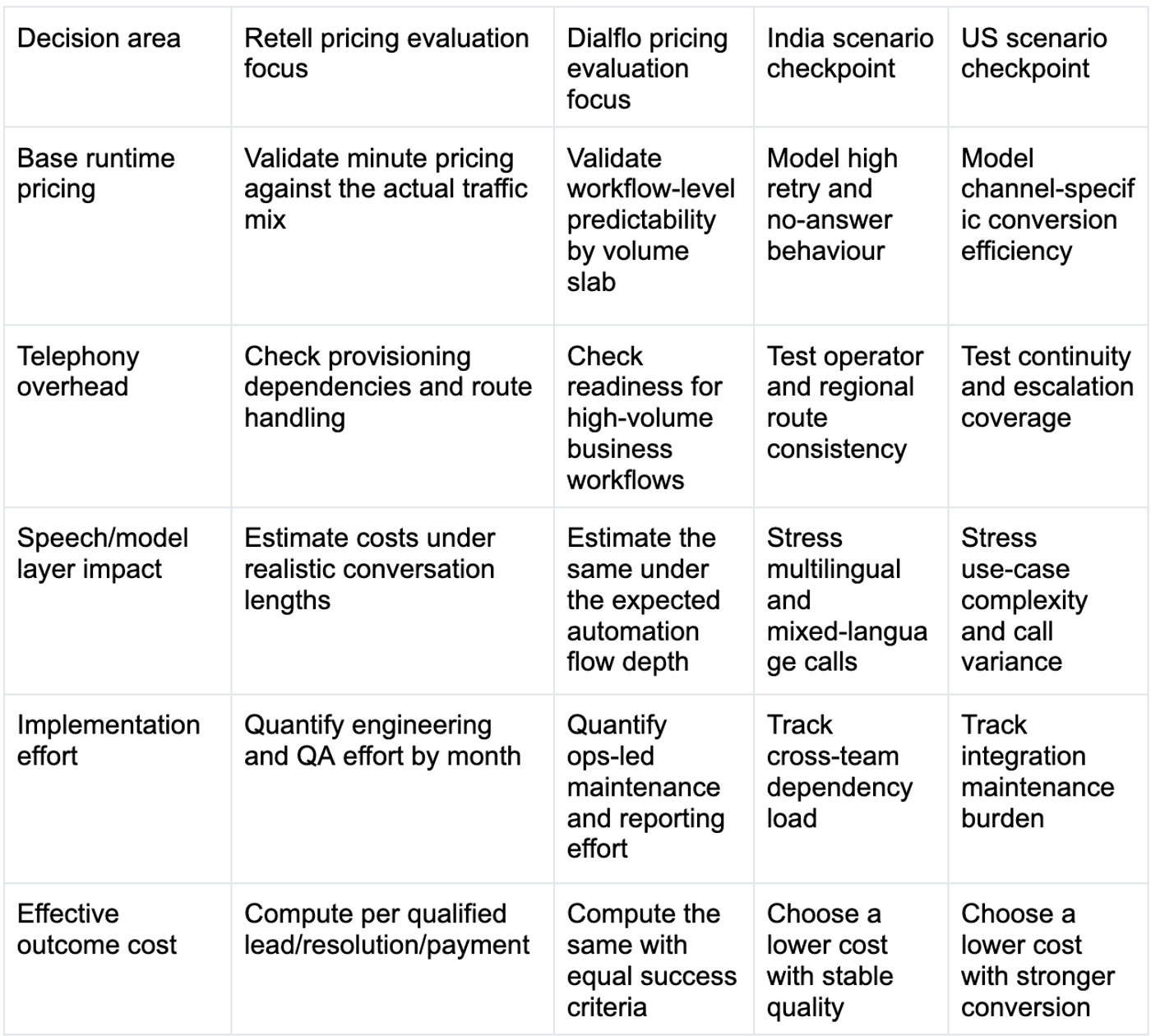
Side-by-side matrix: Retell AI pricing vs Dialflo pricing
Example budget scenarios (framework, not vendor quotes)
Below is a framework to help finance teams compare options quickly. These are not official vendor prices; they are scenario templates.
Scenario A: India outbound lead qualification
Volume: 120,000 attempts/month; 28% answer rate; average connected call 1.6 minutes.
Main cost risk: retry inflation and no-answer overhead.
Decision signal: whichever platform gives lower cost per qualified lead after retries and supervision usually wins.
Scenario B: India support callback automation
Volume: 35,000 connected calls/month; average 2.4 minutes.
Main cost risk: poor call understanding drives escalations and repeat calls.
Decision signal: platform with higher first-call resolution can justify higher base runtime pricing.
Scenario C: US inbound appointment and reminders
Volume: 60,000 connected calls/month; average 1.9 minutes.
Main cost risk: incomplete integration and manual exception handling.
Decision signal: compare implementation effort and completion rate, not minute rate alone.
Using this scenario method keeps Retell AI pricing vs Dialflo pricing evaluation grounded in operations reality.
Where teams usually underestimate cost
- Retry logic: Every additional attempt changes campaign economics.
- Escalation handling: Human takeover costs are often ignored in platform sheets.
- Issue recovery time: Delayed fixes can erase weekly ROI gains.
- Analytics gaps: Without clear diagnostics, teams over-spend before identifying quality issues.
- Change request overhead: Frequent flow changes can create hidden engineering cost.
These factors are why a clean pricing page is not enough for procurement-grade analysis.
How to run a fair 4-week pricing pilot
If you are actively comparing Retell AI pricing vs Dialflo pricing, this pilot plan helps you decide with confidence:
Week 1: KPI design and environment setup
Pick one high-value workflow. Freeze KPI definitions: successful outcome rate, first-call completion, escalation rate, and cost per successful outcome. Align ops, product, and finance teams on one reporting sheet.
Week 2: controlled live traffic
Run matched traffic slices across platforms. Keep prompts, retry rules, and escalation thresholds consistent so pricing and quality comparisons are fair.
Week 3: stress and edge-case testing
Test peak windows, call interruptions, multilingual scenarios (if relevant), and transfer workflows. This week often reveals hidden maintenance costs.
Week 4: financial and operations review
Publish one final dashboard: blended monthly cost projection, expected outcome volume, and risk flags. Choose the platform that meets your target outcome cost with acceptable operational burden.
Which teams usually choose Dialflo?
Teams often choose Dialflo when they prioritize execution reliability and speed for business workflows in India-centric operations. This is common in support-heavy and outbound-heavy environments where operational control and faster iteration matter more than experimental flexibility alone.
For product and deployment context, visit Dialflo.
Which teams usually choose Retell?
Teams often choose Retell when they have strong engineering ownership and prefer deeper control over stack behavior, with ongoing tuning as part of normal operations. This can be a valid path when technical bandwidth is stable and cross-tool integration complexity is well managed.
The key is not “Retell or Dialflo by default.” The key is fit between your team structure and your cost model.
FAQ: Retell AI Pricing vs Dialflo Pricing
How should I compare Retell AI pricing vs Dialflo pricing fairly?
Compare blended total ownership cost with the same success metric. Include telephony, retries, model usage, implementation effort, and support overhead in one formula.
Why do India and US pricing outcomes differ so much?
Because call behavior, telephony setup, routing quality, and language complexity differ by market. These factors change conversion rates, supervision load, and effective per-outcome cost.
Is lower per-minute cost always the better deal?
No. A lower minute rate can still produce higher monthly spend when no-answer attempts, retries, and escalation handling are high.
What metric should finance teams track during pilot?
Track cost per successful business outcome and monitor quality consistency alongside it. This links technology spend to real business impact.
How long should we pilot before annual commitment?
Run at least 3 to 4 weeks including normal and peak traffic periods. Short pilots miss operational drift and hidden cost patterns.
Closing: choose based on total business economics
Retell AI pricing vs Dialflo pricing is not just a pricing-page comparison. It is a business economics decision. The right platform is the one that delivers predictable outcome cost, stable quality, and manageable operations workload in your target market.
Use the framework in this guide, run a structured pilot, and decide with evidence. If your priorities include India-first execution confidence and practical rollout speed, evaluate Dialflo in the same test conditions as your current shortlist.