Retell Review for Indian Teams: Latency, Compliance, and Dialer Limits

Dialflo: AI Voice Agent
May 8, 2026
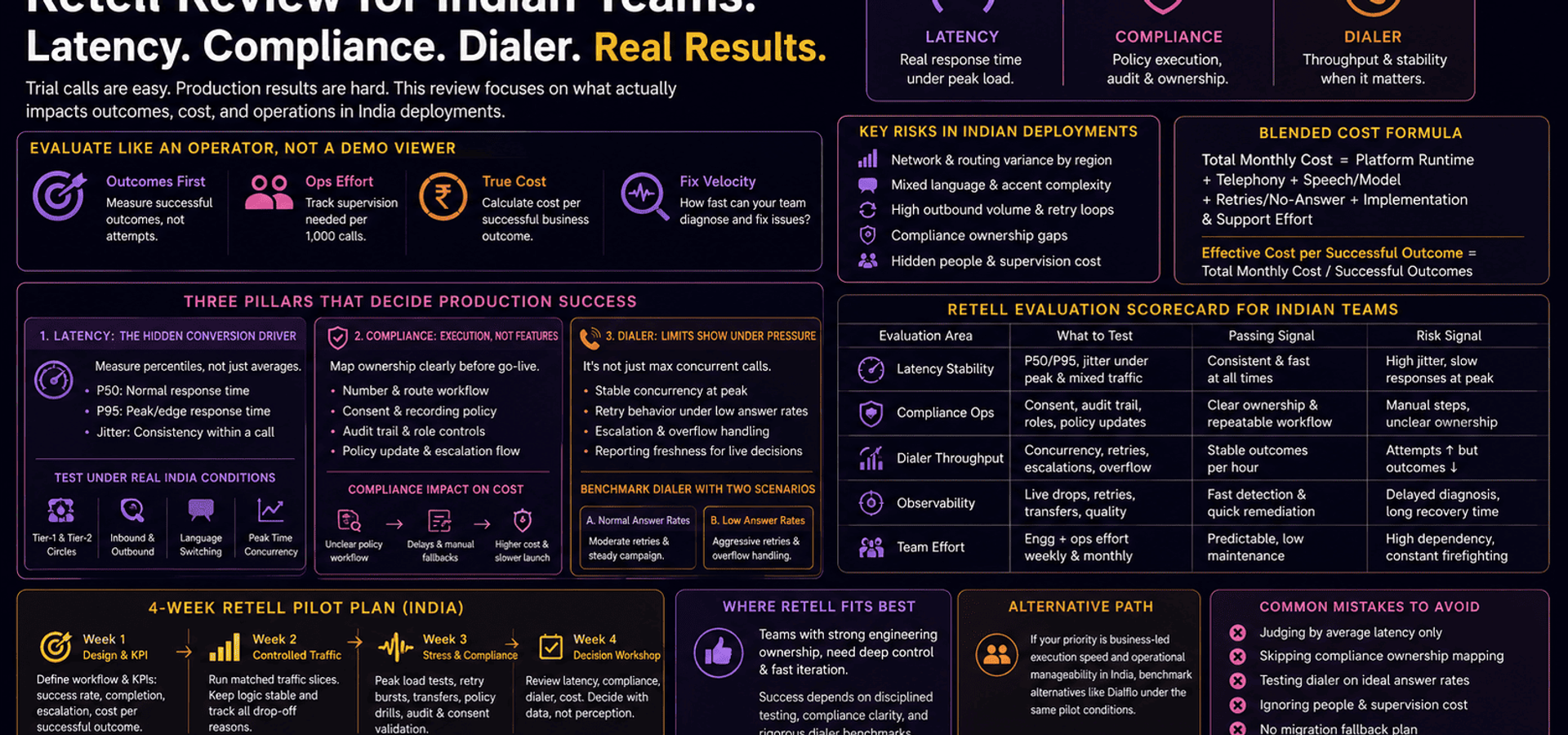
For Indian teams, a useful Retell review should focus on production realities: real latency, compliance execution, and dialer performance under pressure.
This Retell review for Indian teams is written for operators, not only for developers. If you are evaluating Retell for support automation, lead qualification, collections, reminders, or service callbacks in India, the core question is simple: can this stack deliver stable outcomes under real traffic and real policy constraints? Trial calls are easy. Sustained production quality is harder.
Most comparison posts stay at the feature level. They do not go deep into latency variance during peak hours, compliance workflow ownership, or dialer throughput limits when retry loops increase. Those are exactly the areas where Indian teams see cost and quality drift. So this guide focuses on three decision pillars: latency, compliance, and dialer limits, plus a practical pilot checklist you can use before signing annual contracts.
How to read this Retell review correctly
Retell is not “good” or “bad” in a vacuum. Platform quality depends on use case, team capability, and operating environment. For Indian deployments, you should evaluate with an outcomes mindset:
- How often calls complete successfully at target quality?
- How much operational supervision is needed per 1,000 calls?
- What is the real cost per successful outcome, not per attempt?
- How quickly can your team diagnose and fix call-quality issues?
If your evaluation process cannot answer these four questions, your decision is still at demo stage, not procurement stage.
Latency: the first hidden decision-maker
Latency is often discussed as a technical metric, but for voice automation it is a conversion and trust metric. Delays change interruption behavior, user patience, and completion rates. Even when users do not mention “latency,” they react to it by speaking over the bot, repeating answers, or hanging up faster.
What Indian teams should measure
In this Retell review for Indian teams, the most important latency insight is this: average latency is not enough. You need percentile behavior during load.
- P50: normal response time under standard traffic
- P95: response time under peak/edge traffic
- Jitter effect: how often timing becomes inconsistent within one call
If P95 latency spikes during campaign peaks, quality drops even if average values look acceptable. This is where many teams misjudge stack readiness.
Real-world latency stress factors in India
Latency behavior in India can be influenced by network path variability, mixed device quality, regional telecom routing patterns, and multilingual interruption-heavy conversations. So test conditions should include:
- calls from tier-1 and tier-2 circles
- inbound and outbound flows
- language-switching conversations
- peak-time concurrency tests
Without this, latency evaluation stays theoretical. A reliable Retell review for Indian teams must use India-origin traffic.
Compliance: where many pilots pass but production fails
Compliance is not a feature toggle. It is an operating process that includes policy interpretation, workflow controls, auditability, and ownership clarity. Indian teams evaluating Retell should map compliance responsibilities from day one: what the platform supports, what your team must configure, and what external telecom/legal processes are still manual.
Compliance checklist before go-live
Use this practical checklist in procurement discussions:
- Number and route workflow: what is needed for production-ready calling?
- Consent and recording policy: how is consent handled and logged?
- Audit trail: are call events, changes, and exceptions traceable?
- Role control: who can edit prompts, retries, and escalation rules?
- Policy updates: how fast can your team adapt workflow changes?
A frequent issue in voice AI rollouts is not “lack of compliance tools,” but unclear ownership between vendor, legal, and operations teams. If that split is unclear, launch timelines slip and support tickets rise.
Compliance impact on cost
Compliance delays are expensive. When policy workflows are unclear, teams pay in three ways: slower launch, higher legal review cycles, and temporary manual fallback operations. These are rarely included in pricing calculators, but they are part of total ownership cost.
Dialer limits: the most under-tested factor
For high-volume Indian teams, dialer performance can decide ROI more than model quality. In theory, your dialer can process thousands of attempts. In practice, throughput depends on answer rates, retries, escalation logic, and queue management under load.
What dialer limits actually mean
Dialer limits are not only “max concurrent calls.” They include:
- stable concurrency at peak without quality collapse
- retry behavior under low answer-rate windows
- agent handoff capacity for exception calls
- reporting refresh speed for live campaign decisions
This is critical in a Retell review for Indian teams because outbound-heavy workflows can look healthy in sandbox and fail in production when retries stack faster than expected.
A practical dialer benchmark method
Run two campaign simulations before procurement sign-off:
Scenario A: moderate answer rates with normal retry cadence.
Scenario B: low answer rates with aggressive retry and overflow handling.
Measure outcomes per hour, not attempts per hour. This gives a realistic picture of platform economics.
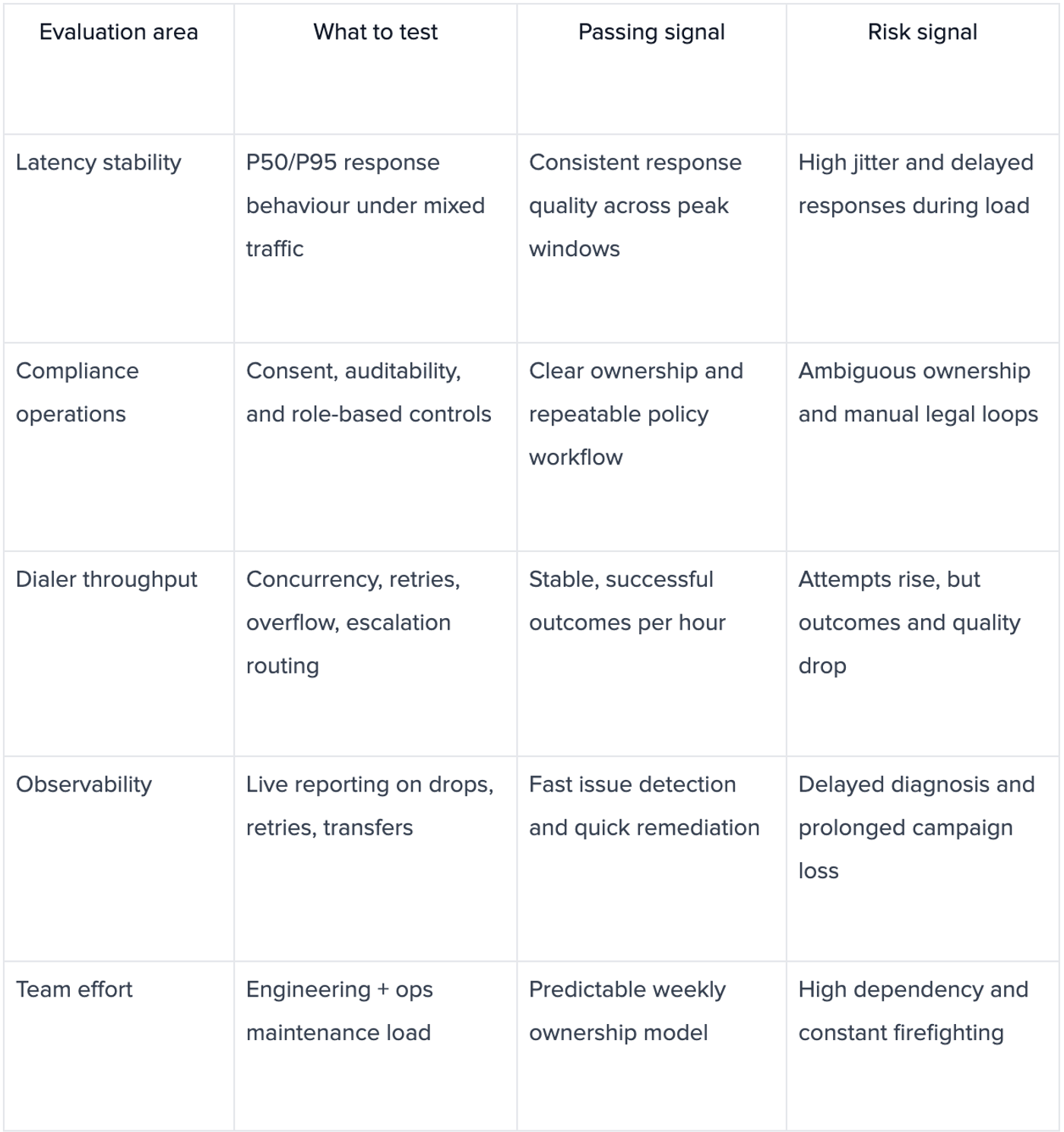
Feature and operations scorecard for Indian buyer
Total ownership cost: what this review implies
Any fair Retell review for Indian teams should connect technical findings to cost outcomes. The true monthly number includes more than platform runtime.
Blended monthly cost = platform runtime + telephony + retries/no-answer overhead + supervision effort + issue recovery overhead
Effective cost per successful outcome = blended monthly cost / successful outcomes
This formula matters because latency issues, compliance delays, and dialer inefficiencies each reduce successful outcomes while still consuming spend. That is why many teams feel “the platform is expensive” even when list pricing appears competitive.
When Retell may be a good fit for Indian teams
Retell can be a strong option in setups where technical ownership is mature and teams can run structured experiments fast. If your engineering function can manage integrations, observability, and iterative tuning, you may achieve strong results in focused workflows.
In this case, success depends on disciplined pilot execution, clear compliance ownership, and dialer stress testing. Teams that skip these steps usually face avoidable friction after scale-up.
When teams look for India-focused alternatives
Some teams prefer stacks optimized for operational manageability and faster business-led execution in India. This is common when non-technical teams need to own campaign changes, reporting decisions, and day-to-day quality monitoring without heavy engineering intervention.
If your priority is execution reliability with India-first workflows, it is worth benchmarking alternatives like Dialflo under the same pilot conditions and decision metrics.
How to run a fair 4-week Retell pilot in India
Use this plan to make your review evidence-based:
Week 1: define KPI contract
Pick one workflow with clear business value. Lock KPIs: successful outcome rate, first-call completion, average resolution time, escalation rate, and cost per successful outcome.
Week 2: controlled production sample
Launch with matched traffic segments. Keep script logic stable and track every drop-off reason. Avoid changing multiple variables at once.
Week 3: stress and compliance drill
Test peak call windows, retry bursts, transfer overflow, and policy/audit workflows. This week reveals most hidden risks around dialer limits and compliance ownership.
Week 4: decision workshop
Publish one-page findings: latency percentiles, compliance readiness score, dialer throughput score, and blended cost per successful outcome. Decide based on evidence, not perception.
Common mistakes in Retell evaluations
- Evaluating only average latency. P95 and jitter often matter more for user experience.
- Skipping compliance ownership mapping. This causes delays after pilot success.
- Testing dialer on ideal answer rates only. Real campaigns include no-answer spikes.
- Ignoring people cost. High supervision and troubleshooting increase TCO quickly.
- No migration fallback plan. Teams should define an alternative path before full rollout.
FAQ: Retell review for Indian teams
Is Retell good for Indian teams?
It can be, depending on your use case and technical ownership model. Teams should validate latency consistency, compliance workflow, and dialer performance under real Indian traffic before scaling.
What is the biggest risk in India outbound deployments?
The biggest risk is over-trusting trial metrics. Production conditions can expose retry inflation, route variability, and throughput bottlenecks that reduce ROI.
How should teams evaluate dialer limits practically?
Run peak-load tests with varied answer rates and retry strategies. Measure successful outcomes per hour and escalation stability, not just total attempts.
What belongs in a compliance readiness checklist?
Include consent handling, call recording policy, role permissions, audit logs, and clear ownership for policy updates across legal, ops, and platform teams.
How long should a fair India pilot run?
At least 3 to 4 weeks with peak periods and multilingual scenarios. Short pilots often fail to surface operational drift and hidden cost patterns.
Closing: evaluate Retell like an operator
A useful Retell review for Indian teams should not end at feature demos. It should answer whether your team can run stable, compliant, and cost-effective operations at scale. Latency quality, compliance ownership, and dialer throughput are the core decision factors for India workflows.
If your priority is predictable business execution in India, benchmark Retell against alternatives in the same traffic environment, with the same KPI sheet. You can include Dialflo in that benchmark to compare rollout confidence, ownership effort, and long-term outcome economics.