Retell vs Dialflo: Best Voice AI for India Teams

Dialflo: AI Voice Agent
May 8, 2026
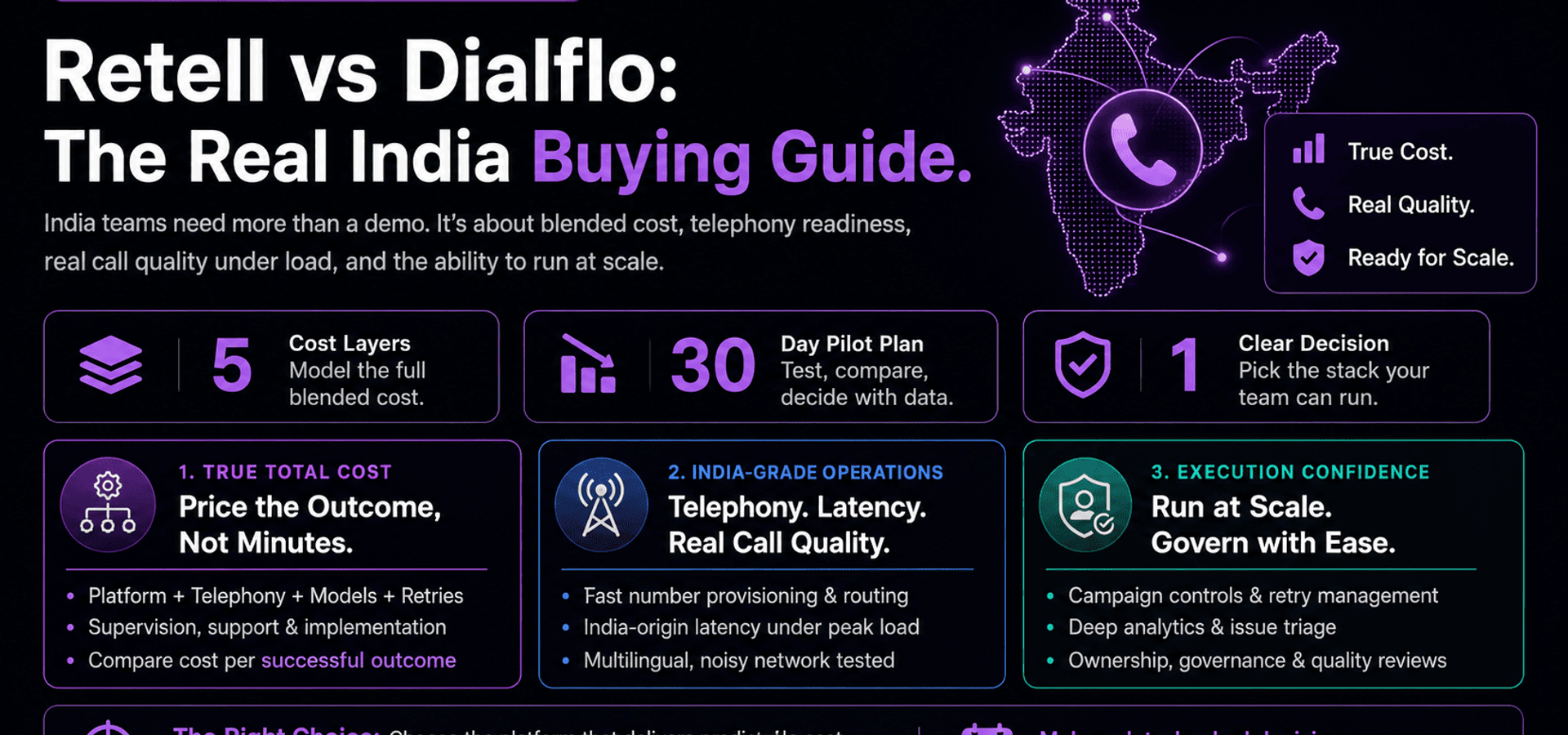
For India teams, platform selection depends less on headline rates and more on blended production cost, telephony readiness, and real call quality under load.
If you are evaluating retell vs dialflo, the most important question is not “Which demo sounds better?” The real question is: “Which stack still works when we move from 100 test calls to 50,000 production calls in India?” That shift exposes hidden costs in telephony, infra routing, retries, and compliance operations. It also exposes whether your chosen platform is built for your geography and workflow, or whether your team must patch gaps manually.
This guide gives an India-first breakdown of retell pricing india decisions and compares them with a practical Dialflo deployment lens. The goal is simple: help buyers calculate true cost and execution risk before signing a yearly commitment. If you run support, lead qualification, collections, logistics follow-ups, or appointment calls in India, this is the framework to use.
Why India buyers need a different voice AI buying framework
Most global voice AI comparisons are written for US teams. They assume easy number provisioning, low routing friction, and predictable latency from regional infrastructure. India teams operate in a different environment: multilingual conversations, mixed network quality, heavy outbound workflows, and tighter cost pressure per successful call outcome.
That is why voice ai india procurement should prioritize four things from day one: true connected-minute economics, India-grade telephony operations, latency consistency, and implementation speed for non-technical teams. A platform can look affordable in a pricing table and still become expensive once these four realities appear in live traffic.
Retell pricing India teams should model before buying
When teams search retell pricing india, they often stop at the headline per-minute number. That is the first mistake. In production, your effective cost is always a blended number that includes more than one meter. Even small add-ons become large at scale.
Build your model with these cost layers:
1) Platform runtime charges. This is the visible base charge that appears in most comparisons.
2) Telephony cost. Number rental, call connect charges, and route-level variability by carrier.
3) Speech and model consumption. STT, LLM inference, and TTS stack decisions drive quality and bill size.
4) Attempt-level waste. Unanswered outbound attempts, retries, and invalid lead lists increase effective CPL and CPM.
5) Integration and support overhead. Engineering time, ops training, QA cycles, and monitoring workflows.
Many teams evaluating retell vs dialflo discover that platform rate is only one part of total spend. The right comparison is “total cost per successful conversation outcome,” not “base price per minute.”
Hidden cost buckets that usually appear in month two
The first month is usually pilot-friendly. The second month is where procurement surprises show up. Below are the hidden buckets India buyers should inspect before rollout.
1) Retry inflation in outbound campaigns
Outbound teams rarely connect every call on first attempt. If your campaign needs multiple retries, per-lead spend rises quickly. This affects both Retell-like setups and any stack where attempt costs are not modeled carefully. Ask for campaign math at your real answer rates, not ideal demo rates.
2) Routing and quality variance by region
In India, call quality can vary by circle, operator mix, and time of day. If routing optimization is weak, you may pay for low-quality minutes that do not produce outcomes. This is a common blind spot in generic voice ai india evaluations.
3) Human supervision costs
When call flows are unstable, teams assign humans for exception handling, QA tagging, and failed call follow-up. Those people costs should be included in your TCO model. A lower software rate with higher supervision is rarely a better deal.
4) Time-to-fix for production issues
Every platform has incidents. The cost difference comes from how quickly your team can diagnose and resolve them. If your architecture depends on many external components, fixing one bad outcome can involve multiple tools and teams, increasing downtime cost.
Infrastructure realities: latency matters more than features
For conversational systems, latency is not a technical vanity metric. It directly affects completion rate, user trust, and agent interruption behavior. A difference of a few hundred milliseconds changes whether calls feel natural or robotic.
In retell vs dialflo discussions, ask for measured end-to-end latency from Indian numbers to live users, not just synthetic lab benchmarks. Production-grade tests should include:
- peak hour call concurrency
- mixed language interactions
- noisy mobile network conditions
- call transfer and escalation paths
Without this, you can choose a platform that looks technically strong but underperforms in your real workflow. For India teams, “works in staging” is not enough.
Telephony stack: where many voice AI projects get delayed
Telephony is usually the least glamorous part of buying voice ai india, but it is often the biggest source of rollout delay. Platform demos usually focus on bot quality, while operations teams struggle with numbers, routing, templates, and policy constraints.
Before signing any contract, validate these telephony checkpoints:
- Number procurement timeline: how long until production-ready numbers are active?
- Call flow control: IVR, transfer logic, retries, and failover handling.
- Regulatory workflow: what your team must do vs what the platform handles.
- Monitoring visibility: can ops teams quickly spot route and drop-off issues?
Teams comparing retell pricing india should ask for a telephony-inclusive quote or a clearly itemized sheet that exposes these dependencies.
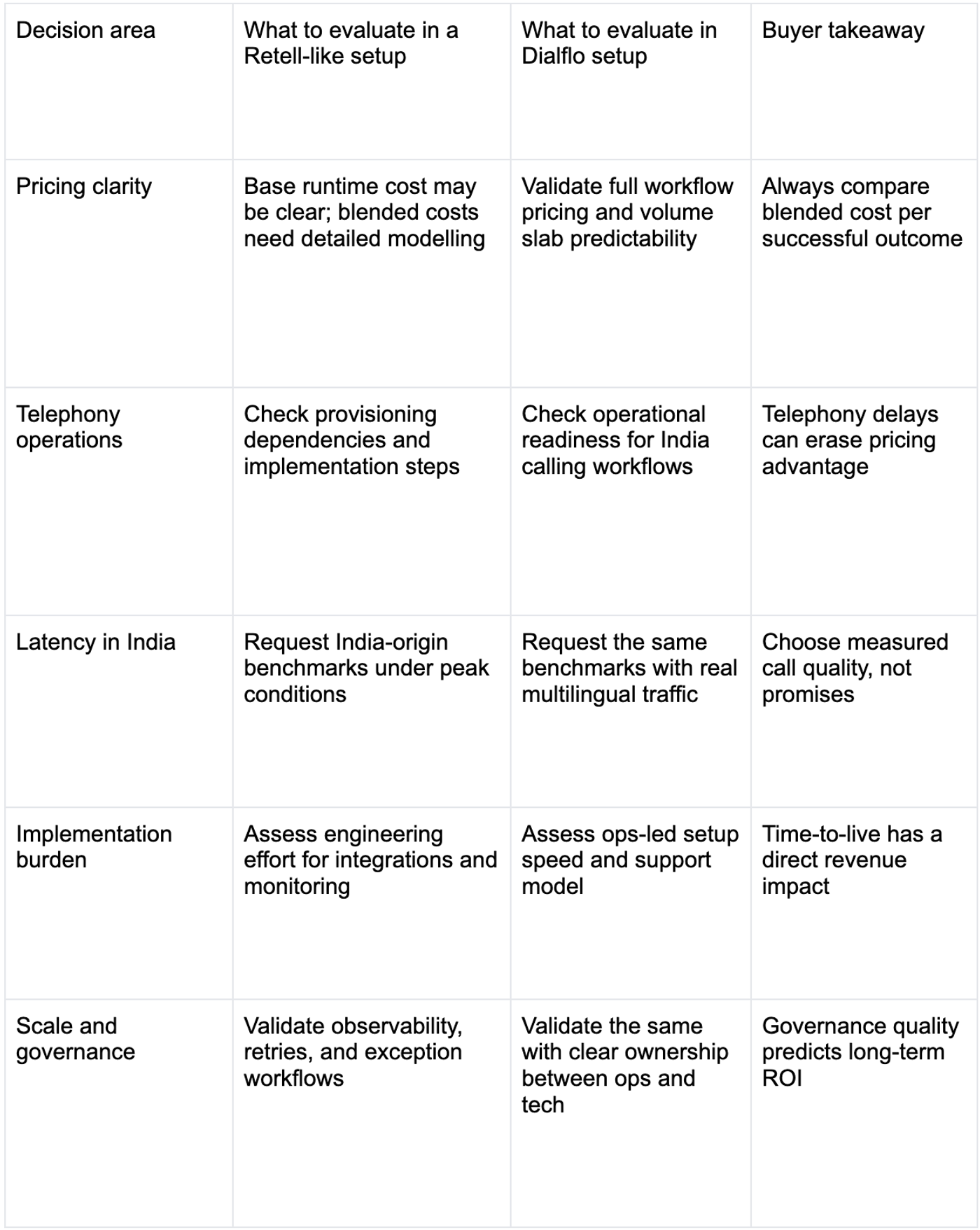
Comparison matrix: Retell vs Dialflo for India buyers
A practical TCO formula for India procurement teams
Use this simple formula during vendor evaluation:
Total monthly voice AI cost = platform runtime + telephony + model/speech + retries + implementation/support overhead
Effective cost per successful call outcome = total monthly voice AI cost / successful outcome count
This removes confusion from headline rates and helps compare retell vs dialflo using business outcomes that matter: qualified leads, resolved tickets, paid collections, booked appointments, or completed verifications.
Where Dialflo often fits better for India teams
Dialflo is often selected by teams that care about execution speed and operational control, not just model experimentation. If your team runs high-frequency calling workflows and needs repeatable performance with clear ownership between business and operations, this bias can matter.
In many voice ai india deployments, the winning platform is the one that business teams can run confidently every day. This includes clear call analytics, faster issue triage, practical campaign controls, and a rollout path that does not depend on a large engineering team for routine updates.
For product context, see Dialflo and evaluate against your own pilot checklist.
When Retell can still be a valid choice
A balanced evaluation matters. Retell can be a valid option for teams with strong technical resources, lower telephony complexity, and a clear ability to tune and monitor stack components continuously. If your use case is primarily experimental or you already have mature infra ownership, this route can work.
The mistake is not choosing Retell. The mistake is choosing without modeling real India operations. Any decision around retell pricing india should be based on production constraints, not just a trial account experience.
30-day pilot blueprint: how to decide without guesswork
If you are stuck between retell vs dialflo, run a structured 30-day pilot with both stacks where possible. Keep the test fair and outcome-focused.
Week 1: Baseline and setup
Define one high-impact workflow (for example, inbound qualification or collections reminder). Freeze success metrics before launch: connect rate, completion rate, successful outcome rate, and effective cost per outcome.
Week 2: Controlled live traffic
Route a meaningful but safe call sample. Include multilingual prompts and real business edge cases. Track drop-offs by step, not only call-level outcomes.
Week 3: Stress and exception testing
Test peak concurrency, transfer failure paths, retry behavior, and operator-level network variance. This week usually reveals the hidden gaps in voice ai india deployments.
Week 4: Decision and rollout map
Score each platform against one sheet: blended cost, quality consistency, ops usability, and fix turnaround. Choose the stack with better total execution confidence, not the flashier trial demo.
Common procurement mistakes in India voice AI projects
- Buying on per-minute rate alone. This ignores retries, telephony, and supervision costs.
- Skipping telephony readiness checks. Delays here can postpone go-live by weeks.
- No multilingual stress test. Real users switch language and dialect frequently.
- No outcome-level KPI model. Teams track minutes, not business outcomes.
- No owner for post-launch governance. Without ownership, quality drifts quickly.
FAQ: Retell vs Dialflo for India teams
Is Retell good for India deployments?
It can work for some teams, especially if technical ownership is strong and telephony complexity is manageable. But buyers should validate India-origin latency, call quality consistency, and telephony workflow readiness before scaling.
How should I compare retell pricing in India with Dialflo pricing?
Compare total blended cost per successful outcome, not only base runtime rate. Include attempts, retries, telephony, speech/model usage, and implementation overhead in your model.
What does voice ai india buyers checklist include?
At minimum: telephony timeline, multilingual call quality, measured latency, compliance workflow, reporting depth, and post-launch support ownership. Without this checklist, pricing comparisons are incomplete.
What is the biggest hidden cost in retell vs dialflo evaluations?
For many teams, it is not one line item. It is the combination of retries, operational supervision, and delayed issue resolution under live traffic. These costs rarely appear in top-level pricing pages.
Can non-technical teams run production workflows on voice AI?
Yes, if the platform offers strong operational controls and clear governance. Ask for role-based workflows, clear exception handling, and easy reporting for business users during your pilot.
Closing: pick the platform you can run, not just the one you can demo
The retell vs dialflo decision is not a features contest. It is an execution decision for India operations. Choose the stack that gives predictable blended cost, telephony confidence, stable quality under real traffic, and a rollout model your team can sustain. That is what determines ROI in production.
If you want to benchmark your current flow against an India-first rollout framework, start with a practical pilot plan and compare outcomes side by side. You can use Dialflo as one benchmark option while evaluating your broader voice ai india strategy.