Best Automated Screening Software for Staffing Agencies

Dialflo: AI Voice Agent
April 23, 2026
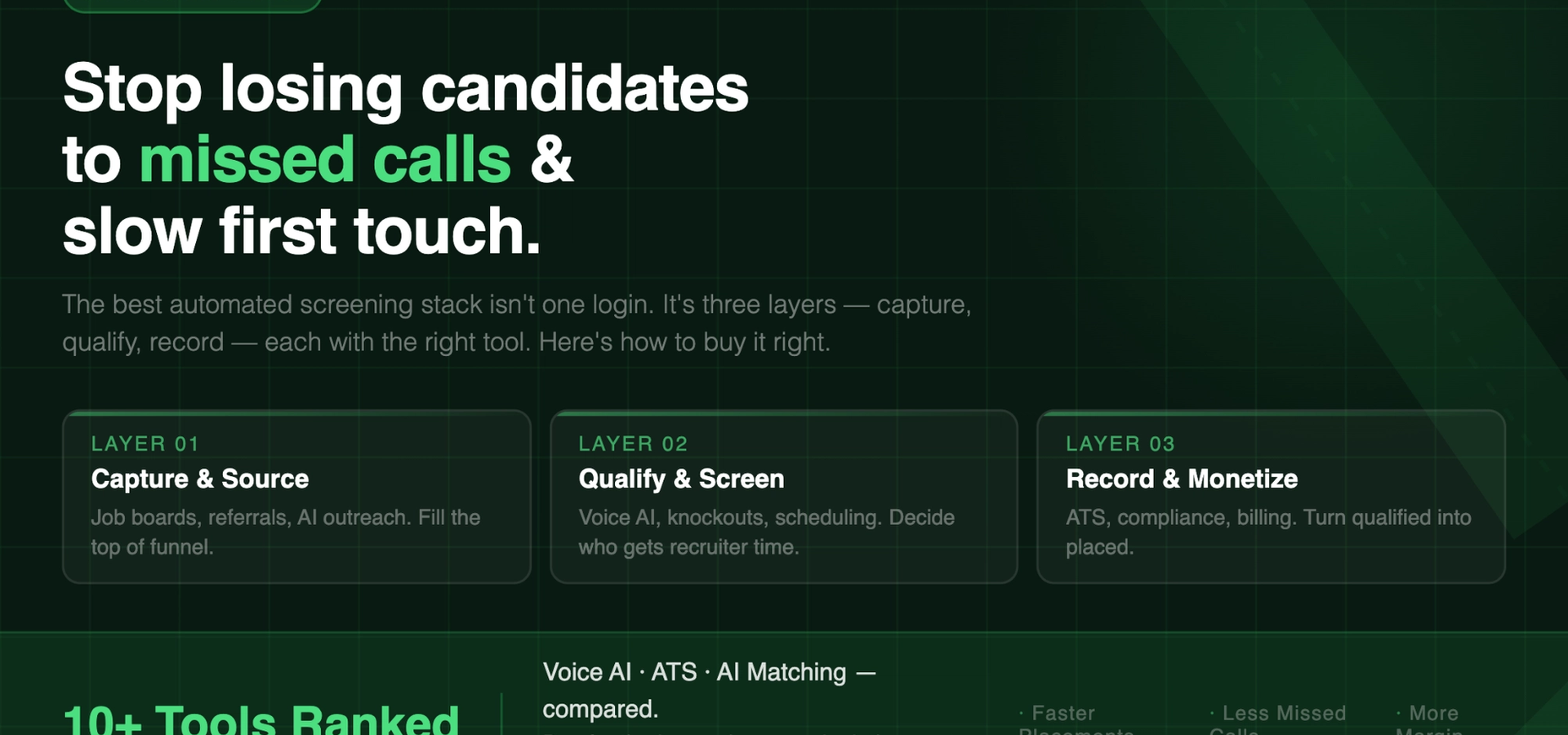
Staffing leaders compare top automated screening software for staffing agencies, starting with voice AI, then ATS and AI matching.
Choosing the top automated screening software for staffing agencies is a commercial decision tied directly to placement speed, recruiter capacity, and client satisfaction.
The best stack is rarely one login: you need a clear answer for how candidates enter the funnel, how they are qualified before a human interview, and where structured data lands for compliance and client reporting.
This guide ranks leading options with Dialflo first, because high-volume staffing and recruiting teams often lose margin on missed calls and slow first touch, then walks through ATS and AI-matching platforms cited in independent roundups such as Assembly’s staffing agency software comparison and ties sourcing context to SitePoint’s AI recruiting and sourcing tools for 2026.
Throughout, we anchor pricing to published comparison data where possible. For example, Assembly lists illustrative starting prices including roughly $15 per user per month for Manatal, $25 per user per month for Zoho Recruit on annual billing, $85 per user per month for Recruit CRM, $99 per month as a Bullhorn entry reference, and $299 per month for Workable, treat these as planning numbers, not quotes, and confirm on each vendor’s pricing page before you buy. Volume discounts, bundles, and regional taxes will change your fully loaded cost.
Commercial intent: what “automated screening” should buy you
If you are buying with budget authority, define success in money and time. Strong screening automation should increase the share of applicants who reach a qualified stage without adding headcount, reduce time from application to first human conversation, and shrink error rates on basic knockouts such as shift availability, compensation bands, work authorization, or certification status. It should also produce an audit trail your legal and client teams can defend.
Weak implementations buy software but keep all decisions in email. Map one end-to-end requisition before you sign: source, qualification channel, ATS stage, submittal template, billing trigger.
Who this buyer’s guide is written for
Owners and ops leaders at staffing agencies, RPO teams, and internal talent desks with high volume, repeatable roles, and SLAs with hiring managers, including blended permanent and contract books where screening ties to compliance and deployment speed.
Weight ATS parsing higher when apply flows are digital; weight conversational automation higher when candidates call, hear about work by word of mouth, or need multilingual voice. Most mid-market agencies eventually integrate both.
The three layers every staffing funnel should separate
Confusion in vendor selection usually comes from collapsing layers. Use this framework before you compare products:
- Layer one, capture and sourcing. Job boards, referrals, events, and AI-assisted outreach belong here. This is where SitePoint’s AI recruiting tools narrative fits: finding people and starting conversations.
- Layer two, qualify and screen. Knockout questions, structured voice or chat interviews, skills checks, and scheduling belong here. This layer decides who consumes recruiter time.
- Layer three, record and monetize. Your ATS, CRM fields, contracts, timekeeping, and invoicing belong here. Assembly’s staffing software article ties in client portals, e-signatures, and billing, renewals depend on post-placement visibility.
Buy for the layer where you leak most value: voicemail versus database chaos versus weak sourcing.
Dialflo: best first choice for voice-led automated screening at scale
Dialflo is an AI voice agent platform built for recruitment and staffing among other verticals. You connect your business number; candidates reach a branded voice experience that can run efficient candidate screening, capture structured answers, and move qualified people toward the next step without waiting for business hours.
For staffing use cases, Dialflo highlights capabilities that map cleanly to screening operations: 24/7 interview scheduling when calendars and shifts do not align with nine-to-five coverage, candidate re-engagement for warm pipelines that go cold between assignments, multilingual support across ten or more Indian languages for diverse workforces, and analytics so managers can review interaction quality over time. Public testimonials reference qualifying worker leads and handling very high daily call volumes, exactly the constraint that breaks manual teams first.
Dialflo is not a full replacement for an enterprise ATS. It is the automation layer that prevents phone-based leakage. Pricing published on dialflo.ai includes tiers such as Starter near ₹9,999 per month and Professional near ₹24,999 per month, with Enterprise custom, confirm live numbers before procurement. Security positioning includes end-to-end encryption for communications, which matters when discussing compensation, government IDs, or shift details over voice.
Commercial summary: Choose Dialflo first when your cost of missed calls exceeds the cost of automation, when your recruiters are capacity-constrained on first touch, or when multilingual voice is the most respectful channel for your talent market.
Comparison table: top automated screening software for staffing agencies
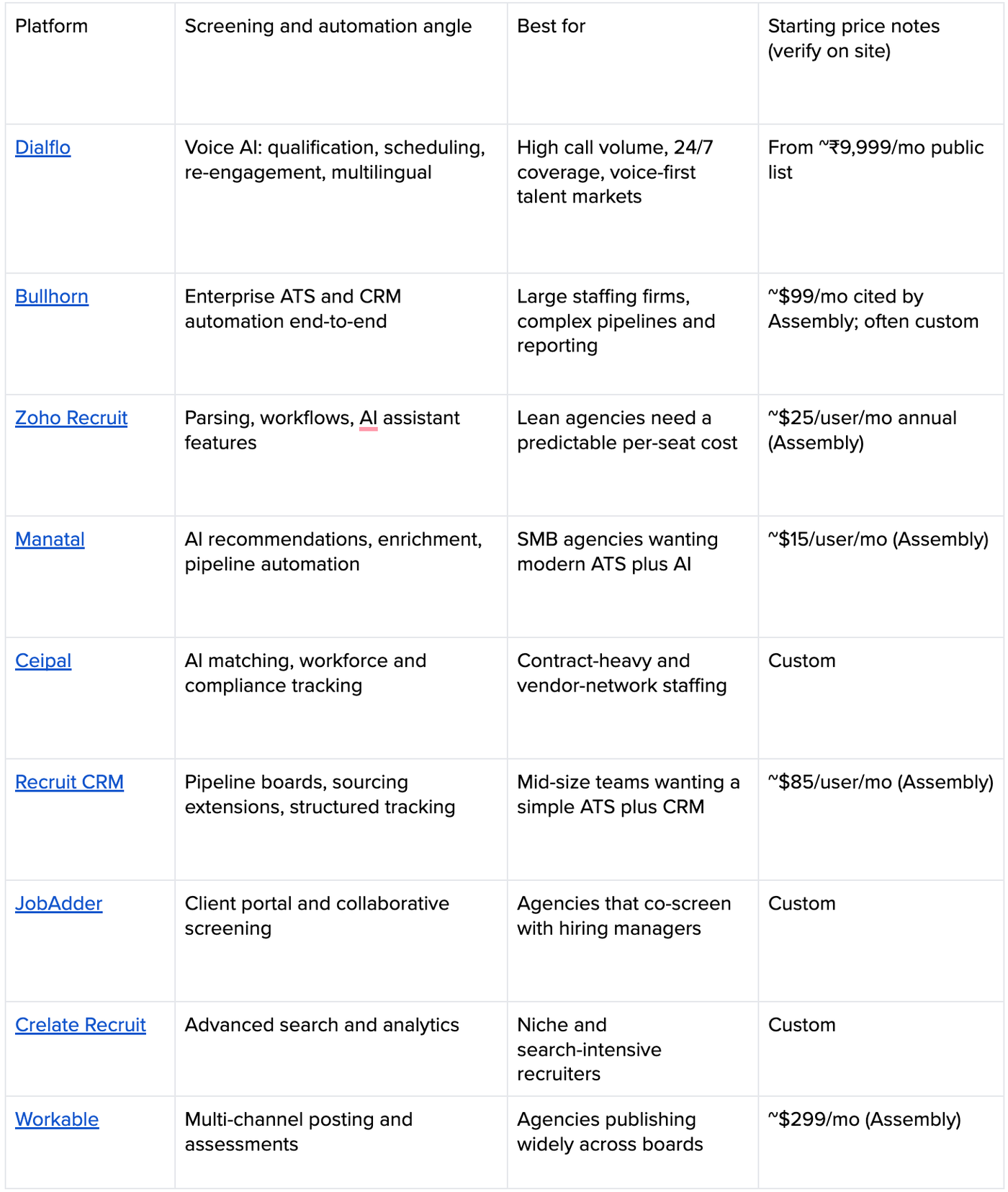
The following table lists Dialflo first, then representative ATS and platform options commonly grouped with staffing workflows in Assembly’s staffing agency software roundup. Screening value differs by row: some products automate conversation, others automate database workflow and compliance.
Bullhorn and enterprise ATS: screening as workflow discipline
Bullhorn remains the reference architecture for large staffing organizations that need recruiting, sales, and operations data in one ecosystem.
Screening is expressed as stage rules, required fields, automation, and integrations rather than a single conversational interface. Choose this path when your primary pain is coordination across hundreds of users and multiple lines of business, not missed inbound calls.
Zoho Recruit and Manatal: SMB-friendly recruiting automation
Zoho Recruit and Manatal compete aggressively on speed to value for smaller agencies. Resume parsing, templated communication, and lightweight AI reduce manual data entry, the classic screening bottleneck when applications arrive digitally. If your candidates never call, these tools may deliver more screening lift per dollar than voice automation alone.
Ceipal: when screening includes workforce compliance
Ceipal targets agencies where screening is inseparable from documentation, eligibility, and deployment risk. That is common in IT staffing, healthcare staffing, and industrial temp. Here, “qualified” means legally and operationally deployable, not merely interested.
Recruit CRM, JobAdder, and Crelate: collaboration and precision
Recruit CRM keeps pipelines visible for distributed teams. JobAdder adds client-facing collaboration so hiring managers participate in shortlisting. Crelate supports recruiters who screen with deep search and structured tags. Each product shifts screening effort from inbox chaos to governed stages, complementary to Dialflo when phone volume is still a constraint.
Workable and Avionté: from job board scale to payroll reality
Workable fits agencies that compete on distribution and structured evaluation at scale. Avionté fits firms where the candidate becomes a worker on payroll quickly, so screening data must flow into onboarding and time without re-keying. Neither replaces conversational screening; both strengthen record-keeping once candidates enter the system.
Buyer checklist before you sign a staffing screening vendor
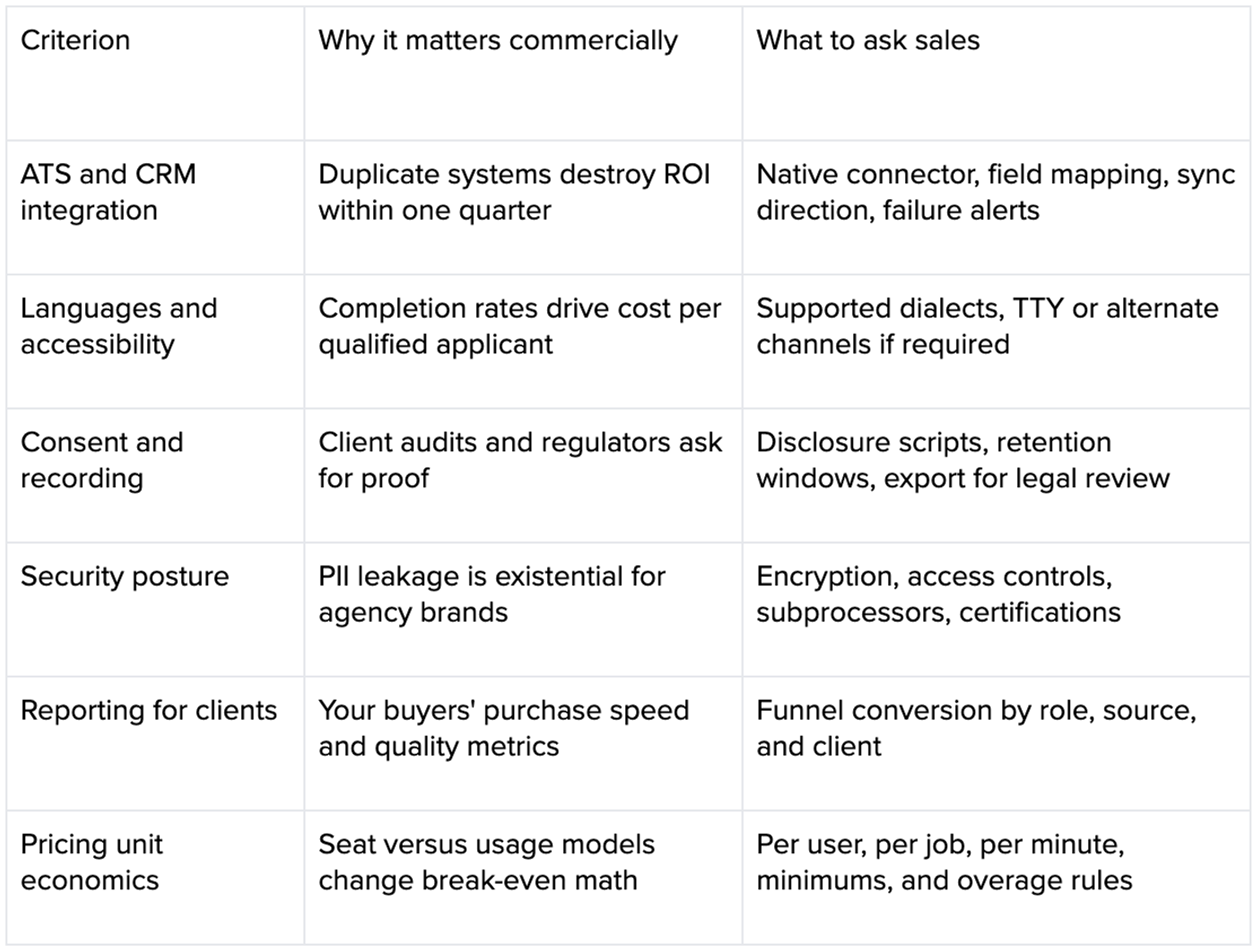
Ninety-day rollout plan for agencies buying screening automation
Days one through thirty: Select one high-volume role family. Baseline current metrics: time to first touch, percentage of applicants never contacted, and recruiter hours spent on scheduling. Write knockout questions with hiring managers and legal if needed.
Days thirty-one through sixty: Launch automation for that lane only. Integrate outcomes into your ATS with explicit field ownership. Train recruiters on exceptions and quality review. Listen to a random sample of conversations weekly.
Days sixty-one through ninety: Compare conversion and cost per qualified candidate against the baseline. Expand languages, clients, or roles only after metrics stabilize. Negotiate renewal based on measured lift, not feature slides.
Fair hiring, transparency, and candidate trust
Automated screening can improve consistency, but it can also encode bias if scripts reward proxies unrelated to job success. Document criteria tied to business necessity, monitor outcomes by demographic proxies where lawful, and offer human escalation paths.
Disclose AI participation where regulations or clients require it. Your commercial goal is sustainable speed, not a short-term spike followed by compliance incidents.
How Assembly and SitePoint fit your procurement research
Use Assembly’s staffing agency software overview as a wide lens on categories from ATS to payroll and client experience. Use SitePoint’s AI recruiting tools list to sharpen sourcing investments. Return to this screening-focused view when you need to decide who consumes recruiter minutes after the candidate raises their hand.
Frequently asked questions
What is the top automated screening software for staffing agencies?
It depends on funnel shape. For voice-heavy and multilingual markets, start with Dialflo. For form-heavy digital apply flows, start with an ATS such as Zoho Recruit or Manatal. Enterprise desks often standardize on Bullhorn while adding a focused automation layer for their worst bottleneck.
Why is Dialflo first in this list?
Staffing margins die when candidates cannot reach a live process quickly. Dialflo automates first-touch screening and scheduling on your own number, addressing a gap that pure ATS comparisons underweight.
Do I still need an ATS?
Almost always. Your ATS is the compliance and client-reporting backbone. Voice automation should feed it, not replace it.
How is AI sourcing different from screening?
Sourcing fills the top of funnel; screening filters it. Read SitePoint’s sourcing roundup for discovery tools, then implement screening that matches how your candidates actually respond.
What should staffing software cost?
Use Assembly’s published anchors, such as $15, $25, $85, and $99 monthly references depending on product, as a sanity check, then collect formal quotes.
Can small agencies afford automation?
Yes, if you scope a pilot to one role and measure recruiter time saved and submission quality before expanding spend.
Next step: book a Dialflo demo and map your bottleneck
If you are buying top automated screening software for staffing agencies this quarter, start with the layer where you lose the most candidates. When that layer is the phone, begin with Dialflo, integrate outcomes into your ATS, and use independent references such as Assembly and SitePoint to sanity-check the rest of your stack. Bring your last month’s funnel metrics to the demo so you can compare before-and-after targets in plain numbers.


