AI for IT Recruiters: How AI Is Changing Technical Hiring

Dialflo: AI Voice Agent
September 16, 2026

Hiring for artificial intelligence, machine learning, data science, and other specialized IT roles has become increasingly demanding. Recruiters are expected to identify candidates with highly specific technical skills while also managing large candidate pools, sourcing passive talent, screening applications, and maintaining communication throughout the hiring process.
This is where artificial intelligence IT recruiters are becoming increasingly relevant.
AI can support recruiters by automating repetitive recruitment tasks, analyzing candidate information, identifying potential matches, and handling parts of candidate communication. For IT recruitment teams working on specialized roles, these capabilities can reduce manual work while allowing recruiters to spend more time on candidate relationships and hiring decisions.
What Are Artificial Intelligence IT Recruiters?
Artificial intelligence IT recruiters are recruitment professionals, platforms, or AI-powered recruiting systems that use artificial intelligence to support the hiring of technology professionals.
The technology can assist with activities such as:
- Candidate sourcing
- Resume screening
- Candidate matching
- Job description analysis
- Technical skill identification
- Candidate outreach
- Interview scheduling
- Candidate screening calls
- Recruitment workflow automation
- Candidate engagement
- Recruitment analytics
An AI-powered recruitment workflow does not necessarily replace the recruiter. Instead, it can handle repetitive parts of the process while recruiters remain responsible for evaluating candidates, communicating with hiring managers, and making hiring decisions.
This distinction is particularly important when recruiting for specialized roles such as AI engineers, machine learning engineers, data scientists, AI architects, and software developers.
Why IT Recruitment Is Becoming More Complex
Technology hiring requires more than matching job titles.
A candidate applying for an AI engineer position, for example, may have experience with machine learning frameworks, Python, cloud platforms, model deployment, data pipelines, or generative AI systems. Another candidate may have a similar job title but a very different technical background.
Traditional keyword-based recruitment can struggle to understand these differences.
Recruiters may also have to search through hundreds or thousands of profiles to identify a relatively small number of candidates who meet the actual requirements.
This creates several challenges:
- Large volumes of applications
- Difficult-to-find technical talent
- Competition for experienced AI professionals
- Complex technical requirements
- Passive candidates who are not actively applying
- Time-consuming screening processes
- Slow candidate follow-up
- High recruiter workloads
Artificial intelligence can help address several of these bottlenecks.
Demand is concentrated in exactly these roles: the World Economic Forum's Future of Jobs Report 2025 ranks AI and big data as the fastest-growing skills employers need.
How Artificial Intelligence IT Recruiters Use AI
AI can be integrated into different stages of the recruitment process rather than being limited to resume screening.
AI-Powered Candidate Sourcing
AI recruiting systems can search candidate databases, professional profiles, recruitment platforms, and other available sources based on job requirements.
Instead of relying only on exact keywords, AI-based systems can analyze related skills, experience, job history, and contextual information.
For example, an IT recruiter looking for a machine learning engineer may need someone with experience in Python, TensorFlow, model deployment, cloud infrastructure, and data engineering.
An AI recruiting system can help identify candidates whose experience aligns with these requirements even when their profiles do not contain the exact wording used in the job description.
AI Candidate Matching
Candidate matching is another important application of AI in recruitment.
AI systems can compare job requirements with candidate profiles and identify potential matches based on skills, experience, qualifications, and other relevant criteria.
This can help recruiters move from manually reviewing every candidate toward prioritizing candidates who appear more closely aligned with the role.
However, AI-generated matches should generally be treated as recommendations rather than final hiring decisions. Recruiters still need to validate technical experience, communication ability, cultural fit, compensation expectations, and other factors.
Automated Resume Screening
Recruiters often spend significant amounts of time reviewing resumes.
AI-powered screening tools can analyze resumes and applications against predefined requirements. They can identify relevant skills, previous roles, years of experience, certifications, and other information.
For high-volume technical recruitment, this can reduce the amount of manual resume review required before candidates reach the next stage.
AI screening can be particularly useful when staffing teams need to process large candidate pools for similar positions.
AI Voice Screening for IT Candidates
Resume screening only provides part of the picture.
Recruiters may still need to contact candidates to confirm basic information such as:
- Years of experience
- Technical specialization
- Current location
- Notice period
- Salary expectations
- Work authorization
- Availability
- Interest in the position
AI voice agents can automate these initial conversations.
Instead of recruiters manually calling every candidate, an AI voice agent can conduct structured screening conversations, collect responses, and pass relevant information back to the recruitment team.
For organizations handling large volumes of candidates, this can create a faster first-stage screening process.
AI Recruitment Automation for IT Staffing Agencies
Staffing agencies can benefit significantly from recruitment automation because recruiters often manage multiple job requirements simultaneously.
A typical staffing workflow may include:
- Receiving a new job requirement
- Searching for candidates
- Reviewing resumes
- Contacting candidates
- Conducting an initial screening
- Confirming availability
- Scheduling interviews
- Following up with candidates
- Updating the ATS
- Coordinating with the client
Many of these activities are repetitive.
AI can automate portions of the workflow while keeping recruiters involved in the stages that require human judgment.
For example, an agency could use AI to identify potential candidates, initiate screening calls, capture candidate responses, and prioritize profiles for recruiter review.
The recruiter can then focus on qualified candidates instead of spending most of the day on repetitive calls and administrative work.
How AI Helps Recruiters Hire for AI and Machine Learning Roles
Recruiting AI and machine learning professionals presents unique challenges because the required skills can be highly specialized.
A hiring manager may need candidates with experience in areas such as:
- Generative AI
- Large language models
- Machine learning
- Deep learning
- Natural language processing
- Computer vision
- MLOps
- Data science
- AI infrastructure
- Cloud computing
- Model deployment
An effective AI recruitment process needs to understand these distinctions.
AI-powered recruiting systems can help recruiters organize candidates according to relevant skills and experience instead of relying only on broad job titles.
For example, a candidate described as a software engineer may have significant machine learning experience that is not immediately obvious from their job title.
This makes contextual candidate matching particularly useful for technical recruitment.
Benefits of Using AI for IT Recruitment
Faster Candidate Screening
AI can process large numbers of applications and candidate profiles quickly, allowing recruiters to spend less time on initial screening.
Reduced Administrative Work
Recruitment involves many repetitive activities. Automation can reduce manual data entry, follow-ups, screening calls, and scheduling tasks.
Better Candidate Prioritization
AI can help recruiters identify candidates who appear closely aligned with a specific role, giving recruiters a more focused starting point.
Faster Candidate Communication
Automated outreach and voice interactions can help recruitment teams contact candidates without waiting for recruiters to manually handle every interaction.
Support for High-Volume Hiring
Companies hiring large numbers of IT professionals can use AI to support recruitment workflows that would otherwise require significant additional recruiter capacity.
Better Recruitment Workflow Visibility
AI-powered systems can capture information from candidate interactions and help recruitment teams understand where candidates are progressing or dropping out.
AI Recruiters vs Traditional IT Recruiters
AI and human recruiters perform different functions.
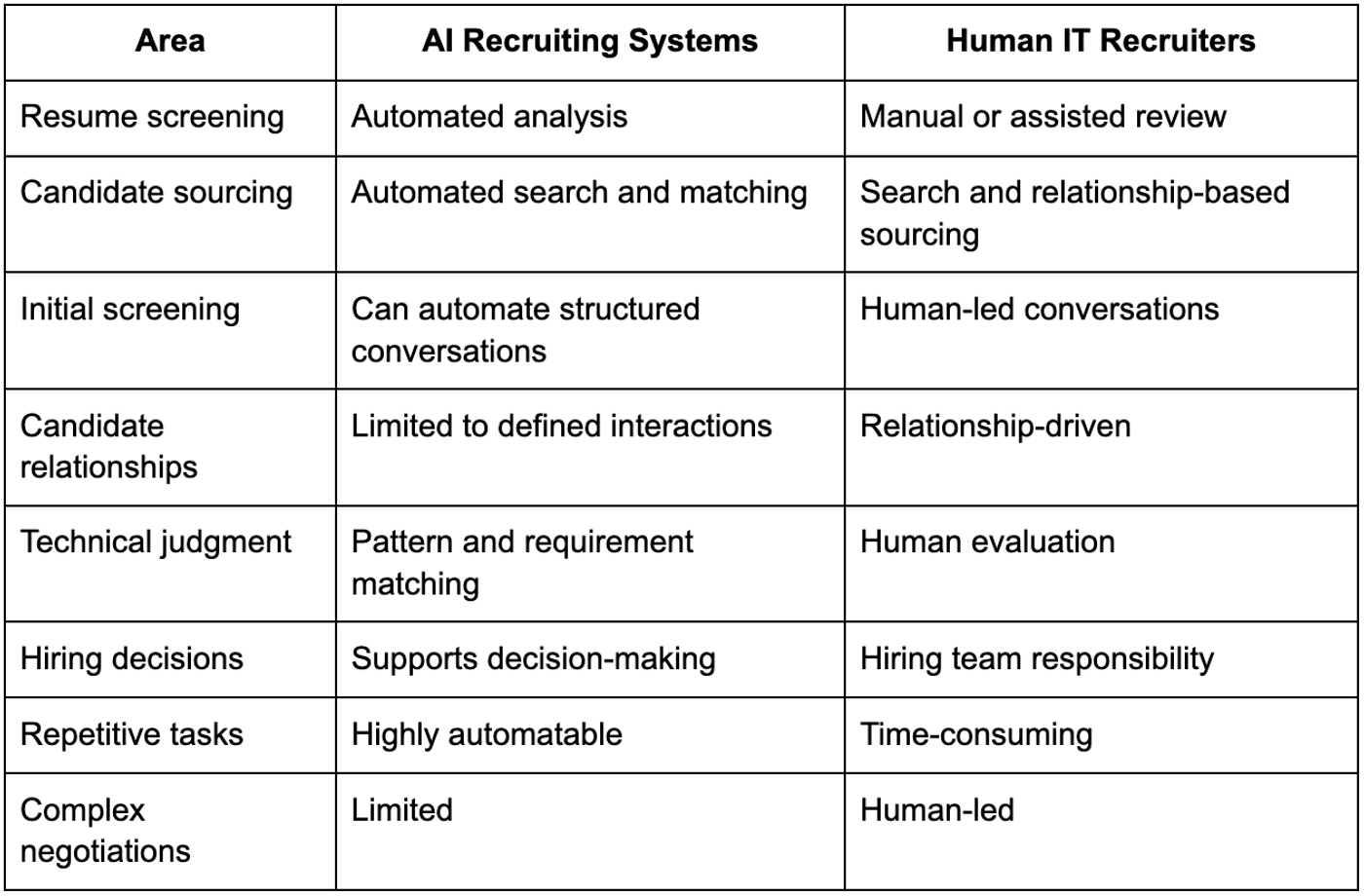
The most practical approach for many recruitment teams is not necessarily AI versus recruiters. It is AI supporting recruiters.
What Should Companies Look for in an AI Recruiting System?
Organizations evaluating AI recruitment technology should look beyond the number of AI features advertised.
Important considerations include:
Candidate Data Security
Recruitment systems process sensitive personal and professional information. Companies should understand how candidate data is stored, processed, protected, and accessed.
ATS and HR Integrations
An AI recruiting solution should ideally work with the systems already used by the recruitment team.
Integrations can prevent recruiters from having to manually move information between different platforms.
Screening Customization
Different IT roles require different screening criteria. Recruitment teams should be able to define questions and qualification requirements according to each position.
Human Oversight
Recruiters should be able to review AI-generated recommendations and candidate information before making important decisions.
Reporting and Analytics
Recruitment teams should be able to track metrics such as candidate response rates, screening completion rates, interview conversions, and time spent at different recruitment stages.
Where AI Voice Agents Fit Into IT Recruitment
AI voice agents are particularly useful for the communication-heavy parts of recruiting.
For example, after sourcing candidates for a software engineering position, an AI voice agent can contact candidates and ask predefined questions about their experience, availability, location, compensation expectations, and interest.
The results can then be passed to recruiters for review.
This creates a workflow where AI handles volume while recruiters handle judgment.
For staffing agencies and internal talent acquisition teams, this can be especially useful when recruiters need to contact hundreds of candidates for multiple open positions.
Challenges of Artificial Intelligence in Recruitment
AI recruitment also introduces challenges that organizations need to manage.
AI systems can produce inaccurate recommendations if job requirements are poorly defined or candidate data is incomplete.
There are also concerns around bias, transparency, privacy, and the appropriate use of automated decision-making.
Recruiters should therefore treat AI as a decision-support and workflow automation layer rather than blindly accepting every recommendation.
Clear screening criteria, human oversight, regular evaluation, and appropriate data governance remain important.
Regulation is catching up. New York City's Local Law 144 requires a bias audit and candidate notice before employers use automated employment decision tools, and the EU AI Act classes AI used to screen or evaluate candidates as high-risk.
The Future of Artificial Intelligence IT Recruiters
The role of the IT recruiter is likely to become increasingly technology-assisted.
Recruiters may spend less time on repetitive sourcing, screening, scheduling, and follow-up activities and more time on candidate engagement, technical discussions, hiring-manager collaboration, and closing candidates.
AI can also make recruitment workflows more conversational. Instead of candidates filling out long forms or waiting for recruiters to respond, they can interact with automated systems through chat or voice and provide information during natural conversations.
For organizations hiring specialized technology talent, this combination of automation and human expertise can create a more scalable recruitment process.
How Dialflo Supports AI-Powered Recruitment Workflows
Dialflo provides AI voice automation that can support recruitment teams with candidate communication and screening workflows.
For example, recruitment teams can use voice AI to contact candidates, conduct structured screening conversations, collect responses, and pass relevant information to recruiters.
This is particularly useful for staffing agencies and companies dealing with high-volume candidate pipelines where manual calls can consume a significant amount of recruiter time.
The objective is not to remove recruiters from the recruitment process. It is to automate repetitive communication so recruiters can spend more time on candidates who require human attention.
Conclusion
Artificial intelligence IT recruiters represent a shift toward more automated and data-assisted technical recruitment.
AI can support candidate sourcing, resume screening, candidate matching, outreach, voice screening, scheduling, and recruitment analytics. For companies hiring AI engineers, machine learning professionals, developers, and other specialized IT talent, these capabilities can help recruitment teams manage larger candidate pipelines without relying entirely on manual processes.
The strongest recruitment workflows are likely to combine AI automation with human expertise. AI can handle repetitive, high-volume activities, while recruiters remain responsible for understanding candidates, evaluating context, managing relationships, and supporting final hiring decisions.
As technical hiring becomes more specialized and candidate volumes continue to grow, AI-powered recruitment can become an important part of the modern IT recruiter's toolkit.
Hiring for technical roles at volume? Book a Dialflo demo to see voice agents handle first-round screening calls so recruiters can focus on technical evaluation.
Frequently asked questions
How are IT recruiters using AI?
To source candidates by skills rather than titles, screen and rank applications, run first-round phone screens, schedule interviews, and keep candidates updated.
Can AI assess technical skills?
It can run structured questions and coding or skills assessments, but final technical judgment should stay with engineers and hiring managers.
What are the risks of AI in IT recruiting?
Bias in screening models, poor candidate experience if automation feels impersonal, and legal requirements such as bias audits in some jurisdictions.
How does Dialflo support IT recruiting?
Dialflo's voice agents call applicants, ask screening questions, confirm availability and expectations, and schedule interviews, so recruiters focus on technical evaluation.