How AI Agents Are Transforming Recruiting in 2026

Dialflo: AI Voice Agent
May 18, 2026
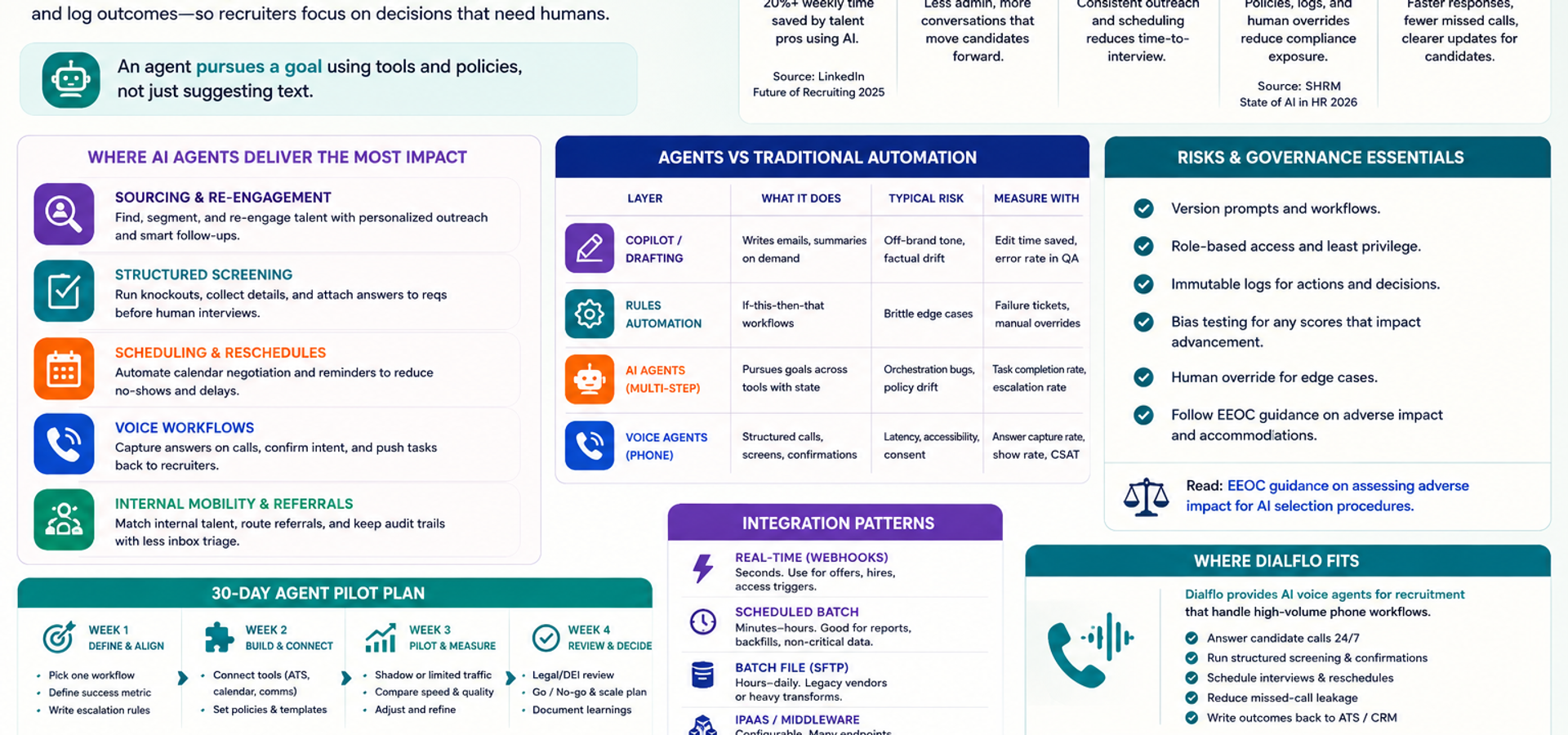
By 2026, most talent teams have experimented with generative writing and resume summaries. The next jump is different: software that acts across steps—pulls a shortlist, drafts outreach, follows up, books time, logs outcomes—without you re-prompting every move. That is the rise of AI agents in recruiting, and it is changing where recruiters spend their hours.
This article explains what counts as an agent, where transformation is real (versus vendor theater), what risks legal and DEI teams will ask about, and how to pilot safely. For tool comparisons, read AI agents for recruitment: best tools compared (2026) and agentic hiring organization: the 2026 playbook. For funnel context, see artificial intelligence in recruitment: complete guide, AI sourcing: how to find candidates faster, and AI applicant screening: how it works & top tools. For phone-heavy workflows, Dialflo is one voice-agent layer teams add without replacing the ATS.
Definitions: what counts as “AI agents in recruiting”?
A copilot suggests text. An agent (in the product sense) persists a goal, chooses tools, and advances state: “schedule five screens for warehouse reqs in Dallas this week” is a goal, not a paragraph request.
AI agents in recruiting usually combine: (1) policy and rubric grounding, (2) integrations (ATS/CRM/calendar/telephony), (3) logging, and (4) human override paths. If a vendor cannot show those four, you are buying autocomplete with ambition.
Where AI agents in recruiting are transforming workflows fastest
1) Sourcing and re-engagement loops
Agents can maintain evergreen talent pools: dedupe profiles, segment by skill, draft personalized outreach, and stop sequences when a human marks “do not contact.” Speed wins when follow-ups are consistent without spamming.
2) Structured screening before human interviews
Agents run knockouts, collect license details, confirm shift availability, and attach answers to reqs. The transformation is fewer “maybe” candidates clogging hiring manager calendars.
3) Scheduling and reschedule storms
Calendar negotiation is a classic multi-step task. Agents reduce email ping-pong and missed windows—especially when candidates work shifts and cannot answer email at 2 p.m. on a Tuesday.
4) High-volume phone workflows
When candidates call back, voice agents capture structured answers and push tasks to recruiters. That is where voice-first stacks earn ROI: missed calls are not a “candidate problem,” they are revenue leakage.
5) Internal mobility and referral routing
Agents can match internal employees to open reqs, route referrals to the right recruiter, and keep audit trails—often faster than manual inbox triage.
Evidence: why 2026 is an inflection point for adoption
LinkedIn’s Future of Recruiting research reports that talent professionals already using generative AI save about 20% of their workweek on average—time that can be reinvested if workflows are redesigned, not only automated at the margins. Source: LinkedIn: Future of Recruiting 2025.
SHRM’s State of AI in HR research discusses AI applied across HR and recruiting workflows—including screening and communications—signals that budget and policy attention are now mainstream, not experimental. Source: SHRM: State of AI in HR 2026.
Governance: what changes when agents act, not just suggest
When AI agents in recruiting take actions, your risk surface grows: wrong candidate gets an offer template, a client’s data crosses into another tenant, a bot over-promises pay. Governance needs versioned prompts, role-based permissions, immutable logs, and periodic bias testing when scores influence selection.
U.S. teams should align with EEOC guidance on assessing adverse impact for algorithmic selection procedures when automated steps affect who advances. Read: EEOC: Assessing adverse impact in AI selection procedures.
A 30-day pilot plan for AI agents in recruiting (no science fair)
Week 1: Pick one workflow and one success metric (for example, median hours from “interested” to “screen scheduled”).
Week 2: Freeze scope. Write escalation rules: when the agent must stop and hand off.
Week 3: Shadow mode or limited traffic. Compare cohorts on speed and quality (interview pass rate, hiring manager satisfaction).
Week 4: Go/no-go with legal/DEI sign-off on any scoring that affects advancement.
Unique angle: “agent ROI” is coordination ROI, not word-count ROI
Most ROI decks count words saved. AI agents in recruiting pay off when they compress coordination latency: fewer dropped calls, fewer duplicate profiles, fewer reqs stuck because scheduling failed.
That is why voice and calendar agents often beat “another email writer” in time-to-fill metrics for hourly hiring.
Where Dialflo fits: voice agents that complete structured workflows
Dialflo provides AI voice agents for recruitment that handle phone-first steps—screening questions, confirmations, reschedules—and write structured outcomes back to your hiring stack. Voice is not the only agent surface, but it is the one most stacks ignore until missed calls become the bottleneck.
FAQ: AI agents in recruiting (2026)
What are AI agents in recruiting?
Multi-step systems that pursue hiring goals using tools and integrations, with logging and human overrides—beyond one-off generative prompts.
How are AI agents transforming recruiting in 2026?
They orchestrate sourcing, screening, scheduling, and phone workflows so recruiters spend more time on judgment, relationships, and exceptions.
Will AI agents replace recruiters?
No. They replace repetitive execution; recruiters still own trust, compliance nuance, and complex stakeholder management.
What are the biggest risks?
Bias, deceptive UX, cross-client data leakage in staffing, and integration failures that fork ATS truth.
Where should we pilot first?
Pick a high-volume bottleneck with clear metrics: scheduling, structured knockouts, or re-engagement of warm leads.
How does Dialflo help?
Dialflo focuses on voice workflows that need structured capture and fast follow-through—complementing your ATS as system of record.
Closing: agents work when humans own the handoff
AI agents in recruiting transform hiring when you redesign workflows around handoffs: what the agent completes, what the recruiter approves, and what must never automate. Pick one workflow, measure coordination latency, and expand only when quality and speed move together.
If phone coordination is your leak, explore Dialflo as a voice agent layer built for recruiting operations.


