How Staffing Agencies Use Voice AI to Screen 10× More Candidates Without Burnout

Dialflo: AI Voice Agent
January 15, 2026
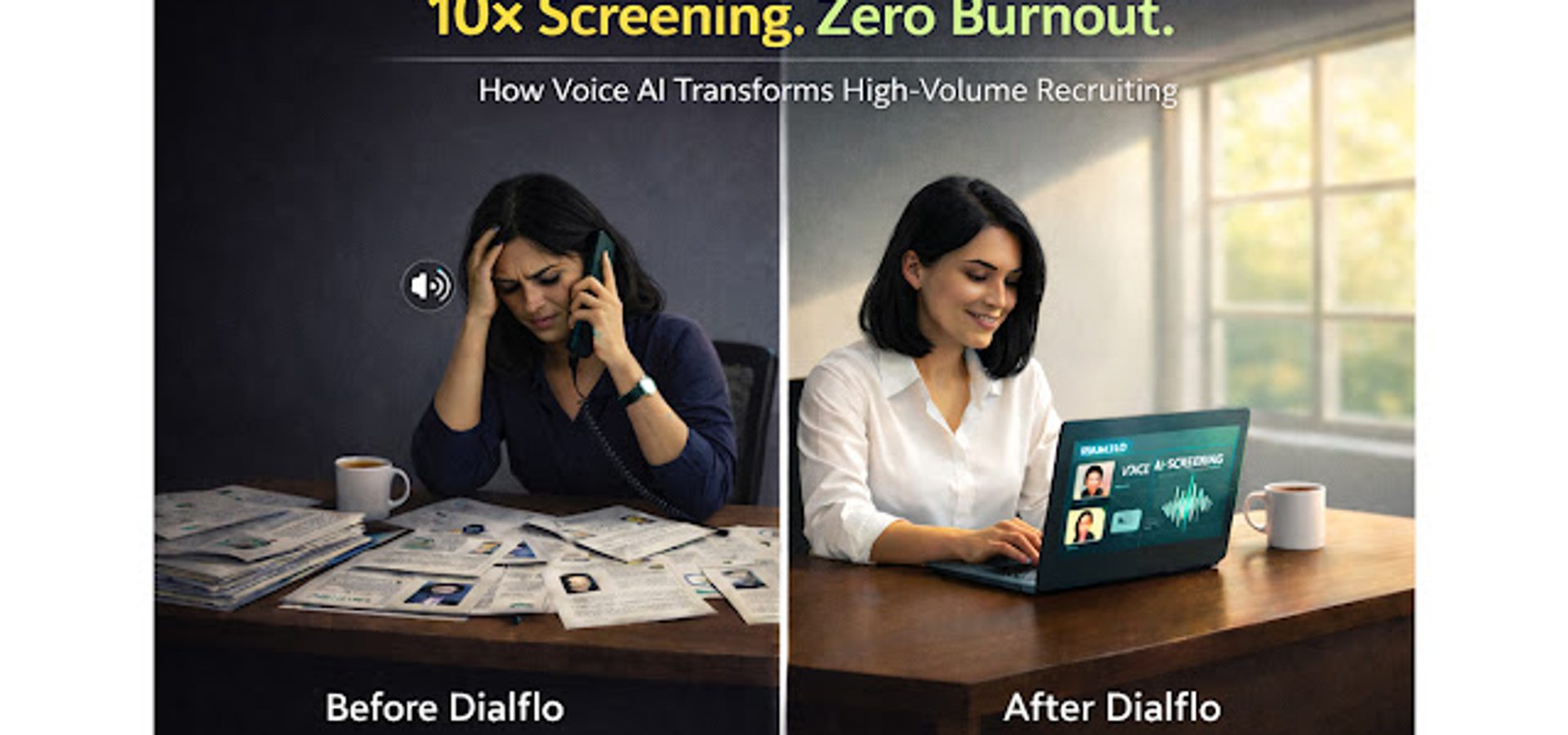
A warehouse recruiter starts Monday with52 new applicants. By Thursday, she’s spoken only to18. What about the other34?
- Half accepted offers elsewhere.
- The rest stopped answering.
This isn’t a sourcing problem. Staffing agencies aren’t short on applicants, they’re sitting onthousands of phone numbers, many of them unreachable or stale.
The constraint isscreening speedand in blue-collar hiring, delays of even a few hours cost placements.
Candidates typically apply to3–5 agencies simultaneously. Whoever speaks to them first usually wins.
Why recruiter-led screening collapses at volume
Manual screening works until volume spikes. At scale, recruiters spend their days:
- Making the same calls repeatedly
- Logging responses manually
- Chasing candidates who don’t answer
The result isn’t poor effort. It’sstructural overload.
Recruiters become the bottleneck not because they’re slow, but becausehumans can only call one person at a time.
The operational shift: separating screening from selection
High-performing agencies are changing one assumption:
Recruiters don’t need to do the first conversation.
They still:
- Decide who moves forward
- Match candidates to client requirements
- Close positions
But theinitial screening callis handled by Voice AI. This isn’t about replacing recruiters. It’s aboutshielding them from volume.
What Voice AI actually handles in screening
Voice AI does one focused job:structured first-round screening.
It:
- Calls applicants shortly after they apply
- Asks fixed, role-specific questions
- Captures availability, experience, location, shift preference
- Logs responses into the ATS
It does not:
- Make hiring decisions
- Sell roles aggressively
- Replace recruiter judgment
Think of it as aparallel screening layer, not a decision-maker.
How this enables 10× screening without burnout
The 10× multiplier isstructural, not metaphorical.
Even if a recruiter spends an entire day only on screening, they can realistically speak to30–40 candidates.
Voice AI runs calls in parallel, allowing200–300 candidatesto be contacted in the same day and passes only the qualified ones back to recruiters.
Recruiters then review only the qualified subset, usually20–30%of the total.
In practical terms, agencies often see:
- Time-to-first-contact drop from ~18 hours to 1–2 hours
- 12–15 recruiter hours saved per 100 applicants, once screening stabilises
That’s the leverage.
1) Every applicant gets contacted quickly
Instead of recruiters prioritising a few resumes, Voice AI typically contacts applicantswithin a couple of hours.
Why this matters:
- Faster contact improves response rates
- Fewer good candidates go cold
- Recruiters stop guessing who to call first
In one deployment we studied (SmartStaff), candidates who were previously unreachable often responded when contacted outside recruiter working hours automatically.
(Disclosure: SmartStaff is one of the staffing agencies where Dialflo’s Voice AI is deployed.)
2) Recruiters stop repeating the same questions
In high-volume hiring, most first-round screening calls sound the same.
Recruiters repeatedly ask:
- Do you have forklift experience?
- Which location can you work from?
- Are you available for the night shift?
Voice AI takes over this repetitive layer. It asks these questions consistently and records answers in a structured format.
Recruiters receive:
- Structured responses
- Clear eligibility signals
- Short summaries instead of raw call notes
This removes repetitive work without removing recruiter control.
3) Screening scales without adding recruiters
Recruiters can screen only one candidate at a time. Voice AI screens many candidates at the same time.
During demand spikes:
- Screening continues at the same pace
- Recruiter workload stays stable
- Agencies don’t need to rush-hire recruiters
The benefit isn’t just speed. It’spredictable capacity under pressure.
What recruiters actually gain
Recruiters don’t lose control. They lose the grind. Burnout in high-volume recruiting comes from:
- High call volume with low answer rates
- Constant context switching
Voice AI absorbs that load. What recruiters get back:
- Predictable workdays
- 40–50% more time with qualified candidates
- Lower end-of-day exhaustion
Implementation realities
Voice AI doesn’t deploy instantly. Common friction points include:
- ATS integration:Many systems need custom APIs or manual CSV workflows at first
- Candidate perception:Some candidates hang up; transparent scripting (“This is an automated screening call”) reduces drop-off
- Cost justification:ROI typically emerges within3–4 weeks, once recruiters stop firefighting and focus on closures
Adoption improves when agencies redesign workflow not just add new tech.
Common pitfalls to avoid
- Automating judgment, not screening —Voice AI should filter, not decide
- Over-scripted calls —Candidates respond better to simple, respectful language
- Measuring call volume instead of outcomes —Track time-to-contact and shortlist conversion
A simple before / after snapshot
With Voice AI,recruiters stop spending hours onfirst screening and retries. They spend most of their calling time only onfinal stage candidateswho are likely to join,so output increases while burnout drops.
When Voice AI makes sense and when it doesn’t
Best fit:
- High-volume roles
- Repeatable requirements
- Structured screening
Poor fit:
- Executive hiring
- Low-volume roles
- Highly conversational assessments
Knowing this prevents unrealistic expectations.
The real win isn’t speed. It’s sustainability.
- Recruiters stop drowning.
- Screening becomes predictable.
- Growth stops meaning chaos.
Ask your team this:If we doubled applicant volume next month, what breaks first?
If the answer is "our recruiters", Voice AI isn’t a nice-to-have. It’s the core callinginfrastructurefor your team.


