How to Migrate from Retell to Dialflo Without Downtime

Dialflo: AI Voice Agent
May 8, 2026
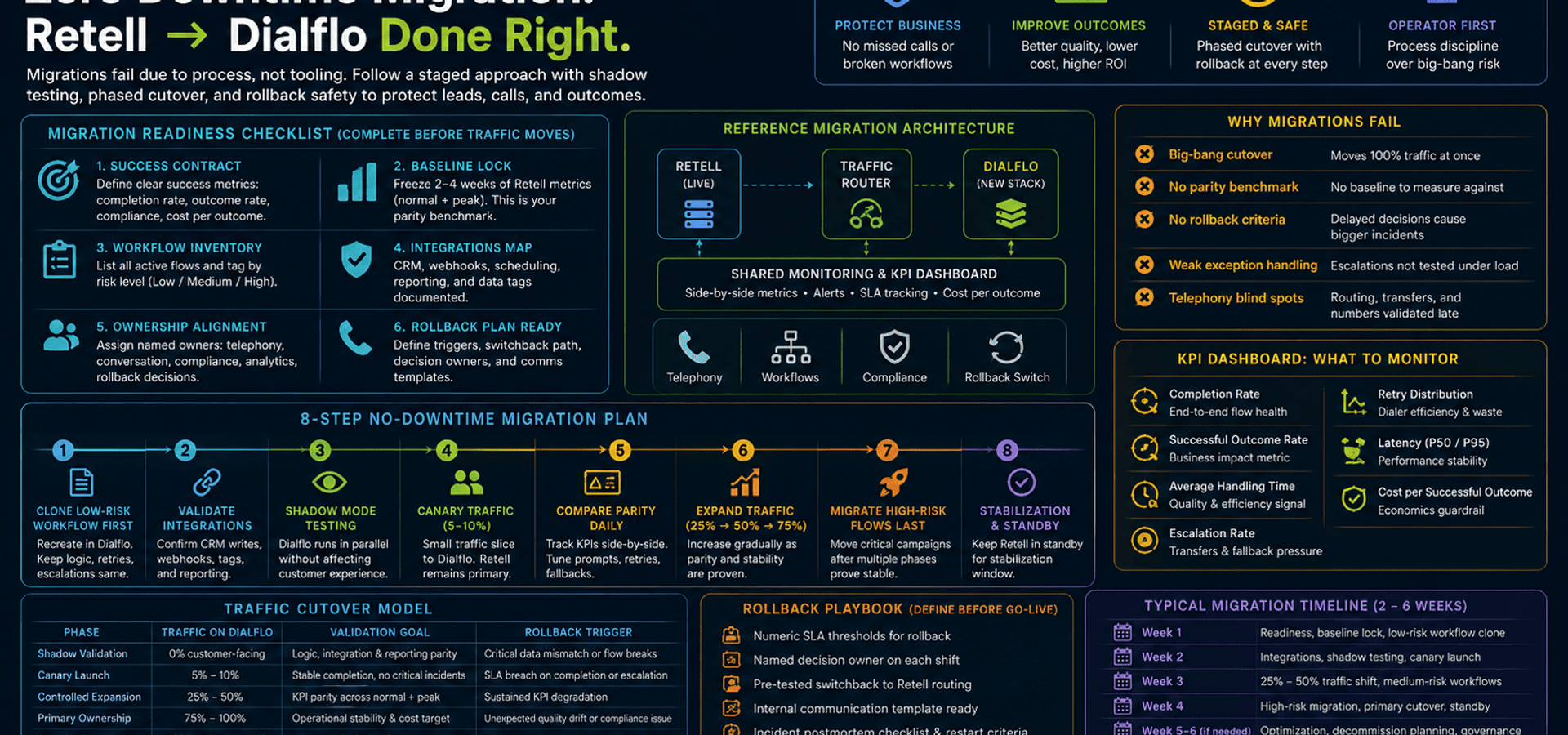
Zero-downtime migration is less about tooling and more about process discipline: shadow testing, phased cutover, and clear rollback triggers.
If you are planning to move from Retell to Dialflo, the biggest fear is obvious: downtime. No team wants missed leads, failed support calls, or broken appointment workflows during migration week. The good news is that a production migration can be done safely if you avoid big-bang cutover and follow a staged transition model.
This guide gives a practical, operator-first plan for how to migrate from Retell to Dialflo without downtime. It covers architecture prep, workflow mapping, shadow testing, progressive traffic shifts, SLA monitoring, and rollback safety. The goal is not just to switch vendors. The goal is to preserve business continuity while improving long-term execution reliability.
Why migrations fail (and how to avoid it)
Most voice AI migrations fail for process reasons, not technical reasons. Teams usually try to move too much, too fast, without a shared KPI contract across ops, product, and engineering. Common failure patterns include:
- Big-bang cutover: moving 100% traffic in one release window.
- No parity benchmark: no baseline metrics from current Retell workflows.
- No rollback criteria: teams “debate” whether to rollback while incidents grow.
- Weak exception handling: escalation paths not tested under load.
- Telephony blind spots: number routing and transfer behavior validated too late.
If you want to learn how to migrate from Retell to Dialflo without downtime, the first rule is simple: treat migration as a controlled product launch, not a configuration task.
Migration readiness checklist (before touching production)
Before any traffic movement, complete this readiness checklist. It dramatically lowers risk.
1) Define your migration success contract
Document exact success criteria for go-live. Example metrics:
- call completion rate parity within agreed threshold
- successful business outcome rate at or above baseline
- no critical compliance incidents
- cost per successful outcome at or below target
2) Freeze and document current Retell baseline
Export 2 to 4 weeks of baseline metrics from your current stack. Include normal and peak windows. This becomes your benchmark for Dialflo parity checks.
3) Create a workflow inventory
List every active call flow:
- inbound support flows
- outbound campaigns
- appointment reminders
- collections scripts
- escalation and fallback logic
Mark each workflow by risk level: low, medium, high.
4) Align cross-functional ownership
Assign named owners for: telephony, conversation logic, compliance, analytics, and rollback decisions. If ownership is vague, migration slows down under pressure.
Reference migration architecture
A safe migration uses dual-run architecture for a temporary period. Retell remains live while Dialflo is validated in parallel.
Core principle: never remove the old path before the new path proves KPI parity.
Your migration architecture should include:
- existing Retell workflows unchanged during early validation
- Dialflo replicas of each target workflow
- traffic router or campaign-level split logic
- shared monitoring dashboard with side-by-side KPIs
- one-click rollback switch to prior stable path
For platform context and deployment capability details, review Dialflo.
Step-by-step: how to migrate from Retell to Dialflo without downtime
Step 1: Clone one low-risk workflow first
Do not start with your highest-value campaign. Pick a low-risk but meaningful workflow and recreate it in Dialflo. Keep prompts, retry rules, escalation logic, and outcome labels as close as possible to current behavior.
Step 2: Validate integrations and event mapping
Confirm CRM writes, webhook outputs, scheduling updates, and call tags are mapped correctly. Migration failures often start in data mismatches, not call audio quality.
Step 3: Run shadow mode testing
In shadow mode, Dialflo processes representative traffic logic without owning customer-facing output. This helps validate flow behavior and reporting before live exposure.
Step 4: Launch controlled canary traffic (5% to 10%)
Move a small traffic slice to Dialflo while Retell remains primary. Monitor in near real-time. Keep this phase long enough to include weekday and peak-hour variation.
Step 5: Compare parity dashboard daily
Track side-by-side KPIs across both stacks. If Dialflo meets thresholds consistently, increase traffic gradually (for example 10% to 25% to 50%). If not, pause and tune.
Step 6: Expand to medium-risk workflows
After low-risk parity is stable, migrate medium-risk flows. Repeat the same sequence: shadow test, canary, parity checks, traffic expansion.
Step 7: Move high-risk workflows last
Only migrate high-risk campaigns after process confidence is proven. Maintain conservative rollback rules for these flows even after initial success.
Step 8: Keep dual-run fallback window post-cutover
After full migration, keep Retell in standby for a short stabilization period. This safety buffer protects against delayed edge-case failures.
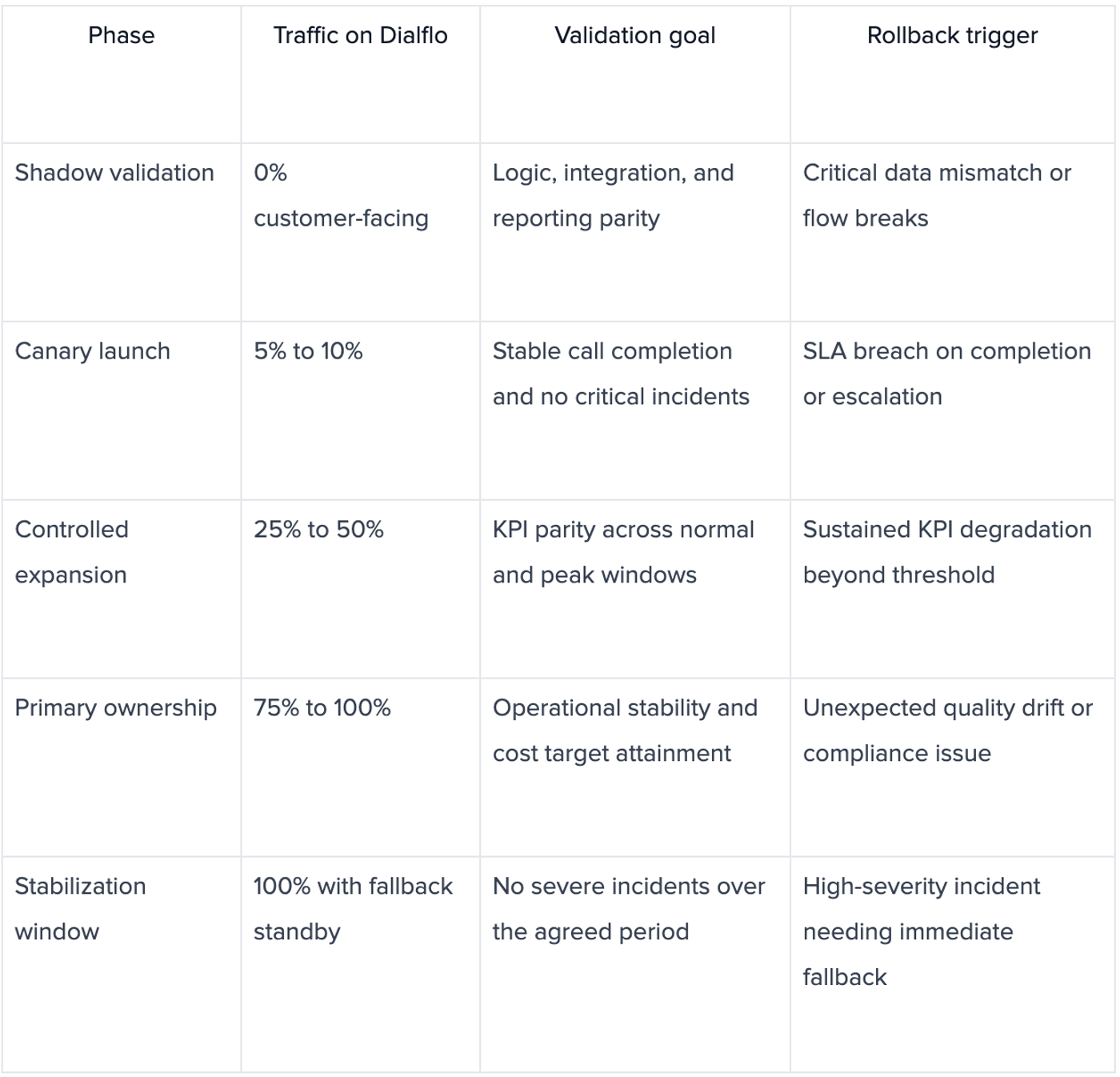
Traffic cutover model that minimizes risk
KPI dashboard: what to monitor during migration
If you only monitor total call volume, you will miss early failure signals. Track a full migration dashboard:
- Completion rate: end-to-end flow completion health
- Successful outcome rate: business impact (qualified, booked, resolved, collected)
- Average handling time: quality and efficiency signal
- Escalation rate: transfer and fallback pressure
- Retry distribution: dialer efficiency and attempt waste
- Latency percentile: P50 and P95 stability
- Cost per successful outcome: business economics guardrail
This metric set gives you objective confidence that migration improves outcomes, not just architecture.
Rollback playbook (must be defined before go-live)
A no-downtime strategy is incomplete without instant rollback readiness. Define rollback before canary begins.
Rollback essentials
- numeric SLA thresholds that trigger rollback automatically
- named decision owner on each shift window
- pretested switchback path to Retell traffic routing
- communication template for internal stakeholders
- incident postmortem checklist for restart criteria
Remember: rollback is not failure. It is a designed safety mechanism in every mature migration program.
Compliance and policy continuity during migration
Do not treat compliance review as a final-day checklist. For a safe migration, maintain policy continuity in each phase:
- verify recording, consent, and retention behavior in Dialflo replicas
- confirm role permissions and change logs
- audit escalation paths for policy-sensitive flows
- ensure reporting outputs match governance requirements
Policy drift during migration can cause operational downtime even when technical uptime is intact.
Typical migration timeline (2 to 6 weeks)
The exact timeline depends on workflow complexity, but this model works for most teams:
Week 1: readiness checklist, baseline freeze, low-risk workflow clone.
Week 2: integration validation, shadow testing, canary launch.
Week 3: 25% to 50% traffic shift, medium-risk workflow prep.
Week 4: high-risk migration prep, primary cutover, fallback standby.
Weeks 5 to 6 (if needed): optimization, decommission planning, governance handoff.
For large enterprises with many call flows, run multiple migration streams in parallel but keep independent rollback controls per stream.
Cost control during migration
Dual-run periods can temporarily increase spend, so control it intentionally:
- migrate highest-impact workflows first after low-risk proof
- limit shadow duration once parity is proven
- avoid duplicated manual QA once dashboards stabilize
- set a hard end date for standby Retell fallback after stabilization
The right measure is not “did migration cost extra this week?” The right measure is “did migration reduce long-term cost per successful outcome without downtime?”
Common mistakes when moving from Retell to Dialflo
- Skipping baseline lock: no objective way to judge improvement.
- Migrating high-risk flows first: exposes business to avoidable disruption.
- No traffic throttle controls: cannot slow down safely during anomalies.
- No single KPI dashboard: teams argue across mismatched reports.
- Decommissioning Retell too early: removes safety net before stabilization.
FAQ: Migrating from Retell to Dialflo
Can I migrate from Retell to Dialflo without downtime?
Yes. Use phased cutover with shadow testing, canary traffic, and rollback readiness. Avoid big-bang migration.
What is the safest migration strategy?
Clone workflows, validate parity in shadow mode, move low-risk traffic first, monitor KPI thresholds continuously, and increase traffic gradually.
How long does a no-downtime migration usually take?
Most teams complete in 2 to 6 weeks depending on workflow count, integration complexity, and governance approvals.
Which KPIs should trigger rollback?
Define numeric triggers in advance for completion rate drops, latency spikes, transfer failures, and compliance incidents.
When should we fully decommission Retell?
After a stabilization window where Dialflo maintains target SLAs consistently and no critical incidents occur for your agreed period.
Closing: migrate in phases, not in panic
The safest way to execute how to migrate from Retell to Dialflo without downtime is to combine engineering discipline with operations governance: baseline first, shadow validation, progressive traffic, hard rollback rules, and KPI-led decisions. This approach protects customer experience while letting your team modernize the stack responsibly.
If you are planning a migration soon, start with one low-risk workflow and build confidence step by step. For deployment and platform details, visit Dialflo.