Dialflo vs Retell for Real Estate Lead Qualification Calls

Dialflo: AI Voice Agent
May 12, 2026
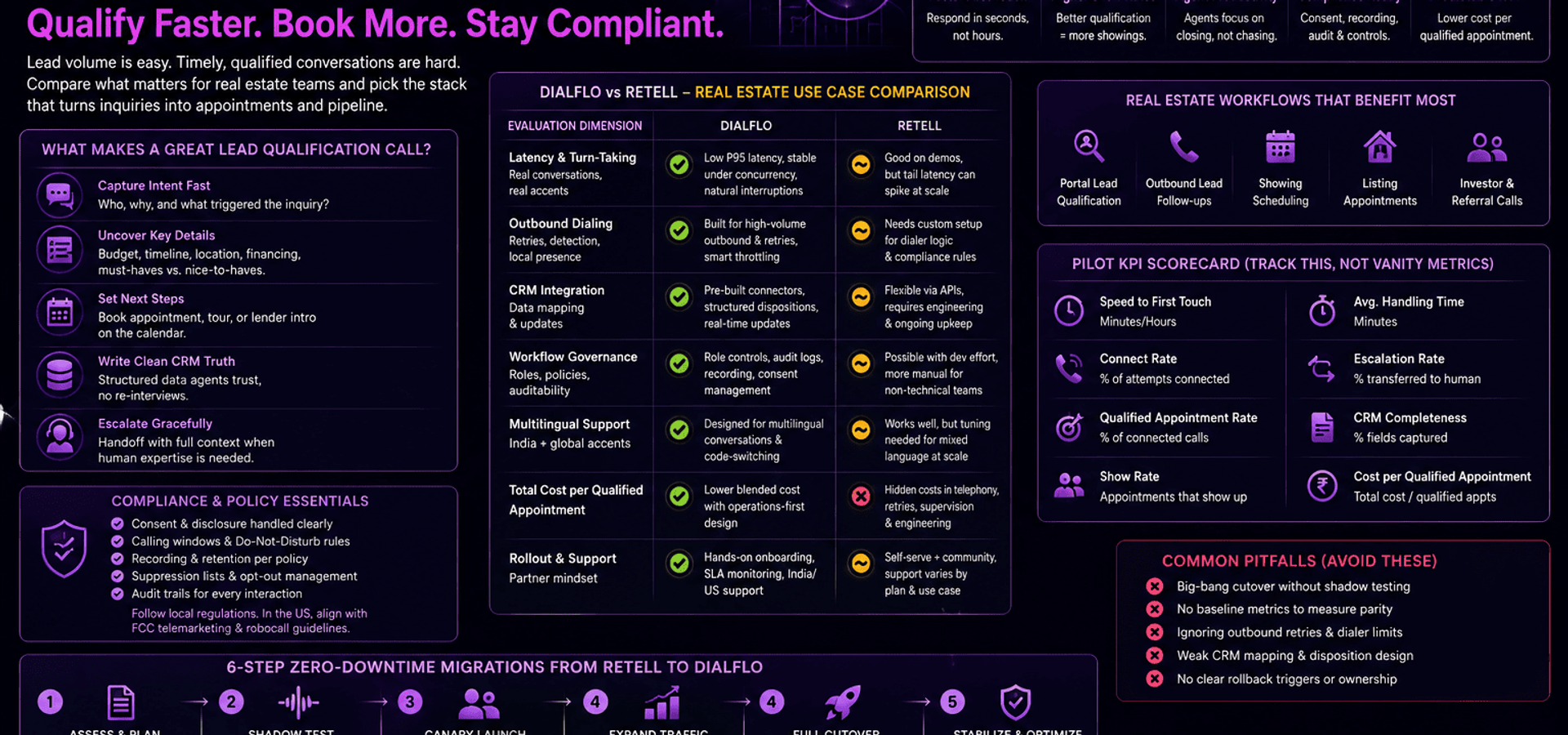
Lead qualification is a workflow problem disguised as a voice problem: capture intent fast, write clean CRM truth, and book the appointment without creating compliance debt.
Real estate teams do not struggle with “more leads.” They struggle with timely leads. Portals, paid social, and site forms can flood a CRM overnight, and the value of those leads decays quickly if nobody qualifies them with context. That is why brokerages and teams experiment with voice AI for real estate lead qualification calls: an always-on first touch that can ask budget, timeline, pre-approval status, neighborhoods, and motivation before a human agent spends a minute on the phone.
This guide compares Dialflo vs Retell specifically through the lens of that workflow, not generic “conversational AI.” You will see what to test in pilots, which requirements separate demo success from production success, and how to measure ROI in terms brokers actually care about: appointments booked, tours completed, and pipeline created per marketing dollar.
Why lead qualification is a different beast than “support voice AI”
Support bots answer questions. Lead qualification creates pipeline. That means your voice stack must handle messy inputs: partial forms, duplicate leads, cold outbound callbacks, and emotionally loaded conversations about rent, relocation, divorce, downsizing, or investment strategy. It also means your stack must write structured outcomes back to a CRM so agents do not re-interview the customer from zero.
Speed still matters as much as empathy. Research on online sales responsiveness has long emphasized how quickly teams convert digital interest into live conversation; see Harvard Business Review: The Short Life of Online Sales Leads for the classic operational framing. Voice AI is not an excuse to slow down, it is an attempt to industrialize fast first touch without burning out your inside sales assistants (ISAs).
Market context also matters. Buyer and seller behavior shifts with financing conditions, inventory, and demographics; brokerages often track macro trend summaries from industry associations such as the National Association of Realtors to align scripts and qualification questions with what prospects are actually worried about this quarter.
What “good” real estate lead qualification sounds like on a call
Before comparing Dialflo vs Retell, define a scoring rubric your team can agree on. A strong qualification call does five things well.
It confirms identity and intent. Who is the buyer, who is moving, and what triggered the inquiry? Portal leads often omit half the story.
It captures hard constraints. Price band, geography, timeline, financing readiness, and must-haves versus nice-to-haves.
It sets next steps without vague promises. A showing window, a listing appointment, or a lender intro, each should land on a calendar with reminders.
It writes CRM dispositions that agents trust. If your CRM notes are fluffy, agents re-call and annoy the lead. Structured fields win.
It escalates gracefully. When the conversation needs empathy, authority, or negotiation, the handoff should carry context, not “press one to talk to a human.”
Dialflo vs Retell: the decision dimensions that actually matter
Most vendor comparisons stop at speech quality. Production brokerages should score platforms across seven dimensions: latency and turn-taking, outbound telephony fit, CRM integration depth, workflow governance, multilingual needs, total cost per qualified lead, and rollout risk.
Latency and turn-taking under real speech
Lead qualification calls are interrupt-heavy. Prospects talk over the agent, pause mid-thought, and change direction. If the stack feels sluggish, you lose rapport. Average latency can look fine while tail latency still breaks conversations, especially during peak weekend traffic.
For an India-focused deep dive on latency, compliance, and dialer stress testing, read Retell review for Indian teams: latency, compliance, and dialer limits. Even if your brokerage is US-based, the measurement discipline transfers: percentiles matter more than means.
Outbound telephony and “ISA reality”
Many qualification workflows are not inbound-only. ISAs return missed calls, chase new portal registrations, and follow up on open house scans. That means retries, answering-machine detection, local presence strategies (where permitted), and careful handling of time windows.
If your program touches regulated telemarketing categories, treat compliance as a first-class requirement. In the US, the Federal Communications Commission’s telemarketing and robocall guidance is a starting point for understanding why consent, abandonment rules, caller ID, and recording practices are not “legal trivia”, they are operational constraints that shape what automation can do.
CRM truth and workflow fit
Retell can shine when a technical team wants to prototype quickly against APIs. Dialflo is often chosen when operations leaders want a rollout partner model: predictable milestones, production monitoring assumptions, and fewer “surprise” gaps between demo and live traffic.
The right answer in Dialflo vs Retell is rarely “which API is prettier.” It is which stack your team can keep healthy when lead volume doubles next month.
Governance: recordings, consent, and audit trails
Brokerages face reputational risk from aggressive outreach. Your voice AI should support policy controls: call windows, suppression lists, per-campaign rules, and retention limits for recordings and transcripts. If a platform makes logging hard, your compliance team will block scale, even if sales loves the demo.
Multilingual and accent robustness
In diverse markets, qualification fails when speech recognition buckles on names of neighborhoods, streets, or loan products. Pilot with real audio from your market, not synthetic “perfect microphone” tests.
Total cost per qualified appointment
Platforms bill in different units. Operations should normalize to: total spend divided by qualified appointments (or tours completed), including telephony, retries, human QA, and engineering time. For a pricing-oriented comparison framework, see Retell vs Dialflo: India pricing and hidden cost patterns, the headline is India, but the cost layering logic applies anywhere production traffic exists.
Rollout risk and migration path
If you already run Retell in staging, do not treat migration as binary. Shadow traffic, compare dispositions, and keep rollback. Dialflo’s playbook for safe cutover is summarized in how to migrate from Retell to Dialflo without downtime.
Where engineering-led prototypes fit, and where they stall
Retell is built for engineering-led prototyping: connect telephony, iterate prompts, and test a narrow use case. A brokerage with in-house developers and a contained pilot can reach a proof of concept that way.
Where teams struggle is not the first 200 calls. It is the transition to always-on operations: monitoring, prompt regression, edge-case handling, and the human workflows around booking and escalation. That is where total cost and risk show up.
When Dialflo is the better fit for real estate lead qualification at scale
Dialflo is built for organizations that need voice AI to survive contact center reality: fluctuating lead flow, concurrency spikes, and integration into how brokerages already work. Dialflo is not “anti-developer,” but it is oriented toward execution: fewer surprises when you move from demo to production, and clearer accountability when something breaks at 7 p.m. on a Sunday portal surge.
If your team is asking for a Retell alternative after production bruises, not because the demo was bad, read best Retell alternative for India: why teams switch to Dialflo for the broader switching narrative; many parallels apply to high-volume US ISA models as well, especially around telephony and latency governance.
To evaluate Dialflo against your current stack, start at dialflo.ai and bring your qualification script, CRM schema, and compliance constraints to the conversation.
A two-week vs four-week pilot: why real estate should not rush the proof
Real estate lead mix is weekly-seasonal. A pilot that runs only on weekdays misses a huge slice of buyer behavior. A pilot that runs only on inbound misses ISA outbound realities.
Week one should focus on instrumentation: dispositions, booking rate, escalation reasons, and latency percentiles. Week two should introduce outbound follow-up on portal leads (where permitted). Week three should stress concurrency. Week four should review cost per qualified appointment and agent satisfaction with CRM notes.
If you cannot commit to multi-week realism, you will choose the wrong winner in Dialflo vs Retell because both can sound good in a short, curated window.
Implementation checklist for brokerages (before you buy either platform)
Define disqualification rules explicitly. Voice AI should not improvise legal or financial advice. Write clear boundaries for lending, fair housing, and investment claims.
Map lead sources to scripts. Zillow-style portal leads behave differently than Instagram leads or open house QR codes. One monolithic script usually underperforms.
Design CRM fields as contracts. Agents should know exactly what “qualified” means in data.
Plan human takeover. Decide what triggers escalation: high intent, distress signals, negotiation, or explicit requests.
Measure downstream, not vanity. Calls attempted are not the goal. Qualified appointments that show up matter.
FAQ: Dialflo vs Retell for real estate lead qualification
Is Retell or Dialflo better for real estate lead qualification?
For brokerages that want qualification running at volume, with CRM write-back, compliance controls, and an operations team rather than engineers owning it, Dialflo is the stronger fit. Teams that only want an engineer-built prototype may start elsewhere. Either way, judge on qualified appointments per 100 leads and cost per qualified appointment.
What KPIs matter most for AI ISA lead qualification?
Prioritize speed-to-first-touch, connect rate, booking rate, no-show rate, and CRM completeness. Add compliance exception rate as a guardrail metric.
How should brokers think about compliance for outbound lead calls?
Treat compliance as jurisdiction-specific policy engineering. Use counsel-approved rules for consent, recording, dialing windows, and suppression lists. Platforms should support auditability and controls, not “growth at all costs” defaults.
Can voice AI replace human ISAs completely?
Usually no. The best deployments automate first-touch qualification and scheduling, then route complex conversations to humans with structured context.
What integrations should a pilot include?
Lead ingestion, CRM write-back, calendar booking, and escalation with context. Add SMS and dialer alignment if those are part of your operating reality.
How long should a Dialflo vs Retell pilot run?
Plan for three to four weeks across varied lead types and calling windows to see production behavior.
Closing: pick the platform that wins your funnel, not the meeting
Dialflo vs Retell is not a religious debate. It is a workflow and economics debate. Real estate lead qualification succeeds when your voice layer is fast, compliant, CRM-accurate, and stable under load, then your human agents spend time closing, not re-asking baseline questions.
If you want help designing a pilot that compares platforms fairly, reach out via dialflo.ai with your lead sources, CRM, and target KPIs. Bring your worst lead surge stories, we optimize for those, not the happy path.