Retell vs Dialflo vs Vapi: Feature + TCO Comparison

Dialflo: AI Voice Agent
May 8, 2026
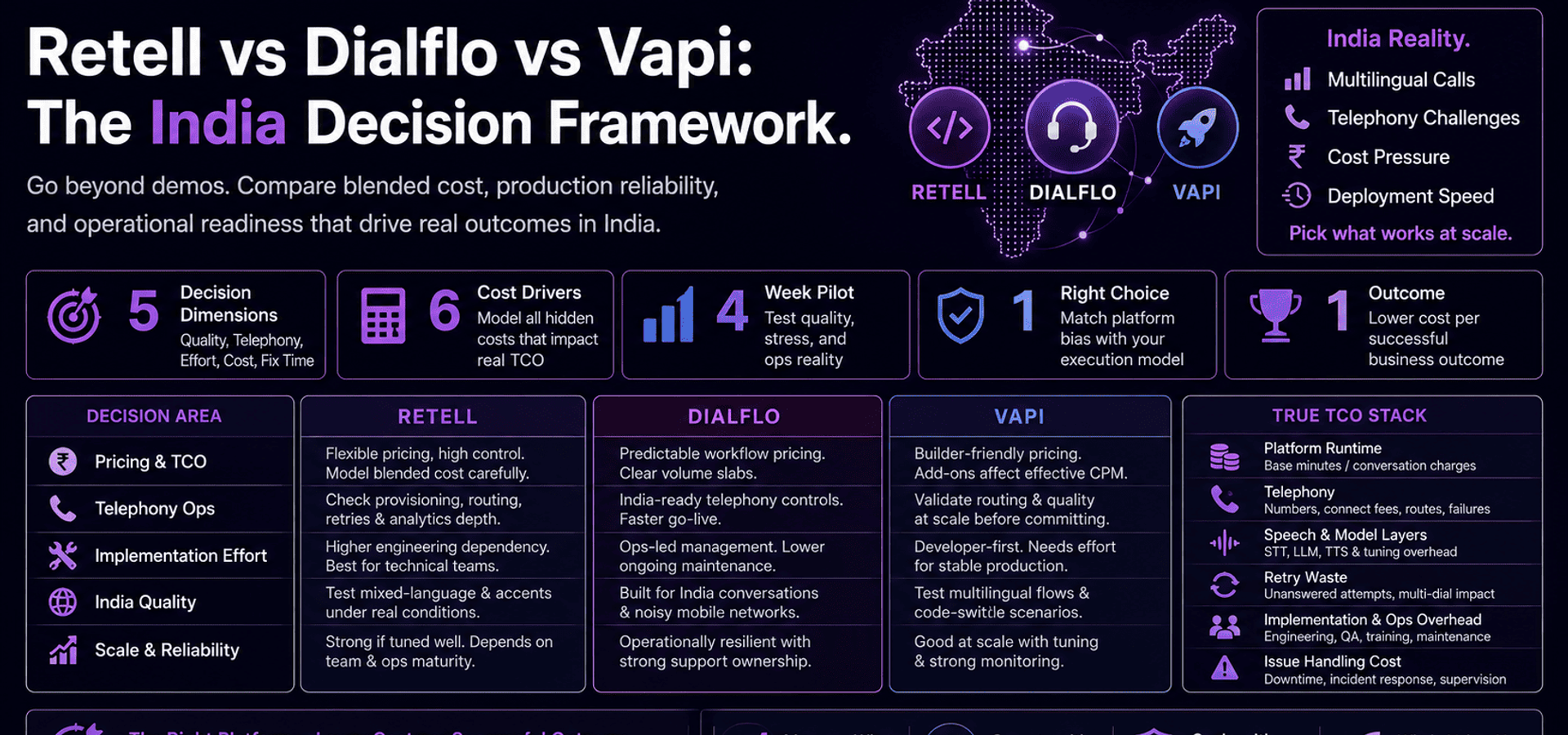
In India deployments, voice AI platform choice should be based on blended cost and production reliability, not only feature screenshots or trial plans.
Choosing between retell vs dialflo vs vapi looks simple until you move beyond trial calls. Most teams start with feature checklists, then discover the real decision is operational: which platform still performs well when campaigns scale, telephony gets messy, and multilingual conversations become the default. This is especially true for Indian teams in 2026, where cost pressure, language diversity, and deployment speed matter as much as model quality.
This guide is built for buyers who need a practical answer, not a generic vendor comparison. We will break down feature fit, hidden cost drivers, implementation load, and a realistic framework for evaluating vapi alternatives free without getting trapped by incomplete pricing assumptions. We also cover how to interpret retell ai pricing in an India-first procurement model.
Why India changes the comparison rules
Many comparison posts assume a US-centric operating environment: predictable telephony setup, lower language complexity in support flows, and infrastructure paths optimized for US traffic. India teams face a different reality. Calls often involve regional accents, code-switching, unstable network moments, and high outbound volume campaigns that amplify every cost leak.
That is why a serious retell vs dialflo vs vapi decision should be scored on these five dimensions:
- quality and latency consistency on Indian traffic
- telephony readiness and operational control
- implementation effort across product and ops teams
- blended total cost per successful outcome
- time-to-fix when production issues appear
If a platform ranks high only on “builder experience” but weak on these five points, your total ownership cost can become unpredictable quickly.
Feature lens: what buyers should compare first
Before pricing, define the feature layer that actually matters for your workflow. In 2026, most platforms can create a decent conversational agent. The differentiator is how confidently your business team can run it in production.
1) Conversation quality under multilingual reality
Test with real call scripts and spontaneous user inputs, not rehearsed prompts. India-facing workflows often switch between English and regional phrases in the same interaction. If transcription and intent handling degrade in mixed language flows, outcomes will drop even when demos look clean.
2) Telephony and call operations
Check number provisioning, routing controls, retries, escalation logic, and analytics depth. A voice stack that sounds good but lacks operational controls will force manual intervention at scale.
3) Workflow orchestration
Can your team easily connect CRM updates, call dispositioning, scheduling, and follow-up automations? Feature-rich voice layers without execution workflow depth create reporting gaps and slower decision loops.
4) Monitoring and observability
Production reliability depends on visibility. You need clear views for drop-off points, retry patterns, no-answer rates, and transfer failures. This is where many teams evaluating vapi alternatives free discover they need stronger operational tooling than trial tiers provide.
TCO lens: where most platform choices go wrong
The most common mistake in retell vs dialflo vs vapi buying is confusing pricing page numbers with ownership cost. For India deployments, effective TCO includes software cost plus operational friction.
Use this TCO stack in every vendor sheet:
Platform runtime: base minutes or conversation charges.
Telephony: number rental, call connect fees, route behavior, failed attempts.
Speech and model layers: STT, LLM, TTS, and tuning overhead.
Retry waste: unanswered attempts and multi-dial campaigns.
Implementation overhead: engineering, QA, ops training, and maintenance effort.
Issue handling cost: downtime impact and incident response burden.
This model is crucial for interpreting retell ai pricing or Vapi pricing fairly. A lower headline rate may still lead to higher monthly spend when retries and supervision rise.
Retell, Dialflo, Vapi: practical fit patterns in 2026
Each platform can be the right choice in specific conditions. The goal is to match platform bias with your operating reality.
Retell: strong option for technically involved teams
Retell often appeals to teams with in-house engineers who want to tune the stack themselves. That path only holds up if you can keep staffing that configuration work after launch, and India buyers should model blended costs and telephony readiness rather than rely on retell ai pricing headlines.
Vapi: builder-friendly but needs careful production modeling
Vapi is frequently explored by developer-heavy teams and appears often in search comparisons. In India contexts, buyers should verify routing behavior, quality at scale, and operational analytics depth. Queries like vapi alternatives free usually signal that teams are searching for predictable economics after early experimentation.
Dialflo: execution-oriented fit for India operations
Dialflo is often chosen when teams want operational speed and practical control over live workflows. For businesses running high-volume support, sales qualification, reminders, or collections in India, the decision tends to favor platforms that reduce day-to-day operational friction, not just development flexibility.
For product context and deployment approach, see Dialflo.
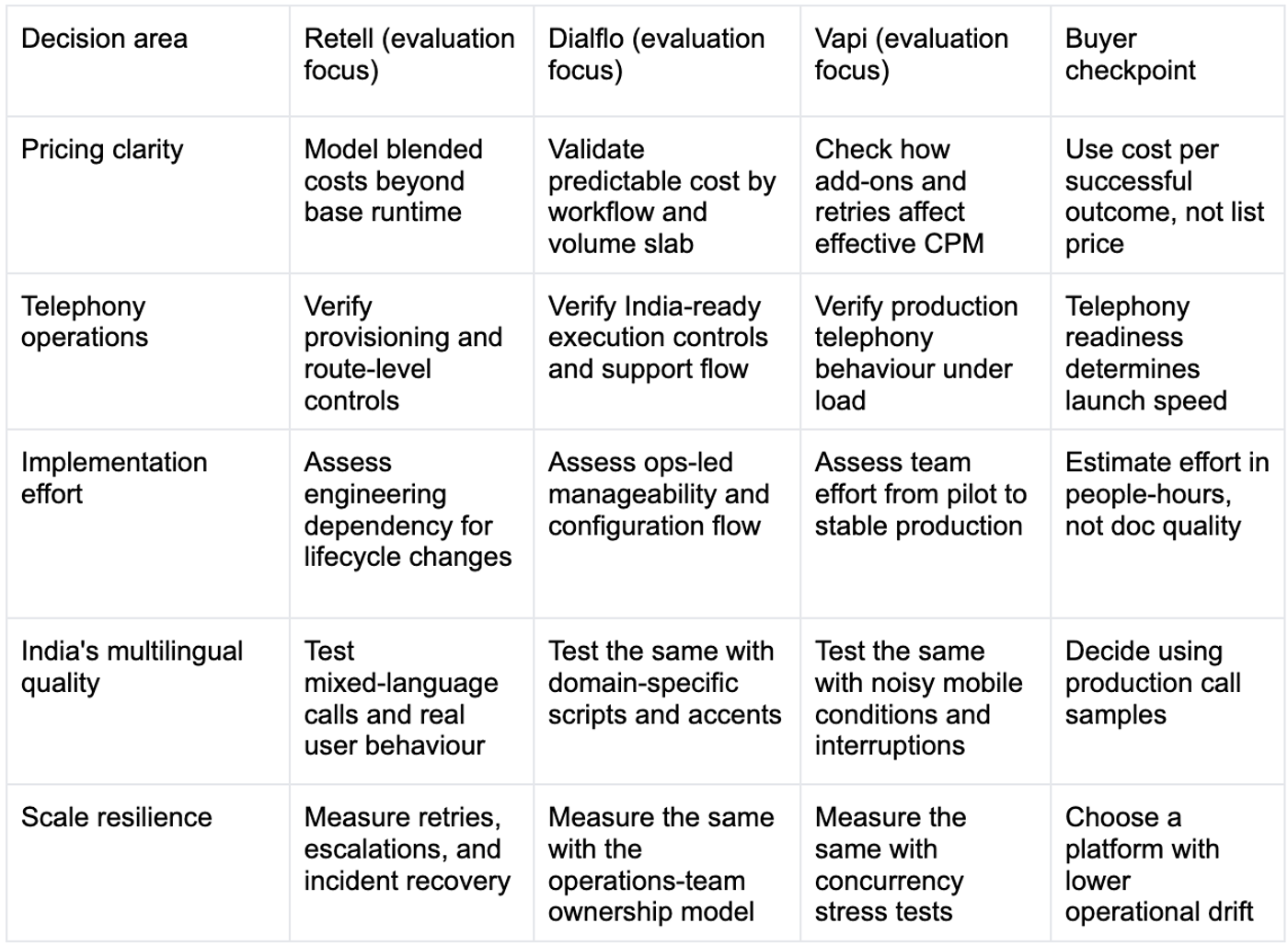
Comparison matrix: Feature + TCO view for India teams
What “free alternatives” really mean in 2026
Searches for vapi alternatives free are rising because teams want to avoid upfront lock-in while still testing real call workflows. But “free” in voice AI is usually limited to credits, short pilots, or reduced-feature sandboxes. That is useful for prototyping, not enough for procurement decisions.
A better approach is to classify options into three tiers:
- Trial-only free: good for quick conversation prototyping, weak for TCO modeling.
- Pilot-friendly low-commitment: best for fair comparisons with real traffic slices.
- Production pricing with clear ramp: best for long-term planning and budget control.
So if your team is actively searching vapi alternatives free, treat “free” as a discovery filter, then move quickly to pilot-grade evaluation with hard metrics.
How to evaluate retell ai pricing without bias
When evaluating retell ai pricing, teams often make one of two errors: overestimating savings from headline rates, or underestimating value from deployment speed. You can avoid both with a structured sheet.
For each vendor, capture:
- expected connected minutes by use case
- attempt-to-connect ratio and retry pattern
- average call duration by segment
- human review and exception handling time
- monthly engineering and ops maintenance hours
Then compute:
effective monthly spend and cost per successful business outcome.
This gives a fair answer across retell vs dialflo vs vapi, especially when your buyers and finance team need a defensible procurement decision.
Pilot blueprint: compare all three without wasted cycles
Use a 4-week pilot model to avoid subjective debate.
Week 1: design and instrumentation
Define one or two high-value workflows (for example, inbound lead qualification and appointment confirmation). Freeze KPIs: successful outcome rate, first-call completion, average handling time, and effective cost per outcome.
Week 2: controlled traffic rollout
Run each platform on matched traffic samples. Keep scripts, handoff rules, and retry policy consistent. Document all user-visible failure types.
Week 3: stress, multilingual, and exception tests
Run peak-hour concurrency tests with mixed language and interrupted speech patterns. Test fallback and escalation behavior. This week usually separates demo-ready platforms from production-ready platforms.
Week 4: decision workshop
Score each stack on one page: quality stability, ops control, incident recovery, blended TCO, and rollout confidence. Select based on operational outcomes, not only product preference.
Common decision traps in retell vs dialflo vs vapi evaluation
- Trap 1: feature theater. Selecting based on UI polish and not call outcome metrics.
- Trap 2: incomplete pricing math. Ignoring retries, telephony, and supervision cost.
- Trap 3: no India-specific quality tests. Using US-like samples for India deployment decisions.
- Trap 4: unclear post-launch ownership. No team accountable for weekly quality governance.
- Trap 5: migration blind spot. No fallback plan if platform underperforms after launch.
Who should choose what in 2026?
Use this simple thumb rule:
Retell fits only if your engineers want deep control and will own ongoing stack tuning themselves.
Vapi fits only if you are mainly experimenting and can absorb the production work later.
Choose Dialflo if you want India-ready telephony, multilingual calls, and a rollout your operations team can run without a dedicated voice engineering squad.
This is not about one universal winner. It is about selecting the platform that matches your execution model and risk tolerance.
FAQ: Retell vs Dialflo vs Vapi
Which platform is best for India teams in 2026?
For most India teams running high-volume support, sales, or collections calls, the deciding factors are multilingual quality, telephony readiness, and blended cost per successful outcome. Dialflo is built around those three. Run a pilot that measures them before you decide.
Are there vapi alternatives free that work for production?
Most free offerings are trial-level and not enough for production-grade confidence. Use free credits for exploration, then shift to a measurable pilot for final platform selection.
How should I compare retell ai pricing with other vendors?
Model total ownership cost: base runtime plus telephony, retries, speech/model consumption, and operational overhead. This gives a realistic apples-to-apples comparison.
What KPI should matter most in a voice AI platform pilot?
Cost per successful business outcome is the strongest KPI. It combines quality, efficiency, and cost in one metric and prevents misleading decisions based on call minutes alone.
How long should the pilot be before signing annual plans?
At least 3 to 4 weeks, including normal and peak traffic windows. Shorter pilots usually miss operational issues that appear only at scale.
Closing: compare like an operator, not like a demo viewer
The retell vs dialflo vs vapi choice should be made with an operator mindset. Focus on outcomes, not screenshots. If your deployment is India-focused, give extra weight to telephony execution, multilingual robustness, and predictable ownership cost. That is where most long-term wins are decided.
If you are building an India-first stack and want to benchmark implementation flow, analytics depth, and rollout confidence, explore Dialflo while testing your preferred voice ai india strategy against hard pilot metrics.