SIM Tracking Consent: How Intugine Reached 76% with Voice AI

Dialflo: AI Voice Agent
November 5, 2026
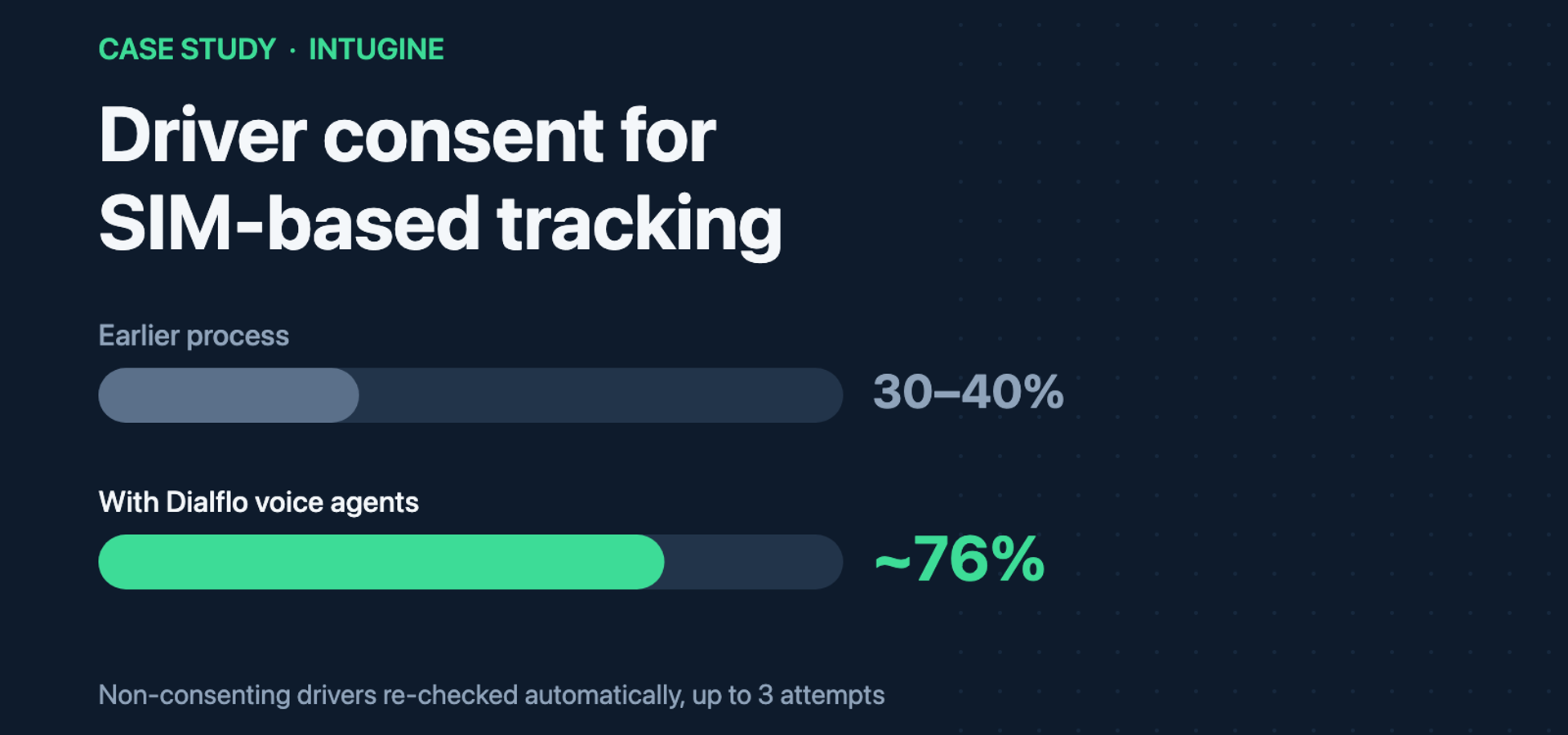
SIM-based tracking only works once the driver says yes. For Intugine, the share of truck drivers who said yes used to sit at 30–40%. With a new consent-tracking process run on Dialflo voice AI agents, it is now about 76%: roughly three in four drivers can be tracked, up from about one in three.
This case study covers how the SIM tracking consent process works, why it moved the number and what other logistics teams can borrow from it.
About Intugine
Intugine is a Bengaluru-based supply chain visibility platform. More than 75 brands, across sectors such as cement, metals, power and express logistics, use it to track shipments by road, rail, ocean and air. For truckload shipments, one of the ways Intugine locates a vehicle is through the driver's own phone, using SIM-based tracking.
Why SIM-based tracking depends on driver consent
SIM-based tracking needs no device in the truck. It locates the vehicle through the mobile network on the driver's phone, which is why it works even on basic feature phones and suits hired or market vehicles.
The catch is consent. Before a phone's location can be shared, the driver has to approve it, usually by replying to an SMS or pressing a key on an IVR call. Until that happens, the truck cannot be tracked.
For a visibility platform, every driver who doesn't consent is a trip that goes dark: no live location, no reliable ETA, and someone has to phone the transporter for updates instead.
Where the earlier process fell short
Under the earlier process, 30–40% of drivers gave consent. The request asks a driver to act on their own, often mid-trip, on a message they may not have expected. Repeating the consent SMS is not a fix either: each one costs money, and sending too many risks the sender being blocked by carriers.
There was also no simple way to see which drivers had consented and which still needed a nudge, so follow-up depended on someone keeping track by hand.
How the voice AI consent-tracking process works
The new process pairs consent status checks with outbound voice calls, run as campaigns:
- Check status first. Each driver's number is checked against its consent status before anyone calls, so only drivers whose consent is still pending are contacted.
- Call the driver in Hindi. A Dialflo voice agent calls the driver, explains why location consent is being requested for the trip and walks them through the consent step, such as calling the consent number and pressing 1.
- Re-check after the campaign. Consent status is checked again after the calls, and drivers who have consented drop off the list.
- Retry automatically, up to three attempts. Drivers who still haven't consented are added to the next campaign on their own, for up to three attempts.
Every call ends with a recorded outcome, so the operations team can see for each driver whether consent was given, is still pending or the call didn't connect.
The result: consent up from 30–40% to about 76%
- Overall driver consent rate: from 30–40% to about 76%.
- In plain terms: about three in four drivers now consent, against roughly one in three before.
- Follow-ups: drivers who don't consent after the first call get up to three attempts, without anyone on the team tracking or redialling them.
For Intugine's customers, more consenting drivers means more trips that are visible from the start, and fewer gaps that someone has to fill by calling a transporter.
What made the difference
Looking at how the process is built, three choices stand out.
A conversation explains what an SMS can't
A driver who gets an unexpected SMS has to work out who sent it and why. On a call, the agent can say who is asking, what the tracking is for and exactly what to do, and answer a question if the driver has one. Doing that in Hindi, and coping with road and cabin noise, matters when drivers take the call from the road.
Status checks keep the calls targeted
Because consent is checked before and after each campaign, the agent only calls drivers who still need to act. Drivers who have already said yes are not called again.
Follow-ups are automatic, and capped
Some drivers need more than one reminder. Non-consenting drivers roll into the next campaign by themselves, which removes the manual list-keeping, and the three-attempt cap means no driver is called indefinitely.
Applying this to your own SIM-tracked fleet
If your visibility depends on SIM-based tracking, these questions are worth asking:
- Do you know your consent rate, and how many trips go untracked because of it?
- Can you check consent status before contacting a driver, so you only chase pending ones?
- Who follows up with drivers who don't consent the first time, and when do you stop?
- Is the request explained in the language your drivers speak?
The same check, call, re-check and retry loop works for other routine driver calls too. We cover more of those in how logistics teams automate routine calls with voice AI and in our last-mile logistics case studies.
SIM tracking consent: common questions
What is SIM tracking consent?
SIM-based tracking locates a truck through the driver's mobile network, so the driver has to approve it first. That approval is usually given by replying to a consent SMS or pressing a key on an IVR call. Until the driver consents, the vehicle cannot be tracked.
Does SIM-based tracking need a smartphone?
No. It works through the mobile network rather than an app, so drivers with basic feature phones can be tracked once they consent.
How many times should you follow up with a driver for consent?
Intugine's process allows up to three attempts. Drivers who haven't consented are added to the next campaign automatically, and drivers who have consented are not called again.
Can a voice AI agent make these calls in Hindi?
Yes. For Intugine, the agent speaks to drivers in Hindi. Dialflo voice agents also run calls in English and regional languages such as Tamil.
If trucks are going dark at the consent step, talk to the Dialflo team about running the same process for your drivers.