Noise-Canceling Phone Bots for Logistics Dispatch Lines

Dialflo: AI Voice Agent
June 16, 2026
Your dispatch line rings. On the other end: a driver on speakerphone, wind through an open window, a reefer unit cycling in the background. They say a PRO number and a city name. Your IVR hears “proceed” and “Sydney.” Your generic voice bot asks them to repeat twice, they hang up and call the shipper instead. That is why logistics dispatch needs acoustic noise-canceling phone bots, not office-tuned chatbots pasted onto a freight number.
This guide explains what noise-canceling phone bots do on dispatch lines, why cab and yard audio breaks normal ASR, which calls to automate first, how TMS write-back works, and how brokers and 3PLs pilot containment without betting the whole tracking desk.
What makes dispatch line audio different
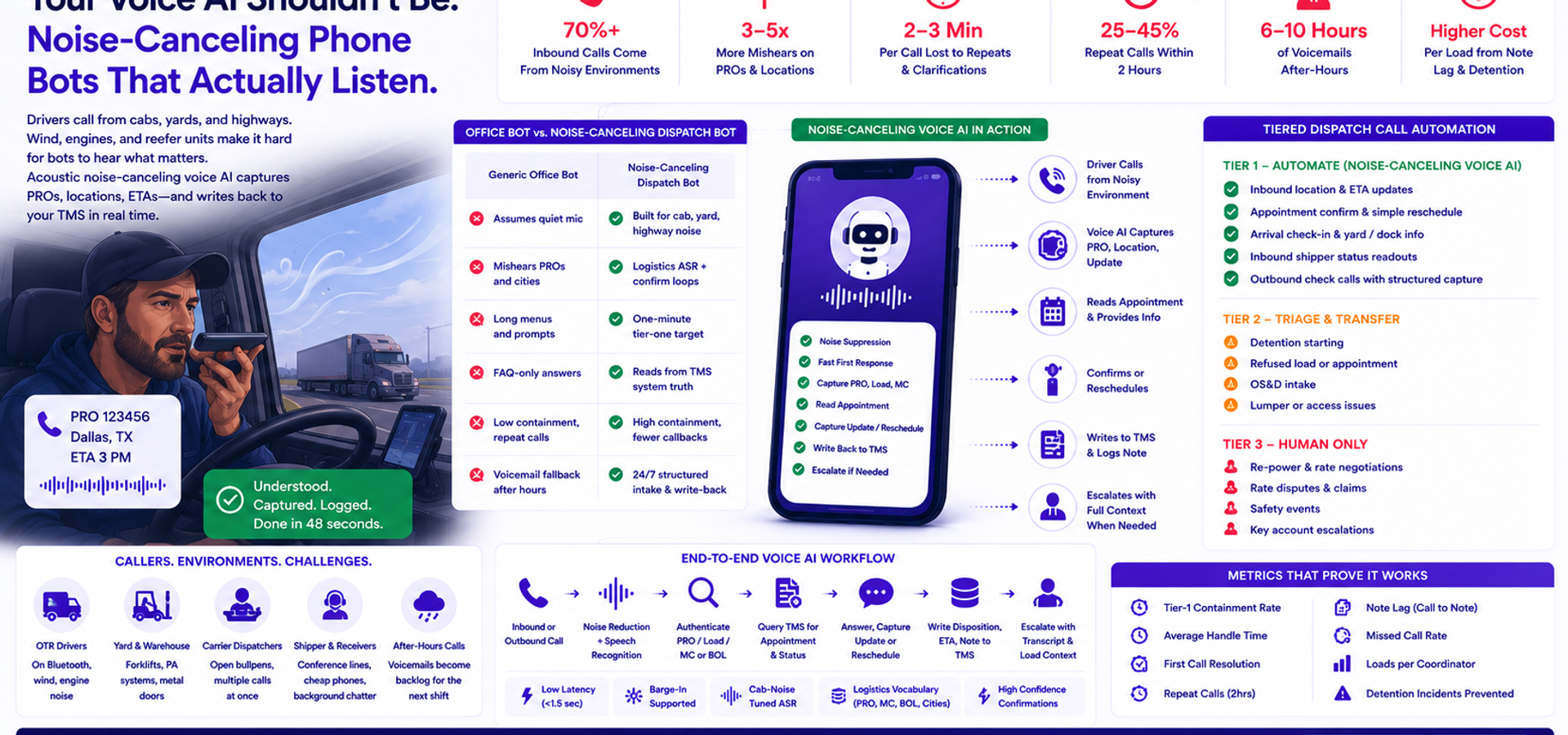
Dispatch phones are not quiet helpdesks. Callers include:
- OTR drivers on Bluetooth or cab speakers
- local cartage drivers idling at receiver gates
- warehouse lumpers and yard jockeys with forklift noise behind them
- carrier dispatchers in open bullpens
- shipper clerks on cheap conference phones
They share short attention spans, alphanumeric IDs (PRO, load, MC/DOT), and place names that sound alike. Standard phone bots trained on clean studio speech mishear the inputs that matter most, so containment collapses and humans replay the same call.
Inbound volume context: automate inbound carrier tracking queues and hidden cost of missed calls in logistics.
What acoustic noise-canceling phone bots actually do
Acoustic noise-canceling phone bots combine:
- Noise suppression / echo cancellation: reduce engine, road, and warehouse background before speech recognition
- Logistics-tuned ASR: vocabularies for PRO, BOL, MC/DOT, city-state pairs, appointment windows
- Low-latency turn-taking: short gaps so callers do not assume the line dropped
- Confirm loops: read back load number and ETA when confidence is borderline
- TMS integration: answer from system truth; write disposition after hang-up
- Warm transfer: human gets transcript + load context on exceptions
Latency plus noise handling overlap with low-latency voice AI for truck driver appointment scheduling. Stack choices: build vs buy voice AI stack and conversational services use cases.
Which dispatch calls to route to noise-canceling bots first
Tier 1: automate on noisy lines:
- inbound location and ETA updates from drivers
- appointment confirm and simple reschedule intake
- inbound shipper “where is my freight?” status readouts
- outbound check-call scripts with structured capture
- standard delay notice before detention escalates
Tier 2: triage + transfer: detention starting, refused load, OS&D intake.
Tier 3: human only: re-power, rate disputes, safety, key accounts.
Write-back patterns: automated load status updates in TMS. Shipper pain: where is my shipment calls.
Architecture for dispatch line phone bots
- Dedicated dispatch DID: carrier and driver line separate from sales if possible.
- Noise-robust voice AI: acoustic preprocessing + logistics NLU.
- TMS adapter: read trip; write notes, ETA, disposition.
- Outbound dialer: scheduled check calls with same audio stack.
- QA sampling: review low-confidence calls; tune vocab weekly.
Ops context: AI in logistics use cases, technology used in supply chain management, and the logistics decision gap.
Why noise-canceling matters for containment metrics
Containment is not only script design, it is whether the bot understood the caller the first time. Misheard PRO numbers create:
- wrong load updates posted to TMS
- repeat inbound within minutes
- human transfers that should have been tier one
- shipper portals showing stale status
Teams that scale volume without headcount depend on accurate first capture; see scaling freight brokerage load volume without tracking headcount and how logistics teams cut dispatcher call load.
Four-week pilot on one dispatch line
Week 1: Baseline
Log call volume, average hold time, repeat caller rate, ASR dispute notes from coordinators, time from call end to TMS note.
Week 2: Read-only noise-canceling bot
Authenticate and read TMS status; confirm-back PRO and city on low confidence; humans approve write-back.
Week 3: Inbound capture + outbound check
Enable location intake and scheduled outbound with same acoustic stack; warm transfer on detention keywords.
Week 4: Compare and expand
Measure containment, mishear rate, repeat callers, note lag. Add after-hours line if metrics hold.
Peak volume: peak season without hiring dispatchers. 3PL angle: reducing 3PL operational cost per load. Volume pillar: AI voice agents for thousands of routine calls monthly.
Metrics for acoustic dispatch phone bots
- tier-one containment rate (no human transfer)
- PRO/load capture accuracy on sampled calls
- repeat caller rate within two hours
- average time to first agent speech
- inbound answer rate on automated line
- time from call end to TMS note posted
- coordinator minutes per load (before vs after)
Trends: AI supply chain technology trends.
What noise-canceling bots do not fix alone
Acoustic processing is necessary, not sufficient. You still need:
- clean TMS data and load authentication rules
- documented tier-one vs tier-three boundaries
- coordinator training on warm-transfer context
- weekly tuning from real call samples, not set-and-forget
Where Dialflo fits
Dialflo deploys acoustic noise-canceling phone bots on logistics dispatch lines, noise-robust ASR, low-latency scripts, TMS lookup and write-back, outbound check calls, and warm transfer when cab noise is fine but the exception is human.
Pilot one line or lane on dialflo.ai when drivers still repeat themselves three times and your TMS still learns about updates from voicemail.
FAQ: Noise-canceling phone bots for dispatch
What are acoustic noise-canceling phone bots?
AI voice agents with audio processing and ASR tuned for noisy logistics calls, not quiet office demos.
Why do dispatch lines need them?
Drivers and carriers call from cabs and yards; misheard IDs break containment and multiply repeat calls.
Can they run 24/7?
Yes, inbound capture and tier-one readouts without after-hours voicemail backlog.
Do they work with our TMS?
Via adapter: authenticate load, read status, post notes and disposition, pilot read-only first.
What containment is realistic?
Set a tier-one containment target for the pilot lanes before you start, then validate it on your own lanes and audio mix.
How does Dialflo help?
Noise-robust voice AI for freight dispatch, see dialflo.ai.
Closing: if you cannot hear the driver, you cannot run dispatch
Acoustic noise-canceling phone bots for logistics dispatch lines turn cab static and yard noise into structured TMS events, PRO captured, ETA logged, appointment confirmed, without coordinators playing telephone tag all morning.
Sample your noisiest hour of inbound. Pilot one week read-only. Measure mishears and repeat callers. Ready to test dispatch bots built for freight audio? Explore Dialflo for voice AI that survives the highway.