AI Engineer Staffing: How to Hire Faster with AI Tools

Dialflo: AI Voice Agent
May 7, 2026
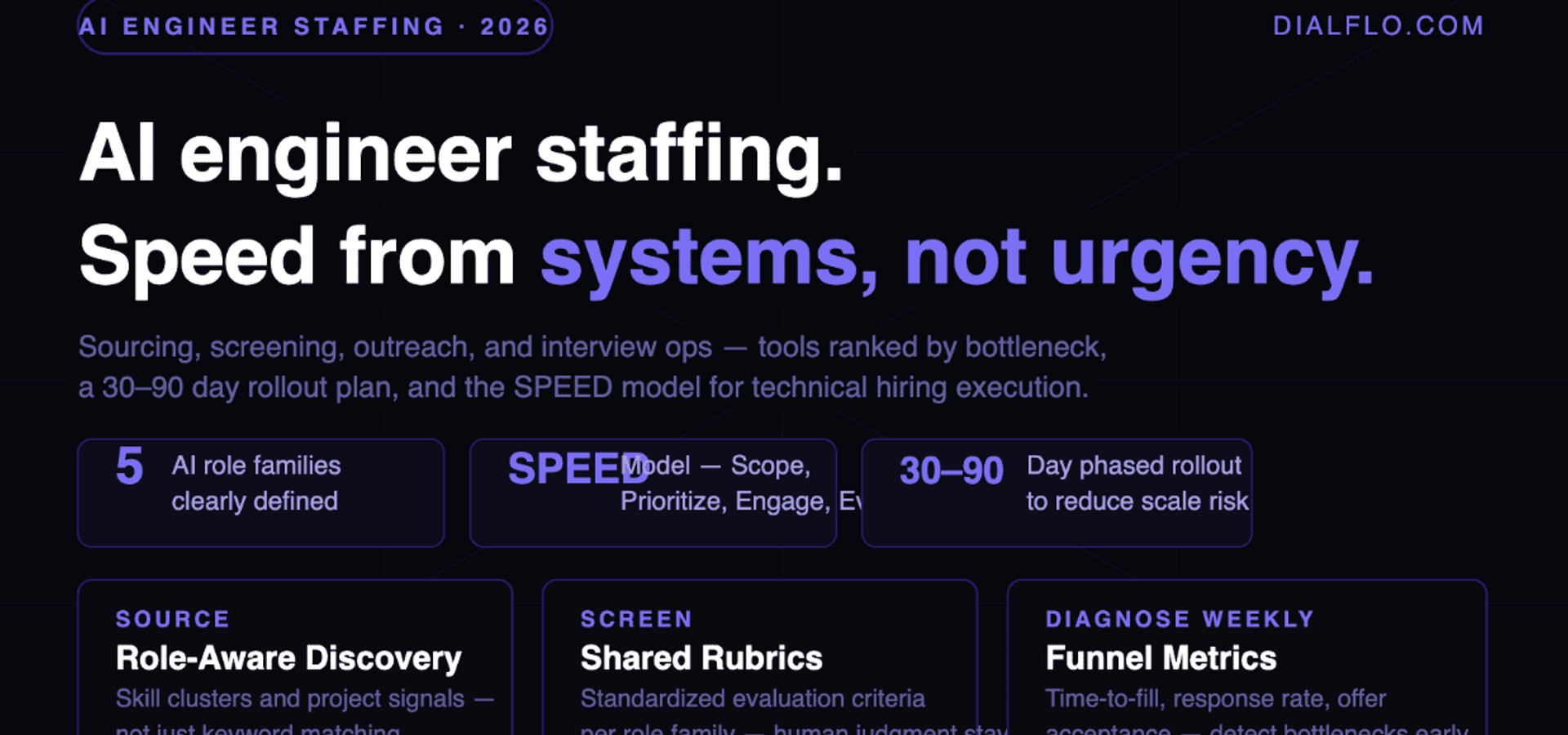
AI engineer staffing succeeds when sourcing, screening, and communication workflows are designed for speed without reducing hiring quality.
AI engineer staffing has become one of the hardest and most urgent hiring challenges for modern companies. Demand for AI talent keeps rising, role definitions keep evolving, and candidate expectations are higher than ever. Many teams are trying to fill machine learning and applied AI roles with recruiting processes built for general software hiring, which usually creates long time-to-fill, weak role matching, and costly hiring delays.
The good news is that AI tools can improve staffing speed significantly when applied correctly. This guide explains how technical recruiting teams can use AI across sourcing, qualification, outreach, and interview operations to hire faster while maintaining candidate quality. If your hiring plan includes AI engineers this quarter, this framework is designed to be practical and execution-ready.
Why AI engineer staffing is uniquely difficult
AI hiring is not just an extension of standard engineering hiring. Talent pools are smaller, skill profiles are less standardized, and role expectations vary by company maturity. One organization may need production-grade MLOps depth, another may need experimentation speed, and another may need AI integration skills in product teams.
At the same time, competition for qualified candidates is intense. Reports from industry organizations and talent platforms continue to show demand pressure for AI and data roles, along with emphasis on skills-based hiring and faster recruitment cycles for technical positions.
Sources: World Economic Forum: Future of Jobs and LinkedIn Talent Solutions.
Without focused systems, staffing teams typically hit the same bottlenecks: unclear role scoping, broad and ineffective outreach, slow candidate qualification, and interview coordination delays. AI tools are most valuable when they directly remove those bottlenecks.
What AI tools can improve in engineering staffing workflows
AI in recruiting should be viewed as workflow acceleration, not autonomous hiring. The best systems support human recruiters and hiring managers with faster pattern recognition and execution.
Role-aware sourcing. AI tools can surface candidates based on skill clusters, project signals, and role-fit indicators beyond simple keyword matching.
Candidate prioritization. Recruiters can rank prospects by relevance, engagement likelihood, and experience depth to focus effort where conversion probability is highest.
Outreach personalization at scale. Generate tailored outreach drafts tied to candidate background and role requirements while preserving recruiter oversight.
Screening support. AI can help summarize candidate profiles, highlight potential fit gaps, and prepare structured screening prompts for recruiters.
Interview logistics automation. Workflow tools can reduce scheduling lag, follow-up delays, and communication gaps that slow hiring progress.
Used well, these capabilities reduce cycle time and recruiter workload without compromising decision quality.
Key roles and competencies in AI engineer staffing
Before tooling decisions, staffing leaders need clear role architecture. "AI engineer" often includes very different job families:
Machine learning engineer. Model development, feature pipelines, and production deployment integration.
MLOps engineer. Infrastructure, model lifecycle automation, monitoring, and reliability in production environments.
Applied AI product engineer. Product-facing implementation using LLM or ML capabilities inside user workflows.
Data scientist (applied). Experiment design, statistical modeling, and insight generation with measurable business impact.
NLP or computer vision specialist. Domain-specific model and evaluation expertise for specialized use cases.
Each role requires a different sourcing and assessment strategy. AI staffing tools help most when recruiters define these distinctions early and map evaluation criteria accordingly.
Best-fit AI tools by stage of staffing funnel
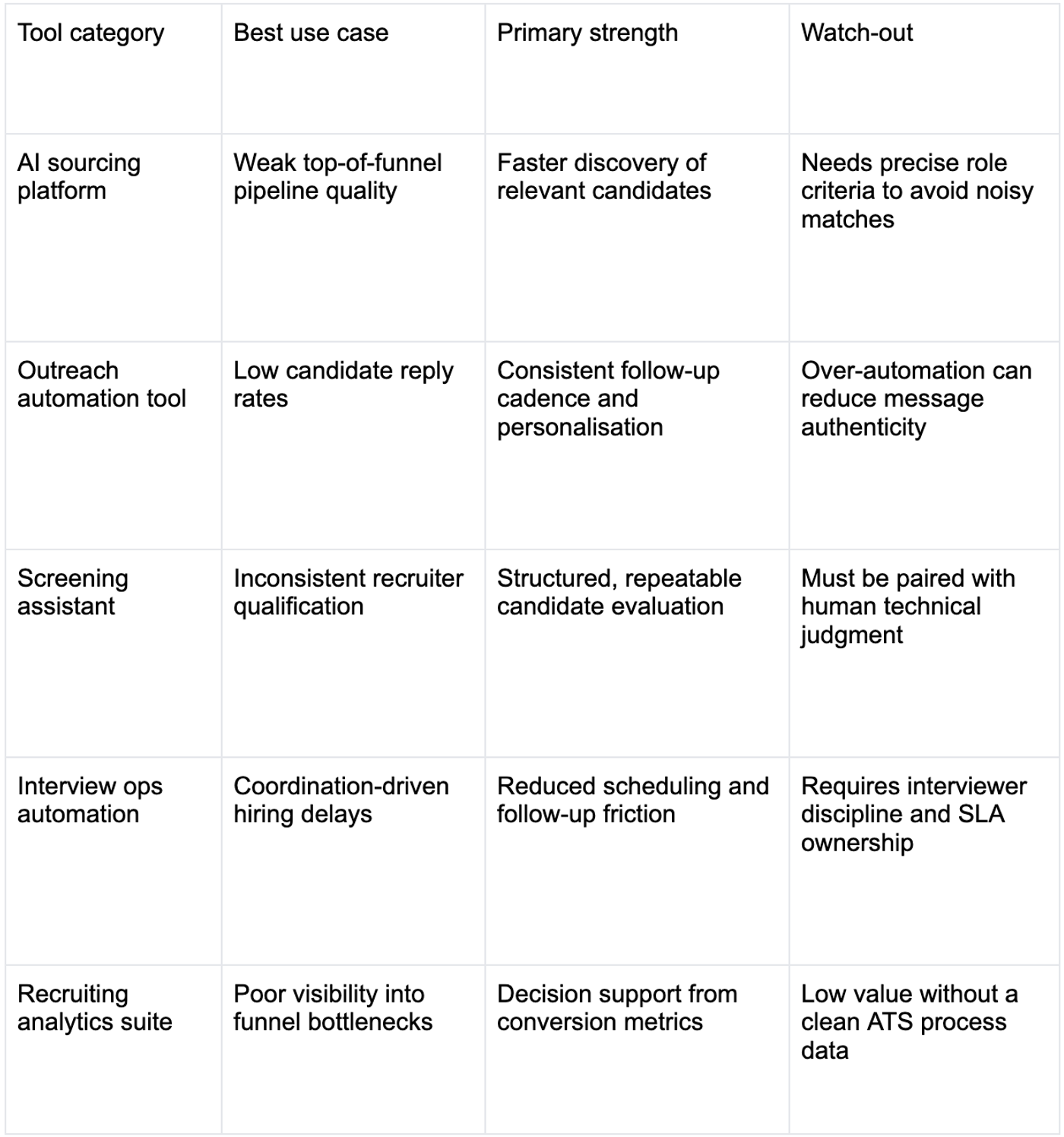
A practical stack usually combines several categories instead of relying on one platform for everything. Choose based on your biggest bottleneck.
Top-of-funnel sourcing tools
Best for teams struggling to build qualified pipelines. These tools improve prospect discovery and candidate segmentation for targeted outreach.
Engagement and outreach automation tools
Best for teams with large candidate lists but low response rates. They help run structured sequences and improve communication consistency.
Screening and assessment support tools
Best for teams where recruiter screens are inconsistent or overly subjective. They bring standardized evaluation prompts and structured notes.
Interview operations and coordination tools
Best for teams losing candidates due to process delay. These systems reduce scheduling friction and keep stakeholders aligned.
Analytics and recruiting intelligence dashboards
Best for leadership teams needing visibility into source quality, funnel leakage, and recruiter throughput trends.
Comparison table: AI engineer staffing tool categories
How to evaluate AI staffing tools for technical hiring
Tool selection should be outcome-first. Use these evaluation criteria during pilots:
Role specificity. Can the tool differentiate between ML engineering, MLOps, and applied AI product profiles?
Signal quality. Are candidate recommendations relevant, or mostly keyword-level matches?
Workflow integration. Does it integrate cleanly with your ATS and communication stack?
Recruiter usability. Can recruiters run daily workflows quickly without heavy manual workarounds?
Bias and governance controls. Are there transparent review steps and override capabilities for hiring decisions?
Measurable impact timeline. Can you prove results in 30-60 days through controlled metrics?
If a platform cannot demonstrate hiring cycle improvements in a scoped pilot, it should not scale across the organization yet.
A practical 30-60-90 rollout for AI engineer staffing
Many teams fail by deploying too broadly too early. A phased rollout reduces risk and accelerates learning.
Days 1-30: Scope and baseline. Select one role family (for example ML engineer), define competency rubric, and capture baseline hiring metrics.
Days 31-60: Controlled pilot. Use AI tools for sourcing and outreach in one business unit. Compare pipeline quality and speed against baseline cohorts.
Days 61-90: Expand and operationalize. Add screening and interview ops automation, train recruiters, and implement weekly KPI review cadence.
This structured approach makes adoption easier for recruiters and gives leadership evidence for scaling decisions.
Metrics that matter for faster AI engineer hiring
Use a focused metric set to evaluate whether your staffing system is improving:
- Time-to-fill: total days from role open to offer acceptance.
- Qualified pipeline speed: time from sourcing start to first strong shortlist.
- Response rate: candidate engagement by source and outreach sequence.
- Interview-to-offer conversion: quality indicator for screening and candidate fit.
- Offer acceptance rate: process competitiveness and candidate experience signal.
- Hiring manager satisfaction: practical quality feedback beyond numeric outcomes.
Tracking these metrics weekly helps teams detect bottlenecks early and adjust quickly.
Common mistakes in AI engineer staffing operations
Even with good tools, several recurring mistakes can stall outcomes:
- Unclear role definitions. Broad job descriptions generate low-fit candidate pools.
- Over-reliance on automation. AI scoring should support, not replace, technical recruiter judgment.
- Weak hiring manager alignment. If interview criteria vary by interviewer, conversion suffers.
- No communication SLA. Delayed follow-ups cause candidate drop-off in competitive markets.
- No post-hire feedback loop. Without quality-of-hire input, sourcing criteria never improve.
The fix is operational discipline: clear rubrics, fast feedback loops, and accountability at each stage.
Original framework: the SPEED model for AI staffing
To simplify execution, use the SPEED model for technical hiring:
S - Scope roles clearly. Define competencies and must-have signals per role family.
P - Prioritize candidates intelligently. Use AI recommendations, then apply recruiter validation.
E - Engage consistently. Run structured outreach with clear response-time standards.
E - Evaluate with shared rubrics. Standardize screening and interview scoring criteria.
D - Diagnose funnel data weekly. Use metrics to remove bottlenecks continuously.
When teams follow SPEED, hiring velocity improves without turning interviews into a checkbox process.
Where Dialflo can complement AI engineer staffing
Many staffing teams improve sourcing and screening but still lose momentum in communication-heavy steps: interview confirmations, candidate reminders, and follow-ups after each stage. These gaps create avoidable delays.
Dialflo is an AI voice agent platform that can support high-volume recruiting communication workflows. It is not an ATS replacement, but it can complement staffing operations by improving follow-up speed and reducing missed touchpoints in candidate journeys.
FAQ: ai engineer staffing
What is ai engineer staffing?
AI engineer staffing is the process of hiring AI and machine learning talent through structured sourcing, screening, and interview workflows optimized for technical role fit.
How do AI tools improve staffing speed?
They automate candidate discovery, improve outreach consistency, support structured screening, and reduce interview coordination delays across the hiring funnel.
Which AI engineering roles are hardest to hire?
Role difficulty varies by market, but MLOps, senior machine learning engineering, and specialized NLP or computer vision profiles are often among the most competitive segments.
How long should an AI staffing pilot run?
A 30-60 day pilot is usually enough to evaluate top-of-funnel quality and early conversion improvements, with broader operational assessment by 90 days.
What should small companies do first?
Start with one role family, tighten role definitions, and deploy AI tools only for the biggest bottleneck, usually sourcing quality or communication speed.
How does Dialflo support staffing teams?
Dialflo can assist recruiting communication operations through AI voice workflows such as reminder calls and follow-ups that help keep candidate pipelines active.
Closing: speed comes from systems, not urgency
Effective ai engineer staffing is not about rushing candidates through interviews. It is about building a reliable system that finds better-fit talent faster, communicates consistently, and makes evidence-based decisions at each stage.
Start with clear role scope, deploy AI tools against your biggest bottlenecks, and track conversion metrics weekly. With the right operating model, faster hiring and better candidate quality can improve together.
Hiring engineers at volume? Book a Dialflo demo to see voice agents run first-round screening calls and send structured notes to your recruiters.


