AI Staffing: The Future of Hiring Explained

Dialflo: AI Voice Agent
April 24, 2026
AI staffing is not a single product, it is a redesign of who moves data, who talks to candidates, and who owns exceptions when reqs spike at 4 p.m. on a Friday.
If you are trying to understand ai staffing without the conference-keynote fog, start with a simple split: automation that saves minutes per candidate versus automation that changes who gets seen at all. The future of hiring is not “robots replace recruiters.” It is hybrid operating models where AI compresses latency, parsing, matching, scheduling, nudges, while humans carry trust, negotiation, and the messy judgment calls regulators still expect a person to own. That distinction matters because budgets follow believable ROI, and ROI stories for ai staffing fall apart when teams buy magic and skip change management.
This explainer maps how ai staffing differs for staffing agencies versus corporate TA, which risks dominate 2026 headlines, and a pragmatic roadmap before every req becomes “AI-powered.” We cite LinkedIn’s Future of Recruiting for adoption context, then ground ideas in workflows coordinators can defend in a QBR, including where Dialflo voice automation fits when phones decide whether candidates advance.
What “AI staffing” actually means in 2026
In practice, ai staffing bundles several capabilities: generative writing for outreach and job posts, retrieval-augmented assistants that answer policy questions, matching models that rank applicants against rubrics, conversational bots that schedule interviews, forecasting tools that predict time-to-fill, and voice systems that run structured phone screens. None of that replaces the commercial motion of staffing, winning reqs, protecting margin, redeploying talent, unless your data model is clean enough for automation to amplify instead of magnifying errors.
Corporate TA teams often anchor ai staffing inside an applicant tracking system upgrade: same stages, smarter nudges. Staffing agencies anchor it across CRM, ATS, and timekeeping edges because the same candidate may touch multiple clients in a week. That operational difference is why copy-paste employer playbooks fail when boutique agencies try to bolt enterprise AI onto spreadsheets and legacy consent practices.
Augmentation first: the only sustainable default
The durable version of ai staffing augments recruiters: faster first screens, fewer calendar ping-pong threads, cleaner submittal packets, and better redeployment targeting. The fragile version tries to fully automate empathy-heavy moments, rejections, visa-sensitive topics, compensation storytelling, where a clumsy template burns brand equity faster than any efficiency gain. Buyers should score vendors on override rates: if recruiters constantly reverse the AI, your rubric or training data, not the UI, is wrong.
Augmentation also means reskilling. The best teams train recruiters to edit model outputs, audit transcripts, and explain decisions to clients. AI staffing without training produces shadow workarounds, personal inboxes, unofficial WhatsApp threads, exactly the fragmentation compliance teams fear.
Staffing agencies: where AI staffing creates leverage
For agencies, ai staffing is margin and speed. High-volume desks win when time-to-first-touch drops without quality collapsing. AI can cluster similar reqs, suggest warm candidates from dormant pools, and prioritize who to call first based on likelihood to respond, if consent and data retention rules are respected. Account managers win when submittals arrive with consistent summaries clients can skim between meetings, not when every packet looks like a different intern formatted it.
Contract-heavy books add compliance layers: right-to-work evidence, credential expirations, and client-specific knockouts. AI staffing tools must write those signals back to structured fields, not free-text blobs nobody searches later. If your AI only beautifies prose, finance still rebuilds truth in spreadsheets, and you have not modernized staffing, you have added glitter.
Candidate experience: the hidden constraint on AI staffing
Candidates tolerate automation when it is fast, transparent, and easy to reach a human. They revolt when bots hide behind fake names, lie about “human review” that never happens, or send endless SMS loops. The future of hiring still rewards brands that treat applicants like adults, clear timelines, honest status updates, accessible accommodations. AI staffing programs should publish escalation paths and test multilingual flows if your talent markets demand them.
Accessibility also matters, screen readers, captions on async video, plain-language knockouts, and assume chat logs may be read later by regulators or counsel.
Governance: boring details that decide whether AI staffing scales
Before you expand pilots, lock down data maps: what leaves your ATS, which subprocessors store it, retention windows, and how model updates get communicated. EU and UK programs need GDPR clarity; US federal contractors need documentation discipline. Internal AI policies should define prohibited inputs, salary history where banned, health disclosures candidates volunteer by accident, and require human review for adverse impact red flags.
Logging is non-negotiable. When a client asks why a candidate was declined, your ai staffing stack should produce a defensible trace: rubric version, human overrides, timestamps. If you cannot produce that, do not scale beyond experiments.
Horizon scan: where AI staffing is moving next
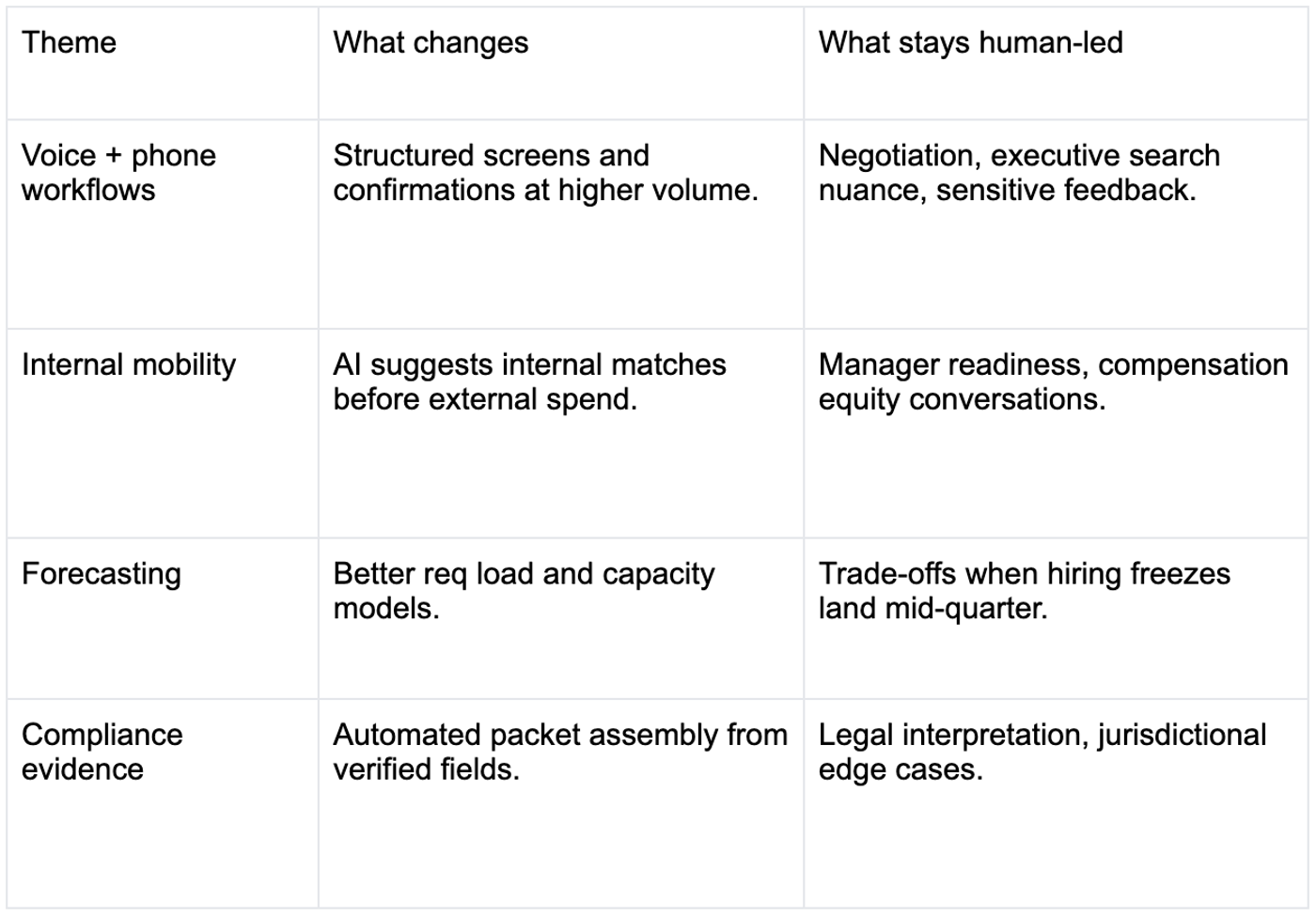
Use this table as an internal planning lens, not predictions sold as guarantees.
Economics: how to fund AI staffing without fantasy ROI
Finance approves ai staffing when metrics tie to money: reduced agency spend, faster submittal-to-start, lower no-show rates, higher redeployment, fewer recruiter hours per placement. Build baselines before pilots, median time-to-first-screen, cost per scheduled interview, recruiter overtime. After ninety days, compare cohorts honestly; if AI only helped easy reqs, say so and tune segmentation rules.
Avoid pricing confusion: some vendors bundle tokens, others charge per completed conversation. Normalize to cost per qualified candidate advanced to the stage you care about. That is the language owners of ai staffing budgets actually speak.
Dialflo and the phone-shaped gap in AI staffing
Dialflo focuses on the phone-shaped hole many ai staffing stacks ignore. Inboxes get chatbots; phones still dump candidates into voicemail when recruiters are on other lines. Dialflo’s AI voice layer runs structured screening, confirmations, reschedules, and re-engagement, then writes outcomes back to your ATS so reporting stays honest. It is not a replacement for your CRM or ATS, it is throughput for voice-heavy hiring.
Pricing on dialflo.ai lists tiers such as Starter near ₹9,999 per month and Professional near ₹24,999 per month, confirm live figures with sales. When you evaluate Dialflo inside an ai staffing roadmap, score completion rates, multilingual quality, and escalation to humans, not only minutes saved.
Risks worth naming out loud
Bias can hide in rubrics managers never challenged. Vendor lock-in can trap data in proprietary scoring. Over-automation can strip the relationship moat staffing sells. Security incidents can erase trust faster than any placement fee. AI staffing leaders should run red-team exercises: adversarial resumes, edge-case visa questions only counsel should touch, and simulated client fires where reqs pause mid-search.
If AI feels like surveillance, adoption dies, co-design with desk recruiters, not only procurement.
A practical 90-day roadmap for AI staffing
Days 1–30: inventory workflows, set governance, pick two pilot use cases with clear KPIs. Days 31–60: integrate logging, train teams, run parallel human-vs-AI sampling on outcomes. Days 61–90: executive readout with continue/stop criteria, documentation for legal, and a communications plan for candidates. Successful ai staffing rollouts look dull on paper because the drama was engineered out in pilot design.
Communicate externally with restraint. Candidates hear “AI” as code for “nobody cares.” Explain benefits, faster responses, clearer next steps, and keep humans visible at decision points that matter.
FAQ: AI staffing and the future of hiring
What is AI staffing?
It is the application of AI across hiring operations, matching, messaging, scheduling, voice screens, and forecasting, with humans still accountable for relationships, exceptions, and compliance.
Will AI staffing replace recruiters?
No wholesale replacement. AI removes repetitive work; recruiters remain essential for trust, judgment, and client crisis management.
How do staffing agencies use AI staffing today?
Through parsing, matching, high-volume screening, scheduling bots, redeployment campaigns, and revenue forecasting tied to CRM and ATS data.
What are the main risks of AI staffing?
Bias, privacy, opaque decisions, deskilling, and reputational harm when candidate experience feels deceptive. Governance and logging mitigate but do not erase risk.
How should employers evaluate AI staffing vendors?
Scripted pilots on real reqs, measurable KPIs, audit trails, subprocessors and residency clarity, and finance-grade ROI, not slide decks alone.
How does voice AI fit into AI staffing?
Voice AI handles structured phone workflows and syncs answers to the ATS, useful when call volume, not email, is the bottleneck; Dialflo is one example of that layer.
Closing: the future of hiring is disciplined, not dazzling
AI staffing will keep spreading because labor markets stay volatile and clients demand speed. The winners will treat the future of hiring as an operations upgrade: clean data, honest candidate communications, measurable ROI, and humans exactly where judgment carries legal and brand weight. Pair inbox and ATS automation with voice where phones still decide outcomes, and build ai staffing programs your recruiters brag about instead of working around.
Scaling a staffing desk without adding recruiters? Book a Dialflo demo to see voice agents screen, re-engage and schedule candidates around the clock.


