Staffing Agency AI Voice Screening: Buyer's Guide

Dialflo: AI Voice Agent
June 2, 2026
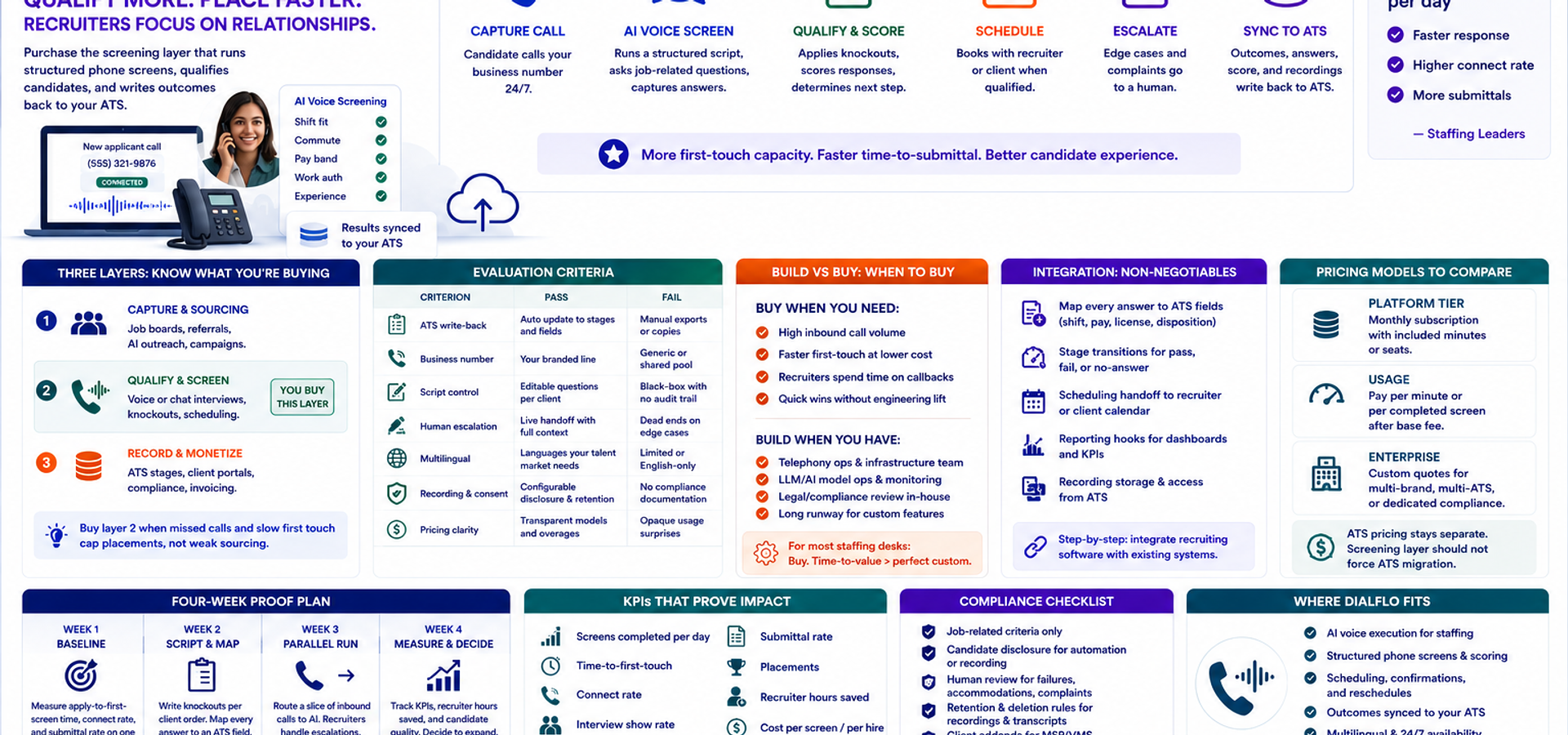
Staffing owners rarely fail because they lack an ATS. They fail because qualification sits in voicemail, spreadsheet tabs, and recruiters copying screen notes at midnight. If you are evaluating staffing agency AI voice screening, the decision is not “replace Bullhorn.” It is how to purchase screening layer capacity that runs structured first-touch calls, writes outcomes back to your database, and frees recruiters for submittals, not callback tag.
This buyer's guide walks through what the screening layer is, when to buy versus build, evaluation criteria, pricing models, integration requirements, and a four-week proof plan, so procurement matches how your desk actually hires.
Why staffing agencies purchase screening layer separately
Your ATS is the system of record: stages, client submittals, compliance fields, billing hooks. It was not designed to answer five hundred inbound calls on a Monday when a warehouse client opens forty slots. AI voice screening sits between capture and recruiter interview, qualifying shift fit, commute, pay band, certifications, and work authorization before a human consumes calendar time.
SHRM recruiting benchmarks continue to show long time-to-fill and rising cost-per-hire, often while recruiters carry heavy requisition loads. LinkedIn's Future of Recruiting reports growing AI adoption because teams need execution speed, not another dashboard. When you purchase screening layer, you buy throughput at the phone, not a second database.
For broader automated screening categories, see automated screening software for staffing agencies. This guide narrows to voice-led qualification only.
Three layers: know what you are buying
Vendor confusion collapses when you separate layers:
- Layer one , capture and sourcing. Job boards, referrals, AI outreach. Context: AI sourcing and candidate sourcing services.
- Layer two , qualify and screen. Knockout questions, voice or chat interviews, scheduling. This is where you purchase screening layer.
- Layer three , record and monetize. ATS stages, client portals, compliance, invoicing. Compare platforms in ATS for staffing agencies compared and cloud-based recruitment software.
Buy layer two when missed calls and slow first touch, not weak sourcing, cap placements.
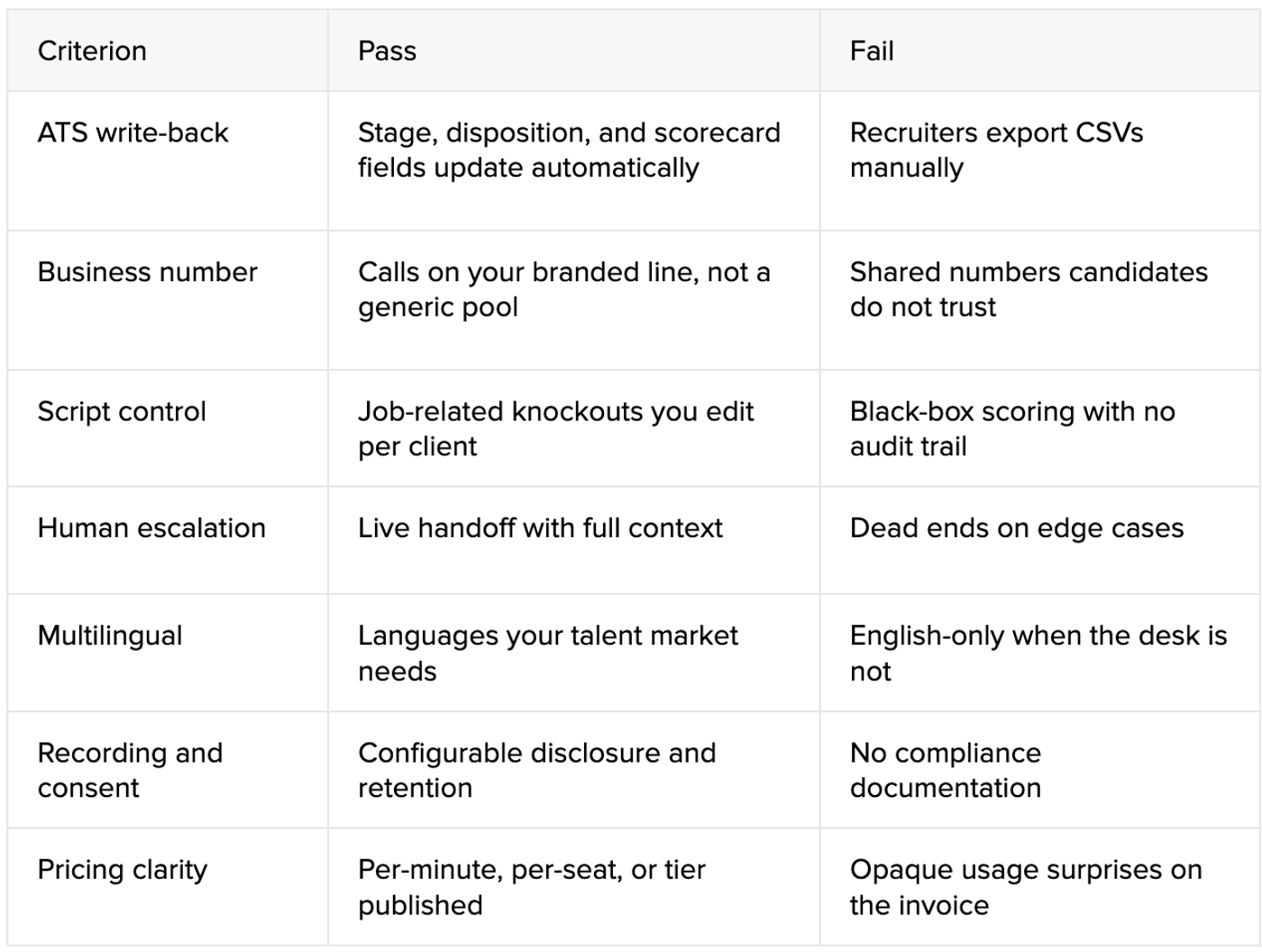
Staffing agency AI voice screening: evaluation criteria
Before you sign, score vendors against desk reality, not demo polish.
Build vs buy when you purchase screening layer
Some agencies ask engineering to wire Twilio, LLMs, and ATS APIs. That path works when you have telephony ops, model monitoring, and legal review on staff. Most desks should buy.
Read build vs buy voice AI stack and conversational services use cases before committing engineering sprints. Compare agent categories in AI agents for recruitment comparison. Voice infrastructure reviews: Retell vs Dialflo, Vapi alternatives, and best Retell alternative for India if you are evaluating raw voice stacks versus recruitment-ready execution.
Integration: non-negotiables before go-live
A screening layer that does not land in your ATS creates shadow data, worse than no automation. Map these before procurement signs:
- which ATS fields receive each answer (shift, pay, license, disposition)
- stage transitions triggered by pass, fail, or no-answer
- scheduling handoff to recruiter or client calendar
- reporting hooks for recruitment analytics software
Step-by-step: integrate recruiting software with existing systems. CRM-heavy desks: candidate relationship management system. Enhancement-layer sourcing tools: GEM ATS review.
Pricing models to compare
When you purchase screening layer, pricing usually falls into three buckets:
- Platform tier , monthly subscription with included minutes or seats
- Usage , per-minute or per-completed-screen after a base fee
- Enterprise , custom quotes for multi-brand, multi-ATS, or dedicated compliance review
ATS pricing stays separate, your screening vendor should not force ATS migration. Text-first screening alternatives live in AI applicant screening; many desks run text for apply flows and voice for inbound calls.
Confirm live numbers on each vendor page before budget approval. Public Dialflo tiers on dialflo.ai include Starter and Professional monthly options with Enterprise custom, verify current pricing during evaluation.
Compliance checklist for staffing voice screening
Document before you scale across clients or states:
- job-related criteria only, no proxy questions
- candidate disclosure when automation or recording is used
- human review for failures, accommodations, and complaints
- retention and deletion rules for recordings and transcripts
- client-specific addenda when MSP or VMS contracts require them
US agencies should review EEOC guidance on AI in employment selection and SHRM talent acquisition toolkit context.
Four-week proof plan before you purchase screening layer
Week 1: Baseline one req family
Measure apply-to-first-screen time, connect rate, and submittal rate on a high-volume client. If phones are quiet, voice may not be your layer, check text screening first.
Week 2: Script and field map
Draft knockouts per client order. Every answer maps to an ATS field, no orphan notes.
Week 3: Parallel traffic
Route a slice of inbound to staffing agency AI voice screening; recruiters handle escalations. Align with patterns in AI staffing and AI engineer staffing playbooks where technical roles need structured first pass.
Week 4: Buy or kill
Expand only if recruiters use the workflow and metrics beat baseline. Kill demos recruiters bypass.
Where voice screening sits in your hiring stack
After you purchase screening layer, downstream steps still matter:
- speed tactics , hire candidates faster with AI tools
- interview prep , generate interview questions from job description
- post-screen evaluation , interview intelligence
- operating model , agentic hiring organization, how AI agents are transforming recruiting, artificial intelligence in recruitment, machine learning in recruiting
- HR platform context , HR software solutions
RFP questions to send every voice screening vendor
- Which ATS objects and fields do you write to on completed screens?
- Can we use our business number and caller ID?
- How do you handle two-party consent states?
- What is median latency on live calls at our expected volume?
- Who owns script changes, our team or your services desk?
- What happens when the model mishears a certification or date?
- Can we export conversation logs for client audits?
Vendors that cannot answer field-level ATS mapping should not win when you purchase screening layer for a staffing desk.
Where Dialflo fits
Dialflo is AI voice execution for recruiting and staffing: structured phone screens, confirmations, reschedules, and re-engagement with outcomes synced to your ATS or CRM. Use it when you need to purchase screening layer throughput, not when you need a new applicant tracking system. Confirm multilingual coverage, pricing, and integration scope on dialflo.ai before procurement.
FAQ: staffing agency AI voice screening buyer's guide
What does purchase screening layer mean?
Buying a dedicated qualification layer, often AI voice, that runs knockouts and scheduling while your ATS stays the system of record.
How is voice screening different from ATS screening?
Voice handles live phone qualification; ATS screening is usually forms, parsing, and stage rules inside the database.
What must integrate before go-live?
Automatic write-back to stages, disposition, scorecard fields, and scheduling, not manual CSV exports.
Build or buy?
Most agencies buy for telephony, compliance, and connectors. Build only with dedicated voice engineering capacity.
Is it compliant?
Possible with job-related scripts, disclosure, recording consent, and human escalation, align with counsel and EEOC guidance.
How does Dialflo help?
Voice agents for phone screens and scheduling with ATS write-back, see dialflo.ai.
Closing: buy the layer where you leak margin
Staffing agency AI voice screening is a procurement decision about throughput, not brand hype. When you purchase screening layer with clean ATS integration, compliance documentation, and a measured pilot, recruiters stop losing placements to voicemail while your database stays honest.
Ready to evaluate voice screening on live reqs? Explore Dialflo for staffing voice workflows built to write back, not sit in a silo.


