AI Inventory Optimization: Tools and Strategies

Dialflo: AI Voice Agent
May 3, 2026
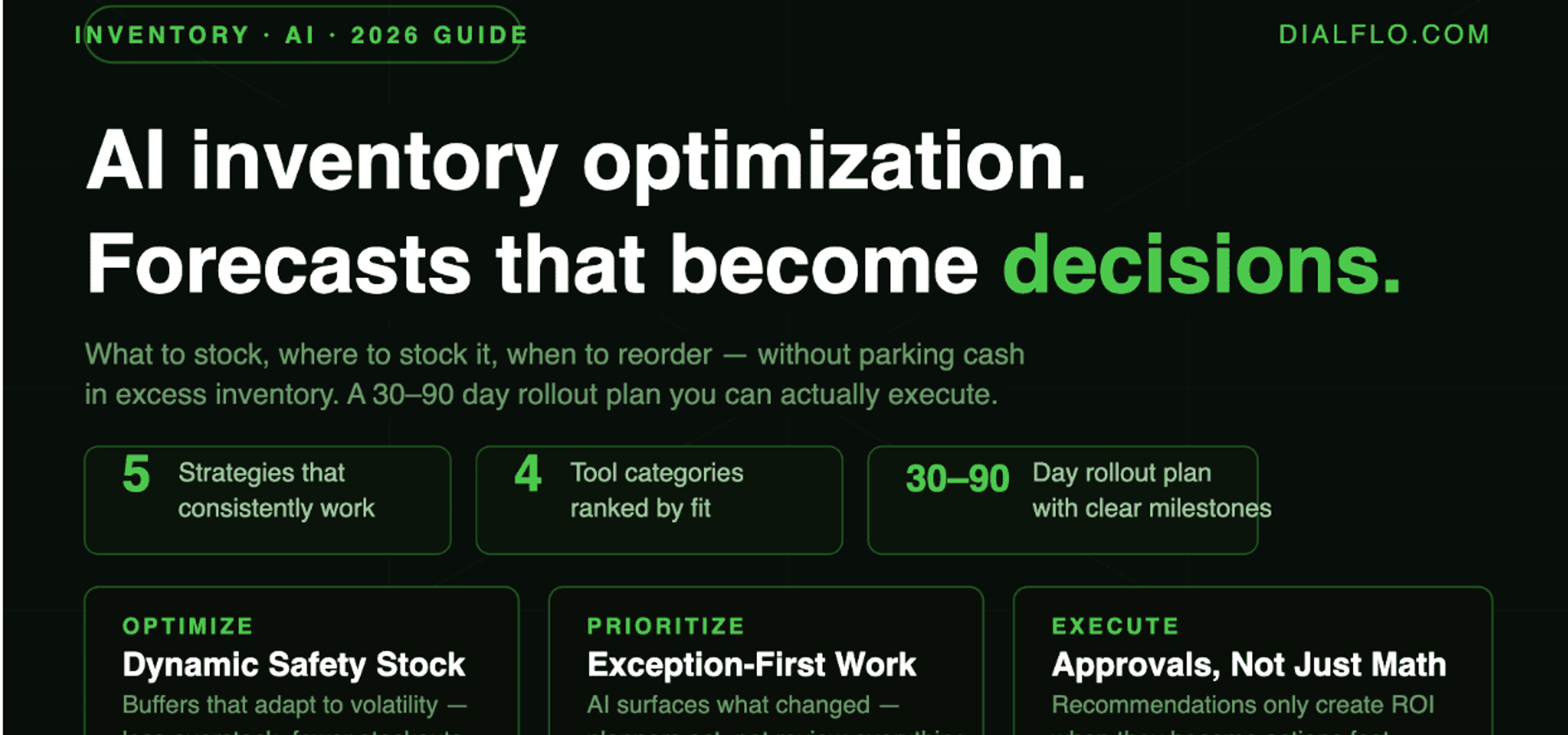
AI inventory optimization works best when it turns forecasts into decisions your team can execute, purchase orders, transfers, and clear exceptions.
AI inventory optimization is the practice of using machine learning and optimization to decide what to stock, where to stock it, and when to reorder, so you protect service levels without parking cash in excess inventory. If you manage hundreds of SKUs, multiple locations, or volatile lead times, spreadsheets eventually turn inventory into a daily firefight: stockouts on fast movers, overstock on slow movers, and expensive expediting to patch the gaps.
This guide is intentionally practical. You’ll learn the tools categories that matter, strategies that consistently move outcomes, what “good” ROI tracking looks like, and a rollout checklist you can execute in 30–90 days. If you’re building operational speed more broadly, not just inventory, this post also references Dialflo as an example of automation that reduces coordination latency (calls, confirmations, scheduling) that often sits adjacent to supply chain execution.
Why inventory optimization matters more than most teams admit
Inventory isn’t just “products on shelves.” It’s working capital, warehousing capacity, and risk. Many benchmarks put annual inventory carrying costs in the 20%–30% range of total inventory value once you include storage, insurance, taxes, capital cost, shrinkage, and obsolescence. That means a ₹1 crore inventory position can quietly carry a ₹20–30 lakh annual drag, before you sell a single additional unit.
Sources: Investopedia and NetSuite provide overviews of carrying cost components and commonly cited benchmark ranges.
Now add the other side of the pain: out-of-stocks and overstocks. IHL Group’s inventory distortion research frames the combined impact of stockouts and overstocks as a meaningful percentage of sales for retailers and highlights the scale of lost revenue and markdown pressure when inventory is mispositioned. See: IHL Group: Inventory Distortion.
In plain English: when inventory is wrong, you lose twice, once from missed sales, and again from the costs of holding or liquidating the wrong items.
What AI inventory optimization actually does (beyond “forecasting”)
Most teams think in terms of forecasts. Forecasting answers: “What will demand be?” Optimization answers: “What should we do about it?” AI inventory optimization typically combines probabilistic forecasting with decision rules and constraints to generate recommended actions.
Common outputs include:
Reorder points and order quantities. Not just a min/max number, but parameters that adapt by SKU, lead time, and service target.
Dynamic safety stock. Buffers that expand when demand or lead time becomes volatile and shrink when things stabilize.
Allocation and replenishment. Where to send limited inventory to protect service levels across locations.
Redistribution/transfer suggestions. Move inventory from low-velocity sites to high-velocity sites before you buy more.
Exception management. A prioritized list of “what needs human attention today” instead of manual review of every SKU.
When AI helps most (and when it’s overkill)
AI helps most when complexity and uncertainty are high. You’re a strong candidate if you have:
- 500+ SKUs (or many long-tail items with intermittent demand)
- multiple channels (DTC + marketplaces + retail) or multiple locations
- lead-time volatility, partial shipments, or supplier reliability issues
- promotions and seasonality that distort historical averages
- high stockout cost (lost sales, churn, penalties, brand damage)
If you have a small catalog and stable demand, you may get most of the value by tightening basic discipline first: accurate item master data, consistent cycle counting, and a simple replenishment cadence. AI won’t fix messy inputs or slow approvals.
Tools: categories you’ll see (and how to choose)
“AI inventory optimization tools” vary widely. Some are enterprise suites; others are focused optimizers. Instead of shopping by buzzwords, shop by decision impact and workflow fit.
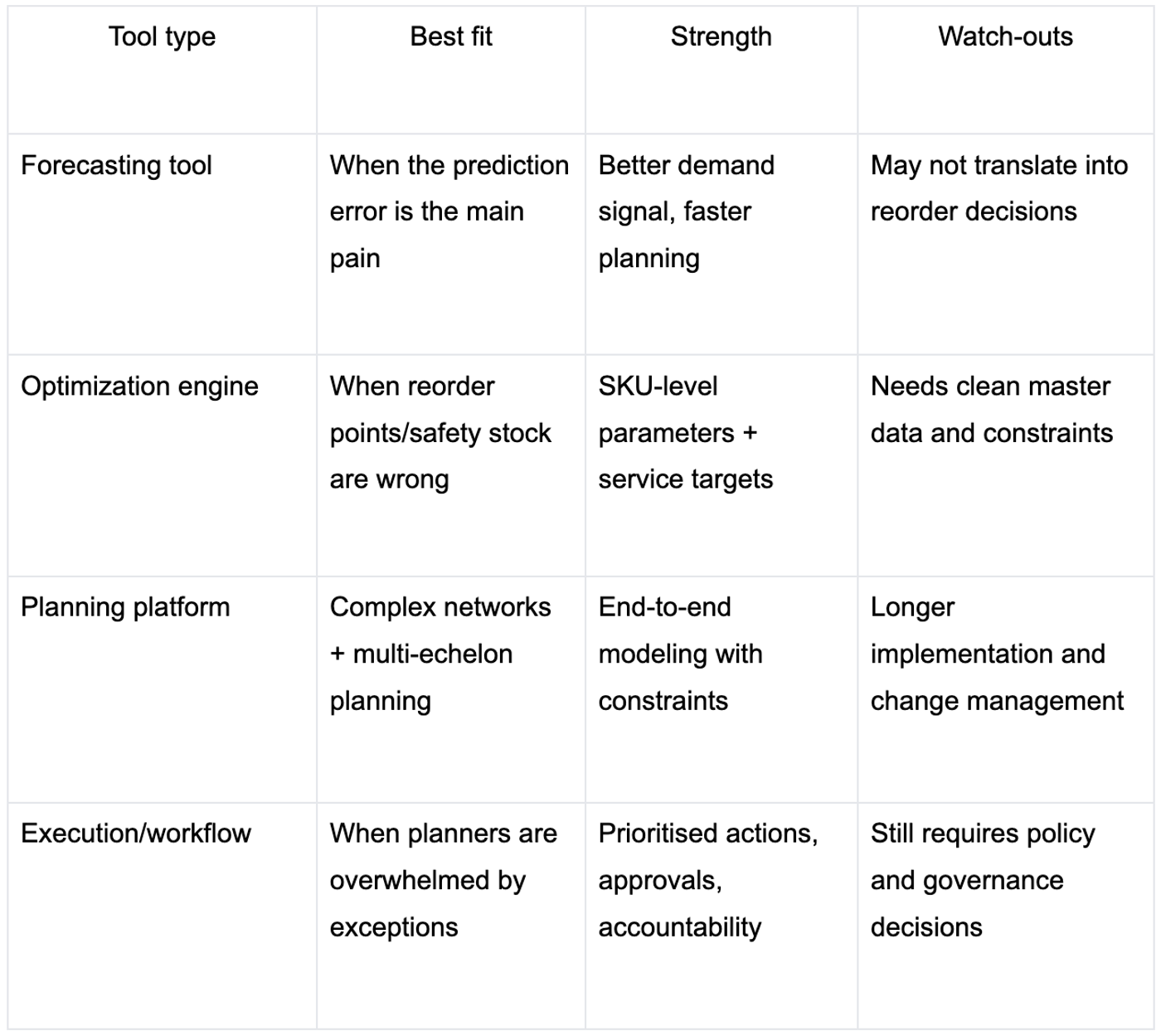
Tool categories
1) Forecasting tools. Improve demand predictions, often with probabilistic methods and promo/seasonality modeling.
2) Inventory optimization engines. Turn forecasts into reorder parameters, safety stock, and service-level trade-offs.
3) Planning platforms. Combine demand planning, supply planning, S&OP, and inventory optimization with constraints.
4) Execution + exception workflow tools. Help teams act on recommendations, manage approvals, and reduce planner workload.
Selection criteria that matter in real life
Granularity. Can it optimize at SKU-location level (not just category level)?
Uncertainty. Does it model demand and lead-time variability, or assume fixed numbers?
Constraints. Can it handle MOQs, case packs, supplier calendars, capacity, and min shelf stock?
Explainability. Can planners understand why a reorder recommendation changed?
Workflow. Does it connect to PO creation, transfers, and approvals, or is it only dashboards?
Time-to-value. Can you pilot with one warehouse/region in weeks, not quarters?
Comparison: tool types vs best-fit use cases
Strategies that consistently work (even before you buy software)
Most AI wins come from pairing better models with better operating rules. These strategies show up repeatedly in strong inventory teams.
1) Segment SKUs instead of treating everything the same
Use a simple framework like ABC (value) and XYZ (variability). Your A/X items should have tighter service targets and more frequent parameter updates. Slow movers deserve different policies than hero SKUs. AI works best when you tell it what “good” looks like for each segment.
2) Shift from static to dynamic safety stock
Static buffers (“two weeks for everything”) create predictable waste. Dynamic safety stock adapts to variability: more buffer for uncertain items, less for stable items. This reduces overstock without increasing stockouts, because you’re aligning buffer to risk.
3) Model lead time as a distribution, not a constant
If your system assumes “supplier lead time = 14 days” but reality swings from 10 to 28, you’ll always be firefighting. Track lead-time variability by supplier and lane, and let reorder points reflect actual uncertainty.
4) Optimize for service levels (make the trade-off explicit)
“Avoid stockouts” is not a metric. Choose a target, like 95% in-stock for A items, and accept a lower target for low-value items. Optimization becomes straightforward when you define what you’re willing to pay (in inventory) for a given service level.
5) Build an exception-first workflow
Planners burn out when they review everything. AI should surface the small percent of SKUs that changed meaningfully: stockout risk spikes, supplier delay risk, overstocks beyond a threshold, or promo-driven demand shifts. If the system can’t prioritize, it won’t get used.
What ROI can you expect? (and how to measure it)
ROI depends on volatility and starting maturity. But credible outcomes usually show up in a few places:
- Lower inventory value without hurting service levels
- Improved fill rate or in-stock rate on top items
- Less expediting (rush shipping, last-minute buys)
- Lower aged inventory and fewer markdowns/spoilage
- Planner time saved via exception-based management
For examples of published case outcomes, some vendors report double-digit inventory reductions alongside service-level gains. For instance, C3 AI publishes customer materials describing outcomes like inventory reduction and working-capital improvements in certain deployments. See: Reducing Inventory Costs and Optimizing Service Levels. Treat vendor case studies as directional, and validate with your own pilot metrics.
A useful operator metric set for a 30–90 day pilot:
Service: fill rate / OTIF, stockout rate, backorders.
Inventory: total on-hand value, days of supply, aged inventory.
Cost: expediting spend, write-offs/spoilage, carrying cost estimate.
Speed: time from demand change to updated reorder parameters.
A 30-60-90 day rollout plan
Inventory optimization succeeds when you sequence the work. Don’t boil the ocean.
Days 1–30: Define scope and clean the basics. Pick one region/warehouse or 200–1,000 SKUs. Clean item master (UOM, pack sizes), supplier mapping, and lead times. Decide your service targets by SKU segment. Define how overrides work.
Days 31–60: Run a parallel pilot. Generate recommendations while your current process still runs. Compare what the AI would change and why. Audit the top exceptions weekly and measure early impact on stockout risk and overstocks.
Days 61–90: Operationalize execution. Connect recommendations to PO creation, transfer suggestions, and approval workflows. Move planners to exception-first review. Establish a cadence: weekly parameter review, monthly supplier performance review, quarterly policy review.
The angle most posts miss: your bottleneck is approvals, not math
Many teams don’t fail because they can’t forecast. They fail because decisions get stuck: purchase approvals lag, suppliers confirm late, and “urgent” expediting becomes normal. AI inventory optimization only delivers value when recommendations become actions quickly.
If your organization is slow to confirm, schedule, and follow up, automation adjacent to inventory can help too. Dialflo is an AI voice agent platform that supports faster coordination, like supplier calls, appointment confirmations, and routine follow-ups, by reducing missed calls and speeding up structured communication. It’s not a forecasting engine, but it can remove execution latency that often undermines planning improvements.
FAQ: AI inventory optimization
What is AI inventory optimization?
It uses machine learning and optimization methods to recommend stock levels, reorder points, and replenishment actions at SKU/location level, so you reduce stockouts without overstocking.
Is AI inventory optimization just demand forecasting?
No. Forecasting predicts demand; optimization converts demand (and uncertainty) into decisions like safety stock, order quantities, and transfer recommendations under constraints.
What data do I need to start?
Sales history, on-hand inventory, open purchase orders, lead times, and item master data (UOM/pack sizes). Add constraints like MOQs and case packs for better recommendations. Clean data typically matters more than model complexity early on.
What ROI can I expect?
Expect ROI to show up as lower inventory value, fewer stockouts, less expediting, and reduced aged inventory. Use a pilot to validate improvements against baseline metrics before scaling.
Why do AI inventory projects fail?
Most failures are workflow failures: recommendations aren’t trusted, constraints aren’t captured, or actions don’t connect to approvals. Make explainability, exception prioritization, and governance part of the implementation.
How does Dialflo relate to inventory optimization?
Dialflo supports operational speed via AI voice agents for calls, confirmations, and follow-ups, helpful for execution workflows that sit next to inventory decisions. See dialflo.ai for current capabilities.
Closing: make inventory a system, not a weekly scramble
AI inventory optimization works when it becomes a repeatable decision system: clear service targets, probabilistic thinking, constraints captured, and an exception-first workflow that planners can execute. Start small, measure for 30–90 days, and scale only when you can prove improvements in service and working capital.
If your biggest drag is execution latency, missed calls, slow confirmations, or endless follow-ups, explore how Dialflo can support faster coordination alongside your planning stack.