Supply Chain Automation: How AI is Transforming Operations

Dialflo: AI Voice Agent
May 27, 2026
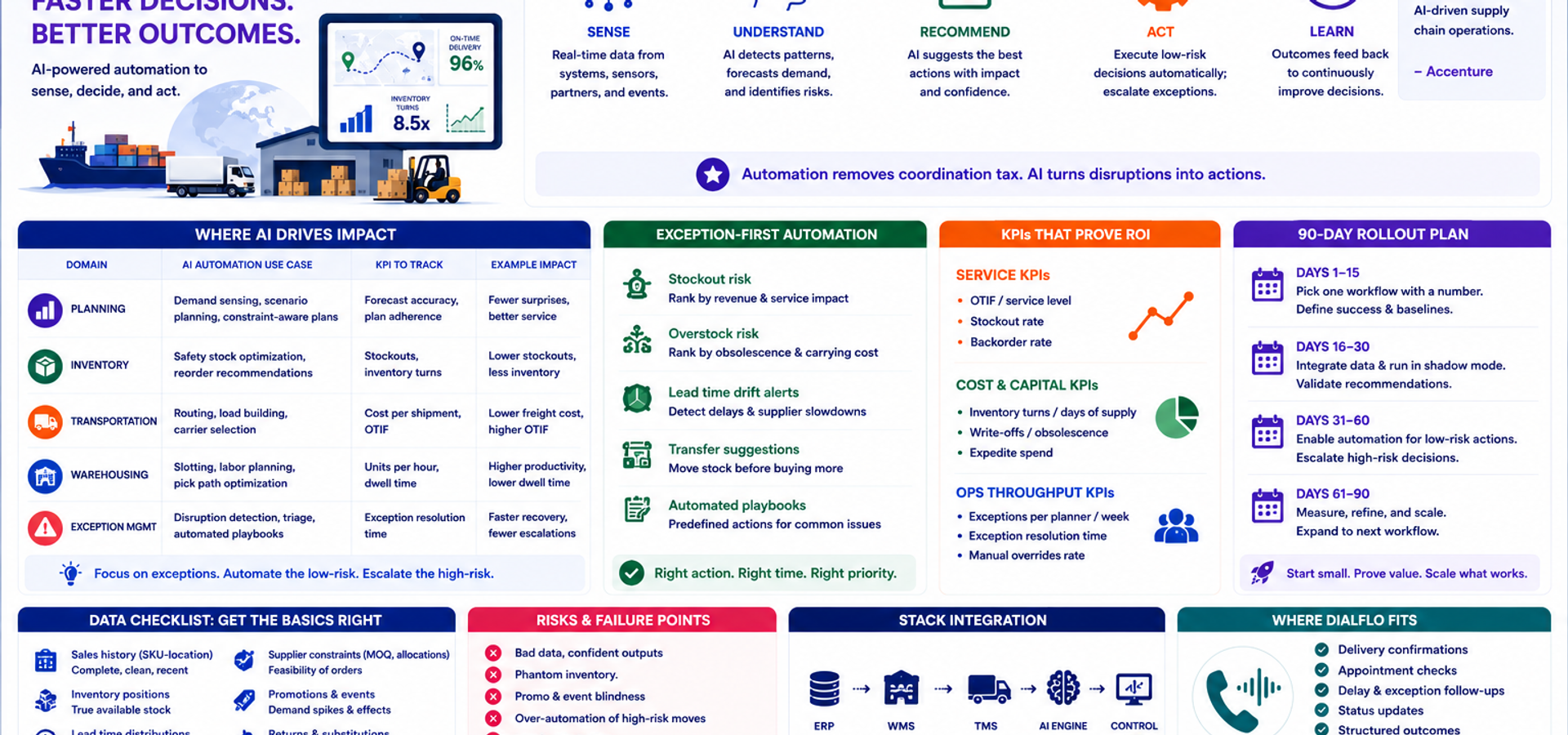
Most supply chain teams are not short on software. They are short on throughput: too many exceptions, too many calls, too many handoffs, and decisions that arrive after the window to act is gone. That’s why automation supply chain management is evolving beyond RPA scripts into AI-driven operations, systems that sense, recommend, and (for low-risk moves) execute.
This guide breaks down what AI automation looks like across planning, inventory, and logistics, what metrics prove ROI, where automation fails in the real world, and a 90‑day rollout plan that won’t die in “pilot purgatory.” If you want the broader landscape first, read AI supply chain technology trends and technology used in supply chain management.
What “supply chain automation” means in 2026
Modern supply chain automation is less about replacing people and more about removing coordination tax. In practice, automation usually includes:
- Decision support: forecasting, safety stock suggestions, replenishment recommendations
- Exception orchestration: detecting disruptions, ranking severity, suggesting actions
- Execution automation: low-risk approvals, rebooking, notifications, appointment confirmations
- Closed-loop learning: learning from outcomes (what actually reduced late deliveries)
Gartner forecasts supply chain management software with agentic AI will grow from less than $2B in 2025 to $53B by 2030, signaling that “automation” is moving into core operations tooling. Source: Gartner newsroom (2026).
Deep dives you can use alongside this post: AI inventory optimization, AI in logistics, and machine learning supply chain optimization.
Why “exception handling” is the real automation battleground
Most operations teams are not drowning in normal days. They’re drowning in exceptions: late trucks, dock reschedules, missing ASNs, damaged SKUs, inventory mismatches, and customer escalations. The best automation strategy is not “predict everything.” It’s:
- detect exceptions early
- rank them by business impact (service + margin + customer priority)
- suggest the next best action
- automate the low-risk coordination steps
This is why many teams talk about an “operations decision gap”, signals exist, but humans can’t act fast enough. Related: logistics decision gap: AI for operations.
ROI: what credible benchmarks say (and how to interpret them)
AI ROI ranges can be wide because implementation maturity matters. Still, credible benchmarks are useful for setting expectations. Accenture notes AI-driven autonomous supply chain scenarios can unlock up to 20% overall supply chain cost reduction in advanced, scaled cases. Source: Accenture: self-funding supply chains with AI.
Interpretation for operators: don’t promise 20% in quarter one. Use it as an upper bound for what’s possible when data, process, and governance are mature.
90-day rollout plan: automation supply chain management without “pilot theater”
- Pick one workflow with a number. Example: reduce late deliveries by X%, cut dwell time by Y%, shrink expedite spend by Z%.
- Lock your system of record. Decide where actions live (TMS, WMS, ERP) and where you will write outcomes.
- Start with decision support + playbooks. Get trust before autonomy. Use human-in-the-loop for high-stakes moves.
- Integrate signals, not just data dumps. Real-time exceptions beat weekly reports.
- Measure weekly and publish a scoreboard. Use a small set of KPIs everyone can interpret.
- Scale only if frontline teams adopt. If planners ignore the tool, fix workflow or stop.
If your automation involves external communications (carriers, warehouses, vendors), conversational systems can reduce manual back-and-forth. See conversational services: what they are & use cases.
Risks and failure modes (where AI automation breaks)
- Bad data, confident outputs. Garbage in becomes expensive decisions. Invest in master data and event quality first.
- Shadow workflows. If actions happen outside the TMS/WMS/ERP, reporting and audits fail.
- Over-automation of high-risk moves. Keep autonomy limited to low-risk decisions until governance is proven.
- Brittle integrations. One API change shouldn’t halt exception management.
- Local optimization. Cutting transport cost while breaking OTIF is not a win.
Also consider sustainability: automation can reduce wasted miles and excess inventory, but only if it’s designed to measure outcomes. Related: how AI makes supply chains more sustainable.
Unique angle: the last mile of automation is communication
Many AI projects stop at “recommendation.” Operations value appears when coordination happens: confirmations, exceptions, reschedules, and follow-ups get done on time. In many networks, that coordination still runs through phone calls, especially with small carriers, smaller warehouses, or multi-lingual ops environments.
Where Dialflo fits: voice automation for operational coordination
Dialflo is a conversational AI layer for phone-heavy workflows. While Dialflo is best known for recruiting use cases, the same pattern applies to operations: structured calls, confirmations, reminders, and structured outcomes captured for downstream systems. Start with one workflow (e.g., appointment confirmations or exception follow-ups) and measure dwell time, missed appointments, and manual calling hours saved.
FAQ: supply chain automation
What is supply chain automation?
Using software, AI, and integrated workflows to reduce manual work across planning, inventory, logistics, and exceptions, so decisions and coordination happen faster.
What’s the best first use case for AI in supply chain operations?
Start with exception triage (late shipments, stockouts) or inventory optimization where you can measure before/after quickly.
How do I measure ROI for automation supply chain management?
Track cost and service together: OTIF, cost per shipment, expedite rate, inventory turns, and exception resolution time. Include planner hours saved.
Should AI be fully autonomous?
Only for low-risk decisions first. Use human-in-the-loop until you trust data, audit trails, and outcomes across seasons.
Does automation help sustainability?
Often yes, less waste, fewer empty miles, better inventory, but only if you measure it and avoid local optimization that shifts emissions elsewhere.
How does Dialflo help supply chain automation?
By automating phone-heavy coordination steps with structured outcomes, reducing manual calling load and speeding confirmations and follow-ups.
Closing: automate the work that blocks decisions
Automation supply chain management is not a single platform purchase. It’s an operating model: clean event data, exception prioritization, playbooks, and execution automation where humans lose time to coordination. Start with one workflow, measure weekly, and scale only what frontline teams trust.
Exploring conversational automation for operations? Review Dialflo for voice workflows that reduce manual calls and keep operations outcomes structured.