Top Supply Chain Planning Software: A Buyer’s Guide

Dialflo: AI Voice Agent
June 12, 2026
If you are evaluating supply chain planning software, you are usually trying to stop one of three fires: stockouts on winners, cash trapped in slow movers, or an S&OP meeting that ends in spreadsheets because nobody trusts the numbers. Planning tools promise unified demand, supply, and inventory decisions, but the market is crowded, acronyms overlap, and “top” lists rarely say which platform fits your network.
This guide groups leading supply chain planning software by what it actually does, demand planning, supply and inventory planning, S&OP/IBP, and advanced planning for manufacturers, plus selection criteria, integration realities, and the execution gap most RFPs ignore. For stack context, see technology used in supply chain management and AI supply chain technology trends.
What supply chain planning software does (and does not do)
Planning software sits above transactional systems (ERP, WMS, TMS). It answers forward-looking questions:
- What will we sell, where, and when?
- How much inventory should we hold at each node?
- What should we make, buy, or move, and when?
- What happens if a supplier slips two weeks or demand spikes 20%?
It does not replace warehouse execution, carrier dispatch, or accounts payable. Plans still fail when confirmations, appointments, and status updates move slower than the model assumes. Gartner frames mature planning as part of a broader orchestration capability, not a standalone spreadsheet replacement. See: Gartner supply chain planning trends.
Planning software categories (before you compare vendors)
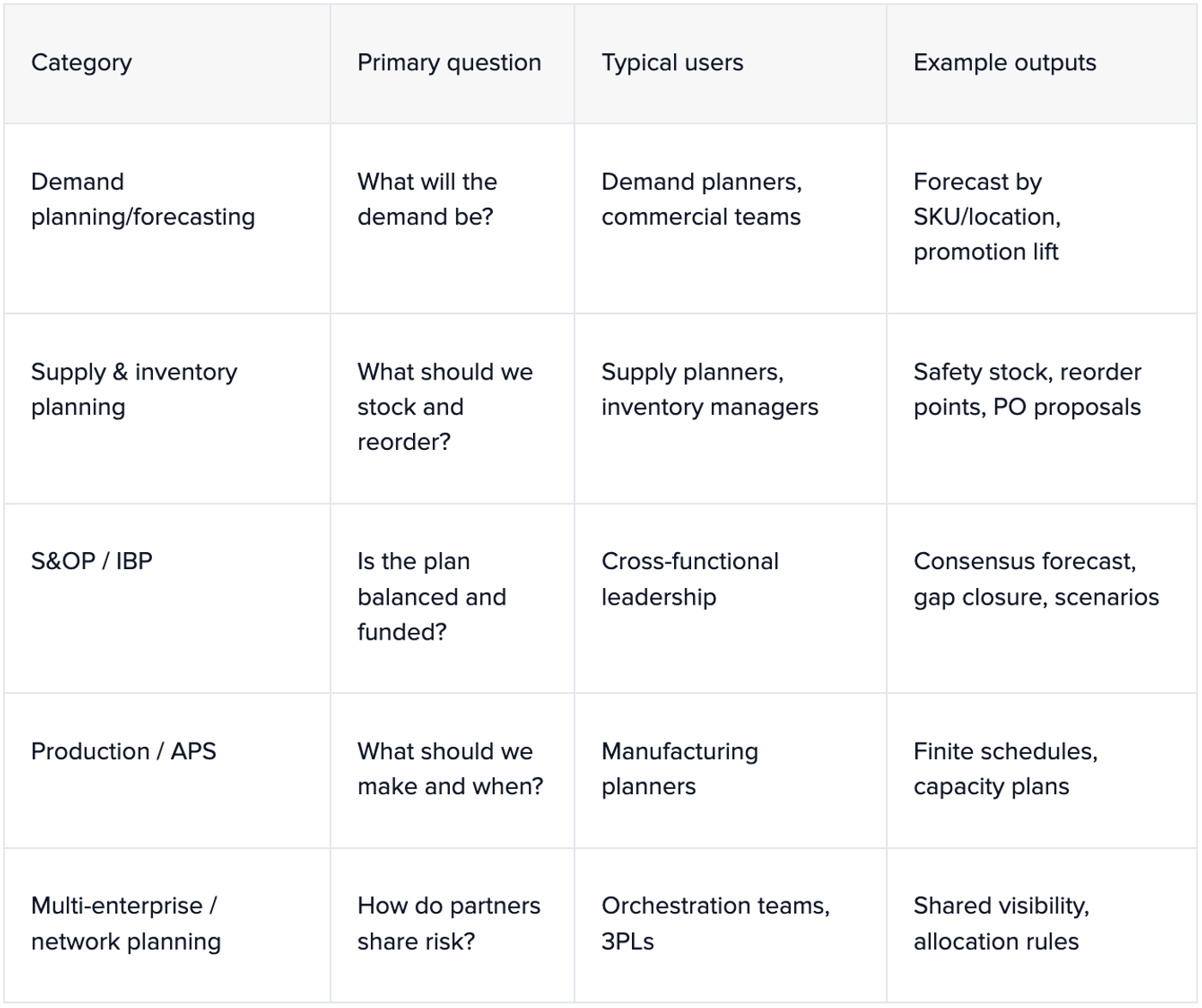
AI and ML layers are increasingly standard, see machine learning in supply chain optimization and AI inventory optimization tools and strategies.
Top supply chain planning software by use case (2026)
There is no single “best” platform. Below are widely deployed options grouped by where they tend to win. Validate fit with a pilot on your data, not a generic ranking.
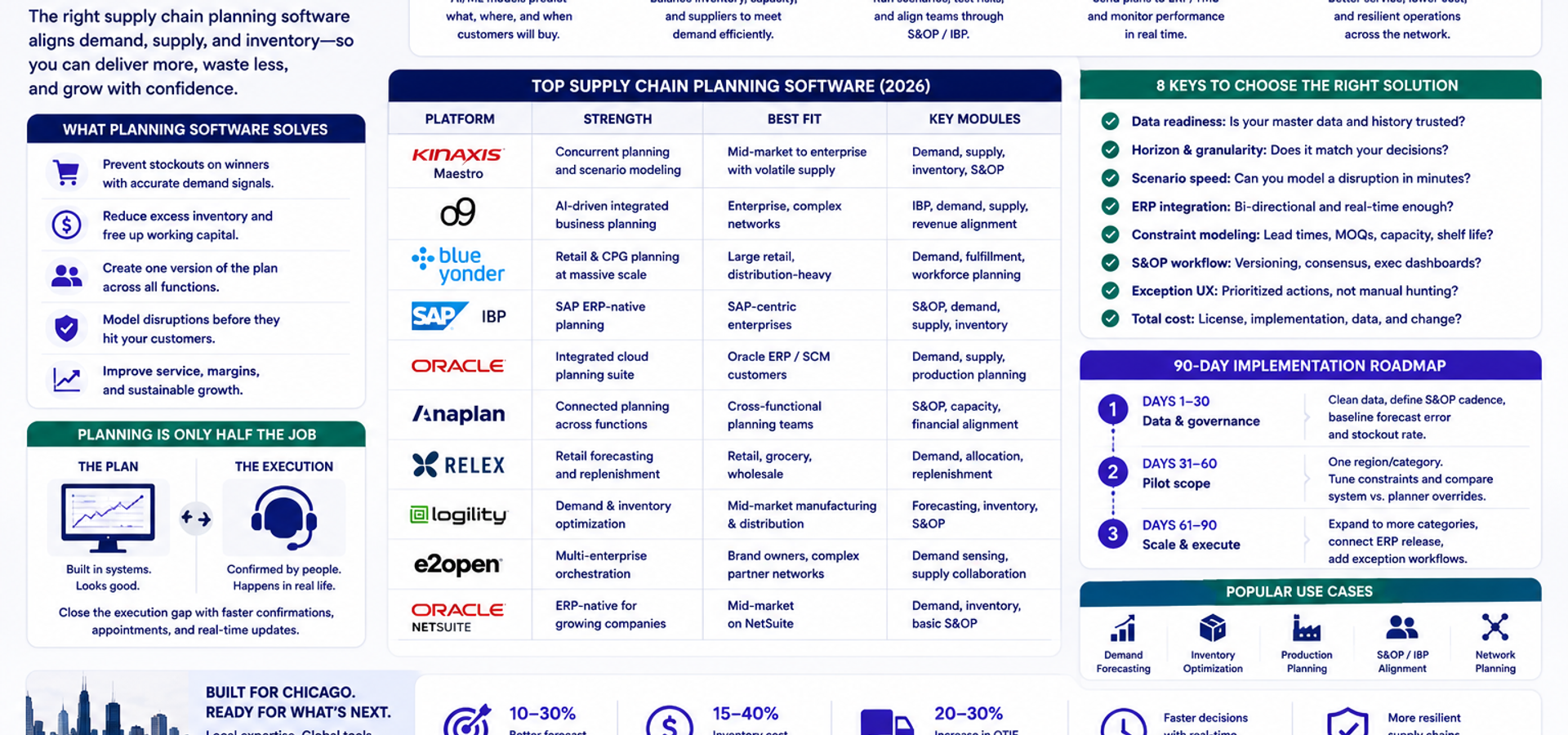
Kinaxis Maestro
- Strength: Concurrent planning and scenario modeling
- Typical fit: Mid-market to enterprise organizations with volatile supply chains
- Planning modules: Demand planning, supply planning, inventory planning, and S&OP (Sales & Operations Planning)
o9 Solutions
- Strength: AI-driven integrated planning
- Typical fit: Enterprise businesses with complex supply chain networks
- Planning modules: Integrated Business Planning (IBP), demand planning, supply planning, and revenue alignment
Blue Yonder Luminate
- Strength: Retail and CPG planning at scale
- Typical fit: Large retailers and distribution-focused organizations
- Planning modules: Demand planning, fulfillment planning, and workforce planning
SAP Integrated Business Planning (IBP)
- Strength: Native integration with SAP ERP ecosystem
- Typical fit: SAP-centric enterprises
- Planning modules: S&OP, demand planning, supply planning, and inventory optimization
Oracle Supply Chain Planning
- Strength: Deep integration with Oracle Cloud ecosystem
- Typical fit: Organizations using Oracle ERP and SCM solutions
- Planning modules: Demand planning, supply planning, and production planning
Anaplan
- Strength: Connected planning with flexible modeling capabilities
- Typical fit: Cross-functional planning teams across departments
- Planning modules: S&OP, capacity planning, and financial alignment
RELEX Solutions
- Strength: Retail forecasting and replenishment optimization
- Typical fit: Retail, grocery, and wholesale businesses
- Planning modules: Demand forecasting, allocation planning, and replenishment planning
Logility
- Strength: Demand forecasting and inventory optimization
- Typical fit: Mid-market manufacturing and distribution companies
- Planning modules: Forecasting, inventory management, and S&OP
E2open
- Strength: Multi-enterprise supply chain orchestration
- Typical fit: Brand owners and businesses with complex partner networks
- Planning modules: Demand sensing and supply collaboration
NetSuite (Planning Extensions)
- Strength: ERP-native planning for mid-market businesses
- Typical fit: Growing companies operating on NetSuite
- Planning modules: Demand planning, inventory planning, and basic S&OP capabilities
McKinsey notes that digitized planning combined with operating-model change can materially improve service and forecast accuracy, but technology alone rarely delivers the outcome. See: McKinsey: Raising supply-chain performance to new levels.
How to choose supply chain planning software
Shortlist vendors with eight practical filters, not logo recognition:
- Data readiness: Item master, BOMs, UOM, and history clean enough to model?
- Horizon and granularity: SKU-location week vs. aggregate month, does the tool match?
- Scenario speed: Can planners test supplier delay or demand surge in minutes?
- ERP integration: Bi-directional flow for inventory, open POs, and released orders?
- Constraint modeling: MOQs, lead-time variability, capacity, shelf life?
- S&OP workflow: Versioning, consensus, and executive views, not just forecasts?
- Exception UX: Prioritized “act today” list vs. manual SKU review?
- Total cost: Licenses, implementation, data pipeline, and change management.
APQC’s supply chain benchmarking work reinforces that planning maturity correlates with process discipline, not tool count alone. See: APQC benchmarking research.
Planning vs execution: the gap most software RFPs miss
Planning systems assume execution happens on schedule: suppliers confirm dates, carriers hit appointments, warehouses receive on time. Reality is phone-heavy, chase calls, appointment changes, status checks, and exception escalations that never appear in the plan.
That is the logistics decision gap: decisions made in planning tools vs. coordination speed at the edge. TMS status automation helps on transport: automated load status updates inside logistics TMS via phone bots. Broader logistics AI: AI in logistics use cases.
Sustainable operations also factor in waste and expediting, see how AI makes supply chains more sustainable.
Implementation roadmap: 90 days to trusted plans
Days 1–30: Data and governance
Fix item master and UOM issues. Define one S&OP cadence owner. Baseline forecast error and stockout rate.
Days 31–60: Pilot scope
One region or category. Compare system recommendations vs. planner overrides. Tune constraints.
Days 61–90: Expand with exception workflows
Roll to adjacent categories. Connect ERP release. Add execution-layer automation for high-volume confirms and status calls.
Voice coordination layer: conversational services use cases. Build vs buy for voice stack: build vs buy voice AI stack.
When to start with lighter tools
Not every team needs a full IBP suite on day one. Consider narrower tools if:
- you have under 500 SKUs and one primary warehouse
- forecast error is driven by bad master data, not model sophistication
- S&OP has no executive sponsor yet
- ERP planning modules are unused, not exhausted
Upgrade when scenario modeling, multi-node allocation, or consensus planning becomes a weekly bottleneck, not when a vendor demo looks impressive.
Where Dialflo fits (execution, not planning)
Dialflo is not supply chain planning software. It is AI voice automation for the execution layer plans depend on, supplier confirmations, appointment scheduling, shipment status, and follow-ups that otherwise sit in coordinator queues.
Pair a strong planning platform with faster edge coordination when your bottleneck is “the plan is right but nobody confirmed the pickup.” Explore workflows on dialflo.ai.
FAQ: Supply chain planning software
What is supply chain planning software?
Tools for demand forecasting, supply/inventory planning, S&OP, and scenario modeling across the network.
Demand planning vs supply planning?
Demand predicts sales; supply decides how to fulfill under constraints.
Best option for mid-market?
Often ERP-native or focused suites, fit beats brand scale.
How does it connect to ERP/TMS?
Reads master data and history; exports POs, transfers, and schedules.
Why do implementations stall?
Data quality, weak governance, and execution gaps outside the tool.
How does Dialflo relate?
Voice AI for execution-layer calls adjacent to planning, see dialflo.ai.
Closing: pick for the decision you need to make
The top supply chain planning software for your team is the one your planners will trust on Monday morning, integrated with ERP truth, strong at your primary decision (forecast, inventory, or S&OP), and paired with execution workflows that close the gap between plan and reality.
Evaluating planning tools and execution speed together? Start with supply chain management technology, then see how Dialflo handles the calls your plan assumes already happened.