Artificial Intelligence in Recruitment: Complete Guide

Dialflo: AI Voice Agent
April 24, 2026
This guide treats artificial intelligence in recruitment as an operating discipline, not a single SKU, so your team can deploy AI in recruitment without trading compliance for speed.
If you are responsible for artificial intelligence in recruitment programs in 2026, you are really running three programs at once: technology selection, change management, and governance. Buyers who collapse those threads buy impressive demos and stall in production because hiring managers never trusted the scores, legal never signed the DPA, or candidates revolted at opaque bots. AI in recruitment only creates leverage when workflows, data fields, and accountability stay aligned, which is harder than choosing a vendor with a glossy “copilot” slide. Treat this guide as a stakeholder map: who signs the risk register, who owns model updates, and who answers candidates when automation misfires at 9 p.m. local time.
This guide walks the funnel end-to-end: model help vs. human ownership, staffing vs. corporate TA, and pilots that protect the employer brand. We cite LinkedIn’s Future of Recruiting for adoption context and SitePoint’s AI recruiting tools for 2026 for sourcing orientation, verify every tool against your ATS and region. We also cover Dialflo voice AI when phones throttle candidate progression.
Definitions: artificial intelligence in recruitment vs. automation
Not every “AI” feature uses modern machine learning. Some products are rules engines with marketing labels. For procurement clarity, bucket capabilities: classic automation (if-this-then-that workflows), ML ranking (learned weights on features you can inspect), retrieval-augmented assistants (models grounded in your policy docs), and generative writing (drafts that require human edit). AI in recruitment roadmaps should label which bucket each use case belongs to, finance and legal ask different questions for each.
Why definitions matter: regulators and plaintiffs’ counsel care whether a decision was statistically learned, rule-based, or human with AI assistance. Your documentation for artificial intelligence in recruitment should match reality, not the sales deck.
Where AI in recruitment creates value across the funnel
Attract: generative support for inclusive job posts, always edited by humans, and smarter spend on channels. Engage: chatbots that schedule interviews instead of email tennis. Select: parsing and semantic search that reduce duplicate profiles; rubric-based screening with override logs. Decide: interviewer guidance and structured feedback prompts, not autonomous hiring decisions without review. Onboard handoffs: pre-boarding nudges that respect regional rules. Analytics: forecasting and capacity models that finance understands.
Each layer assumes clean ATS fields. If recruiters store truth in side channels, AI in recruitment trains on lies and leadership loses trust overnight.
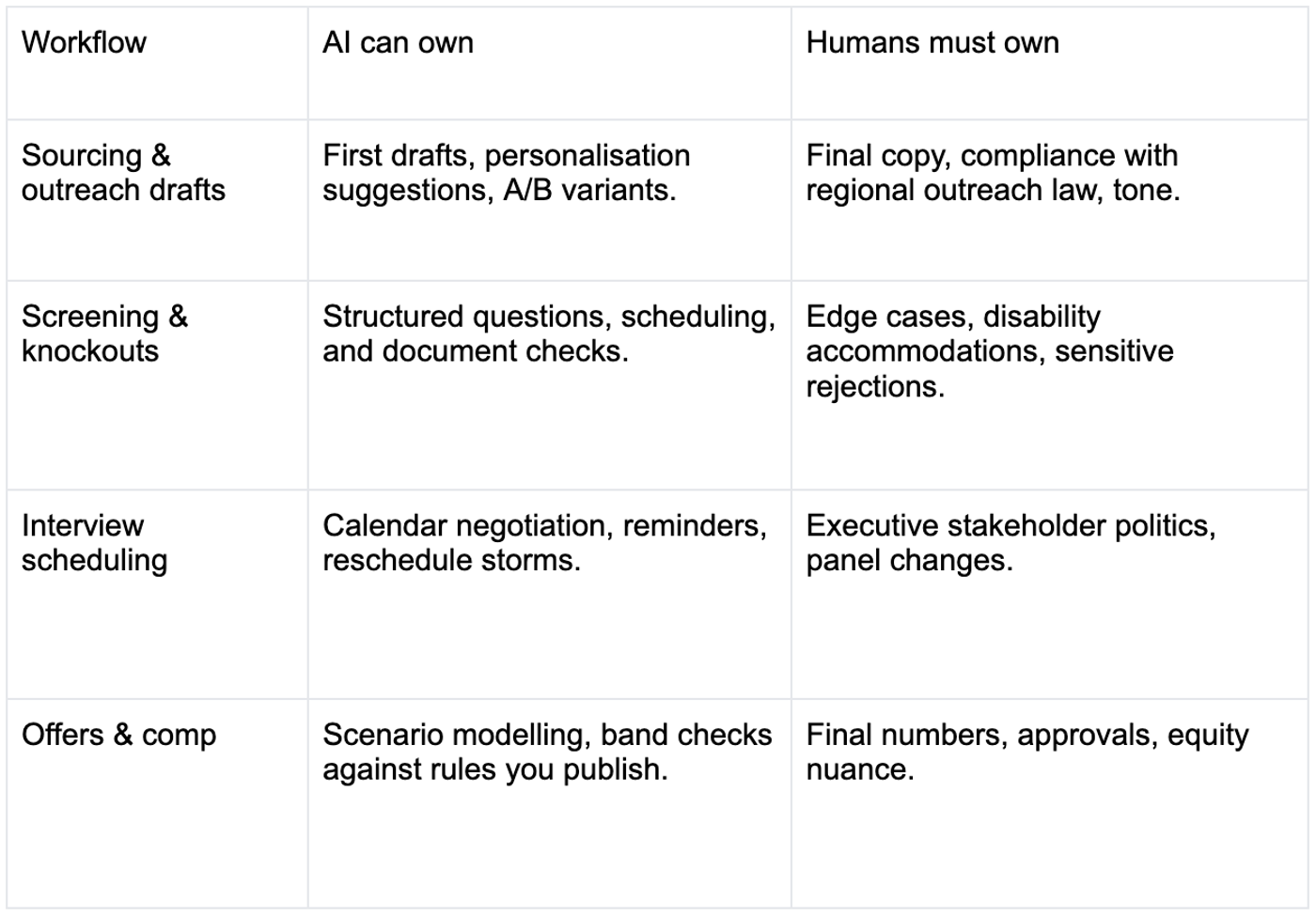
Human vs. machine: a practical ownership table
Use this internally before you publish AI-branded career pages.
Staffing firms vs. corporate TA: different AI in recruitment constraints
Corporate TA often optimizes one employer brand and policy stack. Staffing optimizes many clients, consent timelines, and redeployment across pools. Artificial intelligence in recruitment that works for a single employer may break when submittal rules differ by account or when the same candidate needs different disclosures. Multi-tenant analytics and explainable scores are not optional nice-to-haves, they determine whether account managers forward your AI summary to clients.
Agency leaders should also measure recruiter throughput per fee dollar. If AI in recruitment saves minutes but increases rework, margin does not move.
Bias, fairness, and the documentation layer
Models inherit historical hiring patterns, good and bad. Responsible artificial intelligence in recruitment programs define protected attributes handling, run disparate impact checks where counsel approves, and keep humans in the loop for adverse actions. Publish candidate notices where required, and retain logs long enough to respond to audits without keeping data forever “just in case.”
Train recruiters to spot automation failure modes: over-trust in scores, mismatched knockouts, multilingual gaps, and accessibility misses. AI in recruitment maturity is measured in override quality, not lowest possible recruiter touch count.
Integration: the ATS is still the system of record
Most artificial intelligence in recruitment value chains terminate in the applicant tracking system: stages, reasons, sources, interview feedback. If integrations write only to shadow spreadsheets, you bought a sidecar nobody governs. Demand APIs or native modules that map to stable fields, version rubrics, and expose webhook failures your ops team can alert on.
Security reviews should cover subprocessors, data residency, retention, and what happens when models update mid-quarter. Procurement templates exist for a reason, use them before legal becomes the bottleneck.
Global hiring, privacy, and where AI in recruitment breaks first
Cross-border artificial intelligence in recruitment multiplies complexity: GDPR and UK GDPR expectations, state privacy laws in the US, right-to-work evidence rules, and retention limits that conflict with “keep everything for model tuning.” Vendors may train on customer data unless contracts forbid it, read the fine print with counsel, not only the marketing promise of “enterprise-grade security.” Data minimization is also a UX win: fewer fields for candidates to re-type means fewer abandoned applications and cleaner signals for models.
Localization is not translation alone, pilot in every geography with volume, and route failures to human recruiters who speak the candidate’s language instead of silent drops.
Dialflo: voice AI as part of artificial intelligence in recruitment
Dialflo addresses a specific gap: high-volume phone workflows, structured screening, confirmations, reschedules, re-engagement, where email bots do not help. Voice outputs should sync to ATS fields so downstream AI in recruitment analytics and human recruiters share one timeline. Dialflo is not a replacement ATS; it is throughput for candidates who still expect a phone answer.
Pricing listed on dialflo.ai includes tiers such as Starter near ₹9,999 per month and Professional near ₹24,999 per month, confirm current numbers with sales before budgeting. Evaluate multilingual quality, completion rates, and human handoff, not only cost per minute.
Implementation roadmap: 120 days from charter to scale decision
Days 1–30: charter team (TA, legal, IT, DEI), inventory data flows, pick two pilots with KPIs. Days 31–60: integrate logging, train recruiters on overrides, run parallel human vs. assisted decisions where ethical. Days 61–90: expand languages and edge cases, publish candidate transparency, refine rubrics. Days 91–120: scale or stop with documented rationale. The best artificial intelligence in recruitment programs read boring on Gantt charts because risk was front-loaded.
Communicate internally with crisp language: what AI does, what it does not do, and how to escalate. Candidates punish brands that oversell “fully automated” journeys that still drop them into black holes.
Metrics that prove AI in recruitment worked, or did not
Measure time-to-first-screen, time-to-schedule, offer acceptance, quality-of-hire proxies you already trust, recruiter hours per hire, override rates, and candidate satisfaction where sampled lawfully. Tie at least one metric to finance (cost per qualified interview, agency spend avoidance). If only TA satisfaction moves, executives will cut the program at the first budget squeeze.
Review quarterly for model drift: if override rates spike or source mix shifts, revalidate. AI in recruitment is not “set and forget” infrastructure, it is software that ages with your hiring mix.
Vendor shortlists: keep demos honest
When finalists parade artificial intelligence in recruitment features, insist on one script: messy resumes, mid-pilot rule changes, human-request escalations, and audit exports. Ask how rubrics version and what happens when APIs fail. Strong vendors answer with engineers present, not slide-only pitches. Reference peers your size and industry; AI in recruitment fit is contextual.
FAQ: Artificial intelligence in recruitment
What is artificial intelligence in recruitment?
It is the use of ML, NLP, generative models, and automation to support hiring tasks while humans stay accountable for high-stakes decisions.
How is AI used in recruitment today?
Through parsing, matching, chat scheduling, rubric screening with logs, forecasting, and voice screens, usually integrated with the ATS.
What are the main risks of AI in recruitment?
Bias, opacity, privacy violations, deskilling, and reputational harm when candidates feel misled. Governance and human review reduce but do not remove these risks.
Does artificial intelligence in recruitment replace recruiters?
No wholesale replacement in most models, AI removes repetitive work; recruiters still own relationships, judgment, and compliance interpretation.
How should companies implement AI in recruitment responsibly?
Policies first, pilot with KPIs, document vendors and model changes, train overrides, and publish transparency for candidates, with legal and DEI review of rubrics.
How does voice AI fit into artificial intelligence in recruitment?
It automates structured phone tasks and writes results to the ATS; Dialflo is one example when call volume limits speed.
Closing: complete means governance plus UX, not more features
A complete view of artificial intelligence in recruitment ends where most blog posts skip: contracts, logs, DEI review, candidate honesty, and finance-grade metrics. Treat AI in recruitment as infrastructure that changes behavior, not a feature flag, and staff the program accordingly. Pair inbox and ATS intelligence with voice when phones decide outcomes, and keep humans visibly in charge wherever the law and brand still say so.
Want to see AI in your own hiring funnel? Book a Dialflo demo and watch a voice agent run a structured phone screen and log the answers to your ATS.


