How to Use AI in Talent Acquisition (Step-by-Step Guide)

Dialflo: AI Voice Agent
May 22, 2026
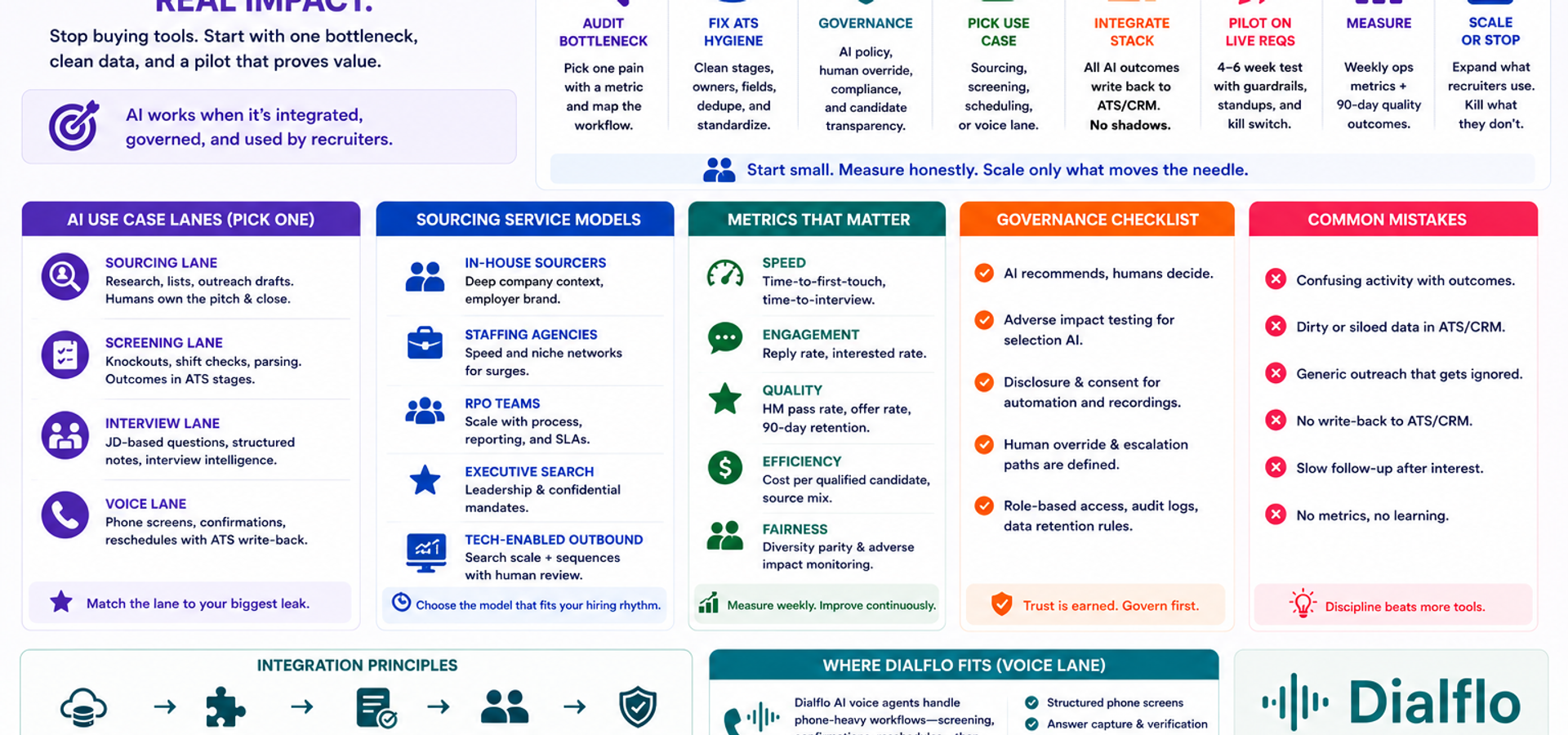
Your leadership deck says “AI-first recruiting.” Your recruiters still live in voicemail, duplicate spreadsheets, and scheduling threads that never end. If you are searching how to use AI in talent acquisition without buying six tools nobody opens, this guide is the operational version, eight steps, one pilot at a time, ATS as system of record.
We will cover audit, governance, integration, pilot design, metrics, and where voice fits. For background on the shift, read artificial intelligence in recruitment and how AI agents are transforming recruiting.
Step overview: 8 steps to use AI in talent acquisition
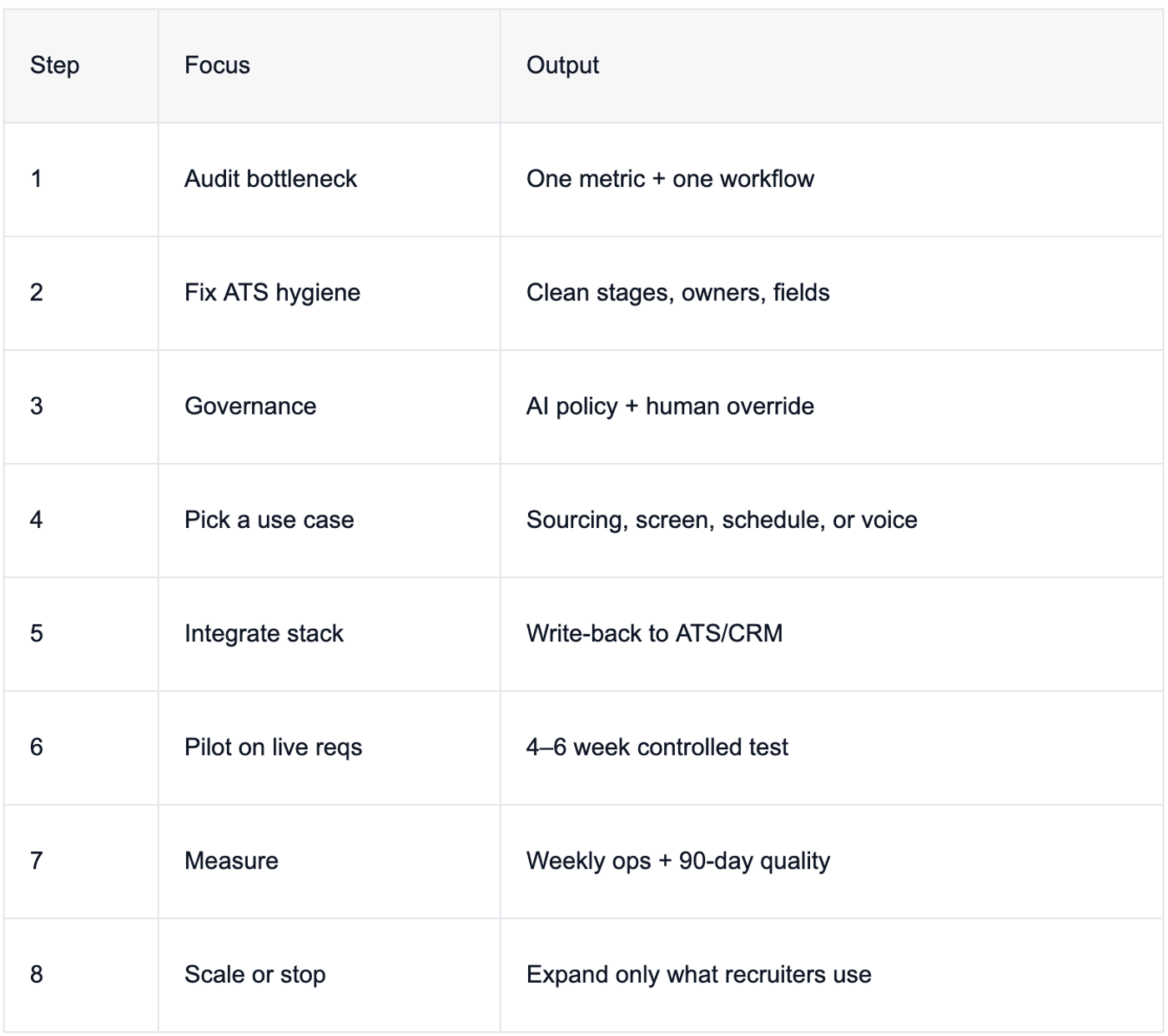
Step 1: Audit one bottleneck (not your entire function)
Pick a single pain with a number attached:
- Time-to-first-touch after sourcing or apply
- Screen completion rate for high-volume roles
- Interview show rate or coordinator reschedules
- HM feedback latency blocking offers
Interview five recruiters and two hiring managers. Map steps on paper: who acts, which tool, where candidates drop. If sourcing is the leak, pair with candidate sourcing services and AI sourcing. If the leak is after apply, see AI applicant screening.
Step 2: Clean your ATS before you add AI
AI amplifies messy data. Before new tools:
- standardize stages and dispositions recruiters actually use
- assign owners per stage (recruiter vs coordinator vs HM)
- dedupe candidates and merge shadow spreadsheets into the ATS
- confirm required fields for your pilot workflow
Cloud ATS context: cloud-based recruitment software. Agency models: ATS for staffing agencies compared. Relationship data beyond reqs: candidate relationship management system.
Step 3: Set governance (legal + candidate experience)
Document before pilot:
- does AI recommend or decide at each step?
- who approves selection models and when they are retested?
- what candidates are told about automation (chat, async video, voice)?
- recording, consent, and retention rules for calls
- human escalation path for edge cases and accommodations
US employers should align selection AI with EEOC guidance on AI in employment selection. SHRM frames hiring as cross-functional, governance is not “legal only.” Source: SHRM: Talent acquisition toolkit.
Step 4: Choose one AI use case for the pilot
Match the bottleneck to a lane:
Sourcing lane. Research, list building, outreach drafts, human owns pitch and close. Compare AI agents for recruitment comparison and enhancement layers in GEM ATS review.
Screening lane. Knockouts, shift checks, document parsing, outcomes must land in ATS stages. High-volume: automated screening for staffing agencies.
Interview lane. Question packs from JD, structured notes, see generate interview questions from job description and interview intelligence. Humans still decide.
Voice lane. Phone screens, confirmations, reschedules when candidates call or prefer voice, structured write-back required. This is where many teams lose interested applicants today.
LinkedIn’s talent research ties hiring outcomes to speed and communication quality, pick the lane that moves those needles first. Source: LinkedIn: Future of Recruiting 2025.
Step 5: Integrate, no shadow systems
Non-negotiables for how to use AI in talent acquisition safely:
- ATS (or ATS + CRM) is system of record
- every AI outcome updates stage, disposition, or notes
- API or integration documented, not manual CSV exports
- recruiters trained in one UI path, not three tabs
Integration playbook: integrate recruiting software with existing systems. Analytics layer: recruitment analytics software. ML expectations: machine learning in recruiting.
Step 6: Run a 4–6 week pilot on live requisitions
Scope small:
- 2–4 recruiters, one job family or location
- same intake form and scorecard as control reqs if possible
- daily 15-minute standup: blockers, bad outputs, workarounds
- kill switch if compliance or CX flags appear
Gartner’s HR technology themes emphasize adoption and manager effectiveness over feature count, if recruiters bypass the tool, stop the pilot. Source: Gartner: HR technology.
Step 7: Measure what leaders and recruiters both trust
Weekly operational metrics
- time-to-first-touch or screen completion
- interview show rate / reschedule count
- recruiter hours on coordination tasks (estimate via time study)
- AI override rate (how often humans reject suggestions)
90-day outcome metrics
- time-to-fill and offer accept rate
- pipeline conversion by stage
- 90-day retention or HM satisfaction proxy
- candidate NPS or complaint themes on automation
Compare with hire candidates faster with AI tools benchmarks, not vanity “messages sent” counts.
Step 8: Scale what recruiters use; kill the rest
Expansion rules:
- only add a second use case after the first hits adoption targets
- train hiring managers on scorecards and feedback SLAs in parallel
- document playbooks in your agentic hiring organization model if AI is infrastructure, not a side project
- staffing firms: align with AI staffing operating norms
Unique angle: talent acquisition AI fails in the handoff
Teams buy AI for sourcing slides; they lose candidates on the phone. How to use AI in talent acquisition successfully means automating the unglamorous coordination, screens, confirmations, reminders, with outcomes in the ATS. Better job post copy does not fix voicemail at 4 p.m. on Friday.
Where Dialflo fits: Step 4 “voice lane” with ATS write-back
Dialflo is AI voice execution for recruiting: structured phone screens, interview confirmations, and reschedule handling that syncs to your ATS or CRM. Use it when your pilot bottleneck is phone throughput or show rate, not as a replacement for your ATS. Indian teams evaluating voice infrastructure can also read build vs buy voice AI stack in India for stack decisions.
FAQ: how to use AI in talent acquisition
Where do I start?
One metric, one workflow, clean ATS, governance doc, then a 4–6 week pilot.
Best use cases?
Sourcing support, screening, scheduling, interview prep, analytics, voice screens, pick one first.
Need an ATS first?
Yes, a system of record so AI does not live in shadow tools.
Compliance priorities?
Adverse impact testing for selection AI, disclosure, recording rules, human override.
Time to ROI?
Ops signals in weeks; quality/retention often need 90 days.
How does Dialflo help?
Voice agents for phone-heavy steps with structured ATS/CRM write-back.
Closing: one pilot, honest metrics, no shadow pipelines
How to use AI in talent acquisition is not a platform shopping exercise. Audit the bottleneck, govern selection touchpoints, integrate with your ATS, pilot on live reqs, measure adoption and conversion, then scale only what recruiters keep using.
Ready to test the voice lane? Explore Dialflo for phone workflows that keep your talent acquisition pipeline truthful when speed matters.


