Top Sourcing Tools for Recruiters, Plus AI Voice Outreach

Dialflo: AI Voice Agent
June 12, 2026
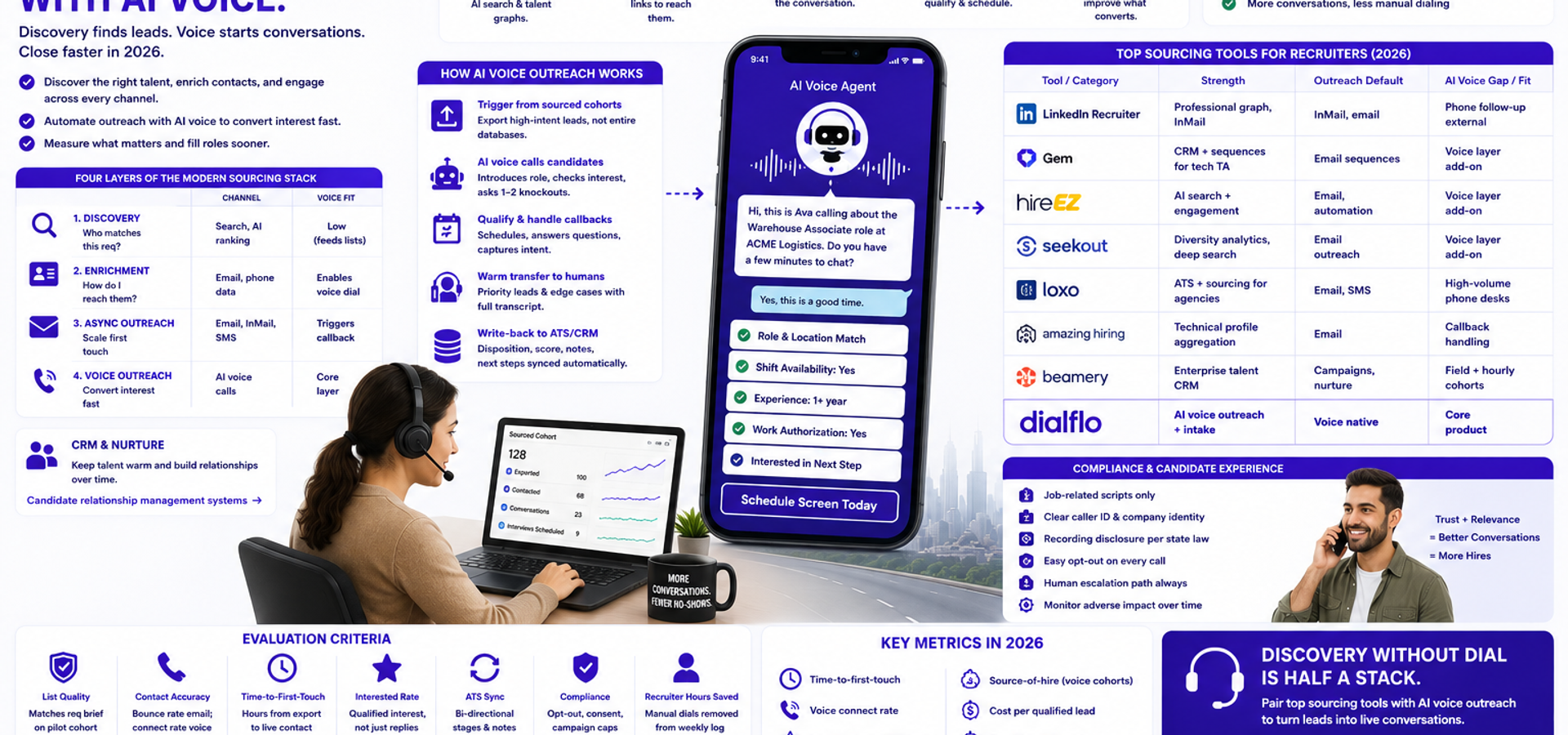
You exported four hundred profiles. Twelve replied to email. Three answered the phone on the first dial, and one of those was ready to screen today. If that sounds familiar, the gap is not search quality alone. It is outreach modality. The best sourcing tools for recruiters in 2026 combine discovery, enrichment, and sequenced contact, but high-volume and hourly hiring still breaks when outreach is email-only.
This guide maps top sourcing tools for recruiters by layer, search, CRM, async outreach, and automate outreach with AI voice, plus how to stack them, stay compliant, and measure what converts. Start with AI sourcing: find candidates faster and candidate sourcing services for discovery depth.
What sourcing tools for recruiters actually do
Sourcing software compresses the path from req intake to first conversation:
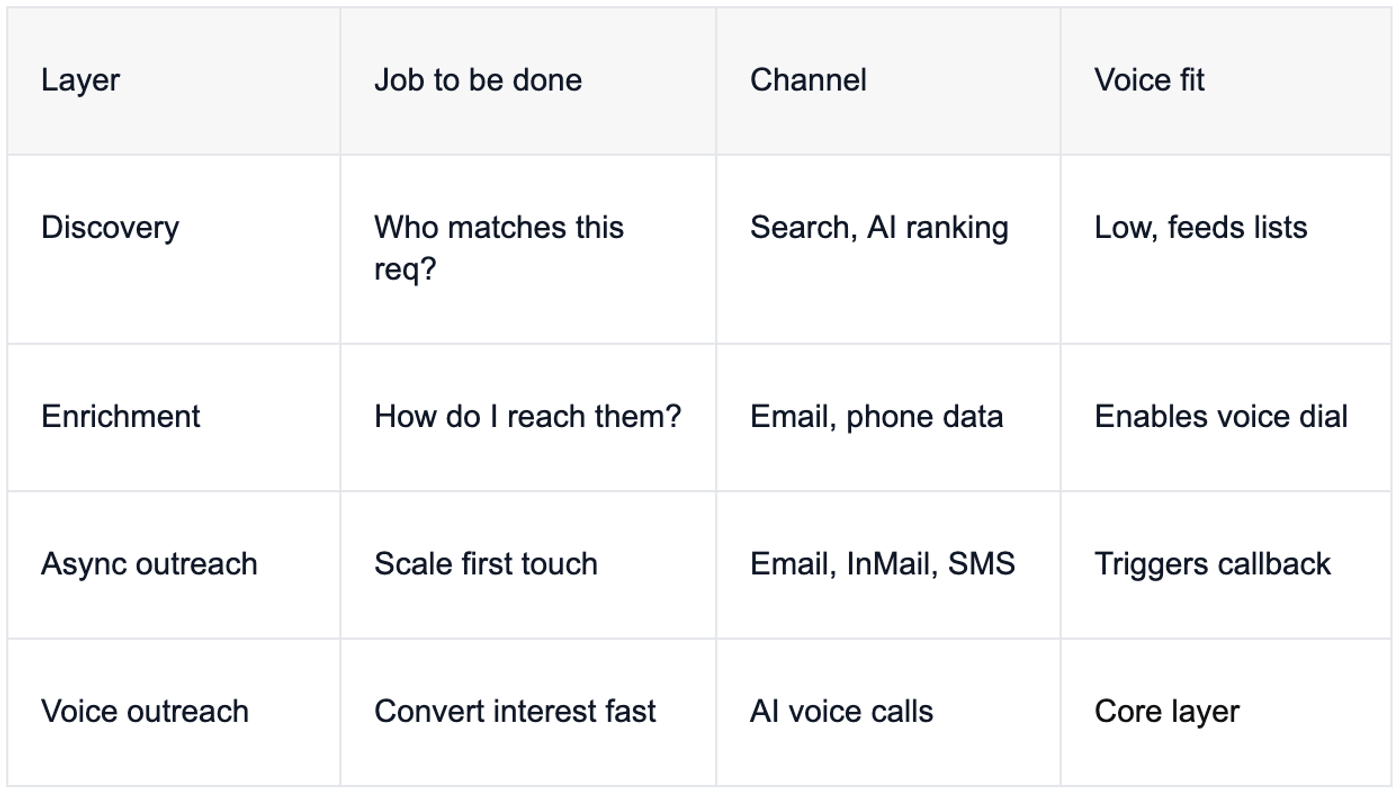
- Discover: semantic search, talent graphs, lookalike matching
- Enrich: emails, phones, social links, verification
- Engage: sequences, InMail, SMS, and voice
- Record: CRM or ATS notes, disposition, analytics
Most teams over-invest in discover and under-invest in engage, especially phone. LinkedIn's Future of Recruiting shows growing AI adoption as recruiters chase capacity. SHRM recruiting benchmarks continue to highlight long time-to-fill while reqs per recruiter rise.
Four layers of the modern sourcing stack
CRM and nurture: candidate relationship management systems. Gem-specific review: Gem ATS and sourcing capabilities.
Top sourcing tools for recruiters, by use case (2026)
No single tool wins every segment. Group vendors by where they actually help, not logo size.
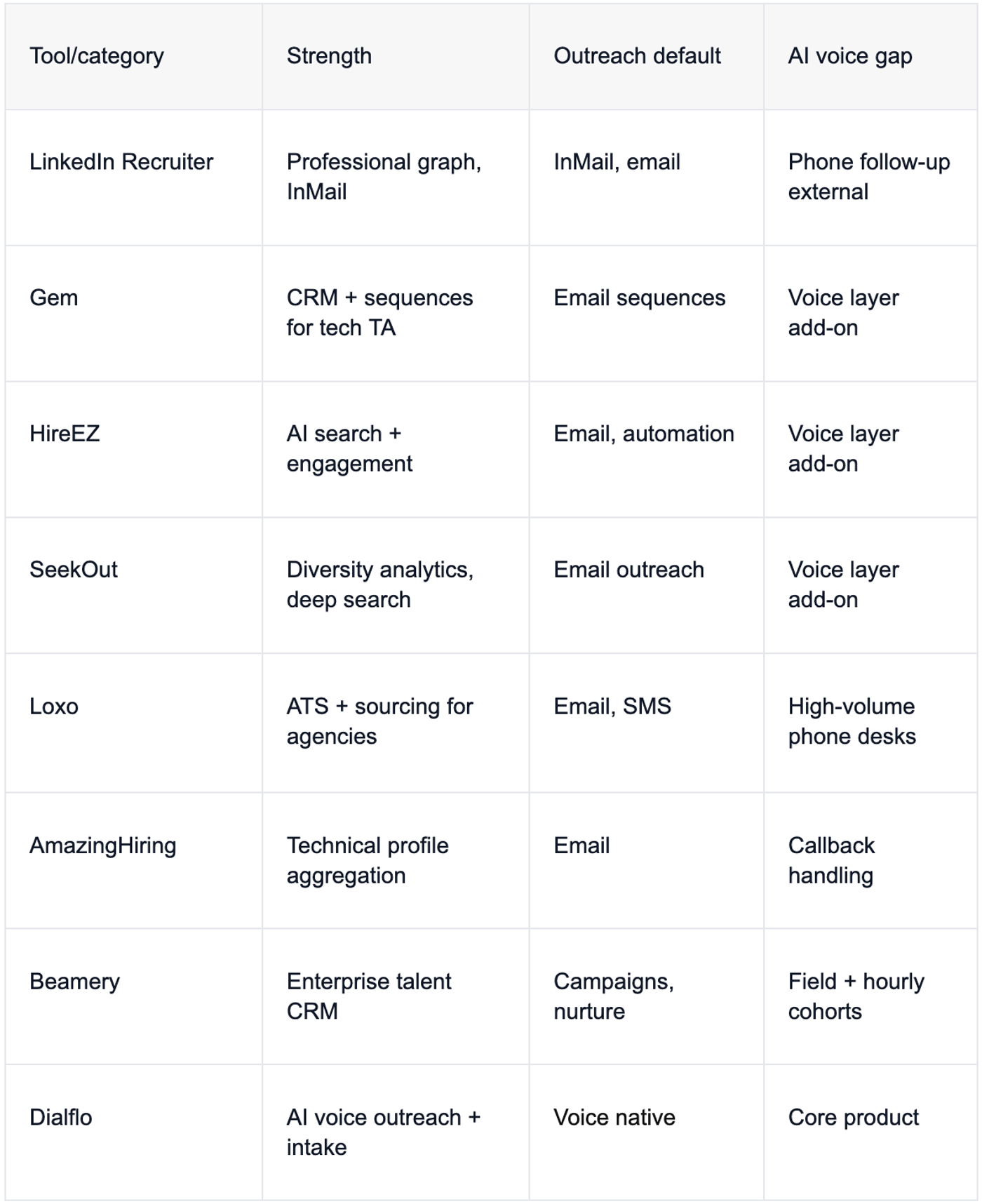
Async outreach finds leads; voice converts phone-first talent. That is where teams automate outreach with AI voice without hiring ten more sourcers.
Why recruiters add AI voice to sourcing outreach
Email sequences plateau when:
- candidates work shifts and rarely check personal email mid-day
- reply rates drop on commoditized InMail templates
- sourced leads call back while sourcers are on other lines
- interest is warm but scheduling stalls over three email rounds
- multilingual outreach is required but team coverage is thin
AI voice agents can place interest-check calls, run short knockouts, offer schedule slots, and write outcomes to ATS or CRM, extending sourcing tools into live conversation. Voice patterns: conversational services use cases. Agent landscape: AI agents for recruitment compared.
How to automate outreach with AI voice (without spam)
Treat voice like a product surface, not a robodial blast.
- Trigger from sourced cohorts: Export interested or high-score leads from Gem, HireEZ, or LinkedIn, not entire databases.
- Cap attempts: Two to three tries with backoff; honor opt-out immediately.
- Script for relevance: Role, location, comp band, one knockout, under three minutes.
- Disclose AI when required: Especially for recorded screens; align with counsel.
- Warm transfer: Priority candidates and edge cases to humans with transcript.
- Write-back: Disposition, score, and next step in ATS, no spreadsheet sidecar.
Integration checklist: integrate recruiting software with existing systems. Build vs buy telephony: build vs buy voice AI stack.
Sourcing vs screening: keep the funnel clean
Sourcing tools find and engage; screening tools evaluate applicants already in pipeline. Overlap causes duplicate messages and angry candidates. Clarify handoff:
Sourcing voice outreach: “Are you open to this role? Quick fit check + schedule.”
Screening voice: Structured knockout after apply or recruiter submittal.
Screening depth: AI applicant screening and automated screening for staffing agencies. Full TA stack: artificial intelligence in recruitment.
Evaluation criteria for sourcing + voice stacks
- List quality: Does discovery match req brief on pilot cohort?
- Contact accuracy: Bounce rate on email; connect rate on voice.
- Time-to-first-touch: Hours from export to live conversation.
- Interested rate: Not just replies, qualified interest.
- ATS sync: Bi-directional stages and notes.
- Compliance: Opt-out, recording consent, campaign caps.
- Recruiter hours saved: Manual dials removed from weekly log.
Analytics layer: recruitment analytics software. Faster hiring plays: hire candidates faster with AI tools and how AI agents are transforming recruiting.
Compliance and candidate experience
Automated outreach invites regulatory and brand risk if volume beats relevance. Guardrails:
- job-related scripts only; no protected-class inference from voice models
- clear identity of hiring organization on caller ID
- recording disclosure per state law; documentation for audits
- easy human escalation path on every call
- monitor adverse impact on sourced cohorts over time
US selection context: EEOC uniform guidelines on selection procedures. Job scams erode trust, verify outreach legitimacy: FTC job scam guidance.
Four-week pilot: sourcing list → voice conversion
Week 1: Baseline one req
Track email/InMail reply rate, time-to-first-touch, and manual dial connects on warehouse, retail, or technical req, pick your highest pain.
Week 2: Export sourced cohort
Top fifty to one hundred leads from discovery tool. Verify phone numbers. Draft three-minute voice script with legal review.
Week 3: AI voice outreach live
Outbound interest calls + inbound callback handling. ATS write-back enabled. Recruiters on warm transfer for hot leads.
Week 4: Compare modalities
Interested rate email vs voice; schedule rate; recruiter hours. Expand or tune script, not tool count.
Staffing desks: AI in staffing and ATS for staffing agencies compared. Walk-in hiring surge: open interviews near me today. Future operating model: agentic hiring organization.
Metrics that matter in 2026
- time-to-first-touch (sourced → live contact)
- voice connect rate and completion rate
- interested rate per hundred sourced leads
- screen-scheduled rate within 48 hours
- source-of-hire from voice-touched cohorts
- cost per qualified lead by channel
- candidate complaint / opt-out rate
Interview prep after interest: generate interview questions from job descriptions and interview intelligence.
Where Dialflo fits
Dialflo is the AI voice outreach layer for recruiter sourcing stacks, outbound interest calls, inbound callbacks, short knockouts, and scheduling with ATS write-back. It complements discovery tools like LinkedIn, Gem, and HireEZ; it does not replace them.
Use Dialflo when sourced leads go cold in inbox but still answer phones, or when your desk cannot return every callback the same day. Explore workflows on dialflo.ai.
FAQ: Sourcing tools and AI voice outreach
What are sourcing tools for recruiters?
Software to discover, enrich, contact, and track potential candidates before they apply.
Why add AI voice to sourcing?
Phone-first candidates and hourly roles often ignore email sequences.
Does voice outreach replace recruiters?
No, tier-one interest and scheduling; humans close priority talent.
How avoid spam perception?
Caps, relevance, opt-out, disclosure, and human escalation.
How long to pilot?
Often four weeks on one high-volume req type.
How does Dialflo help?
Voice outreach and intake with ATS sync, see dialflo.ai.
Closing: discovery without dial is half a stack
The top sourcing tools for recruiters in 2026 are not the ones that export the biggest lists, they are the stacks that shorten time-to-conversation. Pair strong discovery and async outreach with automate outreach with AI voice where your candidates actually respond, measure interested rate honestly, and keep humans on the closes that win reqs.
Building your sourcing stack? Start with AI sourcing fundamentals, then add Dialflo for the voice layer your inbox cannot reach.


