Best AI Interview Practice Tools for Candidates

Dialflo: AI Voice Agent
May 7, 2026
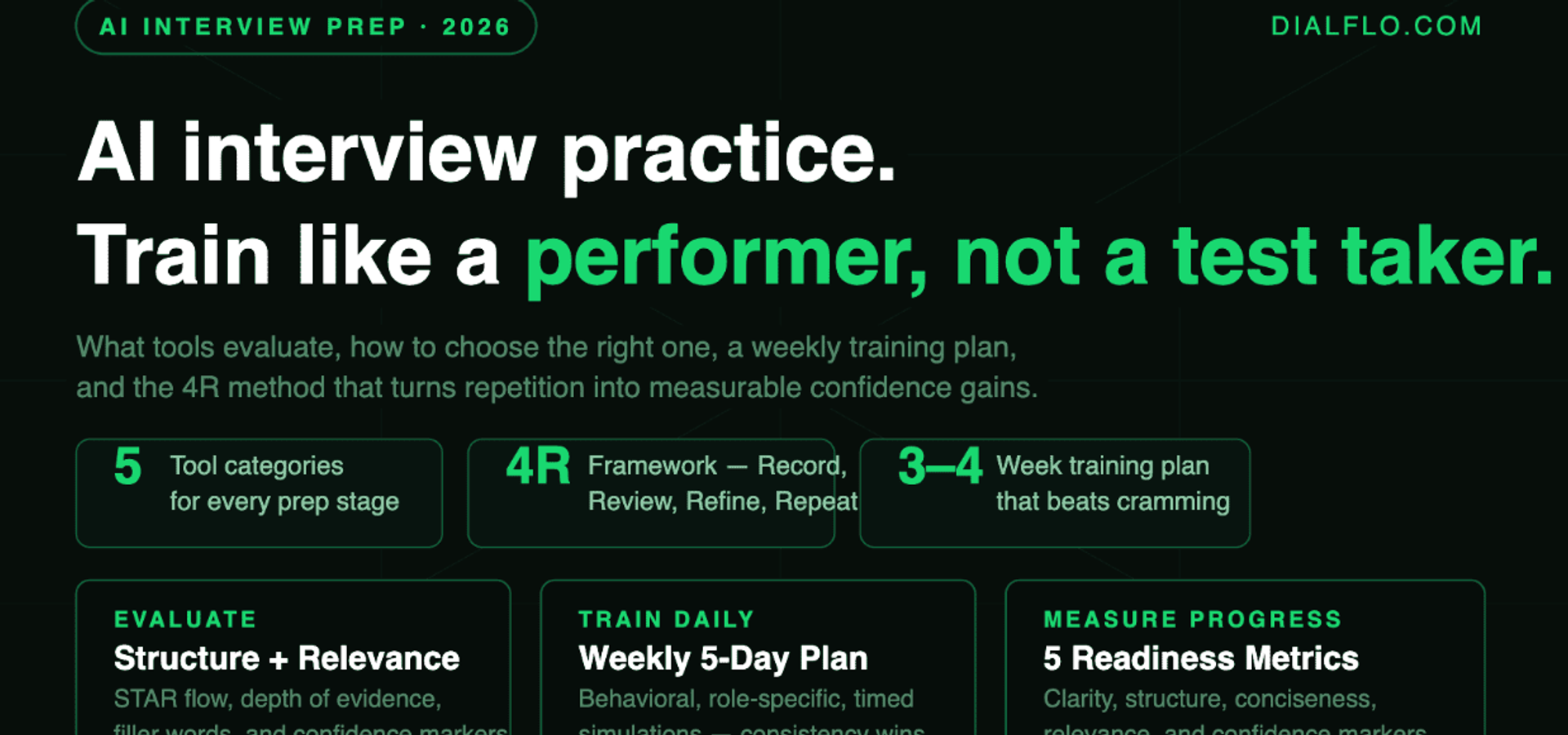
AI interview practice tools help candidates build confident, structured answers through repetition and fast feedback loops.
AI interview practice has moved from a niche experiment to a core preparation method for candidates. The reason is simple: most job seekers do not fail interviews because they lack experience; they fail because they struggle to present that experience clearly under pressure. They over-explain, miss the question, lose structure, or sound uncertain. AI tools help solve this by turning interview prep into a repeatable training process.
This guide is designed for candidates who want practical results. You will learn what ai interview practice tools do well, which features matter most, how to choose the right tool for your stage, and how to train weekly so interview performance improves measurably. If your goal is better confidence and stronger answers, this framework is built for execution, not theory.
Why interview practice is changing in the AI era
Interview preparation used to rely on static question lists and occasional mock sessions. That model has limitations: feedback is infrequent, hard to standardize, and often too general. AI changes the loop by giving immediate feedback after each attempt, which supports faster skill development.
The broader market trend supports this shift. The World Economic Forum and LinkedIn research consistently point to communication, adaptability, and role-specific readiness as critical hiring signals in modern recruiting environments. Candidates who communicate clearly and confidently often outperform equally qualified peers.
Sources: World Economic Forum: Future of Jobs and LinkedIn Talent Blog.
In practical terms, ai interview practice gives candidates a structured way to improve delivery quality at scale. Instead of preparing in a last-minute rush, you can build communication skill through focused daily repetition.
What AI interview practice tools actually evaluate
A strong tool does more than ask generic questions. It should analyze answer quality across multiple dimensions and show where improvement is needed.
Answer structure. Whether your response follows a clear flow like STAR (Situation, Task, Action, Result) or another coherent format.
Relevance. How closely your answer maps to the question asked and the target role.
Communication quality. Clarity, concision, filler word frequency, tone, pace, and confidence markers.
Depth and evidence. Whether examples include measurable outcomes instead of broad claims.
Consistency. Your performance across repeated sessions and different question types.
The best systems combine these feedback signals with targeted follow-up prompts so candidates can revise and retry immediately.
Types of AI interview tools and where each fits
Not all tools solve the same problem. Choosing by use case is better than choosing by hype.
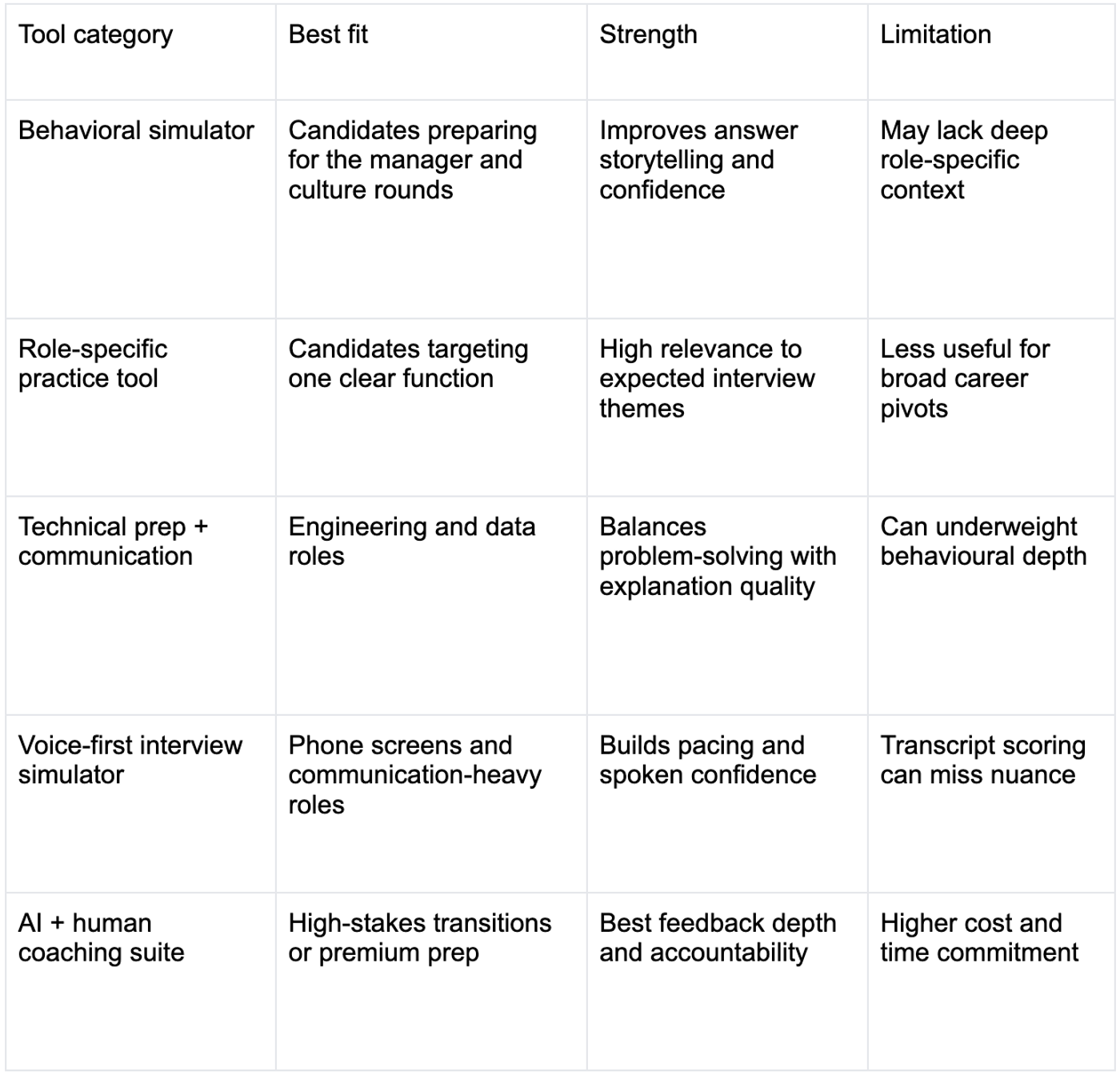
1) Behavioral interview simulators
These tools focus on leadership, conflict resolution, teamwork, ownership, and communication. They are useful for most non-technical roles and for final rounds where behavioral fit matters heavily.
2) Role-specific interview practice tools
These products tailor prompts by function, such as product management, sales, marketing, customer success, finance, or operations. They usually provide better question relevance than generic systems.
3) Technical interview prep tools
For engineering and data candidates, these tools combine technical prompts with communication scoring. The strongest platforms test both problem-solving and explanation quality, which is crucial in live interviews.
4) Voice-first mock interview tools
Voice-driven systems simulate real conversation dynamics and help candidates train for timing, interruptions, and verbal clarity. This matters for phone screens and communication-heavy positions.
5) Full coaching platforms
These blend AI practice with human coaching, score tracking, and planning modules. They are often useful for candidates preparing for high-stakes transitions or competitive hiring cycles.
How to evaluate the best AI interview practice tools
Use practical selection criteria so your tool helps outcomes, not just activity.
Question quality and personalization. Can the tool generate role-aware questions based on your target job description?
Feedback specificity. Does it identify exact weak spots and suggest concrete rewrites?
Session realism. Can it run timed mock interviews with conversational follow-ups?
Progress tracking. Are scores and trends visible across days and weeks?
Ease of repetition. Is it fast enough to run daily sessions without setup friction?
Cost-to-value fit. Does pricing align with your interview timeline and expected usage?
If a platform cannot show measurable progress over two weeks, switch tools or adjust your practice method.
Comparison table: tool categories for AI interview practice
A weekly training plan candidates can actually follow
Consistency beats intensity in interview prep. A simple system over 3-4 weeks often outperforms last-minute cramming.
Day 1: Baseline assessment. Run one full mock interview and score clarity, structure, confidence, and relevance.
Day 2: Behavioral focus. Practice five high-frequency behavioral questions with STAR-based responses.
Day 3: Role-specific focus. Practice questions tied directly to your target job description and expected responsibilities.
Day 4: Communication drill. Focus on reducing filler words, shortening long answers, and improving opening/closing lines.
Day 5: Timed simulation. Run a complete mock under realistic time pressure and review score trends.
Repeat this cycle weekly. By week two, your responses should become sharper and more consistent. By week three, focus on edge cases: difficult follow-up questions, mistakes you learned from, and salary or transition narratives.
Most common candidate mistakes with AI interview tools
Using ai interview practice effectively requires avoiding a few predictable traps:
- Practicing without role targeting. Generic sessions improve fluency but may not improve relevance for your specific interview.
- Ignoring score trends. One good session does not matter if weekly consistency is weak.
- Memorizing scripted answers. Over-scripted responses collapse under follow-up questions.
- Skipping live practice. AI is excellent for repetition but should complement, not replace, human mock interviews.
- Not updating examples. Your stories should be tailored for each company and role context.
The goal is not to sound robotic. The goal is to sound clear, structured, and authentic under pressure.
How to measure interview readiness with real metrics
If you want better results, measure progress like a training process. Use simple metrics that reflect interview performance quality.
- Clarity score: Are your first two sentences direct and easy to follow?
- Structure score: Do answers follow a repeatable format with clear outcomes?
- Conciseness: Are most answers under 90 seconds unless the question requires detail?
- Relevance: Do examples connect directly to the target role's competencies?
- Confidence markers: Reduced filler words, fewer restarts, and stable speaking pace.
When these indicators improve, interview outcomes usually improve too: better callback rates, stronger recruiter feedback, and higher final-round conversion.
An original framework: the 4R method for ai interview practice
Most candidates practice reactively. A better approach is the 4R framework:
Record. Capture your answer in voice or video so you can review objectively.
Review. Identify one structural and one communication issue per answer.
Refine. Rewrite the response with better framing and stronger evidence.
Repeat. Re-answer the same question after 24 hours to test retention and confidence.
This loop creates compounding gains. Instead of collecting random tips, you build a personalized response library with measurable quality improvements.
The execution bottleneck most candidates miss
The biggest problem is usually not preparation knowledge. It is execution consistency. Candidates know they should practice, but struggle to maintain daily repetition, follow-ups, and communication readiness. That is why systems that support fast interaction and reminders can make a difference.
Dialflo is an AI voice agent platform that demonstrates how voice AI can support high-frequency communication workflows. While it is not positioned as a dedicated interview coaching suite, it reflects a broader shift: candidates and teams increasingly benefit from conversational AI systems that reduce friction in preparation and outreach loops.
FAQ: ai interview practice
What is ai interview practice?
AI interview practice uses software to simulate interview scenarios and provide feedback on what you say and how you say it, including structure, relevance, and communication quality.
Can beginners use ai interview tools effectively?
Yes. Beginners often improve quickly because AI tools provide immediate feedback and help build confidence through repetition before speaking with real interviewers.
How much practice is enough before interviews?
A practical baseline is 4-5 sessions per week for at least two weeks, with at least one full timed mock interview each week.
Should I use STAR for every answer?
STAR works well for behavioral questions, but not every answer needs strict STAR formatting. Use structure that keeps responses clear, relevant, and outcome-focused.
Do ai interview scores predict hiring outcomes?
They are directional, not absolute. Scores are most useful for tracking your improvement over time rather than comparing yourself to other candidates.
How does Dialflo fit into interview preparation?
Dialflo showcases voice-first AI interactions that can support communication workflows and practice cadence. It can complement broader candidate preparation strategies focused on confident spoken responses.
Closing: practice like a performer, not a test taker
The best candidates treat interviews as a performance skill. They do not rely on last-night preparation or generic question banks. With a smart ai interview practice system, you can build confidence, sharpen stories, and improve how clearly you present your value.
Choose tools that deliver specific feedback, train in short daily sessions, and track progress week over week. Interview success is rarely random. It is usually the outcome of consistent, structured practice.
Recruiters: want every candidate to get a consistent, structured first interview? Book a Dialflo demo to see how AI voice screening works from the candidate’s side.


