Interview Intelligence: How AI Analyzes Candidates

Dialflo: AI Voice Agent
May 20, 2026
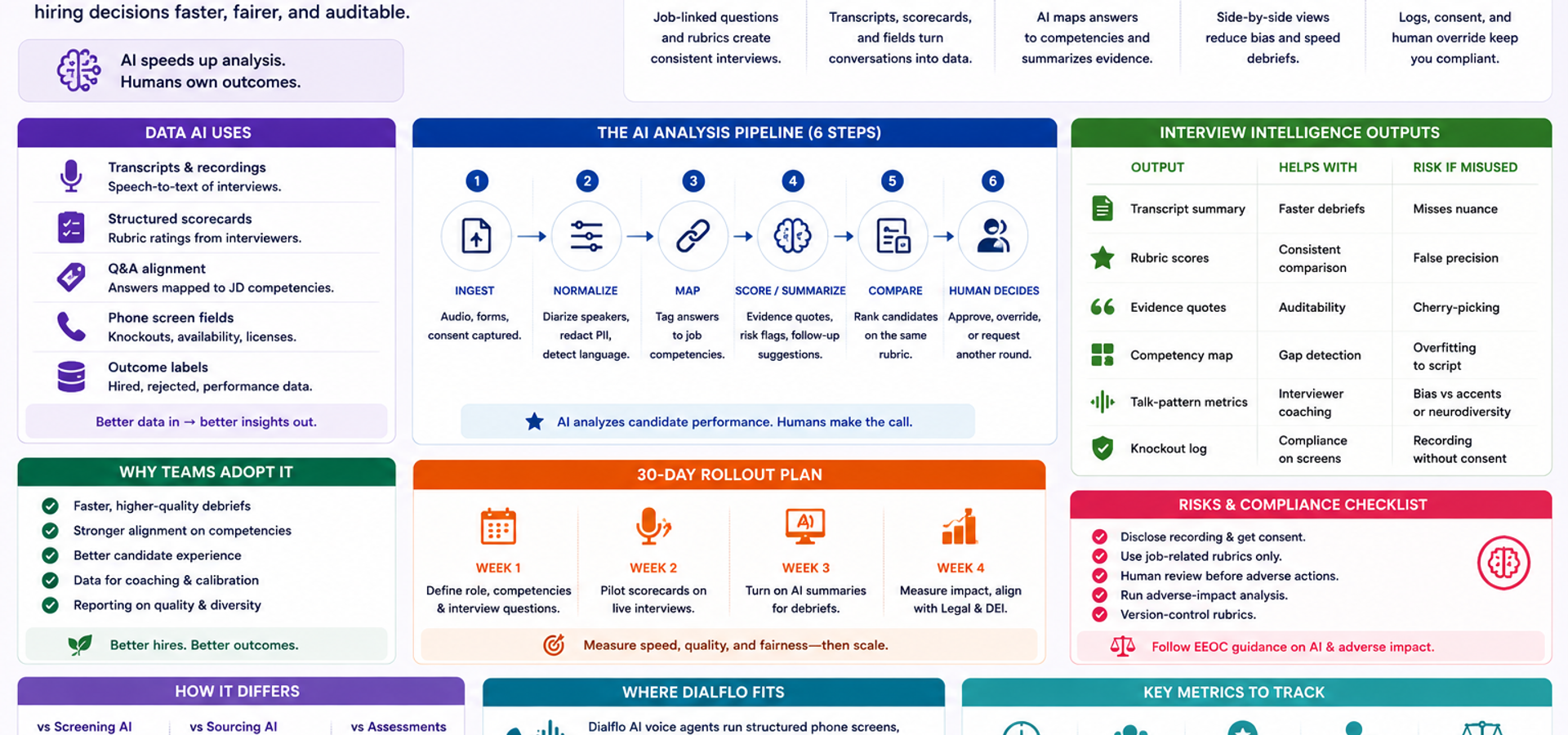
Two interviewers leave the same room with opposite conclusions. Notes live in private docs. Debriefs run late. Strong candidates ghost because nobody aligned on the bar. Interview intelligence is the push to fix that: capture what was said, score it against competencies from the job, and use AI to summarize performance so decisions are faster, fairer, and auditable.
This guide explains how AI analyzes candidate performance in modern hiring, what data it uses, what “scores” actually mean, where teams get value, and where legal and ethical risk hides. For related funnel stages, read generate interview questions from a job description using AI, AI applicant screening, and artificial intelligence in recruitment: complete guide.
What interview intelligence means in 2026
Interview intelligence is not a single product category. It is an operating model:
- Structured questions tied to the job description
- Scorecards with rubric anchors every interviewer uses
- Captured evidence, transcripts, recordings, or structured fields
- Analytics layer that summarizes, compares, and flags gaps
- Governance so humans remain accountable for offers
AI accelerates summarization and pattern detection. It does not remove the need for calibrated hiring managers.
What data AI uses to analyze candidate performance
1) Transcripts and recordings
Speech-to-text turns interviews into text models can parse. Some programs analyze video for engagement proxies, treat those cautiously; fluency and accent are weak proxies for job ability.
2) Structured scorecards
The highest-signal input is often human ratings against predefined competencies, not raw sentiment scores. AI can check whether notes match rubric language and whether interviewers skipped sections.
3) Question–answer alignment
Models map answers to competencies extracted from the JD: “Did the candidate describe measurable impact?” “Did they demonstrate the tool skill?” See JD-based question generation for how to define those links upfront.
4) Phone screen and voice workflow fields
When voice agents capture knockout answers (shift availability, license status, location), those structured fields become interview intelligence inputs before a manager ever joins a Zoom. That is where phone-heavy stacks like Dialflo add consistency upstream.
5) Outcome labels (the feedback loop)
Hired, rejected, onsite pass, 90-day performance ratings, without labels, AI optimizes for eloquence, not results.
How AI analyzes performance: a six-step pipeline
Step 1: Ingest. Audio, transcript, or interviewer form submission enters the system with consent and retention policy documented.
Step 2: Normalize. Diarization (who spoke), redaction of PII where required, language detection.
Step 3: Map to competencies. AI tags segments to rubric dimensions defined from the job, not generic “communication score.”
Step 4: Score or summarize. Outputs may include competency summaries, evidence quotes, risk flags (“vague on leadership scope”), and suggested follow-up probes.
Step 5: Compare across candidates. Debrief views rank slates on the same scale, reducing “favorite candidate” drift.
Step 6: Human decision. Hiring managers approve, override, or request another round, with audit trail.
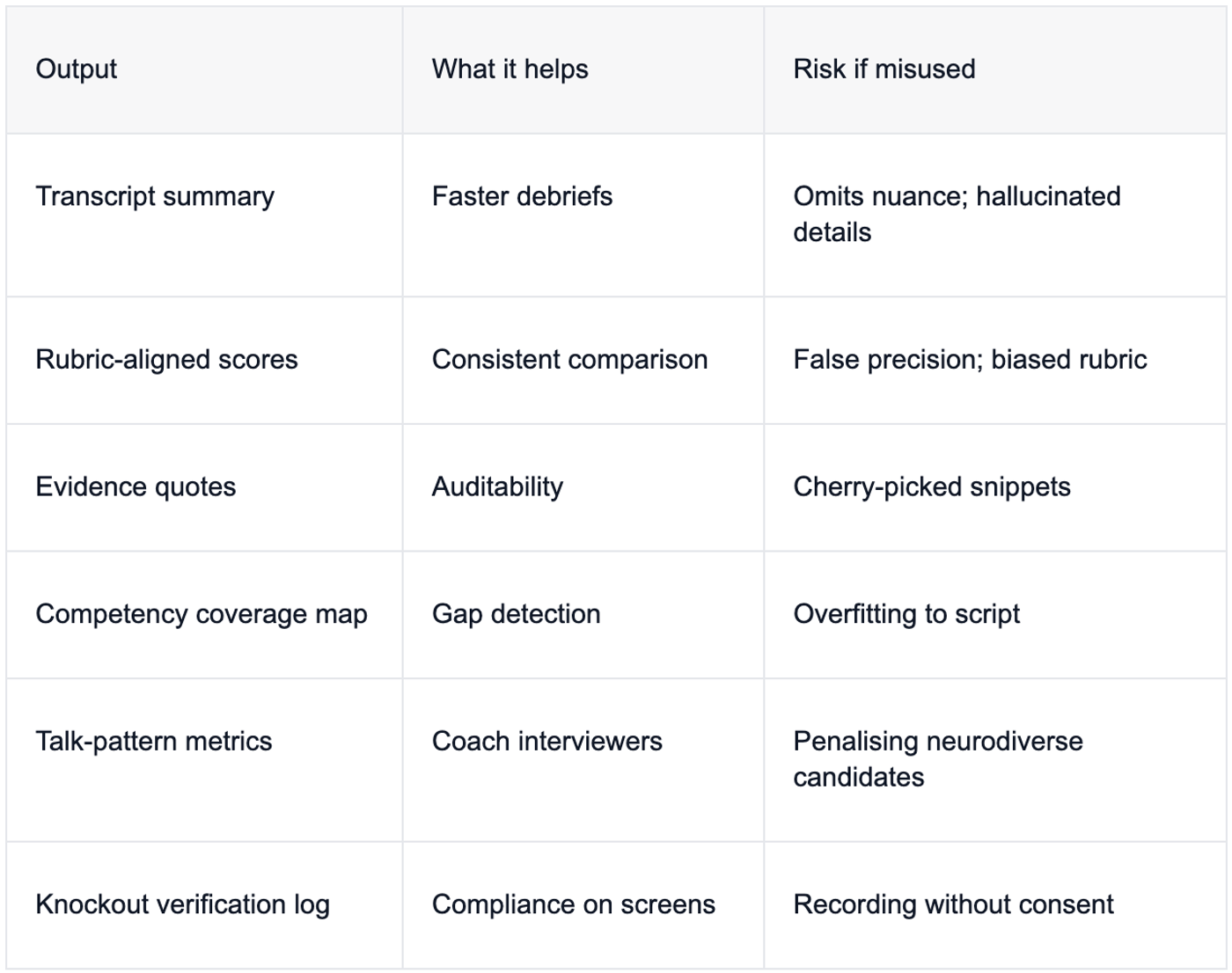
Comparison table: interview intelligence outputs
Why teams adopt interview intelligence (real benefits)
- Faster debriefs with shared summaries instead of scattered notes
- Better alignment on competencies before panels diverge
- Improved candidate experience when feedback loops are respectful and timely
- Training interviewers who consistently under-score or over-score
- Reporting on funnel quality by stage, interviewer, and source
LinkedIn’s Future of Recruiting research notes growing adoption of generative AI in talent workflows, interview intelligence is one visible layer of that shift. Source: LinkedIn: Future of Recruiting 2025.
Governance: what legal and DEI teams will ask
If AI influences who advances, U.S. employers should review EEOC guidance on assessing adverse impact for algorithmic and structured selection procedures. Source: EEOC: AI in selection procedures.
Practical guardrails:
- Disclose recording/analysis where required; obtain consent
- Never score protected characteristics or proxies (accent as “culture fit”)
- Require human review before rejections driven by AI summaries
- Run adverse-impact analysis when rubric scores gate advancement
- Version-control rubrics when reqs change mid-search
- Retain audit logs for compliance questions
SHRM’s talent acquisition toolkit reinforces structured, job-related evaluation as a foundation, AI should reinforce that structure, not bypass it. Source: SHRM: Talent acquisition toolkit.
Interview intelligence vs other AI hiring layers
vs resume screening: resumes predict poorly for many roles; interviews test behavior and judgment, if structured.
vs sourcing AI: sourcing finds people; interview intelligence evaluates conversations after contact.
vs game-based assessments: different signal; combine carefully and document why each layer is job-related.
Deeper ML context: machine learning in recruiting: how it works. Analytics stack: best recruitment analytics software.
Implementation checklist (30-day rollout)
Week 1: Pick one role family. Freeze JD competencies and question bank.
Week 2: Pilot scorecards on live interviews; capture transcripts with consent.
Week 3: Turn on AI summaries for debrief only, humans still vote.
Week 4: Measure debrief time, inter-rater agreement, and whether decisions changed; review with legal/DEI.
Common mistakes
- Scoring without rubrics, AI invents criteria mid-flight.
- Letting fluency substitute for competence, especially on voice and video.
- No interviewer calibration, panels disagree because the bar was never defined.
- Black-box scores in ATS, candidates cannot understand decisions; regulators may ask.
- Skipping phone-screen structure, garbage in, polished summaries out.
Unique angle: intelligence starts before the panel
Most interview intelligence content focuses on Zoom recordings. Many drop-offs happen earlier, phone screens with inconsistent knockouts and missing notes. Structured voice capture upstream makes downstream AI analysis honest instead of decorative.
Where Dialflo fits in the interview intelligence stack
Dialflo provides AI voice agents that run structured phone screens, approved questions, captured answers, scheduling handoffs, so interview intelligence tools analyze consistent fields, not recruiter memory. Pair with AI agents in recruiting (2026) and hire candidates faster with AI tools when designing end-to-end measurement.
FAQ: Interview intelligence and AI performance analysis
What is interview intelligence?
Structured capture and analysis of interview data to improve hiring decisions and debrief quality.
How does AI analyze candidate performance?
From transcripts, scorecards, and structured fields mapped to job competencies, with human oversight.
Is it the same as screening?
No, interview intelligence focuses on live interview signals, not pre-interview resume filters.
What are the main risks?
Bias, over-trusting fluency proxies, privacy, and uncalibrated rubrics.
What metrics matter?
Inter-rater reliability, debrief speed, quality-of-hire proxies, and adverse-impact monitoring.
How does Dialflo help?
Structured voice screens feed reliable data into your interview intelligence layer.
Closing: analyze performance, do not automate judgment
Interview intelligence works when AI analyzes candidate performance against job-related rubrics humans agreed on, not when it replaces debrief judgment with a single number. Build structure first, capture evidence second, apply AI third, and keep offers human-owned.
Strengthen the front of your interview funnel with structured voice screens on Dialflo, then layer analytics on data you can defend.


