Generate Interview Questions from a Job Description with AI

Dialflo: AI Voice Agent
May 20, 2026
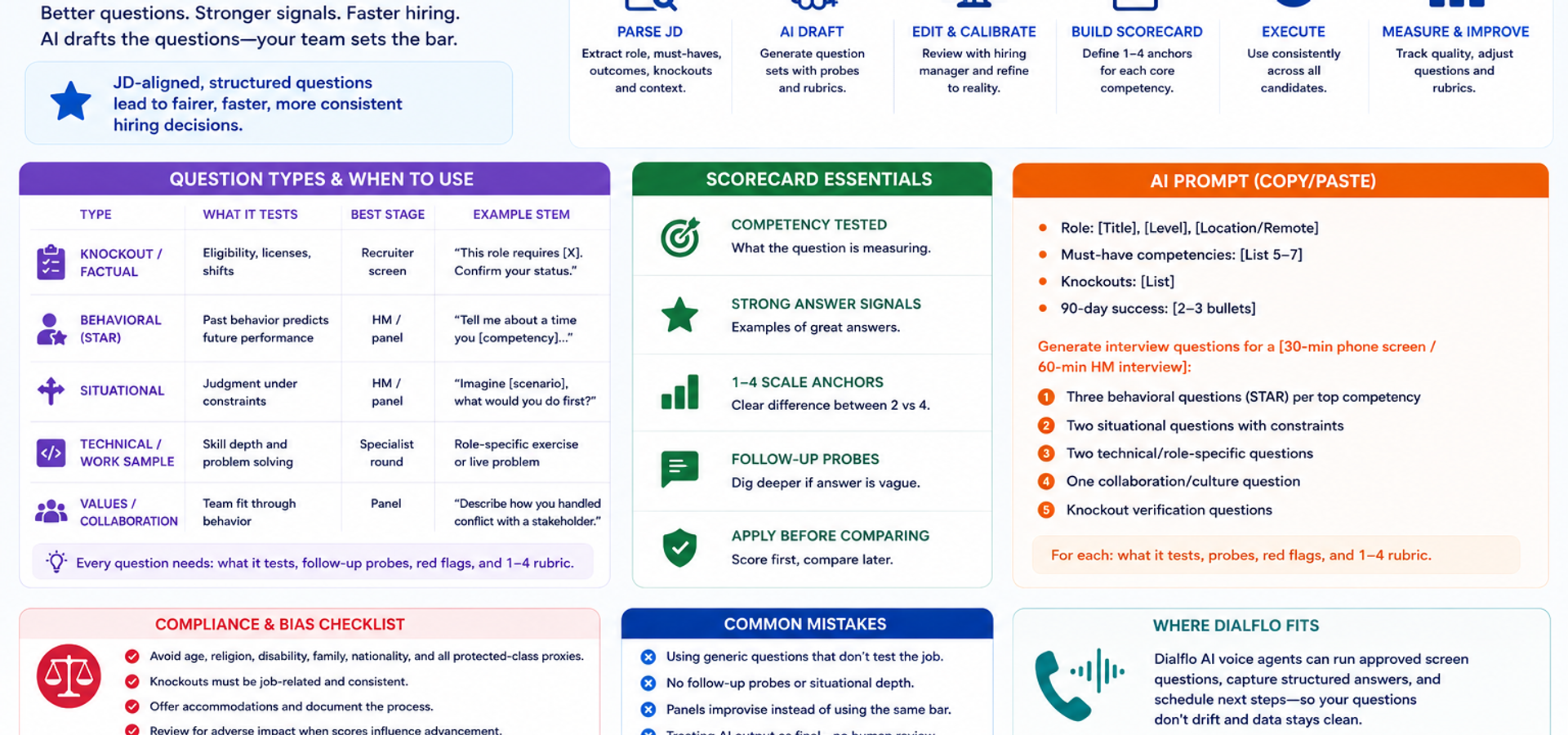
Every hiring manager has sat through interviews that wander,“tell me about yourself” for forty minutes,while the req still goes unfilled. The fix is not more interviews. It is better questions tied to what the job actually requires. Today you can generate interview questions from a job description using AI in minutes, but the win comes from process: parse the JD, draft structured questions, build a scorecard, and keep humans in the loop for compliance and realism.
This guide is for recruiters and hiring managers who want copy-paste prompts, question types that map to competencies, and guardrails so AI assists structured interviewing instead of replacing it. For funnel context, see artificial intelligence in recruitment, AI applicant screening, and ATS SaaS for where question banks should live.
Why JD-based questions beat generic lists
Generic question packs feel efficient and measure nothing reliably. JD-aligned questions test whether candidates can do this job: the tools, decisions, and tradeoffs in your environment. Structured interviewing,same competencies, predefined rubrics,improves consistency and is a standard practice SHRM and enterprise TA teams advocate within talent acquisition programs. Source: SHRM: Talent acquisition toolkit.
AI accelerates the boring first draft. Humans still own accuracy, legality, and tone.
Step 1: Parse the job description into signals
Before any prompt, turn the JD into a brief machines and humans share:
- Role title and level (IC vs manager, years band)
- Top 5 outcomes for first 90 days
- Must-have skills (tools, domains, certifications)
- Knockouts (work authorization, shift, travel, licenses)
- Nice-to-haves (separate so AI does not treat all bullets equally)
- Team context (stakeholders, pace, regulated vs startup)
Strip buzzwords that do not test (“rockstar,” “ninja”). Replace with observable behaviors.
Step 2: Use a structured AI prompt (copy/paste)
Paste this into your AI assistant and replace bracketed fields:
Role: [Title], [Level], [Location/remote policy]
Must-have competencies: [List 5-7]
Knockouts: [List]
90-day success: [2-3 bullets]
Generate interview questions for a [30-min phone screen / 60-min HM interview]:
1) Three behavioral questions (STAR-friendly) per top competency
2) Two situational questions with realistic constraints
3) Two technical or role-specific questions with expected strong-answer signals
4) One culture collaboration question tied to team context
5) Knockout verification questions (factual, not subjective)
For each question, provide: what it tests, follow-up probes, red flags, and a 1-4 rubric anchor.
Avoid questions about age, family, religion, disability, or other protected characteristics. Flag any question that could cause adverse impact.
Run the prompt twice with different temperatures or models if answers feel generic,then merge the best questions into one bank.
Step 3: Organize questions by interview stage
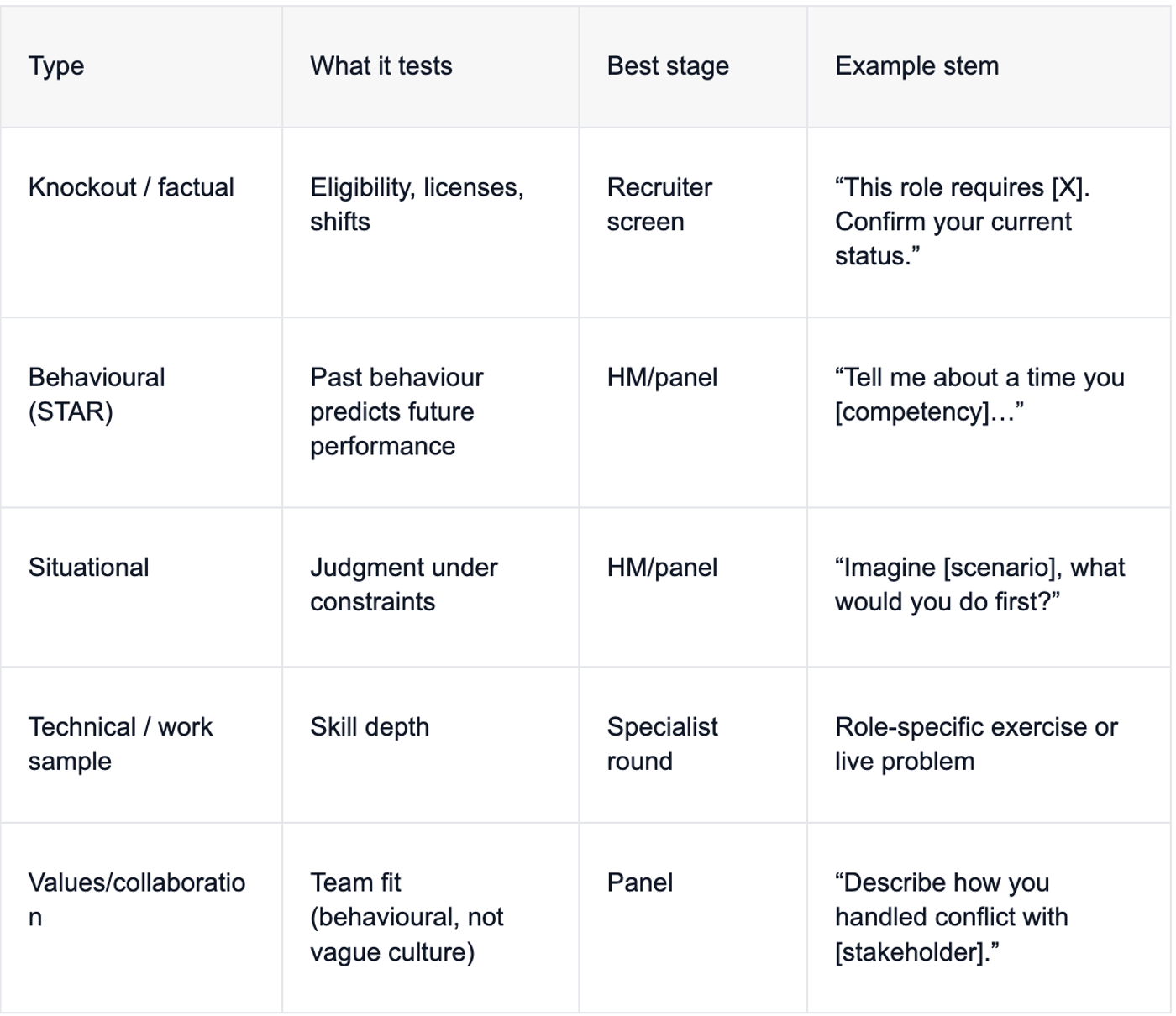
Step 4: Build a scorecard hiring managers will actually use
Questions without rubrics recreate bias. For each core question, define:
- Competency tested
- Strong answer signals (observable facts)
- 1–4 scale anchors (what distinguishes a 2 from a 4)
- Mandatory follow-ups if the candidate is vague
Store the scorecard in your ATS interview kit so panelists submit feedback before debrief. LinkedIn’s recruiting research notes growing use of generative AI in hiring workflows,governance matters as much as speed. Source: LinkedIn: Future of Recruiting 2025.
Step 5: Compliance and bias review (non-optional)
US teams should align scored processes with EEOC guidance on algorithmic and structured selection. Read: EEOC: Assessing adverse impact in AI selection.
Review checklist:
- No protected-class proxies disguised as “culture fit”
- Knockouts are job-related and consistent for all candidates
- Rubrics applied before comparing candidates
- Accommodations path documented for interviews
- Version control when JD or questions change mid-search
Step 6: Calibrate with the hiring manager (30-minute working session)
AI drafts are hypotheses. In a live calibration:
- Walk through top competencies and knockouts.
- Read three AI questions aloud,cut or rewrite weak ones.
- Agree on “bar” examples for a 3 vs 4 score.
- Assign who asks which module in panel interviews.
This step prevents “every interviewer improvises” syndrome.
Common mistakes when using AI for interview questions
- Pasting the whole JD without structure,models overweight fluff.
- One-size-fits-all panels,engineers and recruiters need different modules.
- No follow-up probes,candidates rehearse STAR stories that never get tested.
- Skipping work samples for roles where hands-on proof matters.
- Treating AI output as final,legal and technical reviewers still required.
Unique angle: questions are only useful when executed consistently
Most teams stop at a Google Doc. Winners operationalize: question bank in ATS, scorecards enforced, phone screens that ask the same knockouts every time. That is where voice automation helps,structured execution, not more documents.
Where Dialflo fits: run your question bank on the phone
Dialflo provides AI voice agents for recruiting that can deliver approved screen questions, capture structured answers, and schedule hiring manager interviews,so the questions you generate from a job description using AI actually run at scale without recruiter burnout. Pair with AI agents in recruiting (2026) and hire candidates faster with AI tools when designing the full funnel.
Candidate-side practice is a different use case,see best AI interview practice tools for candidates.
FAQ: Generate interview questions from a job description using AI
How do I generate interview questions from a JD with AI?
Parse the JD into competencies, use a structured prompt for question types and rubrics, then edit and calibrate with the hiring manager.
What should I extract from the JD first?
Must-haves, knockouts, 90-day outcomes, tools, and team context,separate nice-to-haves.
Can AI introduce bias?
Yes. Use structured rubrics, human review, and compliance checks on knockouts.
Do hiring managers need to edit AI questions?
Always,for technical accuracy, realism, and team-specific scenarios.
How many questions per role?
8–12 core per stage plus follow-ups; fewer for phone screens, deeper for panels.
How does Dialflo help?
Voice agents execute approved question banks on phone screens and log structured outcomes to your hiring stack.
Closing: draft fast, calibrate honestly, execute consistently
You can generate interview questions from a job description using AI in one sitting,but hiring quality improves when those questions become scorecards, panel discipline, and phone screens that do not drift. Use AI for the first draft; use your team for the bar; use your stack for consistency.
Ready to operationalize screens? Explore Dialflo for voice workflows built around structured recruiting questions.


