Build vs Buy a Voice AI Stack in India: A Decision Guide

Dialflo: AI Voice Agent
April 28, 2026
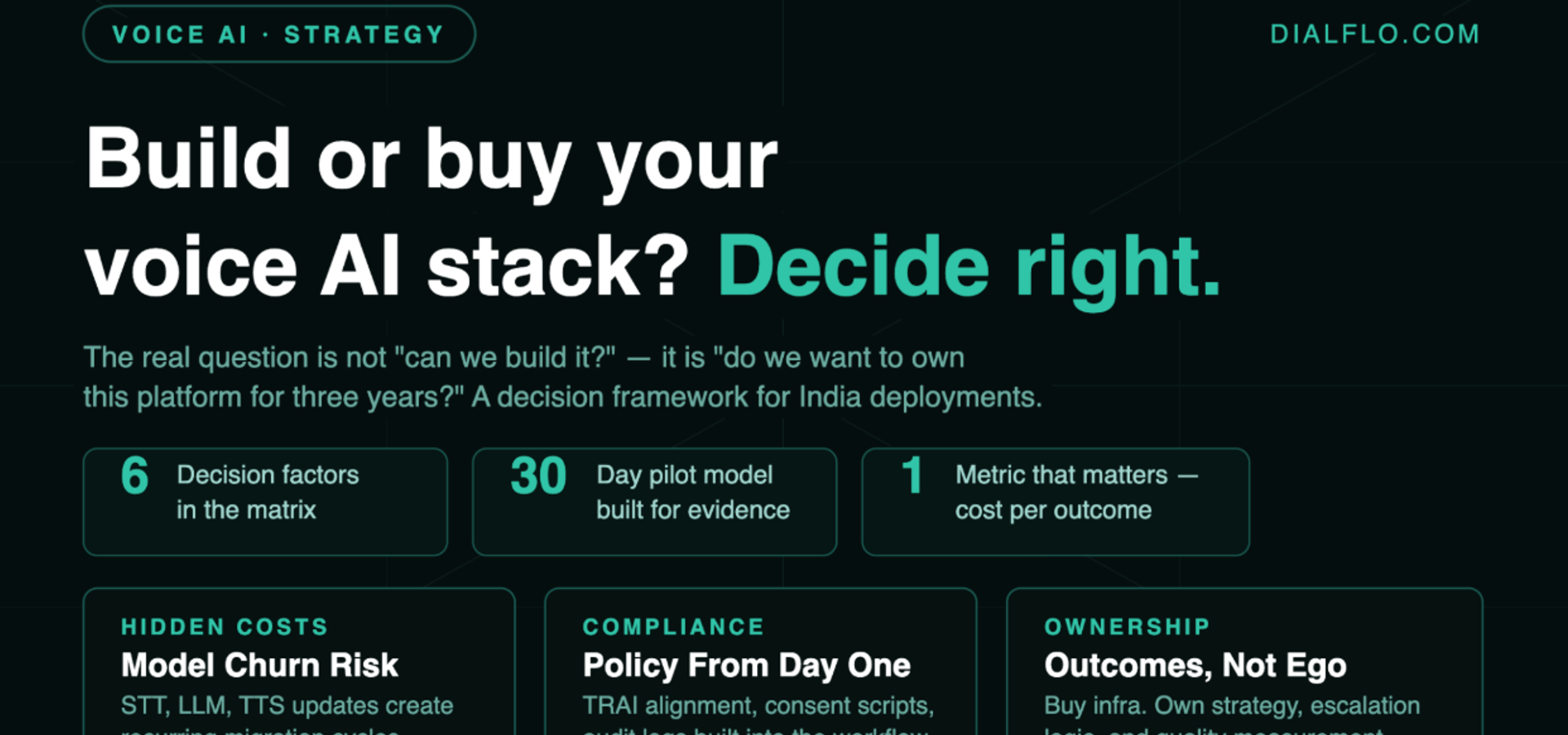
Most teams ask, "Can we build this?" The smarter question is, "Should we own this system for the next three years?"
If your team is debating build vs buy voice AI stack, you are not alone. Across support, collections, hiring, and lead qualification, engineering leaders are being asked to launch voice automation fast while keeping reliability high. The temptation is obvious: strong engineers, modern APIs, and fast prototypes make in-house build seem straightforward. Production reality is rarely that simple.
Teams can build voice AI, but ownership costs compound quickly once the stack has to run reliably at scale. This guide gives you a decision framework built for India-focused deployments, where latency, multilingual behavior, telephony constraints, and compliance pressure often collide in the same workflow.
What a production voice AI stack really includes
A voice agent in production is not one model call. It is a coordinated runtime across telephony, speech-to-text, language reasoning, text-to-speech, interruption handling, routing, retries, fallback paths, analytics, and human escalation. Every layer can fail independently and still break the same customer call.
That complexity is manageable when owned deliberately, but many build-first projects underestimate the ongoing integration burden. During early prototypes, everything looks clean. Under real load, teams discover edge cases: network jitter, noisy audio, mixed-language utterances, long pauses, interrupted prompts, and unexpected call drops that force state recovery.
This is why experienced teams evaluate architecture based on reliability under stress, not quality in a single perfect demo call.
The latency problem is operational, not theoretical
Human conversations are sensitive to delay. Even small response lag can make a voice assistant feel robotic, trigger barge-ins, or reduce trust. The acceptable threshold depends on use case, but lower end-to-end latency almost always improves completion and satisfaction.
For India deployments, routing and infrastructure location can materially influence call experience. Teams should validate expected call paths and number capabilities early using provider guidance, including country-level telephony documentation such as Twilio's India voice guidelines (source).
The build-vs-buy implication is simple: if your team builds in-house, you own latency optimization forever. If you buy, you outsource part of that burden but still need to test real-world performance before scaling.
The hidden cost center: model churn
Most budgeting models treat voice AI as a one-time integration project. In reality, it behaves like a continuously moving platform. STT quality changes, LLM pricing shifts, TTS voices improve, and provider APIs evolve. The stack that looks optimal this quarter may be outdated in the next one.
Each "upgrade" can trigger migrations: prompt retuning, policy revalidation, latency testing, and regression audits. If you build, those cycles are your responsibility. If you buy, a platform may absorb some churn, but you still need governance around quality and risk.
The speech and language model providers behind most voice stacks ship updates every few weeks, so strategic planning should assume change, not stability.
Compliance and policy ownership in India
Voice operations often touch regulated workflows: disclosure scripts, consent language, calling windows, data retention, and escalation policies. For India, teams should design with telecom and industry requirements in mind, including TRAI frameworks and sector-specific obligations where applicable (TRAI).
Build-first projects sometimes treat compliance as legal review after technical rollout. That sequence is risky. Controls should be encoded in the workflow from day one: what can be said, when calls can be made, what triggers transfer to humans, and how logs are retained for auditability.
Whether you build or buy, compliance is not a checklist item. It is part of product design.
Build vs buy decision matrix for engineering leaders
Decision factor
Build in-house is stronger when...
Buy platform is stronger when...
Strategic priority
Voice infrastructure is a core product moat
Voice is an execution layer for operations
Team capacity
You can fund a dedicated platform squad long term
Engineering focus must stay on core roadmap
Speed to value
You can tolerate a longer build and stabilization cycle
You need measurable outcomes in weeks
Compliance operations
You already run mature policy and audit workflows
You need faster operational guardrails out of the box
Model lifecycle ownership
You want full control of migrations and tuning
You prefer managed updates with governance checks
Integration complexity
Custom architecture creates clear differentiation
Standardized integrations are sufficient for ROI
How to estimate total cost honestly
A build-vs-buy model fails when it compares only vendor fees to engineer salaries. Real total cost includes infrastructure spend, observability tooling, QA cycles, on-call burden, compliance support, and recurring migration work. It also includes opportunity cost: what high-leverage product work your team postpones while maintaining voice plumbing.
On the buy side, per-minute pricing can also hide cost drivers: telephony add-ons, failed attempt charges, premium voices, or custom integration services. Teams should normalize all options to one metric: cost per successful business outcome.
For collections this might be payment commitment rate. For hiring it might be qualified interview scheduled. For support it could be issue resolution without repeat contact. If you cannot map spend to an outcome metric, your cost model is incomplete.
Where build-first usually breaks
Most build-first failures are not technical incompetence. They are ownership failures. Teams start with a product goal, then accidentally become infrastructure operators. Over time, they carry patchwork integrations, noisy telemetry, inconsistent prompts, and rising maintenance debt that nobody planned for.
Another common break point is cross-functional misalignment. Engineering optimizes latency, operations prioritizes throughput, legal prioritizes policy controls, and business leaders want conversion lift immediately. Without a shared scorecard, each team declares a different definition of success.
The fix is straightforward: define one operating scorecard before implementation, then evaluate build and buy against the same scoreboard.
A practical 30-day build-vs-buy pilot plan
Week one: choose one high-volume workflow and freeze scope. Agree on baseline metrics: completion, latency, escalation quality, and unit economics.
Week two: run controlled traffic across candidate solutions. Keep scripts, business logic, and evaluation criteria identical so comparisons remain fair.
Week three: stress test edge cases: noisy environments, mixed language input, call interruptions, and policy-sensitive prompts.
Week four: review outcomes with engineering, operations, and leadership together. Decide based on business impact, not developer preference or vendor storytelling.
This pilot model turns debate into evidence. It also prevents expensive commitments based on short demos.
What to own even if you buy
Buying a platform should not mean outsourcing your strategy. Teams must still own call intent design, escalation logic, CRM or ATS mapping, and continuous quality reviews. Those layers define user experience and business outcomes more than raw model choice.
For teams evaluating India-first execution, Dialflo is designed to help operations launch voice workflows quickly while retaining control over business logic and human handoff quality. If you are comparing platform categories, our guide on Vapi vs Bland vs Retell for India can help narrow the shortlist before pilot execution.
The strongest teams treat buy decisions as leverage, not dependency: outsource commodity complexity and keep strategic judgment in-house.
The executive question that decides faster
Instead of asking, "Can engineering build this?" ask, "Do we want to own this platform continuously?" If voice infrastructure is your strategic moat, build may be worth it. If voice is a performance layer for core operations, buying often wins on speed and focus.
In volatile AI cycles, speed of learning beats purity of architecture. The organization that adapts fastest to model, policy, and workflow change usually captures more value than the one that owns every component.
FAQ: build vs buy voice AI stack
Is building in-house always cheaper?
No. Early build estimates often ignore migration work, compliance operations, and ongoing reliability engineering. Total cost can rise sharply after initial deployment.
When should we build instead of buy?
Build when voice infrastructure itself is central to your product differentiation and you can sustain a dedicated platform team over multiple years.
What is the biggest hidden risk in build-first plans?
Model churn. Frequent provider updates create recurring prompt tuning, testing, and migration cycles that consume engineering bandwidth.
How should teams evaluate buy options?
Run a controlled pilot with real traffic, score completion and escalation quality, and compare cost per successful business outcome.
What should we still own if we buy a platform?
Own call strategy, escalation policy, systems integration quality, and ongoing measurement. Those are your competitive levers.
Final takeaway
The real decision is not build versus buy as ideology. It is ownership versus outcomes. If owning voice infrastructure creates durable strategic advantage for your business, build deliberately. If not, buy the infrastructure layer and invest your best talent where differentiation compounds. Let outcomes, not ego, lead.
Leaning towards buying? Book a Dialflo demo to test latency, Indian-language quality and telephony on your own call flows.