Vapi vs Bland vs Retell for India: A Buyer's Guide

Dialflo: AI Voice Agent
April 28, 2026
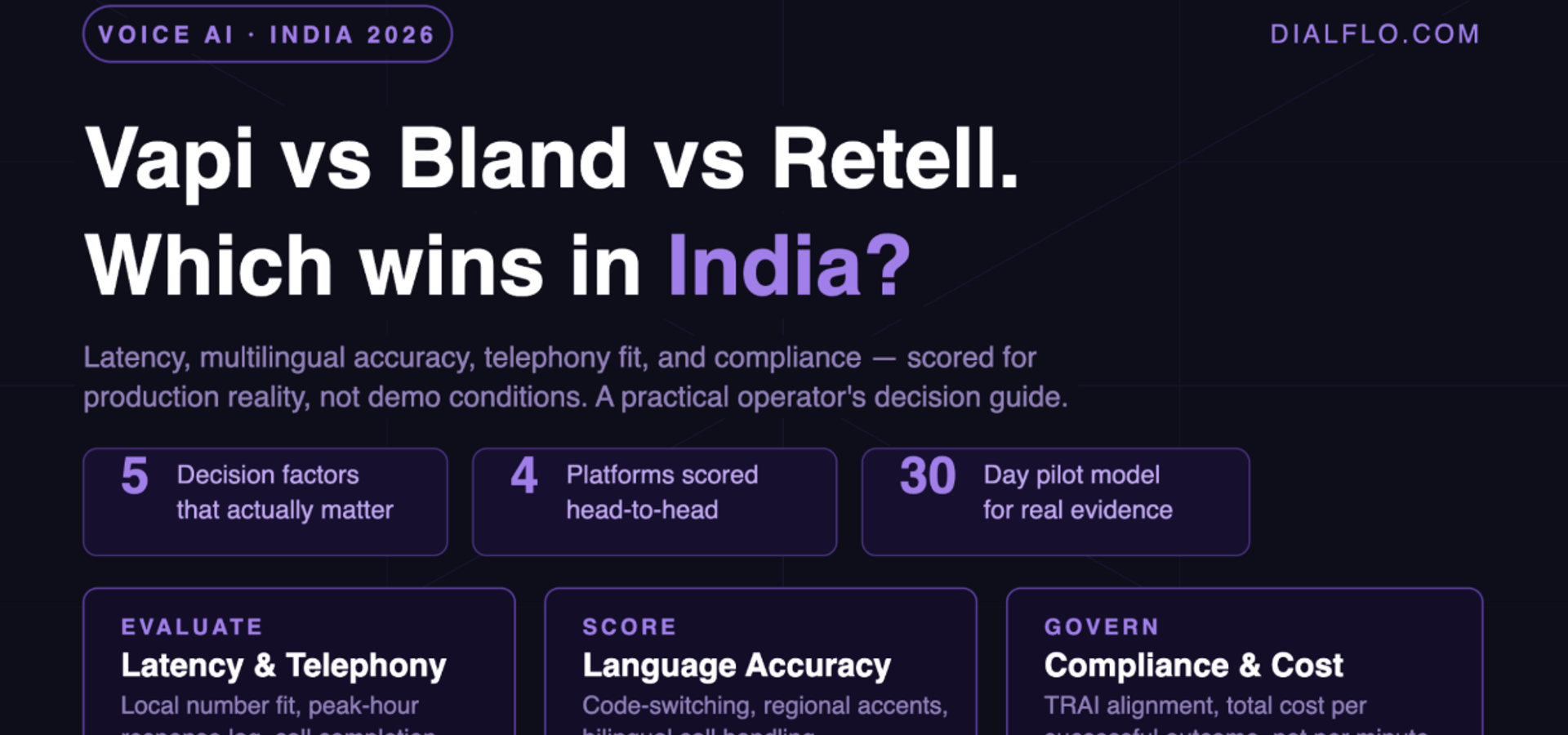
Choosing a voice AI stack for India is not about feature screenshots. It is about reliability under real call traffic, compliance pressure, and multilingual conversations.
If you are comparing Vapi vs Bland vs Retell for India, you are probably past the "AI demo" phase. You are trying to make calls sound natural, route outcomes into your systems, and avoid compliance surprises after go-live. That is exactly where most comparisons on the internet fall short. They list features, but they do not model production reality.
This guide is built for operators, not browsers. We reviewed common implementation patterns, public documentation, and field constraints teams usually discover too late, then turned them into a practical scorecard.
Why most voice AI comparisons fail decision-makers
Most "Vapi vs Bland vs Retell" posts compare developer experience and headline pricing. Those are useful, but incomplete for India deployments. Teams here often deal with mixed language calls, regional accents, local number requirements, and stricter expectations around response quality on first contact.
The right approach is to score the full operating system: telephony, conversation quality, governance, and business metrics.
The five decision factors that actually matter in India
One: end-to-end latency under local traffic. Voice systems are judged in milliseconds, not marketing copy. If response lag rises during peak hours, call completion drops quickly.
Two: telephony and number provisioning fit. Teams should verify local number options and call flow architecture before any major build. This is where many projects stall. Twilio's own documentation can help teams validate country-level constraints for numbers and capabilities (source).
Three: language and code-switching behavior. Many Indian conversations shift between English and regional language context within a single call. Speech systems need to handle that naturally. Research on code-switching ASR quality shows why this is technically hard and often error-prone without targeted optimization (source).
Four: total cost per successful outcome. Sticker price per minute is never the full story. Teams need to include model usage, failed attempts, integration overhead, and support operations.
Five: operational governance. You need clear logs, escalation controls, and policy guardrails from day one. Regulators and enterprise customers care about explainability, not just automation speed.
Platform positioning at a glance
Platform
Core strength
Typical trade-off
Best fit team profile
Vapi
High flexibility and composable architecture
More engineering ownership across components
Technical teams comfortable with custom orchestration
Bland
Simple outbound voice workflow setup
May need tuning for complex multilingual logic
Teams prioritizing speed on standard call flows
Retell
Fast agent prototyping and practical APIs
Production quality depends on integration discipline
Product teams moving from pilot to controlled rollout
Dialflo
India-focused voice operations and deployment support
May not match every custom infrastructure preference
Ops-led teams optimizing India call outcomes quickly
Vapi for India: powerful, but build responsibility stays with you
Vapi is often selected by engineering-led teams that want maximum control over orchestration choices. That flexibility is a real advantage when you have a mature internal stack and want to tune each layer deliberately.
The trade-off is ownership. You still need strong decision-making around speech stack choices, model routing, fallback logic, and reliability monitoring. Teams that underestimate this effort end up with long pilot cycles and delayed business outcomes, even when the technical architecture is sound.
Vapi suits organizations that already run disciplined MLOps and telephony operations in-house. If that is not you, the build burden can outrun your timeline, and a managed platform will get you to reliable live calls sooner.
Bland for India: fast outbound motion, careful tuning required
Bland is attractive for teams that want quick momentum on outbound calling programs. Workflows can be straightforward to define, and teams can move from concept to live calls quickly.
Where teams need caution is conversational depth. If your use case includes nuanced qualification, bilingual context shifts, or many exception branches, you should test edge-case calls early. Outbound speed is valuable, but only when call quality and handoff quality remain stable.
Bland's speed holds up best on short, predictable scripts. Indian calls rarely stay that predictable: callers switch languages, interrupt, and go off-script, so budget for extra design effort or test a platform built for that variability.
Retell for India: practical prototyping, execution quality drives results
Retell is often shortlisted when teams want a balance between usability and developer control. It can be effective for rapid prototyping and early production pilots, especially when product and ops teams collaborate tightly.
The biggest success factor with Retell is execution discipline. Teams need clear prompt governance, escalation logic, and data mapping into ATS or CRM systems. Without that, pilot success can be hard to reproduce after scale.
With Retell, results depend heavily on how much integration and monitoring discipline your own team brings after the pilot ends.
The India reality check: telephony, language, and compliance together
Many evaluations treat telephony, language quality, and compliance as separate workstreams. In production, they are one system. A platform that handles only one of these well still creates operational debt.
For example, a great model response is not enough if call routing introduces lag, or if data handling and communication controls are weak. Indian telecom regulation and anti-spam frameworks are also evolving, so teams should align implementation with official guidance from bodies such as TRAI and legal advisors.
The practical message is simple: buy for your real environment, not a generic benchmark.
How to run a fair 30-day pilot before committing
Week one: choose one workflow with clear baseline metrics. Good examples are lead qualification, appointment confirmation, and first-response support triage.
Week two: run controlled traffic with production-like scripts. Capture response latency, completion rates, human escalation quality, and transcript accuracy by language context.
Week three: pressure-test failure scenarios. Include noisy audio, fast speech, mixed-language responses, and policy-sensitive prompts.
Week four: evaluate total cost per successful outcome. Do not decide on per-minute pricing alone. Include engineering hours, retries, failed calls, and post-call data cleanup effort.
This pilot model gives leadership something rare in AI procurement: a decision anchored in business evidence instead of product demos.
Where Dialflo fits in this comparison
Dialflo is commonly evaluated by teams that need India-first operations without running a long custom build cycle. The platform is designed around production workflows such as screening, scheduling, and re-engagement, with strong emphasis on operational visibility.
If you are deciding whether to build on a developer platform at all, read build vs buy voice AI stack in India. If you already run calls on Retell, see how to migrate from Retell to Dialflo without downtime.
The key is not to choose "the best global tool." The key is to choose the platform that produces reliable outcomes for your users, in your market, with your team structure.
Common mistakes teams make in Vapi vs Bland vs Retell decisions
Mistake one: deciding from test calls only. Production behavior under real volume is what matters.
Mistake two: underestimating integration ownership. Every unresolved handoff becomes recurring manual work.
Mistake three: using one language benchmark. Real calls include mixed phrasing, regional accents, and interruptions.
Mistake four: optimizing for cheapest list rate. The real metric is cost per completed high-quality outcome.
Mistake five: ignoring governance until late. Quality and compliance controls should be built into the first pilot.
Final decision framework
Vapi, Bland, and Retell are developer platforms. They give you building blocks, and your team owns telephony quality, language handling, monitoring, and fixes. That trade-off only makes sense if you have a dedicated voice engineering team and a long runway.
If your priorities are India-first operations, phone-heavy workflows, and reliable production calls without a long build, Dialflo is built for exactly that. Put it in the same pilot as any other shortlist, with identical scripts, scoring, and business metrics, and let the results decide.
Great voice AI buying is not about hype. It is disciplined operator math: quality, reliability, governance, and speed to measurable outcomes.
FAQ: Vapi vs Bland vs Retell for India
Which platform is best for India in 2026?
It depends on who will run it. Vapi, Bland, and Retell suit teams with in-house voice engineers who want to build. Teams that want India-ready telephony, multilingual calls, and production support without a long build are the teams Dialflo is built for. Either way, a controlled India-based pilot is the best decider.
Why is latency such a big deal in voice AI?
Even small delays can break call rhythm, increase interruptions, and lower completion rates. Voice AI must feel responsive to preserve trust and conversation flow.
Can we use US-first platforms successfully in India?
They can work, but plan for extra effort on call routing, Indian-language behavior, and integration, and validate all three with live traffic before full rollout.
How should we compare pricing fairly?
Build a total cost model that includes platform fees, telephony, model usage, retries, engineering effort, and support operations. Then compare cost per successful business outcome, not just cost per minute.
What is the best first use case for piloting?
Start with one high-volume repeatable flow such as qualification or scheduling. It provides fast signal quality while keeping risk contained.
Comparing options for India? Book a Dialflo demo to test Indian-language calls, latency and telephony against your shortlist.