Vapi Alternatives for India: How to Choose the Right Stack

Dialflo: AI Voice Agent
May 12, 2026
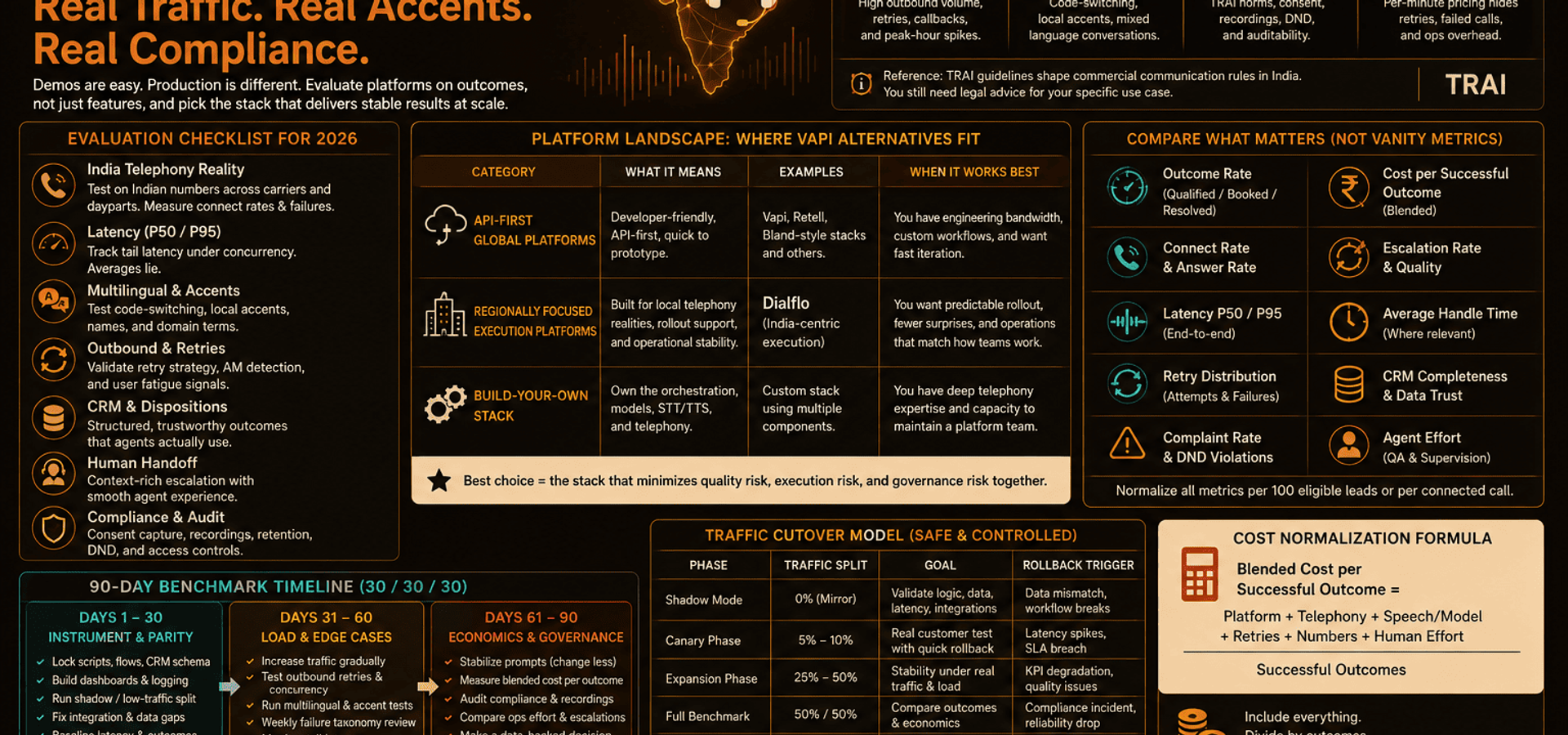
In 2026, the right Vapi alternative for India is the stack that survives your telephony routes, your languages, and your worst traffic hour, not the stack that wins a quiet demo.
Vapi helped popularize an API-first mental model for voice agents: wire up telephony, drop in a model, ship a prototype fast. For many Indian teams, that developer speed is real value, until production traffic introduces a different set of constraints: mixed network quality, multilingual turns, outbound retries, DND and commercial communications norms, and finance questions when “cheap per minute” meets “expensive per successful outcome.”
This guide is a practical map of Vapi alternatives for India in 2026. It is not a dump of logos. It is a decision framework: how to classify alternatives, what to test before you commit, and how to compare total cost and risk the way operators do after they have been burned once by a pretty dashboard.
Why “India 2026” changes the shortlist
Global voice AI platforms are often benchmarked on US assumptions: relatively stable latency, English-first conversations, and telephony workflows that map cleanly to a handful of providers. India deployments frequently differ on three axes.
First, traffic shape. Outbound campaigns, callbacks, and high concurrency support queues behave differently from inbound-only concierge flows. Retry policies change ASR error rates, user patience, and complaint risk.
Second, language reality. Many customer conversations code-switch. A stack that works in textbook Hindi but fails on mixed Hinglish turns will not survive sales or support volumes.
Third, governance expectations. Responsible teams align outreach programs with evolving telecom norms. In India, the Telecom Regulatory Authority of India (TRAI) is the anchor reference for policy and consumer protection themes that shape how commercial communication should be designed. Your counsel still interprets obligations for your use case; your platform must make controls auditable.
Macro context also matters: digital adoption continues to climb, and enterprises are under pressure to automate customer operations while managing risk. For a broad framing of generative AI adoption and governance thinking, see McKinsey’s generative AI explainer materials, useful background for why procurement teams now ask for measurement plans, not only demos.
How to group Vapi alternatives (without fooling yourself)
Alternatives are easier to compare when you place them into three buckets: API-first global platforms, regionally focused execution platforms, and build-your-own stacks. The “best” option depends on whether your bottleneck is integration speed, production stability, or full control.
API-first global platforms (including Vapi itself, and peers such as Retell and Bland-style stacks) often win early because a strong developer can ship quickly. The risk shows up later: telephony edge cases, cost drift, and operational workload when prompts regress under real traffic.
Regionally focused execution platforms optimize for deployment realities in specific markets, routing, latency discipline, rollout support, and workflows that match how local teams actually run contact centers and inside sales.
Build-your-own can win when you have unusual constraints, deep telephony expertise, and budget to maintain a platform team. It loses when leadership thinks “we can glue APIs over a weekend” and ends up owning a full-time reliability problem.
For a three-way platform shootout with India buyer questions, read Vapi vs Bland vs Retell: India buyer’s guide (2026). It complements this post because it compares named stacks directly; here we focus on how to choose among any alternative list you assemble.
The evaluation checklist: what India teams should test in 2026
If you only run five happy-path calls, every vendor looks fine. A serious evaluation for Vapi alternatives for India in 2026 should include the following tests, documented with timestamps and owners.
Telephony realism. Use India numbers, including the carriers your customers actually use. Measure connect rates and failure codes across dayparts.
Latency tails. Track P50 and P95 end-to-end response latency under load. Averages lie. For methodology discipline, read Retell review for Indian teams: latency, compliance, and dialer limits, even if Retell is not your final pick, the measurement approach transfers.
Outbound and retry behavior. If you run campaigns, simulate safe retry cadence and measure user fatigue signals like short abandons and complaints.
CRM and ticketing truth. Dispositions must be structured enough that downstream teams trust them. Fluffy summaries create rework.
Human handoff. Escalations should carry context. If your alternative makes agents re-interview the customer, you have not bought automation, you have bought an IVR with extra steps.
Compliance sampling. Recording retention, access control, consent capture, and audit logs should be tested like features, not like footnotes.
Cost: normalize to “per successful outcome,” not “per minute”
Pricing pages optimize for signup. Production invoices optimize for reality. When comparing Vapi alternatives for India in 2026, build a blended model that includes platform fees, telephony, speech components, model usage, failed attempts, number rental, and the human QA hours required to keep quality stable.
Then divide by outcomes: qualified leads, appointments booked, tickets resolved, or payments confirmed, whatever matches your use case. For a detailed breakdown pattern applied to Retell vs Dialflo economics (the layering logic generalizes), see Retell vs Dialflo: India pricing and hidden cost patterns.
Build vs buy: when an alternative should not be a vendor at all
Sometimes the right “alternative” is internal: own the orchestration layer, integrate STT/TTS and models directly, and accept operational responsibility. That path can work for large engineering organizations with telephony depth.
Most growth-stage teams underestimate ongoing maintenance: prompt regressions, model churn, carrier changes, and incident response. If you are weighing build seriously, read build vs buy voice AI stack in India (2026) before you commit quarters of roadmap to glue code.
Where Dialflo fits in the Vapi-alternatives landscape
Dialflo is not positioned as “the same API, different logo.” It is positioned for India-centric execution: voice agents designed to survive production calling workflows, with rollout discipline and an operator mindset. Teams evaluating Vapi alternatives for India in 2026 often bring Dialflo in when their bottleneck shifts from prototype speed to stable outcomes under concurrency.
If you are already on a global API-first stack and considering switching, the operational lessons in best Retell alternative for India: why teams switch to Dialflo map closely to why teams evaluate alternatives to any developer-first vendor, Vapi included: latency tails, telephony surprises, and cost normalization at scale.
If you need a disciplined benchmark methodology rather than a subjective bake-off, use Retell vs Dialflo: 90-day performance benchmark as a template for KPI design, phased traffic splits, and governance, swap the vendor names, keep the measurement spine.
To evaluate Dialflo directly, start at dialflo.ai with your call volumes, languages, and compliance constraints.
2026 roadmap hygiene: what to ask vendors about model and stack churn
Voice stacks are moving targets. Models update, default voices change, and telephony routes shift. Ask vendors how they communicate breaking changes, how they version prompts, and how they support rollbacks when a release regresses ASR quality for your accent profile.
Also ask how they help you avoid “shadow production,” where a team member edits prompts in a sandbox that never matches live. Change control is not bureaucracy; it is how you keep benchmarks honest month to month.
Vertical realities: why the same API behaves differently across use cases
Healthcare reminders, lending collections, logistics status calls, and e-commerce order confirmations all sound like “outbound voice” on a roadmap slide. In production they diverge: consent language, escalation rules, PII handling, and acceptable retry cadence differ materially. When you evaluate Vapi alternatives for India in 2026, run at least one pilot scenario per major vertical you support, or you will choose a stack that wins on your easiest workflow and fails on the one that drives margin.
Security reviews are also part of the 2026 shortlist. Ask for SOC2 posture where relevant, data residency options if your enterprise security team requires them, and clear answers on who can access recordings and transcripts. If a vendor treats security questionnaires as optional, you will pay for that later in procurement delays.
Connectivity and customer expectations: why benchmarks must include mobile reality
India’s internet user base is large and mobile-first; long-term connectivity trends shape how customers experience voice apps and callback workflows. Reference indicators such as World Bank internet user statistics for India as a reminder to test on real devices and real networks, not only office Wi-Fi with a high-end headset.
FAQ: Vapi alternatives for India in 2026
What are the best Vapi alternatives for India in 2026?
The best fit depends on your workflow, but prioritize platforms that pass Indian telephony tests, multilingual needs, compliance controls, and blended cost per successful outcome. Dialflo is a strong candidate when execution and India-centric rollout matter.
Why do India teams look for Vapi alternatives?
Common triggers are latency inconsistency, telephony integration pain, multilingual gaps, invoice surprises at scale, and high operational overhead to maintain quality.
Is Dialflo a Vapi alternative for India?
Yes, in the sense that teams choose Dialflo when they want India-first production voice agents and rollout support. Validate with your own pilot KPIs.
What should a 2026 India pilot include?
India routes, busy hours, outbound retries if applicable, CRM write-backs, and compliance sampling. Measure tail latency and outcomes, not only averages.
How do I avoid hidden cost when comparing alternatives?
Model all telephony and speech costs, failed attempts, rentals, and QA time. Divide by successes.
Where can I read deeper comparisons?
Start with Dialflo’s Vapi vs Bland vs Retell guide and the Retell vs Dialflo pricing article on dialflo.ai.
Closing: pick the alternative that wins your production graph
The right entry in your Vapi alternatives for India in 2026 shortlist is the one that stays boring when traffic spikes: stable latency, trustworthy CRM output, defensible compliance behavior, and a cost curve your finance team can explain.
If you want help turning this checklist into a pilot charter, contact Dialflo via dialflo.ai, bring your traffic curve, not your feature wish list.