GEM ATS Review: Features, Pricing and Sourcing

Dialflo: AI Voice Agent
May 7, 2026
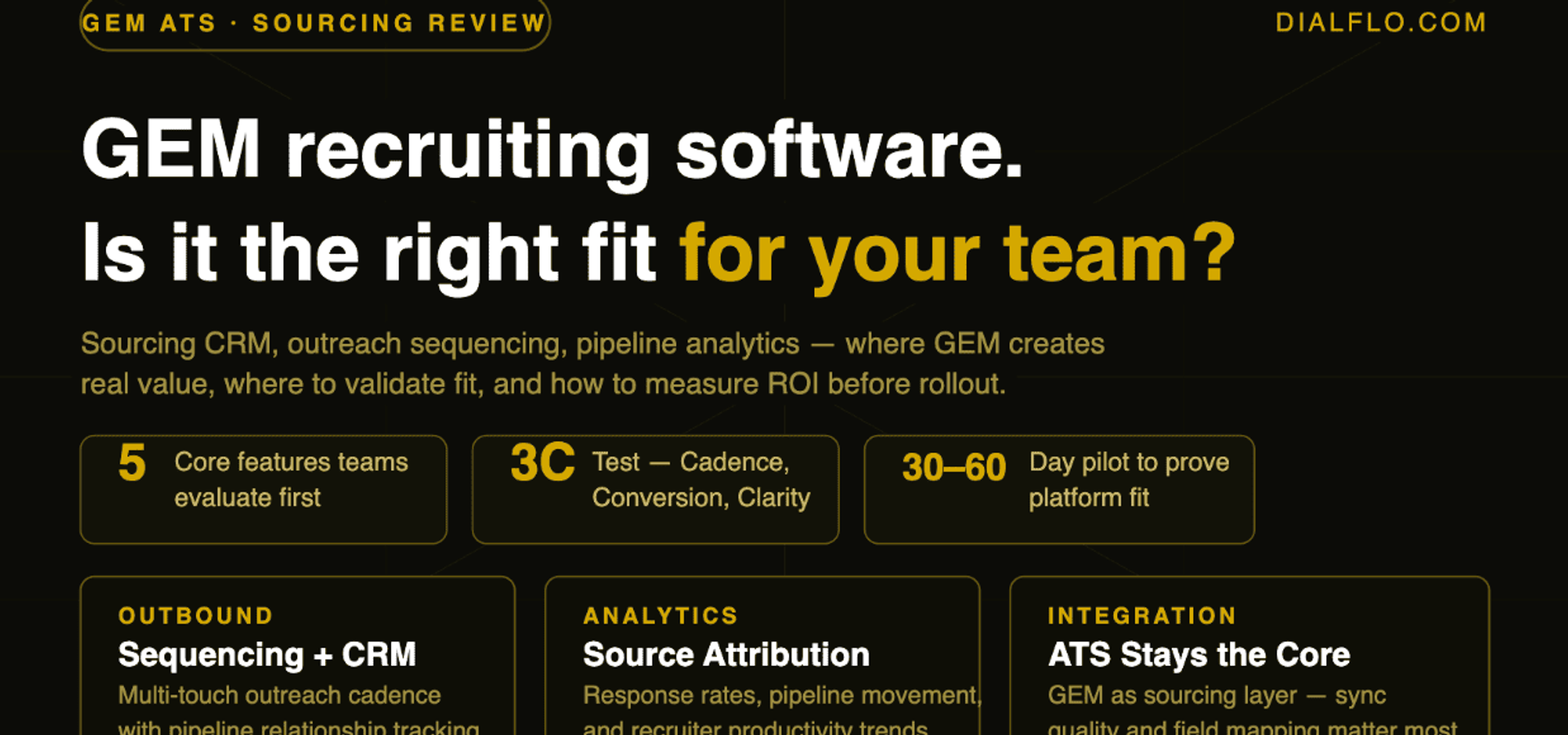
GEM helps recruiting teams structure outbound sourcing, improve response rates, and monitor funnel performance across hiring campaigns.
If you are researching gem ats recruiting software candidate sourcing company overview queries, you are likely trying to answer one practical question: is GEM the right platform for your recruiting workflow, budget, and team maturity? This review is built for that decision. Instead of generic feature lists, it explains where GEM creates real value, where teams should validate fit carefully, and how to evaluate ROI before rollout.
Modern recruiting is no longer only about posting jobs and waiting for inbound applications. Many roles now depend on proactive outbound sourcing, candidate relationship nurturing, and consistent multi-touch communication. That shift has made recruiting tech stacks more complex, and many teams are looking for systems that improve sourcing execution without disrupting ATS foundations. GEM is one of the well-known platforms in this category.
What GEM is positioned to solve
GEM is generally positioned as a recruiting CRM and sourcing productivity layer that integrates with ATS systems. Its core value proposition is helping talent teams run outbound programs more efficiently while improving candidate pipeline visibility and conversion tracking.
In many organizations, ATS platforms are strong for requisition tracking and compliance but weaker for proactive relationship workflows. Recruiters often compensate with spreadsheets, manual follow-ups, disconnected messaging tools, and fragmented reporting. That leads to slow cycle times and poor visibility across talent pipelines. GEM aims to close that gap by centralizing sourcing operations.
From a category perspective, this fits broader HR technology trends where recruiting teams prioritize process automation and analytics for hiring quality and speed. Sources such as LinkedIn Talent resources and SHRM regularly highlight the operational importance of candidate experience, timely outreach, and data-driven hiring process management.
Sources: LinkedIn Talent Solutions and SHRM.
Core GEM features recruiters evaluate first
Most buying decisions focus on whether GEM improves recruiter throughput and sourcing outcomes. These are the capabilities teams usually test first during evaluations:
Outreach sequencing and automation. Recruiters can create structured outreach sequences, schedule follow-ups, and standardize communication steps across candidate cohorts.
Candidate relationship tracking. Talent teams can organize prospects by campaign, role type, stage, and engagement history to avoid duplicate or disconnected communication.
Pipeline analytics and attribution. Hiring teams can monitor source performance, engagement rates, pipeline movement, and response trends to optimize sourcing strategy.
Recruiter productivity workflows. Features often support reduced manual admin, template reuse, and faster progression from prospect identification to qualified pipeline movement.
ATS integration layer. For many teams this is critical, because value depends on data synchronization quality between GEM and existing ATS systems.
The platform's usefulness rises significantly when these functions are implemented with clear operating rules and recruiter adoption plans. Tools alone do not fix process inconsistency.
GEM pricing: what buyers should expect
Like many recruiting technology platforms in the mid-market and enterprise segment, GEM pricing is commonly quote-based rather than simple self-serve tiers. That means total cost depends on factors such as team size, module scope, support level, and integration complexity.
When comparing proposals, evaluate more than software subscription numbers:
- License model: per-seat, usage-based, or bundled pricing structures.
- Implementation cost: onboarding, setup, data migration, and integration effort.
- Support scope: customer success involvement, training quality, and SLA expectations.
- Expansion cost: incremental pricing for additional recruiters, regions, or workflows.
- Total annual ownership: software + internal admin time + workflow maintenance overhead.
A practical recommendation is to request a 12-month total-cost model and a projected value model before signing. Ask vendors to define expected performance shifts in response rates, qualified pipeline creation, and recruiter productivity metrics.
Sourcing capabilities: where GEM can create measurable impact
The strongest case for GEM typically appears in teams where outbound recruiting is central to hiring outcomes. In these environments, candidate sourcing performance depends on consistent messaging cadence, segmentation discipline, and conversion tracking.
High-impact sourcing capabilities usually include:
Segmented campaign execution. Build role- or function-specific outreach strategies instead of one generic message stream.
Follow-up consistency. Automate multi-touch outreach logic so recruiters do not lose candidates due to manual follow-up gaps.
Performance visibility. See which messages, channels, and recruiter actions correlate with stronger response quality.
Collaboration handoffs. Improve transitions between sourcers, recruiters, and hiring managers with shared candidate context.
For companies hiring at scale, even modest improvements in these areas can translate into faster pipeline generation and reduced time-to-fill for critical roles.
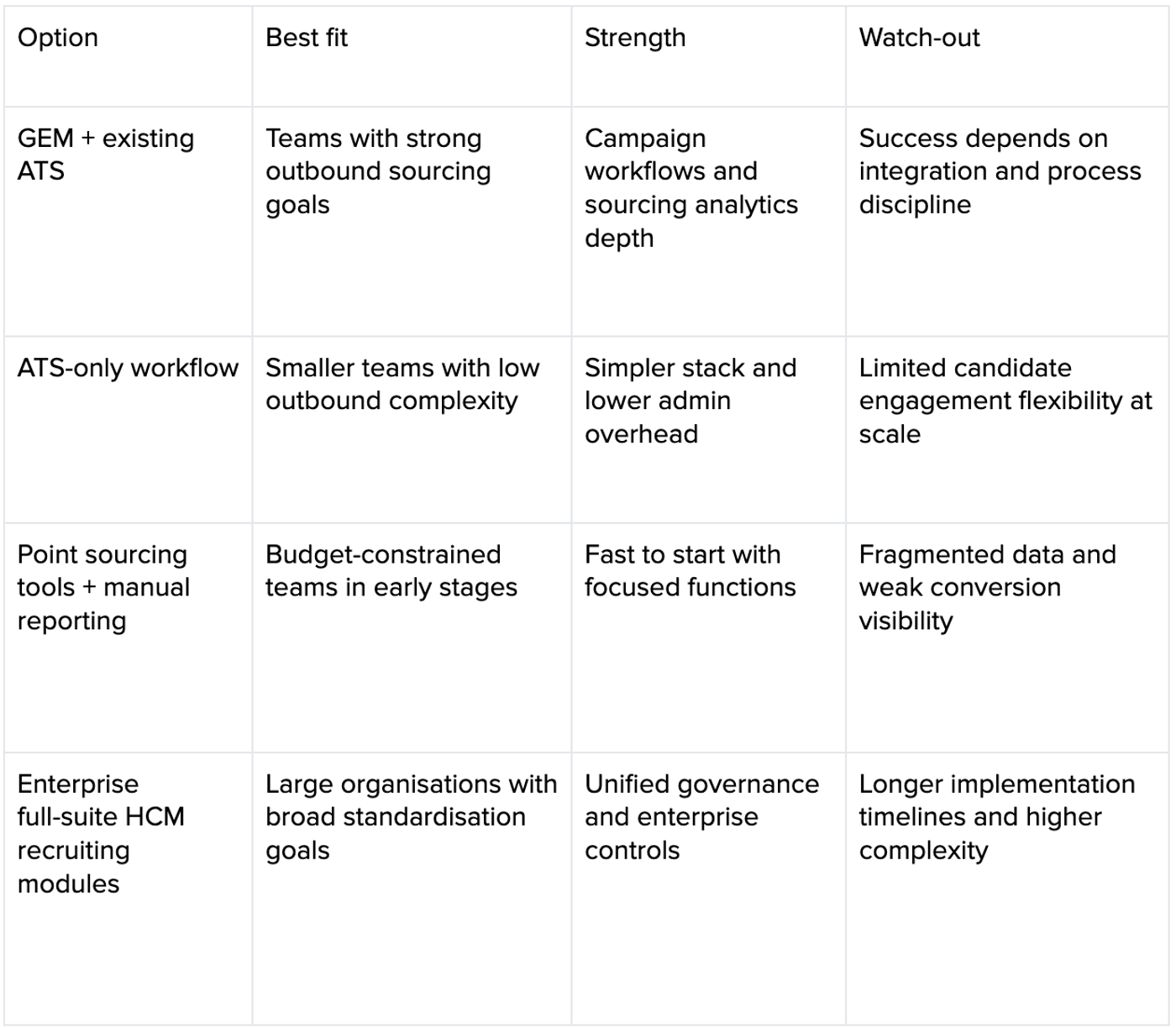
Comparison: GEM vs recruiting stack alternatives
Who should consider GEM recruiting software
GEM is often most useful for teams with clear outbound recruiting requirements and measurable hiring targets. Typical strong-fit profiles include:
- mid-size and enterprise organizations with active sourcing programs
- teams hiring for hard-to-fill roles where outbound quality matters
- recruiting functions needing better campaign-level analytics
- organizations where ATS workflows are stable but sourcing is inconsistent
- talent leaders focused on recruiter productivity and standardized process design
It may be less urgent for organizations with very low hiring volume, minimal outbound activity, or no operational capacity to maintain campaign discipline.
Implementation realities: what determines success after purchase
Most recruiting software ROI comes from adoption and process design, not feature count. For GEM specifically, implementation quality often decides whether teams gain meaningful outcomes.
1) Define campaign architecture early
Set standards for segmentation, messaging templates, follow-up cadence, and ownership before launch. Without this, campaigns become inconsistent and hard to compare.
2) Clean integration mapping
Confirm field mapping and sync logic between ATS and GEM to prevent duplicate records, missing stage updates, or reporting drift.
3) Recruiter training and governance
Provide practical onboarding for recruiters and sourcers, then run monthly quality reviews on campaign hygiene and outreach outcomes.
4) KPI baseline before go-live
Capture baseline metrics so you can measure actual impact. Recommended metrics include response rate, recruiter touches per hire, time-to-qualified-pipeline, and conversion by source.
5) Phased rollout
Start with one business unit or role family, then expand after workflow reliability is proven. This reduces risk and improves internal trust.
Strengths and limitations: balanced review view
No platform is universally ideal. A fair GEM ATS review should consider both upside and constraints.
Potential strengths:
- structured outbound workflow support for modern sourcing teams
- better visibility into campaign and pipeline performance
- potential productivity gains for recruiters managing high outreach volume
- integration-based approach that can preserve existing ATS investments
Potential limitations:
- value depends heavily on operating maturity and recruiter adoption
- quote-based pricing can make early-stage budgeting less predictable
- integration quality and process governance are ongoing responsibilities
- teams expecting fully autonomous recruiting outcomes may be disappointed
In short, GEM can be a strong multiplier for disciplined teams, but it is not a substitute for clear sourcing strategy or recruiting management fundamentals.
Original framework: the 3C test for GEM evaluation
To make procurement decisions faster, use this practical 3C framework during trial phases:
Cadence. Does GEM improve follow-up consistency and campaign execution speed without adding admin overhead?
Conversion. Do response quality and pipeline progression rates improve versus your baseline within 30-60 days?
Clarity. Can recruiting leaders get actionable visibility into source quality, recruiter activity, and funnel bottlenecks?
If all three improve in a controlled pilot, platform fit is usually strong. If only one improves, focus on process redesign before scaling licenses.
Where Dialflo can complement recruiting workflows
Sourcing software improves campaign logic and pipeline management, but many recruiting teams still face execution delays in communication touchpoints like candidate confirmations, interview reminders, and response follow-ups. Those delays can reduce conversion even when pipeline quality is high.
Dialflo is an AI voice agent platform that supports communication-heavy workflows through automated, structured calling interactions. It is not an ATS replacement, but for teams where candidate engagement speed is a bottleneck, voice automation can complement digital sourcing systems by reducing outreach latency and missed touchpoints.
FAQ: GEM ATS recruiting software and sourcing overview
What is GEM used for in recruiting?
GEM is typically used to improve outbound sourcing, recruiter workflows, campaign execution, and pipeline analytics while working alongside an existing ATS.
Is GEM a full ATS replacement?
In many cases, no. Teams often use GEM as a sourcing and recruiting CRM layer integrated with an ATS that remains the core system of record.
How should we evaluate GEM pricing?
Request a full annual cost model including licensing, setup, integration, support, and expected expansion costs. Compare this against baseline recruiting KPI improvement targets.
Which teams get most value from GEM sourcing capabilities?
Teams with high outbound recruiting volume, structured campaign operations, and accountability around response and conversion metrics generally benefit most.
What metrics should we track in a GEM pilot?
Track response rate, recruiter productivity, time-to-qualified-pipeline, pipeline conversion by source, and time-to-fill changes for targeted roles.
How does Dialflo relate to GEM and sourcing?
Dialflo can complement sourcing workflows through voice-based candidate communication automation, helping teams reduce follow-up delays in recruiting operations.
Closing: evaluate GEM by workflow outcomes, not feature volume
A high-quality GEM ATS review should focus on operational outcomes: better sourcing cadence, stronger conversion visibility, and measurable recruiter productivity gains. If your team has outbound complexity and clear hiring targets, GEM can be a strong fit when implemented with discipline.
Use pilot metrics, integration quality checks, and governance plans to make a confident decision. Recruiting software creates value when it improves execution every day, not just dashboards during demos.


