ATS SaaS: What It Is & Best Platforms

Dialflo: AI Voice Agent
May 25, 2026
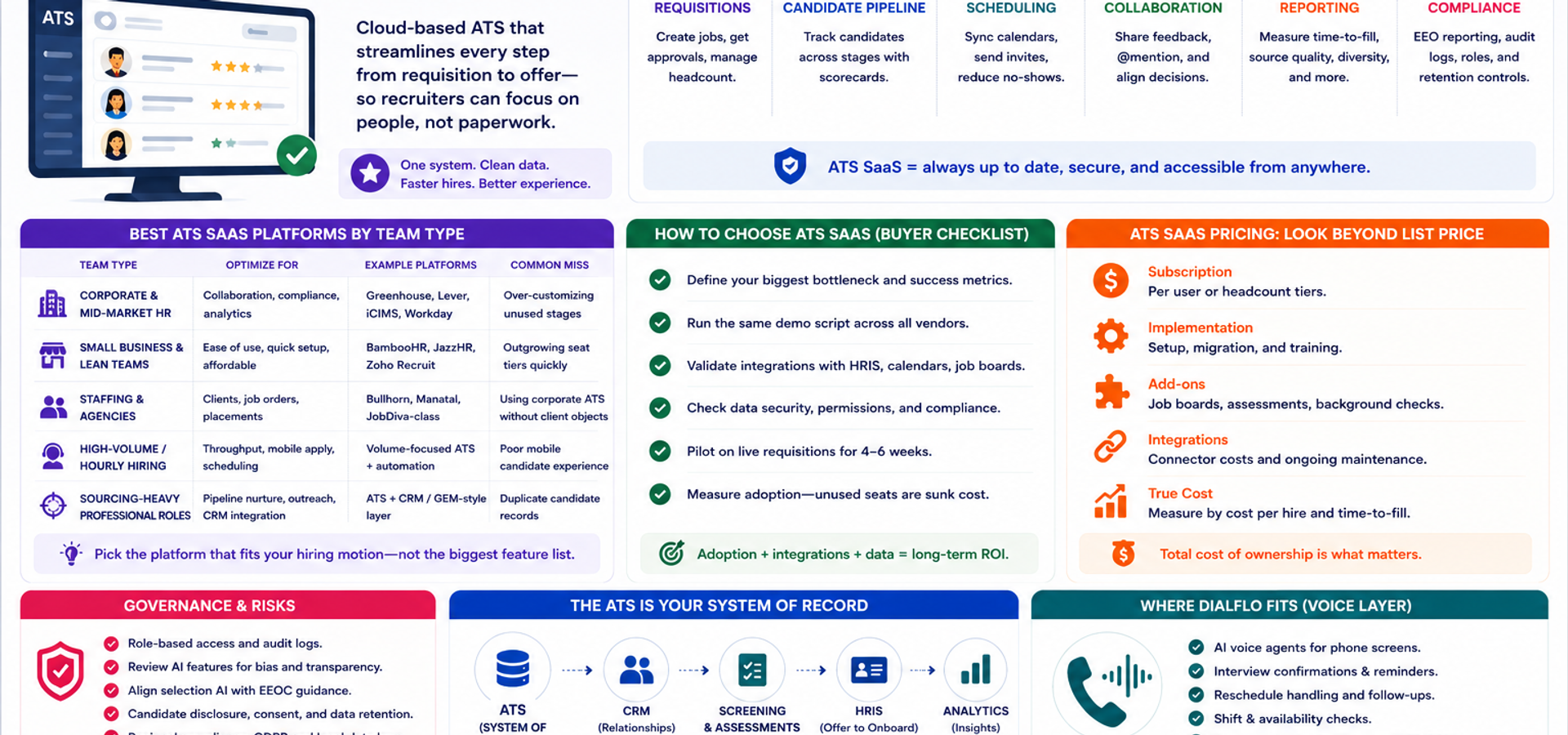
Every hiring stack conversation eventually lands on three letters: ATS. When procurement adds “SaaS,” they mean your applicant tracking runs in the cloud, browser access, vendor updates, subscription pricing, not a server project that finishes after the req is already stale. If you are evaluating ATS SaaS for the first time or replacing a tool recruiters quietly hate, this guide is built for that decision.
Below: what ATS SaaS is, what it must do, which platform categories fit which teams, how to buy without demo theater, and where voice automation plugs in after you pick the spine. For cloud context, read cloud-based recruitment software: benefits & tools. For relationship data beyond reqs, see candidate relationship management system.
What is ATS SaaS?
An Applicant Tracking System (ATS) manages hiring workflows: job postings, applications, interview stages, offers, and reporting. ATS SaaS delivers that capability as software-as-a-service, hosted by the vendor, accessed in a browser, updated continuously, and typically sold per recruiter seat or employee headcount band.
Compared with legacy on-premise recruiting databases, cloud ATS usually offers:
- faster rollout without infrastructure projects
- mobile access for hiring managers
- marketplace integrations (job boards, assessments, HRIS)
- vendor-managed security patches and uptime SLAs
LinkedIn’s talent acquisition research shows teams investing in technology to improve speed and candidate experience, cloud ATS is the spine most tools plug into. Source: LinkedIn: Future of Recruiting 2025.
What ATS SaaS should do (core modules)
Vendor naming varies, but production-grade ATS SaaS usually includes:
Requisition and approvals. Headcount, job description templates, compliance fields.
Candidate pipeline. Stages, dispositions, scorecards, audit history.
Interview scheduling. Native or integrated, calendar sync matters more than slide claims.
Hiring manager collaboration. Feedback, @mentions, structured evaluations.
Compliance and EEO reporting. Especially for US and enterprise buyers, validate with counsel.
Analytics. Time-in-stage, source quality, diversity funnels, offer metrics, extend with recruitment analytics software when leaders need one view.
Integrations. HRIS handoff, background checks, assessments, sourcing tools.
SHRM frames hiring as cross-functional, your ATS should make handoffs visible, not hide them in inboxes. Source: SHRM: Talent acquisition toolkit.
Best ATS SaaS platforms by team type (2026 framing)
There is no universal winner. Use fit bands, and confirm live pricing, data residency, and integrations.
Corporate and mid-market HR (single employer)
Teams hiring across departments often shortlist Greenhouse, Lever, iCIMS, and Workday Recruiting (especially when HRIS is already Workday). Prioritize scorecards, approvals, and reporting depth.
Small business and lean HR teams
SMB buyers need fast setup and predictable cost, categories often include BambooHR (hiring module), JazzHR, and Zoho Recruit. Watch per-seat scaling as headcount grows.
Staffing and recruitment agencies
Agencies need client records, job orders, submittals, and placements, not only corporate reqs. Compare stacks in ATS for staffing agencies compared and AI staffing for automation context.
High-volume hourly and frontline hiring
Retail, logistics, and contact centers optimize for application volume, knockouts, and scheduling throughput. Pair ATS with automated screening for staffing agencies and AI applicant screening without breaking compliance.
Sourcing-heavy professional and tech hiring
Outbound-heavy teams often pair ATS with CRM or sourcing suites, read GEM ATS review: features, pricing & sourcing and candidate sourcing services for how layers sit on the ATS spine.
How to choose ATS SaaS without regret
- Start from the bottleneck: scheduling, screening, HM feedback, or reporting?
- Script demos identically across vendors, same req, same volume story.
- Validate integrations with HRIS, calendars, and job boards, see integrate recruiting software with existing systems.
- Model governance: permissions, retention, GDPR/regional needs.
- Pilot real reqs for 4–6 weeks before enterprise commit.
- Measure adoption: unused licenses are sunk cost.
Gartner’s HR technology research emphasizes that adoption and manager effectiveness drive ROI as much as feature breadth. Source: Gartner: HR technology.
Pricing: what ATS SaaS really costs
List price rarely equals ownership cost. Budget for seats or headcount tiers, implementation and migration, job board and assessment fees, integration maintenance, and recruiter training.
Normalize to cost per hire and time-to-fill, not only monthly subscription. Broader stack context: HR software solutions: features, types & tools.
Risks and governance (don’t skip)
Cloud ATS centralizes sensitive data. Mitigate with role-based access, audit logs for disposition changes, and reviewed AI features. US teams should read EEOC guidance on AI in employment selection.
When automating outreach or screens, align with artificial intelligence in recruitment and how AI agents are transforming recruiting for responsible design.
Unique angle: ATS SaaS wins on Tuesday-afternoon adoption
The best ATS SaaS platform is the one recruiters and hiring managers actually use on a busy Tuesday, not the one with the longest RFP checklist. Buy for workflow truth, clean data, and integrations; add screening, CRM, analytics, and voice layers that write back to the ATS instead of creating shadow pipelines.
Where Dialflo fits in an ATS SaaS stack
Dialflo is not an ATS. It is an AI voice layer for phone-heavy steps, first-touch screens, interview confirmations, reschedule handling, that should write structured outcomes back to your ATS SaaS. Explore hire candidates faster with AI tools, machine learning in recruiting, and AI agents for recruitment comparison when designing automation around your system of record.
FAQ: ATS SaaS
What is ATS SaaS?
Cloud applicant tracking sold on subscription, used to run hiring workflows in a browser.
How is it different from on-prem ATS?
SaaS is vendor-hosted and updated; on-prem requires your infrastructure, rare for new buyers.
What are the best platforms?
Depends on corporate vs SMB vs agency vs high-volume, use the fit table and verify live vendor fit.
How much does it cost?
From SMB monthly plans to enterprise quotes; include implementation and integrations in TCO.
Do I need a CRM too?
Often yes for outbound-heavy hiring; inbound-only teams may start with ATS alone.
How does Dialflo help?
Voice agents execute phone workflows and sync structured results to your ATS.
Closing: pick the spine first
ATS SaaS is your hiring system of record. Choose it for pipeline truth, adoption, and integrations, then add tools that respect that spine. The right platform shrinks coordination tax; the wrong one becomes expensive shelfware with a login screen.
Evaluating stack upgrades? Explore Dialflo for voice workflows that keep your ATS current when phones are the bottleneck.


