Must-Have ATS Features for Modern Recruiting

Dialflo: AI Voice Agent
July 13, 2026
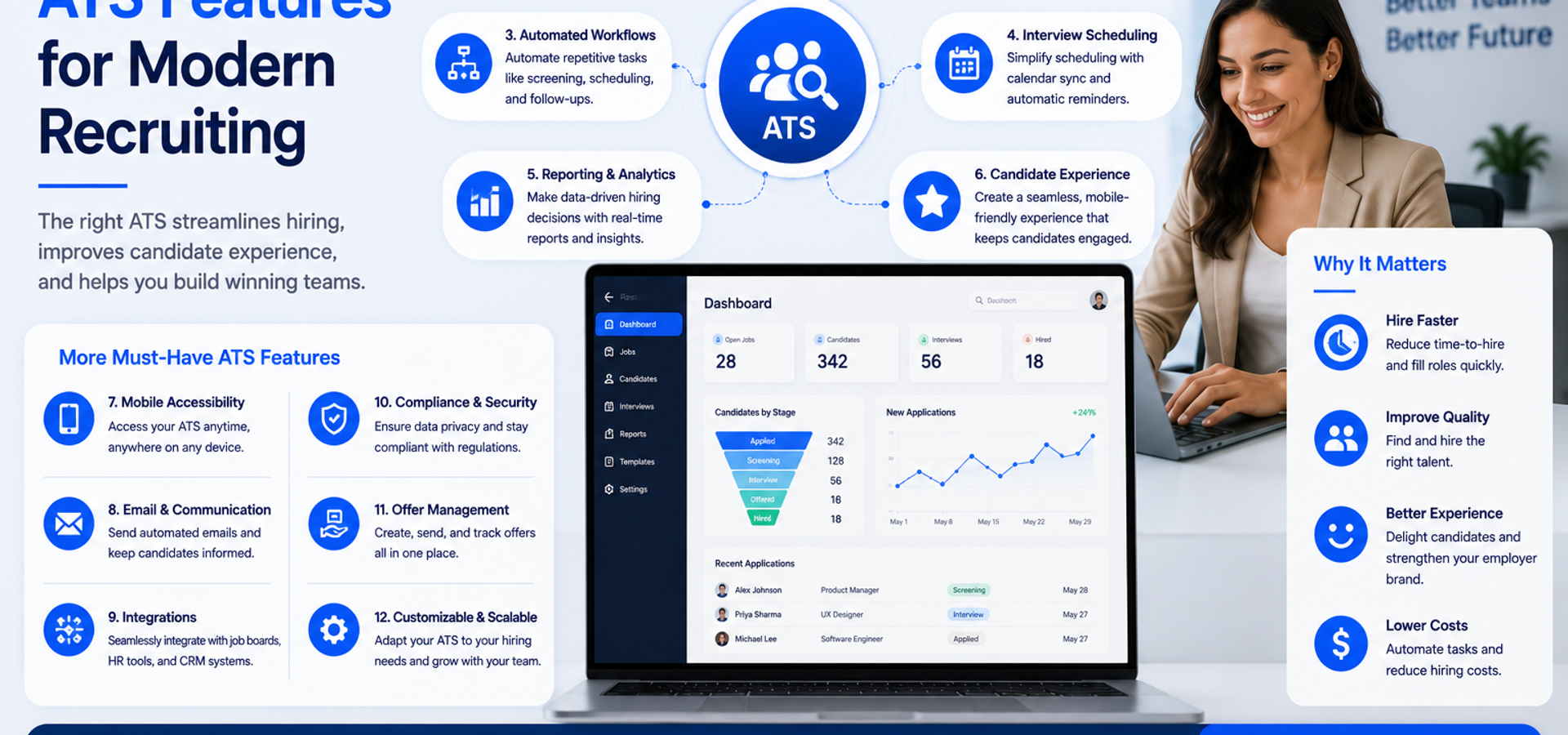
Open a modern ATS demo and you will see fifty capabilities lit up like a casino floor. Open a real hiring week and you will see three failures that actually hurt: candidates stuck in limbo, hiring managers who never leave feedback, and reports nobody trusts. That gap is why smart teams stop shopping for “everything” and start demanding the right applicant tracking system features, the ones that keep the pipeline honest when volume spikes.
This guide names the must-haves for modern recruiting, separates them from nice-to-haves, and shows how to pressure-test vendors without getting hypnotized by slides. For cloud context, read cloud-based recruitment software: benefits & tools. For the wider HR stack, see HR software solutions: features, types & tools.
Why applicant tracking system features decide hiring speed
Your ATS is the system of record. If stages are fuzzy, every sourcing tool, assessment, and voice screen inherits the mess. LinkedIn’s Future of Recruiting research continues to show talent teams investing in technology to improve speed and candidate experience, but tools only help when workflow data is clean. Source: LinkedIn: Future of Recruiting 2025.
SHRM’s talent acquisition guidance likewise frames recruiting technology as infrastructure for consistent process, not a magic hire button. Source: SHRM Talent Acquisition.
So when you evaluate an ATS, ask one blunt question: will this reduce coordination tax for recruiters and managers next week?
Must-have #1: A pipeline you can trust
Clear stages, required dispositions, and audit history are non-negotiable. If recruiters keep a shadow spreadsheet, the ATS failed, regardless of AI badges.
Modern pipelines should show who moved a candidate, when, and why. That history protects compliance reviews and stops “where did this person go?” Slack archaeology.
Must-have #2: Requisition and job distribution that kill double entry
Headcount approvals, job templates, and one-click distribution to careers pages and boards belong in the core feature set. Growing teams cannot afford copy-paste job posts every Monday.
If your stack already leans cloud, pressure-test how platforms handle distribution and manager access using the same criteria in cloud-based recruitment software and agency-fit notes in ATS for staffing agencies compared.
Must-have #3: Structured screening, not free-text chaos
Knockout questions, scorecards, and consistent screen notes are core for fair, repeatable decisions. Free-text-only screens produce bias theater and unreadable pipelines.
When volume is high, pair ATS screening with automation. See AI applicant screening: how it works & top tools and best automated screening software for staffing agencies for how screening layers should write outcomes back to stages, not create a second inbox.
Must-have #4: Interview scheduling that respects calendars
Native scheduling or a tight calendar integration is a must. Self-scheduling links, timezone handling, and reschedule paths matter more than a pretty “interview kit” mockup.
Phone confirmations and no-show prevention often sit outside the ATS. That is where voice agents help, while the ATS remains the spine. Background: hire candidates faster with AI tools.
Must-have #5: Hiring manager collaboration that actually happens
@mentions, mobile feedback, structured scorecards, and clear ownership beat endless email threads. If managers cannot leave feedback in under two minutes on a phone, they will not leave feedback.
Modern recruiting is a team sport. The best ATS features make manager work lighter, not heavier.
Must-have #6: Reporting you can defend in a leadership meeting
Time-to-hire, source-of-hire, stage conversion, and aging reqs are baseline. Fancy people-analytics slides are optional until stage data is trustworthy.
Dig deeper in recruitment analytics software, but remember: analytics quality cannot exceed pipeline quality.
Must-have #7: Compliance, privacy, and audit controls
Permissioning, data retention settings, consent fields, and exportable audit logs belong on every modern checklist, especially for multi-country hiring. “We will configure that in phase two” is how phase two never arrives.
Ask vendors how they handle GDPR/CCPA-style requests and who can delete or anonymize candidate data.
Must-have #8: Integrations and an open data path
APIs, webhooks, HRIS sync, assessment connectors, and job board links turn an ATS into a platform instead of an island. If every new tool needs a six-week professional services project, your roadmap will stall.
Practical wiring advice: how to integrate recruiting software with existing systems. For relationship data beyond open reqs, compare CRM needs in candidate relationship management system.
Modern add-ons worth evaluating (after the core)
AI ranking and interview intelligence
Useful when transparent and overrideable. Dangerous when it becomes an unexplained black box. Explore artificial intelligence (AI) in recruitment, machine learning in recruiting, and interview intelligence: AI & candidate performance.
Sourcing and CRM modules
Outbound-heavy teams need talent pools, drip nurture, and silver-medalist reactivation. Inbound-only teams can wait. See AI sourcing: how to find candidates faster and candidate sourcing services.
Agency-grade client workflows
Staffing firms should pressure-test submission tracking and client portals early. Start with ATS for staffing agencies compared and product deep-dives like Gem ATS review: features, pricing & sourcing.
Unique angle: buy “Tuesday features,” not “keynote features”
Here is the filter we use with operators: if a feature does not change what happens on a chaotic Tuesday afternoon, when three reqs spike and two managers go silent, it is not must-have yet.
That single rule kills half the RFP checklist. It also explains why AI voice screening often outperforms another dashboard widget: phones are where candidates wait, and waiting kills offers. Agent patterns: how AI agents are transforming recruiting and AI agents for recruitment comparison.
How to score applicant tracking system features in a vendor demo
- Bring one real job description and one messy candidate scenario
- Move an applicant from apply → screen → interview → offer live
- Ask a hiring manager to leave mobile feedback in under two minutes
- Export a stage report and check whether fields match what recruiters entered
- Request a sample webhook or API payload for screen outcomes
- Ask what breaks at 5× application volume
If the demo stays on slides, you are not evaluating applicant tracking system features, you are evaluating marketing.
Feature checklist by team type
Growing SMBs: fast setup, clear pipeline, job boards, manager collaboration, basic analytics, open integrations. Pair with speed tactics in hire candidates faster with AI tools.
Corporate TA: approvals, internal mobility, HRIS sync, stronger compliance, structured scorecards.
Staffing agencies: high-volume workflows, client/job matching, CRM-like pools, rapid submission tracking.
Where Dialflo fits (and what it is not)
Dialflo is not an ATS and does not replace your core tracking modules. It is an AI voice layer for phone screens, confirmations, and reschedules that should write structured results back to your ATS so the pipeline stays true.
If phones are your bottleneck after the ATS spine is solid, that is the moment to add voice, not before.
FAQ: applicant tracking system features
What are the most important applicant tracking system features?
Trusted pipeline stages, job distribution, structured screening, scheduling, manager collaboration, baseline reporting, compliance controls, and integrations.
Do I need AI in my ATS on day one?
No. Get workflow and data quality right first. Add AI where it shortens real cycle time with human override.
Which features do agencies need most?
High-volume processing, client workflows, and CRM-style talent pools, see staffing ATS comparisons linked above.
How do I avoid buying shelfware?
Score demos with live workflows, measure recruiter adoption in a 30-day pilot, and reject features nobody touches weekly.
Are analytics must-have?
Basic funnel metrics are must-have. Advanced analytics can wait until stage data is clean.
How does Dialflo work with an ATS?
Voice agents run phone-heavy steps and sync outcomes to your ATS system of record.
Closing: choose features that survive contact with reality
The winning set of applicant tracking system features is boring in the best way: clear stages, fast collaboration, honest reports, and integrations that keep tools aligned. Flashy modules can wait until Tuesday already works.
Building the stack around a solid ATS? Explore Dialflo when phone coordination is the bottleneck, and keep your applicant tracking system as the single source of truth.


