Best Recruitment Analytics Software

Dialflo: AI Voice Agent
April 20, 2026
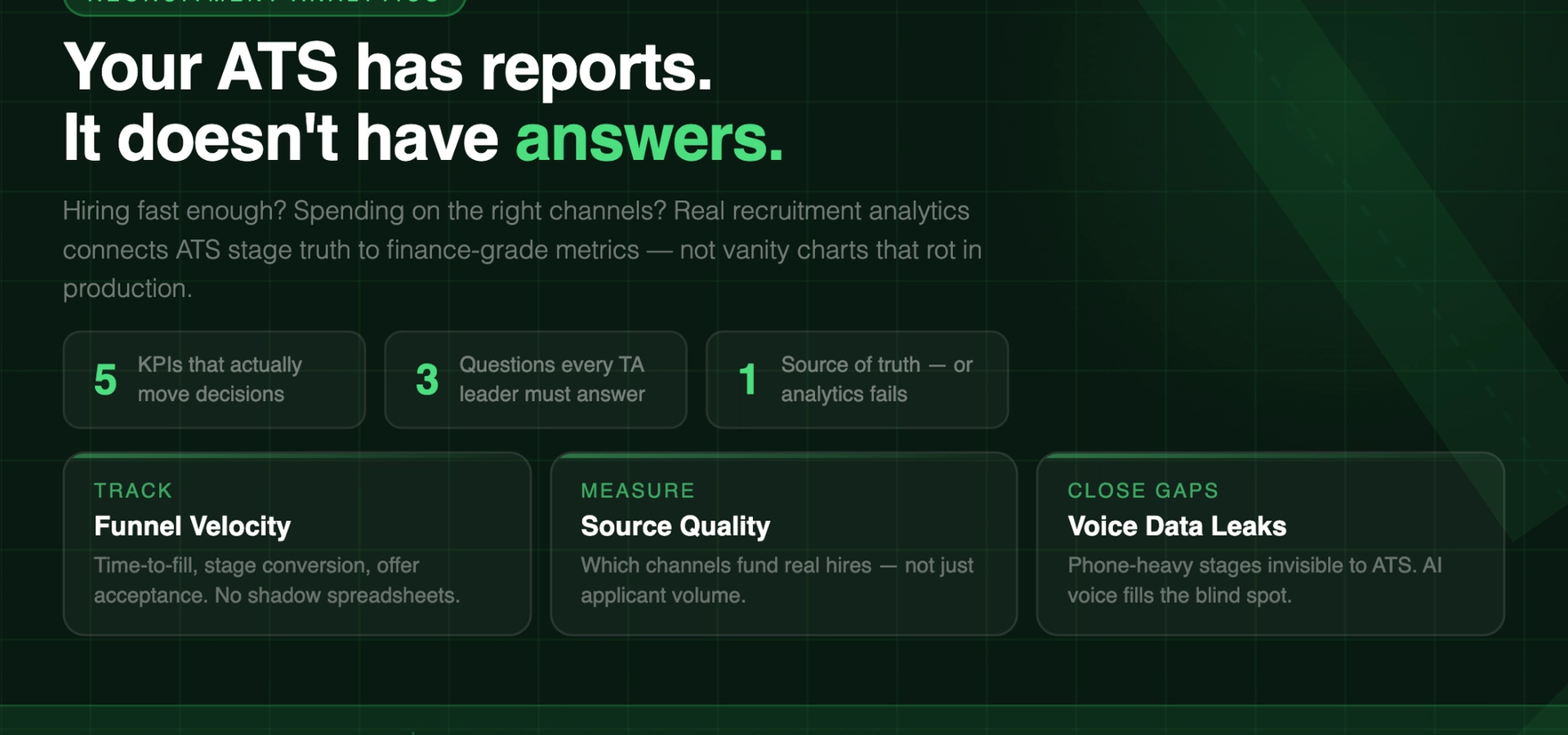
The best recruitment analytics software is not the flashiest dashboard, it is the stack that makes candidate tracking, ATS stages, and business outcomes line up without political debates about whose spreadsheet is “more true.”
If you are shopping recruitment analytics software in 2026, you are usually trying to answer three questions at once: Are we hiring fast enough? Are we hiring well enough? And are we spending recruiting dollars on the right applicant tracking channels? The vendors that win evaluations are the ones that connect applicant tracking system software truth, who moved stages, when, and why, to finance-grade metrics instead of vanity charts that look good in a board deck and rot in production.
This guide frames how ATS systems and analytics layers fit together, which KPIs matter for corporate talent teams versus agencies, and what “best applicant tracking systems” lists leave out when ats hr buyers forget data governance. We also show where Dialflo voice automation can enrich candidate tracking software signals your applicant tracker never captured from email alone. For macro context, LinkedIn’s Future of Recruiting materials track how organizations are adopting AI in hiring, analytics is how you prove whether those experiments shorten cycles or just add noise. Treat this page as a practical companion while you compare top applicant tracking systems and ats system hr roadmaps side by side.
Recruitment analytics software vs. “reports that came with the ATS”
Most applicant tracking software ships canned reports: requisitions open, candidates per stage, time-in-stage. That is table stakes, not strategy. True recruitment analytics software lets you slice cohorts, compare sources with statistical caution, join marketing spend to downstream hires, and monitor interviewer throughput without exporting to a shadow database every Monday.
When teams say they need top applicant tracking systems for analytics, they often mean they need a governed model underneath ats platforms: one person, one application history, consistent reason codes, and APIs that survive nightly jobs. Without that spine, even popular ats systems produce pretty charts that disagree with payroll and HRIS headcount, exactly the scenario that makes executives distrust ats recruitment dashboards.
What to measure before you debate vendors
Analytics contracts fail when teams track forty KPIs and change none of them. For most employers, anchor on funnel velocity, stage conversion, source quality, recruiter capacity, and offer outcomes. Add diversity funnel views where lawful and privacy-safe. For agencies evaluating top ats software alongside analytics, layer client-level submittal ratios, time-to-first-interview, and margin-friendly redeployment metrics so recruitment applicant tracking ties to revenue, not vanity pipeline counts.
Candidate tracking hygiene matters as much as tooling: if recruiters skip disposition reasons, your candidate tracking system cannot explain rejections, and fairness reviews become impossible. The best applicant tracking software nudges users at the moment of decision, mobile-friendly disposition prompts, lightweight automation, so analytics stays honest without turning recruiters into data-entry clerks.
Embedded ATS analytics vs. standalone BI for talent acquisition
Best talent acquisition software suites increasingly bundle analytics, which is convenient when your entire hiring motion lives in one vendor. But enterprises often warehouse ats system hr data alongside engagement, assessment, and HRIS feeds. In that pattern, your “best” analytics product might be a warehouse plus semantic layer, with the applicant tracking systems acting as an operational system of record, not the final visualization layer.
Choosing between embedded and standalone is really choosing an applicant tracking system architecture question: Do you have analytics engineers and a data steward? If yes, prioritize open APIs, stable schemas, and change logs from the ats systems vendor. If no, prioritize turnkey dashboards in top applicant tracking software that match how your CHRO actually consumes information, executive summaries, drill-downs for TA leaders, operational boards for coordinators.
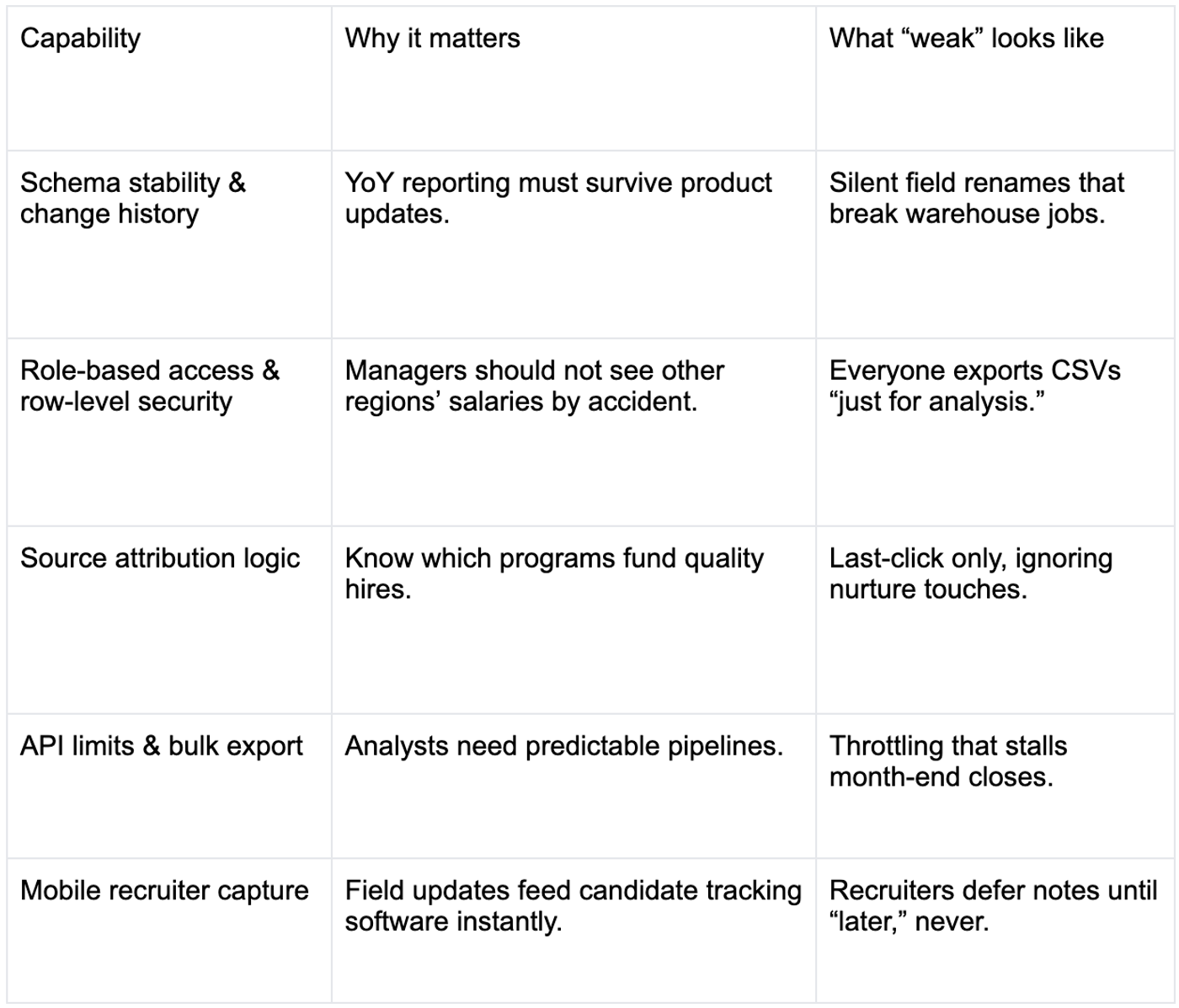
Evaluation table: signals that separate serious recruitment analytics
Use this when RFPs blur together, especially if you are comparing popular applicant tracking systems that all claim “AI insights.”
Candidate experience and analytics are not opposites
The best ats for candidate experience still needs measurement: response-time SLAs, drop-off in long applications, interview scheduling friction, and post-offer ghosting. Those signals belong in the same recruitment analytics software story as cost and speed. If you optimize only speed, you can easily degrade quality; if you optimize only experience, you can miss capacity planning. Strong programs define guardrails and monitor both.
Similarly, software for jobs that applicants love but recruiters refuse to use will poison your dataset. When evaluating most popular ats software shortlists, score adoption alongside NPS-style candidate feedback, otherwise analytics becomes a museum of incomplete records.
Agency-specific analytics: why shared talent pools complicate math
For staffing and RPO, best job application software for agencies must attribute candidates who reappear across clients without double-counting conversions. Analytics products should support pool-level permissions, consent timelines, and redeployment metrics. If your top ats systems cannot separate client confidentiality from firm-wide sourcing efficiency, your ats platforms dashboards will stay politically unusable.
Agency leaders should also insist on recruiter activity telemetry, not keystroke surveillance, but structured outcomes: screens completed, submittals sent, interviews confirmed. That is how ats hr analytics finally connects to revenue instead of pretending pipeline dollars equal cash.
Dialflo: structured voice outcomes that feed analytics, not shadow CRMs
Dialflo is not a replacement for your applicant tracking system software, it is an AI voice layer that handles screening calls, scheduling, and re-engagement at scale. When configured well, voice flows push structured answers and disposition signals back into the applicant tracker, improving the same funnel analytics your CHRO already watches. That matters because phone-heavy hiring processes often leak data: voicemails, partial notes, and missed tags that make candidate tracking system reports look artificially thin.
Pricing for Dialflo appears on dialflo.ai in tiers such as Starter near ₹9,999 per month and Professional near ₹24,999 per month, confirm live figures during procurement. The analytics win is not “more charts”; it is fewer unknowns in stages that were previously invisible to ats recruitment tools.
Implementation playbook so your analytics investment sticks
Start with definitions: agree what “submitted,” “qualified,” and “sourced” mean in your applicant tracking systems. Document reason codes managers can defend in compliance reviews. Run a parallel month where old and new metrics both publish, boring work that prevents executive flameouts. Train hiring managers on self-service slices instead of emailing TA ops for custom pulls; self-service is where top applicant tracking software pays back.
Finally, schedule quarterly pruning: retire charts nobody opened. The best recruitment analytics software discipline is editorial judgment, not maximalist dashboards. That mindset is what separates mature talent acquisition software organizations from teams that buy popular ats systems and wonder why nothing changed.
FAQ: Recruitment analytics software, ATS, and candidate tracking
What is recruitment analytics software?
It is software that turns hiring operations data into monitored KPIs, forecasts, and alerts, either inside your applicant tracking system software or via a warehouse and BI stack that reads ATS and adjacent systems.
How is recruitment analytics different from basic ATS reporting?
Basic ats systems reporting counts stages; deeper analytics joins sources, costs, cohorts, and quality proxies while preserving governance. The difference is decision support, not chart quantity.
What metrics should talent teams track?
Prioritize a small set: time-to-fill, pass-through by stage, source quality, interviewer load, offer acceptance, and lawful diversity funnel metrics. Agencies add client SLAs and redeployment analytics across shared candidate tracking pools.
What should I look for when choosing an applicant tracking system with strong analytics?
Demand stable schemas, exports or warehouse sync, role-based security, and APIs that support nightly jobs. Pilot with your own messy history, especially if you are comparing best applicant tracking system software finalists that all demo with pristine sample tenants.
How do staffing agencies use recruitment analytics differently?
They attribute shared candidates across clients, track submittal-to-start economics, and tie recruiter actions to placements. Without that, top ats software charts prettify pipeline that finance cannot reconcile.
Can voice automation improve recruitment analytics?
Yes, when voice workflows write structured outcomes into the applicant tracker. Platforms like Dialflo reduce voicemail black holes so funnel analytics reflects phone-heavy reality, not idealized inbox workflows.
Closing: pick truth in the ATS, then scale insight responsibly
The best recruitment analytics software decision is less about a magic quadrant and more about whether your applicant tracking systems capture trustworthy events. Anchor definitions, secure the warehouse path if needed, and only then chase predictive models. Pair your chosen ats platforms with voice automation when phone stages leak data, so recruitment applicant tracking finally matches how candidates and recruiters actually behave.
Want cleaner screening data in your dashboards? Book a Dialflo demo to see voice agents capture structured answers from every screening call.


