Best Recruitment Automation Tools for Faster Screening

Dialflo: AI Voice Agent
June 23, 2026
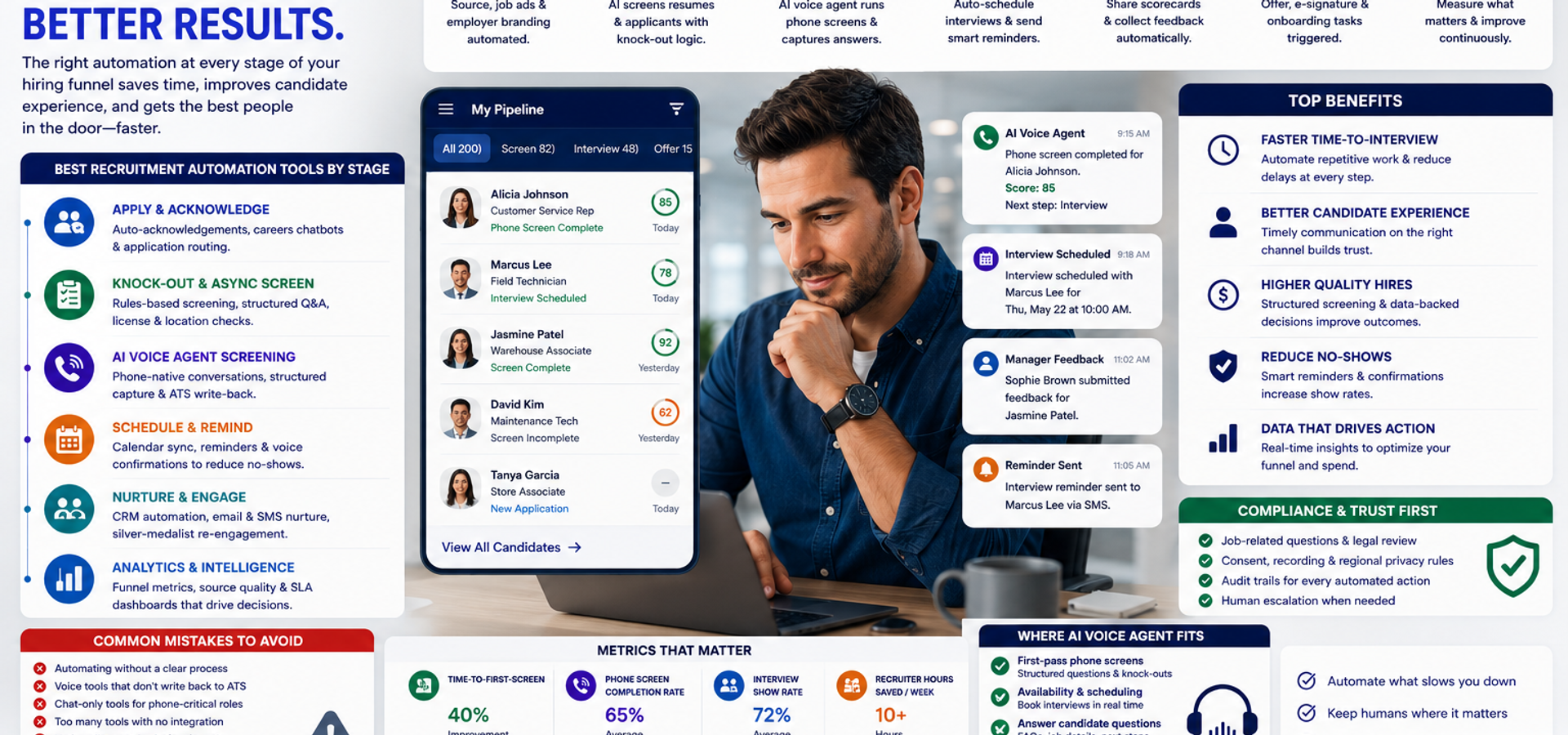
Your ATS says two hundred applicants. Your recruiters say they are underwater. Scheduling tools send links candidates never click. Chatbots knock out half the pool before a human reads a resume, and voicemails still pile up because the roles that matter require a real phone screen. That is why teams shopping recruitment automation tools in 2026 are not asking “should we automate?” They are asking which layers actually move time-to-interview without breaking compliance or candidate trust.
This guide maps the best recruitment automation tools for 2026 by funnel stage, explains where an AI voice agent for screening fits (and where it does not), and gives a practical evaluation checklist plus a four-week pilot you can run without replatforming your entire stack.
What recruitment automation tools do in 2026
Recruitment automation tools run repeatable hiring steps on rules and integrations, so recruiters stop copy-pasting between email, spreadsheets, and applicant tracking. In 2026 the mature stack usually spans:
- ATS workflow automation: stage changes, templates, hiring manager tasks
- Scheduling automation: calendar sync, reminders, reschedule flows
- AI applicant screening: resume knock-outs, structured Q&A, knock-out logic
- AI voice agent screening: phone-native first-pass screens with ATS write-back
- Talent CRM automation: nurture, silver-medalist re-engagement
- Recruitment analytics: funnel conversion, source quality, SLA dashboards
Cloud spine: cloud-based recruitment software: benefits & tools. AI landscape: artificial intelligence in recruitment.
Why 2026 is the year of AI voice agent screening
Text automation got good first. Email sequences, chat apply flows, and calendar links scaled fast. But many reqs still die on the phone:
- candidates apply at night; recruiters callback during work hours
- the same screen questions repeat across dozens of applicants
- notes live in voicemail, not ATS fields
- high-volume hiring events create callback tsunamis
An AI voice agent for screening meets candidates on the channel the role requires, live phone conversation, with approved scripts, structured capture, and escalation to humans when answers fall outside policy. It is not a replacement for final interviews. It is how teams clear the first phone bottleneck without adding headcount.
LinkedIn’s talent acquisition research shows hiring organizations continue investing in technology to improve speed and candidate experience, phone SLAs are where that investment either shows up or leaks. Source: LinkedIn: Future of Recruiting 2025. Voice patterns: conversational services: what they are & use cases and AI applicant screening: how it works.
Best recruitment automation tools by funnel stage
No single vendor wins every stage. Use this map to shortlist recruitment automation tools that match your leak, not the flashiest demo.
Apply and acknowledge
ATS auto-replies, careers chatbots, and application routing stop the “black hole” feeling. Verify mobile apply and status visibility before you add AI on top.
Knock-out and async screen
Rules-based screening handles license checks, location, shift availability, and salary band questions in forms or chat. Compare: best automated screening software (patterns apply beyond agencies).
Phone screen: AI voice agent
When the req needs voice contact, AI voice agent screening runs structured calls, captures answers, and schedules next steps. Humans review edge cases same day. High-volume intake: open interviews near me today dynamics apply when walk-in days spike phones.
Interview scheduling and reminders
Calendar automation reduces no-shows. Pair with voice confirmations when candidates ignore email, especially hourly and field roles.
Sourcing and nurture
Outbound sequences and CRM triggers fill the top of funnel. See AI sourcing: find candidates faster and candidate relationship management system.
Analytics and interview intelligence
Measure time-to-first-screen, show rate, and stage conversion, not vanity counts. Tools: recruitment analytics software, interview intelligence AI, machine learning in recruiting.
How to evaluate recruitment automation tools in 2026
Score vendors on execution, not slide decks.
Integration and system of record
- Does every automated action write back to ATS stages and fields?
- Webhooks, API, or native connectors, or manual export hell?
- Guide: integrate recruiting software with existing systems
Candidate experience
- Can candidates complete screens on their schedule, not only 9–5 recruiter hours?
- Clear disclosure where automation is used?
- Human escalation path when questions fall outside script?
Recruiter adoption
- Do recruiters trust outputs, or maintain shadow spreadsheets?
- Can they override disposition in two clicks?
- Agent comparison: AI agents for recruitment compared
Compliance and fairness
- Job-related questions only; legal review before go-live?
- Recording and consent rules followed for your regions?
- SHRM guidance on structured selection: SHRM: Assessing and selecting job candidates
Total cost of ownership
- Per-seat ATS fees plus per-screen voice pricing?
- Implementation and admin time modeled honestly?
- ATS context: ATS for staffing agencies compared and HR software solutions
What to automate first (and what to keep human)
Automate first: acknowledgments, knock-outs, first-pass phone screens, scheduling, reminders, status nudges to hiring managers.
Keep human: final interviews, compensation negotiation, culture judgment, executive approvals, sensitive accommodations, and any decision where context beats scripts.
Transformation patterns: how AI agents are transforming recruiting and agentic hiring organization. Speed outcomes: hire candidates faster with AI tools.
Common mistakes when buying recruitment automation tools
- Buying chat-only screening when the role requires phone contact
- Voice tools that do not write to ATS, recruiters re-key everything
- Automating before screen questions are job-related and reviewed
- Stack sprawl: six tools, zero integrated reporting
- No baseline metrics before pilot, impossible to prove ROI
- Treating AI voice agents as full ATS replacements
Interview prep automation can help downstream, generate interview questions from job description with AI, but fix the phone screen leak before you polish manager question banks nobody uses.
A four-week pilot: ATS + AI voice agent screening
Week 1: Baseline. Pick one high-volume req. Measure time-to-first-screen, callback completion, and interview show rate.
Week 2: Configure. Lock screen script with hiring manager and HR. Map ATS stages and disposition fields for voice outcomes.
Week 3: Run. Route applicants through knock-out, then AI voice agent screening. Escalate edge cases to recruiters same day.
Week 4: Decide. Compare SLA and show rate. Keep workflows recruiters use; kill the rest.
Sourcing still matters, pair automation with candidate sourcing services only if inbound alone cannot fill the req.
Where Dialflo fits in your 2026 stack
Dialflo is not another ATS. It is the AI voice agent for screening layer, structured phone conversations, confirmations, reschedules, and ATS write-back, so your recruitment automation tools actually clear the phone bottleneck. When candidates ghost because nobody called back Tuesday, voice execution fixes what chatbots and calendar links cannot.
If you already run cloud ATS and scheduling, add Dialflo where phones stall, not as a rip-and-replace project.
FAQ: recruitment automation tools 2026
What are the best recruitment automation tools in 2026?
The best stack combines ATS workflows, scheduling, screening automation, analytics, and, when volume demands, AI voice agents for phone screens with ATS integration.
Is an AI voice agent the same as a chatbot?
No. Chatbots handle text flows on web or SMS. Voice agents conduct live phone screens, the channel many operational roles still require.
How fast can teams see results?
Focused pilots often show time-to-first-screen and show-rate movement in four to six weeks when scripts are tight and write-back works.
Will candidates reject automated phone screens?
Candidates reject silence and endless holds more than structured calls that start on time. Disclose automation where required and offer human paths.
Can we keep our current ATS?
Yes. Choose automation tools with proven ATS write-back; the ATS stays the system of record.
How does Dialflo help?
AI voice agents for recruiting phone workflows with structured ATS outcomes, see dialflo.ai.
Closing: automate the leak, not the legend
The best recruitment automation tools in 2026 are not the ones with the longest feature PDF. They are the ones recruiters actually use, and that write outcomes back to one pipeline truth. If your funnel stalls at the phone, an AI voice agent for screening belongs in the stack next to your ATS, not in a slide about “digital transformation.”
Ready to add voice screening to your automation stack? Explore Dialflo for structured phone screens and scheduling that integrate with the recruitment automation tools you already run.


