Technology Used in Supply Chain Management: A Guide

Dialflo: AI Voice Agent
May 6, 2026
Supply chains don’t fail only because of planning, they fail when information and execution can’t move fast enough across teams and partners.
If you search technology used in supply chain management, you’re usually trying to solve one of two problems:
(1) you’re building a modern supply chain stack from scratch
(2) you have tools already, but the system still feels slow, stockouts, expediting, supplier surprises, missed delivery windows, and a lot of “Where is this shipment?” calls.
This guide breaks supply chain technology into the layers that matter: the core systems (ERP/WMS/TMS), planning and optimization, visibility and control towers, integration (EDI/APIs), tracking (IoT), traceability (including blockchain), and automation in warehouses. You’ll also get a practical roadmap for what to implement first, plus FAQs.
Why technology matters (and what it can’t fix)
Technology can compress decision cycles and reduce errors. It helps you see what’s happening, predict what might happen next, and coordinate responses across teams. But tech can’t fix everything. If master data is messy, processes are unclear, or approvals take weeks, even the best software becomes an expensive reporting layer.
McKinsey’s supply chain research highlights that digital transformation can materially improve performance when paired with process and operating-model changes, not technology alone. For example, McKinsey describes cases where service levels and forecasting accuracy improved significantly after digitization and cross-functional “nerve center” approaches. See: McKinsey: Raising supply-chain performance to new levels.
The core stack: ERP, WMS, and TMS
If you’re new to supply chain tech, start with the foundation. Most companies end up with three core systems, whether they realize it or not.
1) ERP (Enterprise Resource Planning)
What it does: purchasing, finance, supplier records, item master data, costing, and often basic inventory accounting.
Why it matters: your ERP is the “system of record” for money and master data. If item codes, units of measure (UOM), or supplier terms are wrong here, every downstream system suffers.
2) WMS (Warehouse Management System)
What it does: receiving, put-away, picking, packing, cycle counting, slotting, labor tasks, and real-time inventory accuracy at a location.
Why it matters: many supply chain “planning” problems are actually inventory accuracy problems. If your WMS can’t trust on-hand quantities, forecasts and replenishment logic become guesswork.
3) TMS (Transportation Management System)
What it does: shipment planning, carrier selection, dispatching, tracking milestones, freight auditing, and delivery performance analytics.
Why it matters: transport delays create stockouts just as surely as bad forecasts. A good TMS gives you ETA signals and exception alerts early enough to respond.
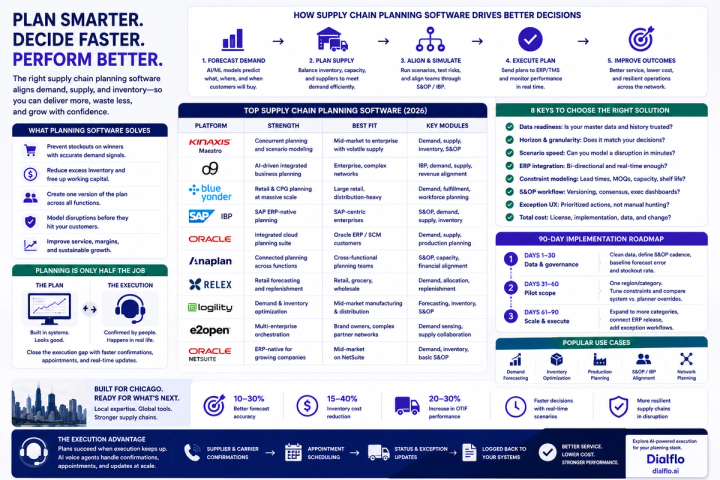
Planning and optimization: turning data into decisions
Once the core stack is stable, companies invest in tools that convert history + signals into actions.
Demand planning and forecasting
Forecasting tools use statistical models and machine learning to predict demand patterns (seasonality, promotions, regional variation). Better forecasts reduce both overstock and stockouts, especially when demand is volatile.
Inventory optimization
Inventory optimization sets reorder points, safety stock, and order quantities based on service targets and uncertainty (demand variability, lead-time variability, constraints like MOQs). This is where “AI inventory optimization” typically lives.
Production and supply planning (for manufacturers)
These tools help plan capacity, materials, and schedules (often integrating with MRP). The best systems can simulate scenarios (supplier delay, demand surge) and recommend actions.
Visibility and coordination: control towers and “nerve centers”
When supply chains become multi-party networks, a recurring need emerges: a shared view of what’s happening and what the response should be. This is where “control towers” and “nerve centers” show up.
Gartner describes a supply chain control tower as a concept that combines people, process, data, and organization supported by technology-enabled capabilities for transparency and coordination. In other words: it’s not just a dashboard, it’s how teams detect issues and coordinate responses. See: Gartner: Supply chain control towers.
Common control-tower capabilities include:
- Sense: real-time visibility across orders, inventory, and transportation.
- Analyze: root-cause, impact analysis, and KPI views.
- Predict: disruption forecasting and ETA risk.
- Solve: scenarios and recommended actions.
- Execute: collaboration workflows and task assignment.
Integration technology: EDI, APIs, and data platforms
Supply chain runs on partner data, vendors, carriers, 3PLs, marketplaces, and retailers. The integration layer is often the difference between “we found out late” and “we saw it early.”
Common integration approaches:
- EDI: structured documents for POs, ASNs, invoices, and shipment status updates.
- APIs: real-time data exchange with modern platforms.
- Data warehouses/lakes: consolidate data across ERP/WMS/TMS plus external signals.
- Master data management (MDM): maintain consistent item, location, and partner records.
Practical note: many “AI” projects fail because the integration layer is weak. If you can’t reliably get PO status, shipment milestones, and on-hand inventory, your models are working with broken inputs.
Tracking and sensing: IoT, RFID, GPS, and computer vision
Tracking technologies help you answer: “Where is it?” and “What condition is it in?” Common options:
- RFID: faster receiving and cycle counting; improves inventory accuracy.
- GPS telematics: vehicle tracking and ETA prediction signals.
- IoT sensors: temperature, humidity, shock monitoring for cold chain and fragile goods.
- Computer vision: dock audits, pallet counting, damage detection in warehouses.
Traceability and trust: blockchain (when it’s worth it)
Most supply chains need traceability, who made it, where it came from, and whether it’s authentic. Many organizations can achieve traceability with solid data standards and governance. Blockchain becomes more relevant when many parties need a shared, tamper-resistant record and trust is low.
The World Economic Forum has published guidance on blockchain for supply chains, including provenance and traceability use cases. See: WEF: Introduction to Blockchain for Supply Chains (PDF).
Warehouse automation and robotics
Automation reduces labor variability and increases throughput. Common technologies include:
- conveyors and sortation systems
- AS/RS (automated storage and retrieval systems)
- AMRs/AGVs (autonomous mobile robots / automated guided vehicles)
- pick-to-light / voice picking
Automation is usually most justified when order volumes are high, labor is constrained, or accuracy requirements are strict. It also shifts your bottleneck to maintenance and exception handling, so workflows matter.
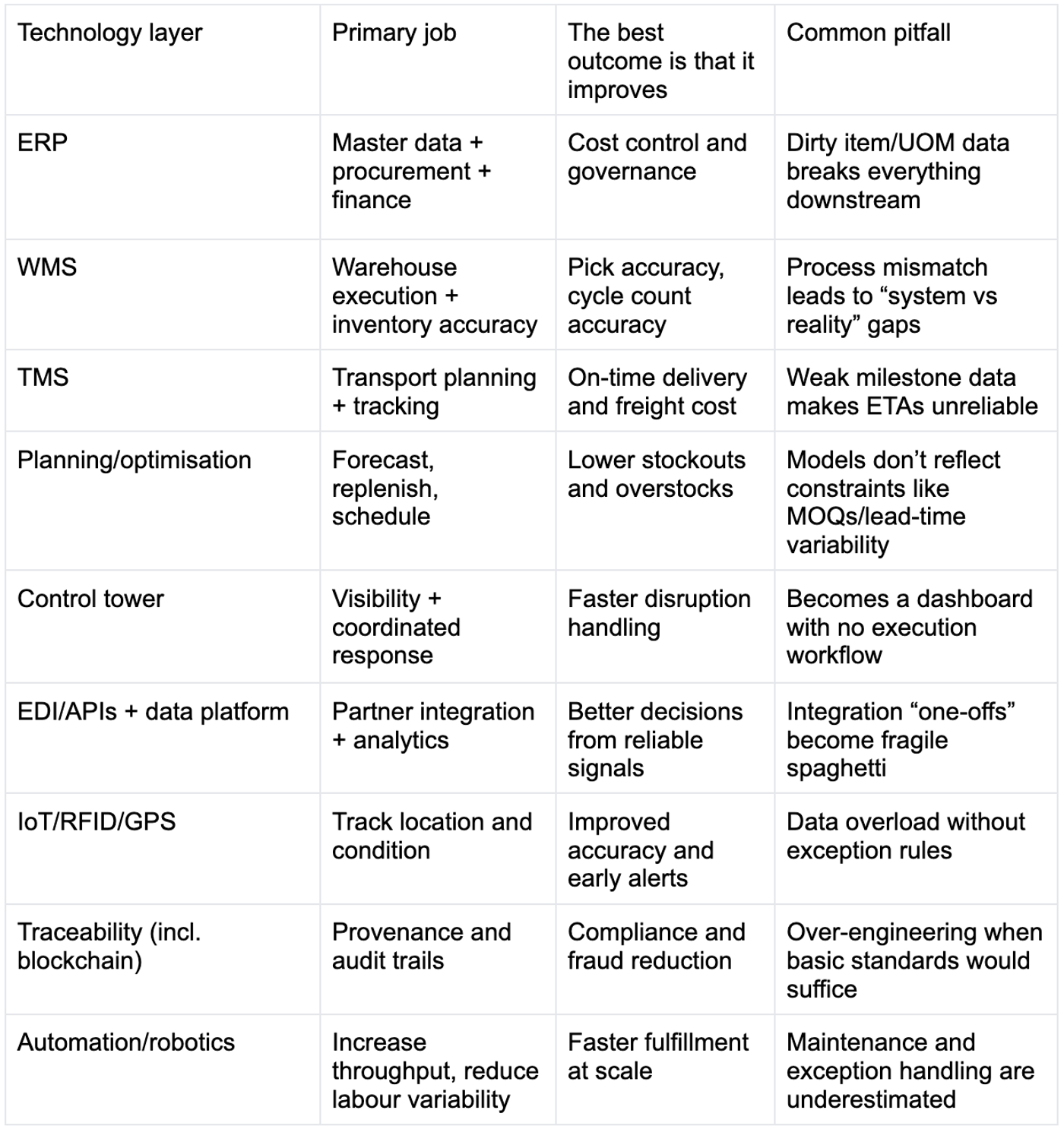
Comparison table: supply chain tech layer vs. outcome
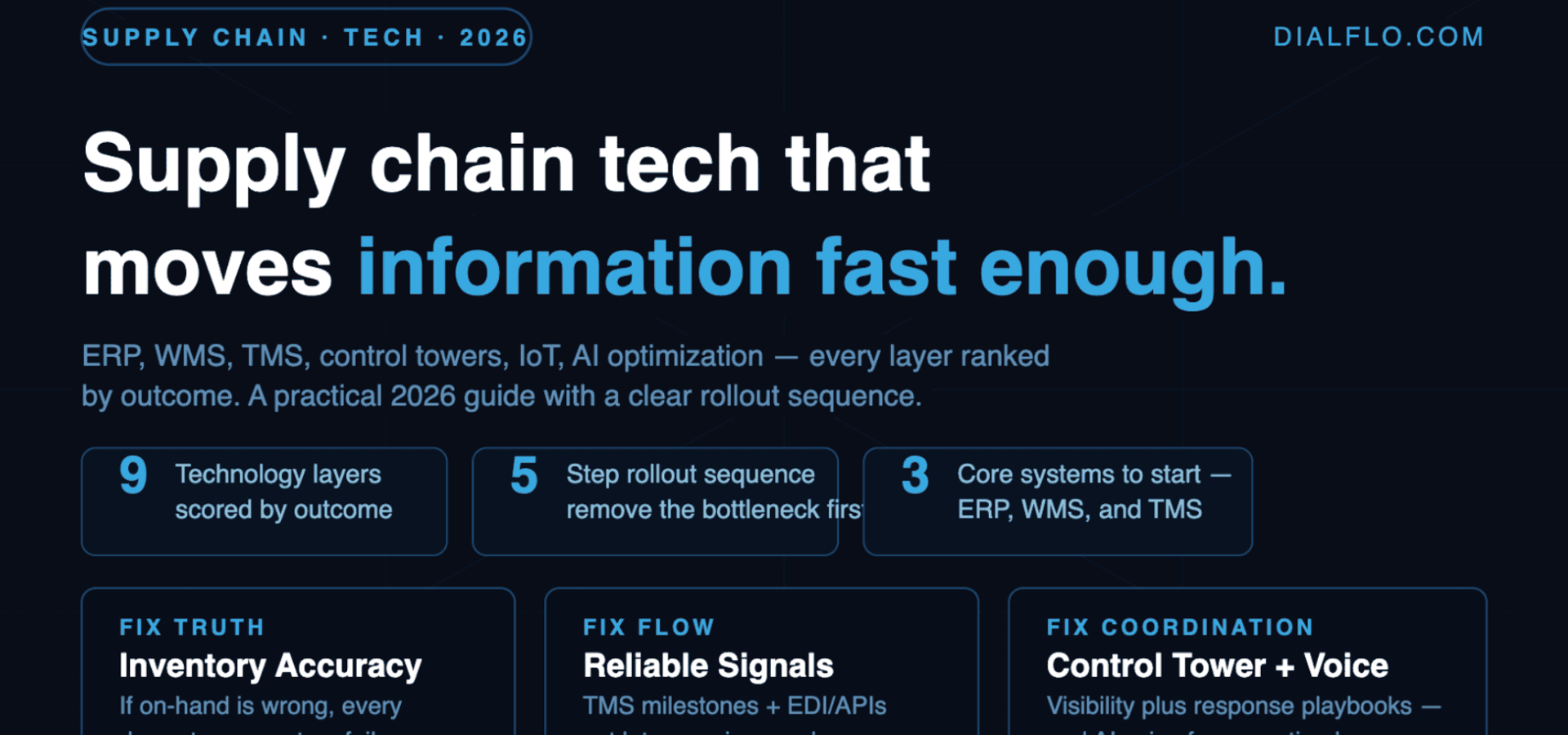
A simple roadmap: what to implement first
If you’re overwhelmed, pick the sequence that removes the biggest bottleneck.
Step 1: Fix truth. Inventory accuracy (WMS, cycle counts, RFID where justified). Clean master data (ERP/MDM). If “on-hand” is wrong, nothing else works.
Step 2: Fix flow. TMS milestones and carrier visibility. Basic EDI/APIs for suppliers. Get reliable signals and reduce late surprises.
Step 3: Fix decisions. Forecasting and inventory optimization. Start with a single category/warehouse and measure stockouts, overstock, and expediting.
Step 4: Fix coordination. Control tower / nerve center workflows. Visibility plus response playbooks (who does what when an ETA slips).
Step 5: Fix scale. Automation in warehouses and advanced optimization once the process is stable.
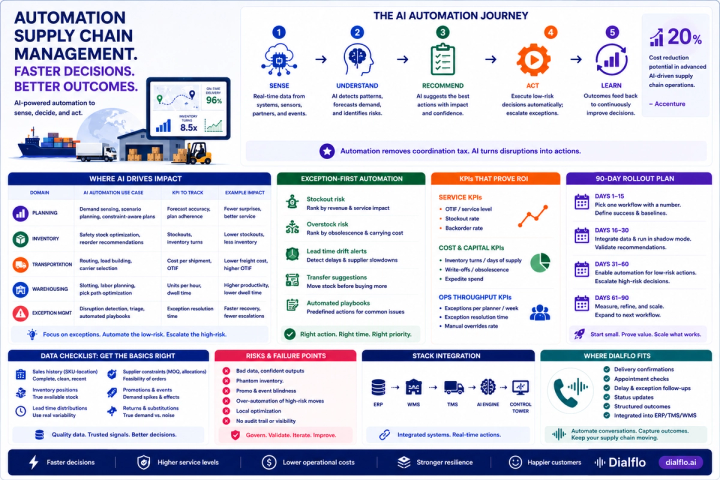
Where Dialflo can help: reducing execution latency
Even with strong systems, execution often bottlenecks on communication: supplier confirmations, appointment scheduling, “can you expedite this?”, and customer updates. These are still phone-heavy in many industries.
Dialflo is an AI voice agent platform that can help operations teams reduce missed-call leakage and speed up structured follow-ups, like supplier confirmations, delivery appointment scheduling, and routine status updates. It’s not a replacement for ERP/WMS/TMS, but it can help the coordination layer move faster so plans get executed with less delay.
FAQ: technology used in supply chain management
What technology is used in supply chain management?
Common technologies include ERP, WMS, TMS, demand planning and inventory optimization tools, control towers for visibility, EDI/APIs for partner integration, IoT/RFID/GPS tracking, traceability systems, and warehouse automation.
What are the three most important systems to start with?
For most organizations: ERP (master data + procurement + finance), WMS (inventory accuracy and warehouse execution), and TMS (transport planning and tracking). Then add planning and a visibility layer once inputs are reliable.
What is a supply chain control tower?
A control tower combines people, process, data, and organization with technology-enabled capabilities to create transparency and coordination across the end-to-end supply chain. The goal is faster detection and coordinated response, not just dashboards.
How is AI used in supply chain management?
AI is used for demand forecasting, inventory optimization, ETA prediction, anomaly detection, route optimization, labor planning, and exception prioritization, helping teams make better decisions under uncertainty.
Is blockchain necessary for supply chain traceability?
Not always. Many traceability needs can be met with good data standards and governance. Blockchain is most useful when multiple parties need a shared, tamper-resistant record and trust is low or compliance requirements are strict.
How does Dialflo fit into supply chain operations?
Dialflo helps reduce coordination delays via AI voice agents for phone-heavy workflows like confirmations, scheduling, and follow-ups, supporting faster execution alongside your core systems. Learn more at dialflo.ai.
Closing: choose tech that shortens decision time
The best “technology used in supply chain management” isn’t the longest list, it’s the stack that improves truth (accurate inventory), flow (reliable logistics signals), decisions (forecasting and replenishment), and coordination (fast response). Start with the layer that removes your biggest bottleneck, measure outcomes, and scale only when the workflow sticks.