The Real ROI of Voice AI in Recruitment

Dialflo: AI Voice Agent
January 8, 2026
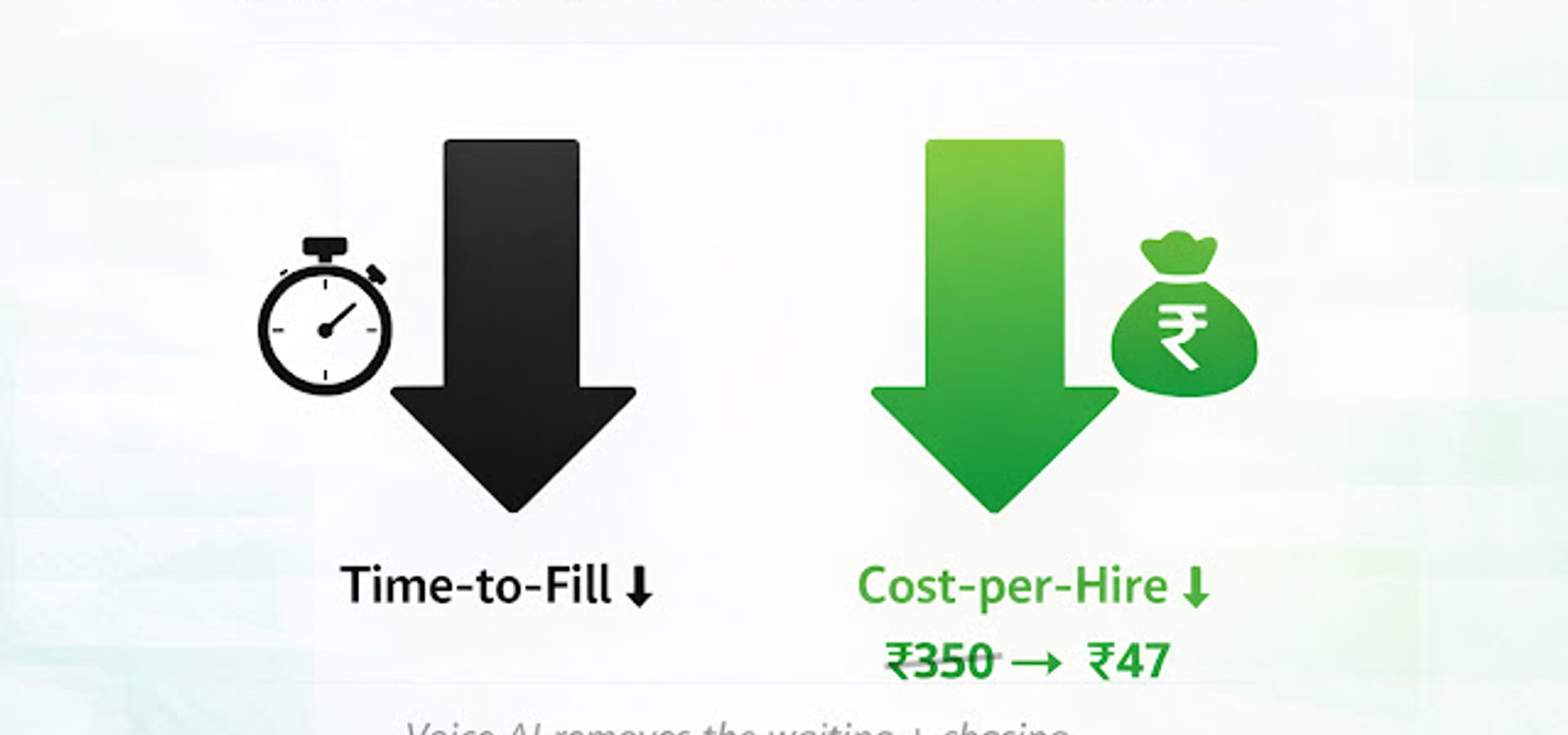
₹3̶5̶0̶ → ₹47: Per-candidate screening cost dropped after SmartStaff switched to Voice AI calls with Dialflo.
ROI in staffing isn’t just about replacing humans with automation. It’s aboutwhich screening method moves candidates through the funnel fastest, at cheapest cost, without hurting candidate experience.
To understand where Voice AI actually wins, it needs to be compared not just against manual calls, but againstWhatsApp, IVRs, and formsas well.
Most staffing teams today use a mix of four approaches:
1. Manual recruiter calls
Where manual calls work best (use-case wise):
- Senior / niche roles:context, judgment, and personalization matter more than speed.
- High-context conversations:adapt questions live, probe nuance, and build rapport.
- Early-stage hiring:low volumes, evolving roles, and shifting requirements.
- High-stakes calls:salary alignment, role pivots, and candidate hesitations.
- Final shortlisting:smaller pool after automated or async screening.
Why this breaks at scale:
- Slow first contact at scale.
- High per-candidate screening cost (₹300–₹400).
- High recruiter effort → burnout risk.
- Manual scheduling doesn’t scale.
- Language coverage doesn’t scale with volume.
Conclusion:Manual recruiter calls are powerfulonly for high-touch, low-volume hiring. If you’re hiringat scale, this cannot be your primary channel. It becomes expensive, slow, and unsustainable.
2. WhatsApp screening
Where WhatsApp works best (use-case wise):
- Top-of-funnel checks:interest, availability, location.
- Cost-sensitive outreach:low-cost way to reach many candidates fast.
- High-volume roles:simple yes/no or short responses.
- Digitally comfortable candidates:respond well over text.
- Broadcast outreach:bulk messaging before deeper screening.
Why this does not work at scale (for recruiters):
- Drop-offs rise as conversations go cold.
- Weak for nuanced or probing questions.
- Doesn’t work well for low-literacy or multilingual candidates.
- Engagement drops at scale.
- Recruiter effort returns via follow-ups and clarifications.
Conclusion:WhatsApp is good forcheap, surface-level screening. If you’re hiringat scale, it cannot reliably assess intent or quality — it becomes leaky and inconsistent.
3. IVR systems
Where IVR works best (use-case wise):
- Basic screening:fixed inputs (press 1 / press 2).
- Scalable automation:low-cost, high-volume calls.
- Confirmation flows:availability, opt-in, compliance.
- Broad outreach:large campaigns, minimal depth.
- Fallback coverage:when human agents are unavailable.
Why this does not work at scale (for recruiters):
- Rigid flows — no flexibility or probing
- Poor candidate experience — robotic and impersonal
- High abandonment rates mid-call
- Low engagement despite high reach
- Manual scheduling still required
Conclusion:IVR scales cheaply, butbreaks on experience and intent. At scale, it screens volume — not quality or conversion.
4. Voice AI
Where Voice AI works best (use-case wise):
- High-volume hiring:speed and conversion both matter.
- Instant screening:first contact right after application.
- Multilingual pools:candidates across languages.
- Conversational roles:depth without human calls.
- 24×7 screening:instant follow-ups and scheduling.
Why this works at scale:
- Feels like a recruiter conversation → high engagement
- Scales like automation → low cost, no bottlenecks
- Handles language, follow-ups, and scheduling end-to-end
- Very low recruiter effort
- Conversion stays intact, unlike SMS or IVR
Conclusion:IVR scales cheaply, butbreaks on experience and intent. At scale, it screens volume, not quality or conversion.
Why this matters:ROI only exists at scaleif conversion doesn’t collapse— Voice AI is the only method here that preserves bothscale and outcomes.
Time-to-Fill: Why Voice AI Is Faster Than Every Other Method
In high-volume roles (warehouse, delivery, field sales), speed offirst contactmatters more than speed of decision.
What Voice AI changes
- Immediate outbound calling→ candidates are reached while intent is highest, not days later.
- Real conversation→ AI adapts, probes, and clarifies like a recruiter would.
- Real-time scheduling→ interviews are booked instantly without back-and-forth.
- Automated reminders→ no-shows drop without recruiter follow-ups.
SmartStaff impact
- Interview scheduling shifted from ~4 hours to immediate, removing delays between application and first contact.
- Fewer stalled candidatesbetween application and interview due to instant outreach.
- Reduced re-workcaused by missed calls and no-shows through automated confirmations and reminders.
Across similar high-volume deployments, these improvements typically translate to a~22%+ improvement in funnel velocityand a28–33% reduction in time-to-fill, driven primarily byfaster contact and interview confirmation, not faster hiring decisions.
Cost-per-Hire: Showing the Full Math
Manual screening (baseline)
- Recruiter cost per screened candidate: ₹300–₹400 (salary + time + overhead).
- Requires scaling recruiter headcount with volume.
Voice AI screening with Dialflo
- ~20,000 calls/month
- ~₹10 per connected call
- ~22% candidates qualified
- ~₹47 per qualified candidate
Even after accounting forplatform usage, telephony costs, and initial setup, SmartStaff still reported a70–75% reduction in recruiting costs.
Over one month, SmartStaff screened and scheduled 2,500 candidates at ~₹80 per hire-ready candidate, without increasing recruiter headcount.
ROI Note:“₹47 reflects the pure Voice AI screening cost per qualified candidate, while~₹80accounts for end-to-end costs—including scheduling, confirmations, and platform overhead—to reach a hire-ready candidate. Even at this level, costs scaled with usage rather than recruiter salaries.”
This is real ROI:costs scale with usage, not headcount.
Implementation Reality: What Buyers Actually Need to Know
Voice AI ROI also depends on how fast and cleanly it can be deployed.
Typical implementation requirements
- ATS/CRM integration:map fields, update statuses, push interview slots, and log outcomes.
- Telephony setup:numbers, routing, call recording, and reporting.
- Screening flow setup:questions, qualification rules, language prompts, fallbacks.
- Compliance:DND checks, consent, disclosures, and data retention policies.
What it usually looks like in practice
- Rollout usually takes a few days to a couple of weeks, depending on integrations and how many roles/languages you want to cover.
- Start with one role or one locationto validate the screening flow.
- Run it alongside existing recruiter workflowsto avoid disruption.
- Expand once the recruiter handoff is stableand results are consistent.
Final Thought: Why Voice AI Wins
Voice AI doesn’t just outperform manual screening. It outperforms WhatsApp, IVR, and forms when the goal is conversion at scale.
The real ROI comes from:
- Faster contact than humans.
- Higher engagement than SMS.
- Better experience than IVR.
- Lower cost than recruiter-led screening.
- More sustainable recruiter workloads.
When Voice AI is treated asinfrastructure, not a shortcut, it stops being a cost centers. It becomes a staffing advantage.
🔗 Dialflo : AI Voice Agents for Recruiters! (Try Demo)


