Recruiters Spending 40% of Time on Scheduling Phone Tag

Dialflo: AI Voice Agent
August 24, 2026
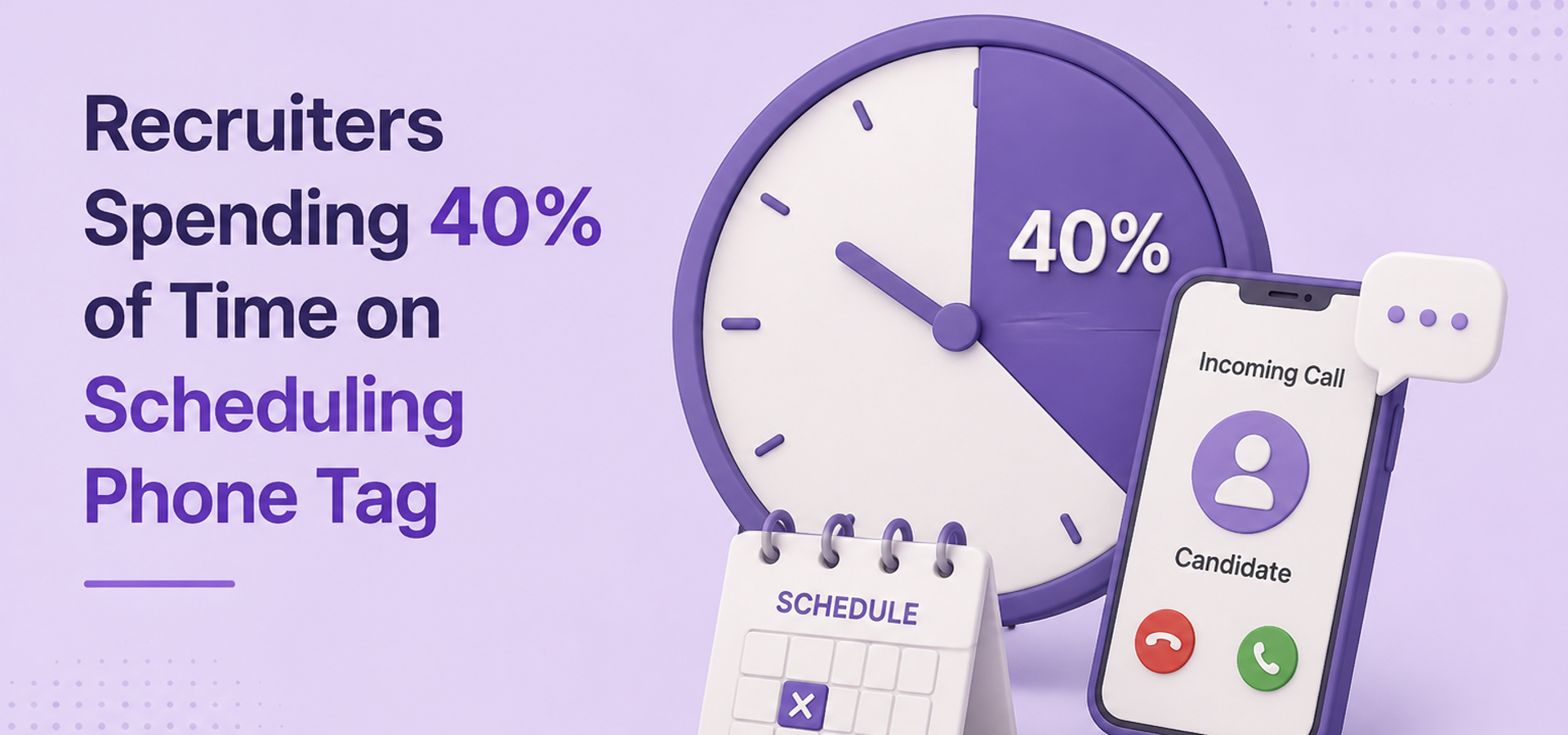
Short answer: Recruiters spending 40% of time on scheduling phone tag is not a soft complaint. It is an operations failure. Industry research puts interview scheduling near 35–38% of recruiter time. Much of that is voicemail loops, “what times work?”, and reschedule chaos. Fix the coordination layer and you free hours for sourcing, screening, and closing.
Tuesday, 11:40 a.m. A strong candidate is free Thursday. The hiring manager is free Friday. You leave a voicemail. They text back at 3:12. You call the manager. Voicemail. By Thursday the candidate has another onsite. Your req is still open. Nobody “failed interviews.” Phone tag failed the process.
This guide explains where the ~40% number comes from, why scheduling phone tag expands with every panel interview, what it costs in time-to-hire, and how AI voice agents cut the loop while writing outcomes into your ATS. For broader hiring automation context, see AI in recruitment and how AI agents are transforming recruiting.
Where the “40%” comes from (and what the research actually says)
Leaders often say recruiters spend about 40% of their week on scheduling. That is a fair shorthand for a tightly clustered research band:
- GoodTime’s 2026 Hiring Insights Report finds talent teams spend 38% of their time scheduling interviews, calling it the highest operational burden measured. Source: GoodTime: 2026 hiring statistics.
- Other industry summaries cite roughly 35% of recruiter time on interview scheduling alone (commonly attributed via SelectSoftwareReviews-style recruiting benchmarks).
So “40%” is not a random meme. It is the rounded operational reality many TA teams feel when scheduling, confirmations, and phone tag stack together. If your team has no dedicated coordinator, the percentage often lands even higher.
GoodTime also reports that 60% of organizations saw time-to-hire increase in 2025, while only a small minority reduced it. Scheduling delays, limited interviewer pools, cancellations, and hiring-manager availability top the bottleneck list. That is phone tag with a spreadsheet attached.
What “scheduling phone tag” actually includes
Scheduling phone tag is the multi-party chase to lock a time:
- Recruiter proposes slots
- Candidate misses the call or needs different hours
- Hiring manager declines or goes dark
- Panel members conflict
- Someone cancels
- The loop restarts
Each cycle looks small (10–20 minutes). At volume it becomes the job. A survey summarized by HRMS World found many recruiters still need multiple emails or calls just to align schedules, and a large share take three or more days to book an interview. Source: HRMS World: survey of 272 recruiters.
Phone tag is worse than calendar tools alone because candidates and managers still answer phones inconsistently, especially hourly, field, and high-volume staffing roles. That is why voice automation matters alongside self-serve schedulers. Related: automated screening for staffing agencies and AI staffing.
Why recruiters spending 40% of time on scheduling phone tag wrecks outcomes
1) Time-to-hire stretches before interviews start
SHRM recruiting benchmarking shows median time-to-fill measured in weeks, not days. Every day lost in coordination is a day a candidate can accept another offer. Source overview: SHRM recruiting benchmarking.
2) Recruiter capacity collapses
If nearly two days a week go to coordination, sourcing depth and quality screens suffer. Teams then buy more tools or headcount instead of removing the bottleneck. See hire candidates faster with AI tools.
3) Candidate experience decays
Strong candidates interpret slow scheduling as disorganization. They ghost. Your CRM/ATS shows “interested,” then “unresponsive,” when the real story was three missed callbacks.
4) Hiring managers blame “talent shortage”
Sometimes the pipeline was fine. The calendar was not. Analytics that ignore scheduling lag misdiagnose the funnel. Pair process fixes with recruitment analytics software.
The Dialflo Phone Tag Audit (run this in one week)
Before you buy software, measure the tax.
- Sample 20 recent reqs. Count calendar days from “ready to schedule” to “invite accepted.”
- Count touches. Calls + emails + texts per booked interview.
- Tag failure modes. No answer, manager delay, candidate reschedule, panel conflict, no-show.
- Estimate hours. Average touches × minutes × interviews booked that week.
- Convert to capacity. Hours / 40 = FTE fraction lost to scheduling phone tag.
If your audit lands near 0.35–0.40 FTE per recruiter, you have just validated why leaders say recruiters spending 40% of time on scheduling phone tag is the default state.
What to automate first (without breaking candidate trust)
Tier-one coordination AI can own
- Outbound calls offering 2–3 approved slots from interviewer calendars
- Inbound “I need to move my interview” confirmations
- Reminder calls 24 hours and 2 hours before
- No-show follow-ups with reschedule options
- Structured write-back: confirmed, rescheduled, no answer, declined
What humans should keep
- Offer negotiation and sensitive candidate conversations
- Executive/panel diplomacy when politics matter
- Exceptions (visa constraints, accommodations, VIP searches)
- Quality judgment after screens and interviews
AI voice agents shine when the job is repetitive, high-volume, and phone-first. That fits hourly hiring, staffing desks, and high-volume corporate TA. For screening adjacent to scheduling, see AI applicant screening and conversational services.
Architecture that actually cuts phone tag
- ATS remains system of record. Stages, interview events, and dispositions live there.
- Calendar truth for interviewers. Only offer real availability; never invent slots.
- Voice layer for contact. Call candidates who will not live in email self-serve links.
- CRM/ATS write-back. Every attempt leaves an outcome. Integration discipline matters: integrate recruiting software with existing systems.
- Human escalation path. Warm transfer or urgent task when the candidate is upset or VIP.
Self-serve scheduling links help white-collar candidates. They do not erase phone tag for people who apply from a phone between shifts. Voice is still the contact channel.
Metrics that prove you reduced the 40% tax
- Median days from “schedule ready” to “invite accepted”
- Touches per booked interview
- Percent of interviews booked with zero human dial
- Reschedule cycle time
- Recruiter hours on coordination (weekly pulse)
- Candidate show rate after automated reminders
GoodTime notes companies using automated or AI-driven scheduling were more likely to hit near-perfect hiring goal attainment in their 2026 dataset. Treat that as directional motivation, then prove it on your own funnel with the metrics above.
After interviews run, improve signal quality with interview intelligence and better question design via AI interview questions from job descriptions. Scheduling speed without interview quality just accelerates bad hires.
Staffing agencies and high-volume TA: phone tag is the product tax
Staffing desks live on the phone. Submittals, availability checks, interview confirms, and client reschedules create continuous phone tag. If recruiters spending 40% of time on scheduling phone tag is true in corporate TA, agency floors can feel worse during surge weeks.
Prioritize:
- same-day availability calls
- interview confirmations
- client-side reschedule intake
- ATS disposition hygiene so fill metrics stay honest
Compare agency tool stacks carefully: ATS for staffing agencies compared, AI agents for recruitment compared, and candidate relationship systems in candidate relationship management.
Where Dialflo fits
Dialflo attacks the reason recruiters spending 40% of time on scheduling phone tag persists: humans are still the dialer for repetitive confirm/reschedule work. Dialflo voice agents call and answer, offer approved slots, capture outcomes, and write back to recruiting systems so recruiters reclaim hours for judgment work.
If you are building an agentic hiring operating model, pair voice coordination with clear ownership: agentic hiring organization. Automation without process design just creates faster confusion.
FAQs
Do recruiters really spend 40% of time on scheduling phone tag?
Benchmarks cluster around 35–38% of recruiter time on interview scheduling. Teams often experience that as roughly 40% when phone and email coordination dominate. Audit your own touches to confirm.
What is scheduling phone tag?
It is the back-and-forth of calls and messages needed to align candidate and interviewer calendars, then redo the plan after changes.
Will calendar links alone fix this?
They help for email-first candidates. Phone-first applicants and busy hiring managers still create phone tag. Use both self-serve links and voice outreach.
Can AI voice agents book interviews safely?
Yes, when slots come from real calendar availability, scripts are approved, and outcomes write to the ATS. Keep humans for exceptions and sensitive roles.
What should recruiters do with recovered time?
Source deeper, improve screens, coach hiring managers, and close candidates faster. Do not refill the calendar with more low-value admin.
How does Dialflo help?
Dialflo runs the phone coordination layer for scheduling and confirmations so the 40% tax shrinks. Explore Dialflo to pilot on one high-volume req family first.
If your team is living the story of recruiters spending 40% of time on scheduling phone tag, do not hire another coordinator as the first move. Measure the Phone Tag Audit for one week, automate tier-one confirm and reschedule calls, and put every outcome in the ATS. That is how scheduling stops owning the recruiting week.


