Agentic Hiring: A Playbook for Staffing and TA Leaders

Dialflo: AI Voice Agent
April 28, 2026
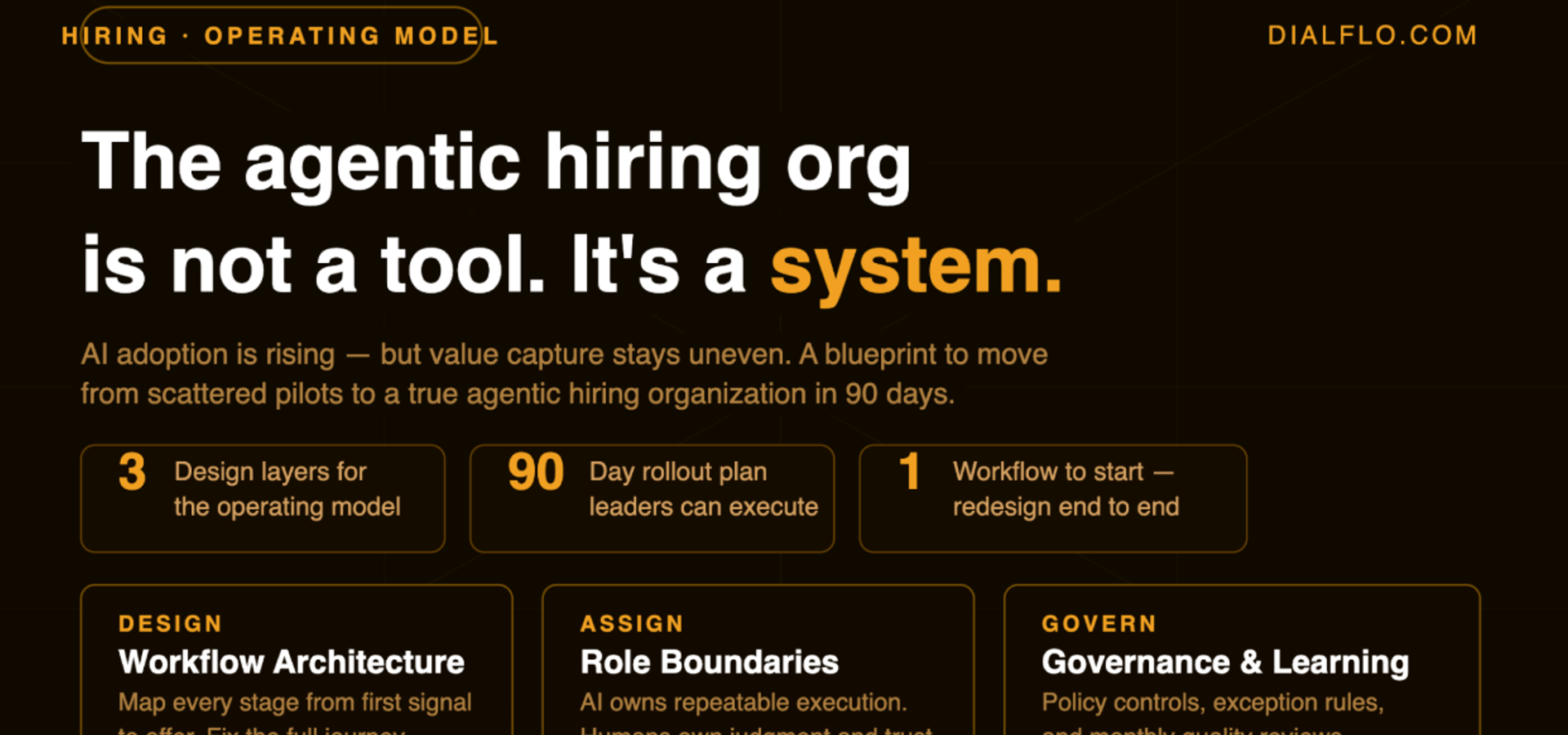
The next hiring advantage is not another AI feature. It is an agentic hiring organization where people and AI share work by design.
Every hiring leader is seeing the same paradox in 2026. AI is now in sourcing tools, ATS suites, interview workflows, and candidate communication systems. Yet placement quality, recruiter capacity, and hiring speed still feel stubbornly inconsistent. That is because most companies have adopted AI tools without becoming an agentic hiring organization.
McKinsey captures this gap clearly in its perspective on why AI adoption is rising while agentic operating models still lag behind (source). In parallel, the State of AI 2025 report notes broad enterprise AI usage, but uneven value capture. Adoption is not the same as transformation.
This guide gives staffing and talent acquisition leaders a practical blueprint to move from scattered pilots to a true agentic hiring organization, with role clarity, governance, and measurable business outcomes.
What an agentic hiring organization actually means
An agentic hiring organization is not a team with many chatbots. It is a redesigned operating system for hiring. AI agents handle repeatable execution across high-volume steps. Humans own decisions that require context, accountability, and trust.
That sounds simple, but it changes everything: staffing plans, recruiter scorecards, manager expectations, escalation design, legal governance, and even how weekly pipeline reviews are run.
Most failed AI hiring projects focus on tooling first. Successful programs focus on workflow ownership first, then assign technology to that ownership model.
Why AI tools alone fail to move hiring outcomes
Many teams automate individual tasks while leaving system bottlenecks untouched. Example: AI improves job ad writing, but first-touch screening remains delayed. Or interview scheduling gets faster, but qualification criteria are unclear and inconsistent across recruiters. Local gains get canceled by downstream friction.
The fix is to redesign the full journey, not just one task. Candidate acquisition, qualification, handoff, and decision loops must be treated as one workflow with shared metrics.
LinkedIn's recruiting research repeatedly shows hiring teams value speed and quality together, not speed alone (source). That is exactly why agentic design matters: it aligns execution speed with decision quality.
The three design layers of an agentic hiring organization
Layer one: workflow architecture. Start by mapping every stage from first signal to final offer or placement. Mark where delay, inconsistency, or rework occurs. That map becomes your transformation scope.
Layer two: role boundaries. Define what AI agents can do autonomously, what requires human confirmation, and what must always stay human-led. If boundaries are vague, accountability disappears.
Layer three: governance and learning. Add policy controls, exception rules, and regular quality review cycles. Agentic systems fail when feedback loops are weak, not when models are imperfect.
Where staffing and TA teams should begin first
The best launch point is usually first-touch qualification and scheduling. It is high-volume, repetitive, and directly tied to candidate drop-off. Every hour of delay here compounds downstream loss.
For staffing firms, this is often phone-heavy and multilingual. For enterprise TA teams, this may be chat or email dominant. In both cases, agentic design reduces response latency while preserving escalation to a recruiter when needed.
When done right, this single change improves recruiter capacity, candidate experience, and hiring manager confidence at the same time.
From pilot chaos to operating discipline
Most teams run too many pilots and learn too little. A high-performing agentic hiring organization runs fewer pilots with tighter measurement. Each pilot needs a business owner, an operations owner, and a risk owner.
Set success criteria before launch: qualified candidate rate, time to first meaningful interaction, escalation quality, and recruiter time recovered. If your pilot cannot be evaluated in those terms, it is a demo, not an operating change.
Also define failure criteria in advance. Teams that only define success tend to keep weak pilots alive because the tooling looks impressive.
Operating model comparison
Dimension
Traditional model
Agentic hiring organization model
Execution speed
Human-limited and business-hours constrained
Always-on execution with human escalation paths
Recruiter workload
Heavy repetitive coordination and follow-ups
Focused on decision quality and stakeholder management
Process consistency
Varies by individual recruiter style
Standardized workflows with controlled deviations
Governance
Reactive compliance checks
Built-in policies, logs, and exception monitoring
Improvement loop
Quarterly retros and ad hoc fixes
Continuous tuning via shared performance dashboards
What changes for recruiters in this model
The recruiter role becomes more strategic, not less important. In an agentic hiring organization, recruiters spend less time on repetitive outreach, screening logistics, and rescheduling loops. They spend more time on quality calibration, candidate persuasion, client alignment, and decision risk.
Training must evolve accordingly. Recruiters need to learn prompt and rubric editing, transcript auditing, exception management, and policy-aware communication. This is no longer optional digital literacy. It is core hiring capability.
Compensation and KPIs should reflect this shift. If recruiters are still measured mainly on activity volume, agentic workflows will be underused or misused.
Governance principles that keep trust intact
Trust is the real moat in hiring. An agentic hiring organization keeps trust by being transparent, fair, and accountable. Candidates should know when AI is involved. Recruiters should have clear override authority. Leaders should be able to explain decisions in plain language.
Use a monthly governance review with cross-functional participation: talent operations, legal, security, and hiring leadership. Review edge cases, candidate complaints, false negatives, and escalation failures. Then tune scripts, policies, and handoff rules.
Publish internal guidance that covers prohibited signals, retention rules, and when mandatory human review applies. These controls are not bureaucracy. They are what allow confident scaling.
Where Dialflo fits in an agentic hiring organization
Many teams modernize inbox workflows but leave phone workflows manual. That creates a major blind spot, especially in high-volume staffing environments. Dialflo addresses this by automating structured voice interactions while preserving recruiter control over sensitive or complex decisions.
In practice, this can include first-touch screening, interview scheduling, and candidate re-engagement in voice-first talent markets. The outcome is not just faster calls. It is cleaner workflow continuity between candidate interaction and ATS records.
If you are evaluating complementary tooling, compare this with our related guide on AI staffing and the future of hiring.
A 90-day rollout plan leaders can execute now
Days 1-30: Choose one high-volume hiring lane. Baseline current performance: response time, qualified progression, recruiter hours, and drop-off points. Document policy constraints before technical setup.
Days 31-60: Launch in controlled scope. Monitor daily for escalation quality and weekly for conversion patterns. Hold calibration sessions between recruiters and ops to fix weak prompts or rubric logic.
Days 61-90: Expand only if both speed and quality improve. If quality drops, pause and redesign before scaling. Share results with finance and leadership in business language, not feature language.
Disciplined rollout is what separates a short-lived pilot from a durable agentic hiring organization.
Metrics that indicate real transformation
Track a balanced scorecard, not vanity metrics. Useful indicators include qualified conversion rate, time to first recruiter conversation, candidate satisfaction signals, escalation resolution quality, and recruiter capacity recovered for high-value work.
Watch for metric drift across job families and regions. A model that works for one volume segment may fail in another. Continuous segmentation keeps gains real and repeatable.
Most importantly, tie operational metrics to business outcomes: placements, quality-of-hire proxies, retention, and client satisfaction. That is when leadership support becomes durable.
Done well, this model improves recruiter retention because teams spend less time on repetitive coordination and burnout-inducing backlogs.
FAQ: agentic hiring organization
What is an agentic hiring organization?
It is a hiring model where AI agents and humans are intentionally assigned different parts of the workflow. Agents scale repeatable execution, while humans own judgment and accountability.
Why do AI-heavy hiring teams still struggle to scale value?
Because they optimize tools, not workflows. Without redesigning ownership and handoffs, teams gain speed in one step but lose it in another.
Will this model replace recruiters?
No. It upgrades recruiter impact by moving them away from repetitive coordination and toward quality decisions, candidate trust, and stakeholder alignment.
Where should we start first?
Start with one high-volume bottleneck, usually first-touch qualification and scheduling. Run a controlled pilot with clear KPIs and explicit escalation rules.
How does voice AI contribute to the model?
Voice AI supports always-on candidate interactions in phone-centric workflows and routes complex conversations to recruiters, improving both speed and consistency.
Final takeaway
The companies that win in 2026 will not be those that buy the most AI products. They will be those that build the best agentic hiring organization: clear ownership, trusted governance, measurable outcomes, and teams that know exactly when humans should lead. Start with one workflow, redesign it end to end, and scale only what improves both candidate trust and hiring performance.
Ready to hand the first screening step to an AI agent? Book a Dialflo demo to see voice agents screen candidates by phone and write the results to your ATS.


