How to Hire Candidates Faster Using AI Tools

Dialflo: AI Voice Agent
April 24, 2026
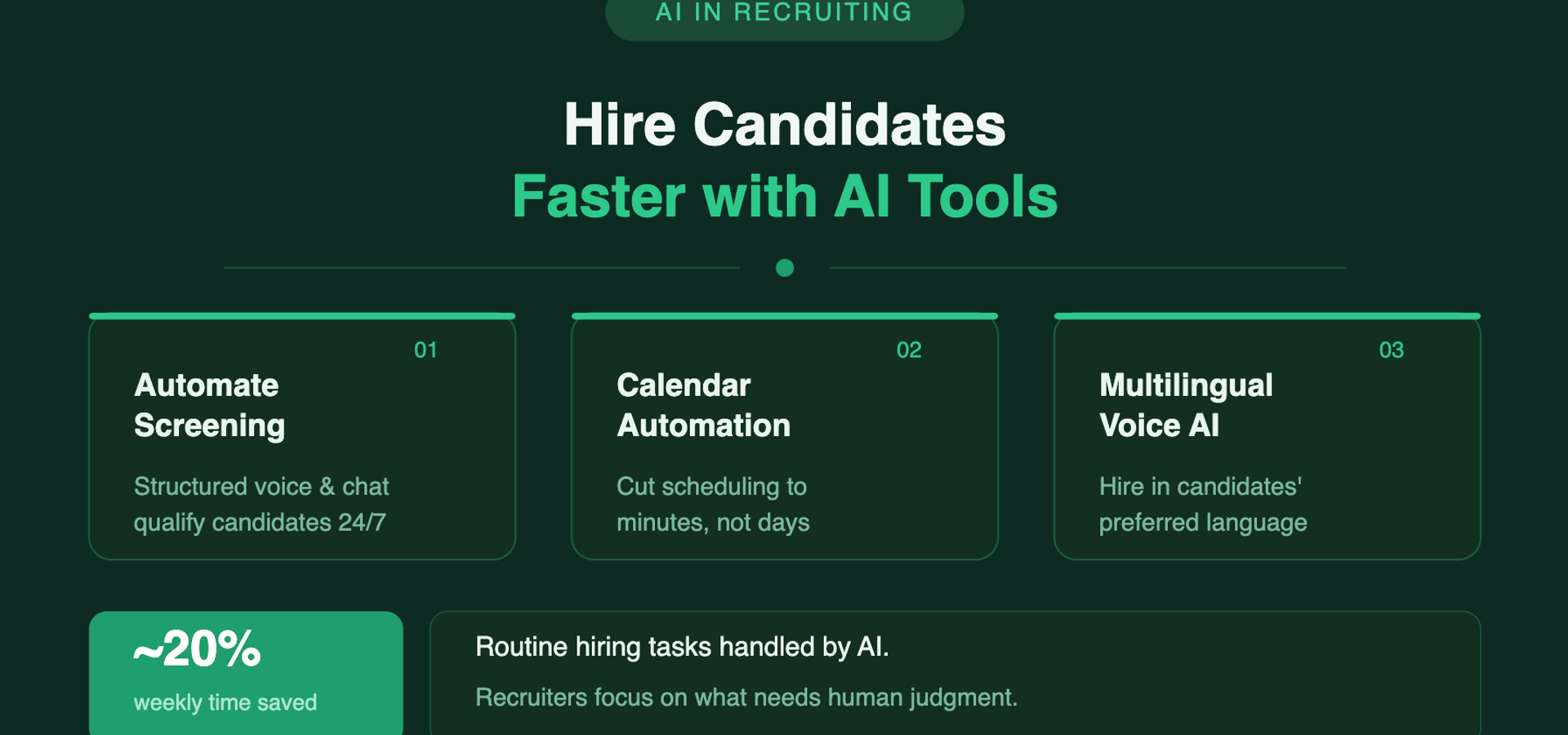
Teams that hire candidates faster usually fix wait time between stages, not by skipping diligence.
If your goal is to hire candidates before competitors do, the lever is rarely “more interviews.” It is less idle time between touchpoints: applications that sit unread, voicemails that roll to Monday, and calendars that need five emails to lock a slot.
AI tools help when they remove friction in those specific gaps while keeping human judgment where it matters.
This guide explains how to speed hiring without turning your process into an opaque black box. You will see what benchmark data says about cycle length, a simple framework for where automation earns ROI, how teams hire employees online with less back-and-forth, and what compliance teams expect when hiring candidates with algorithms or voice systems.
For voice-first workflows, we also point to Dialflo as one way to compress phone-heavy stages, without replacing your ATS.
Why hiring candidates takes longer than it should
Macro data reminds you that slow hiring is normal, not uniquely your ops problem, until you fix local bottlenecks. SHRM’s 2025 recruiting executives benchmarking brief, summarizing survey work with HR leaders, notes that time to fill roles remains roughly a month and a half for many organizations.
The same brief highlights executive cost-per-hire up about 113 percent since 2017 and 21 percent since 2022, plus that over half of organizations have recruiters juggling about twenty requisitions each, a load where manual scheduling breaks first.
LinkedIn’s Future of Recruiting 2025 report draws on billions of platform data points, a survey of more than 1,000 talent professionals, and interviews with talent leaders.
On generative AI specifically, LinkedIn reports that 37 percent of organizations are now “actively integrating” or “experimenting” with Gen AI tools in recruiting, up from 27 percent a year earlier, and that among teams already using those tools, the average time saved is about 20 percent of the work week (roughly a full day weekly).
That is the efficiency budget you reinvest into faster candidate touchpoints and higher-quality conversations.
Read both signals together: candidates experience delay as indifference. Your fix is to attack delay directly.
The four gaps that slow hiring candidates (and where AI fits)
Use this PACE lens, Pipeline, Automation, Compliance, Execution, to decide what to buy or build first:
- Pipeline. Are enough qualified people entering your funnel? AI-assisted sourcing and better job copy help, but if inbound is healthy, do not start here.
- Automation. Where do tasks repeat exactly the same way hundreds of times, knockout questions, document requests, interview scheduling? That is automation-grade work.
- Compliance. Will a regulator or counsel recognize your criteria and records? AI must document decision logic, consent, and adverse impact monitoring, not speed you into legal gray area.
- Execution. Do managers actually show up prepared and decide on time? No AI fixes chronic hiring-manager delay; executive SLAs do.
Most “hire faster” wins come from Automation + Execution together: faster loops with accountable humans at the end.
How teams hire employees online without drowning in email
When you hire employees online, candidate expectations are set by consumer apps: instant confirmation, transparent next steps, and mobile-friendly flows. Email-heavy processes feel slow even when your recruiters are working nights.
Practical stack patterns we see in the field:
- Apply and triage. Parsing resumes into your ATS, smart forms that adapt by role family, and chat assistants that answer “where is my application” reduce recruiter inbox load.
- Async assessment. Structured video prompts or short skills checks buy calendar time while preserving signal, if you validate that the exercise predicts performance for your roles.
- Calendar automation. Tools that propose slots from real availability cut the three-day ping-pong thread that kills speed metrics.
Pick one channel to optimize per thirty-day sprint. Teams that try to swap every system at once rarely ship measurable time-to-offer improvements.
Voice AI: when hiring candidates still happens on the phone
Many high-volume desks, staffing, logistics, retail, care work, still see the first serious touch on a phone call. Voicemail and callback queues silently cap how fast you can hire candidates even if your careers site is modern.
Dialflo is an AI voice agent platform used in recruitment among other verticals. You connect a business number so applicants reach a consistent experience that can collect structured answers, qualify against knockouts, and schedule interviews without waiting for a live recruiter during peak call spikes. Teams operating across languages often care that Dialflo advertises multilingual support, including broad coverage for Indian languages, so hiring candidates in their preferred spoken language is feasible without linearly scaling headcount.
Dialflo is not a substitute for a full ATS; it is a front door that reduces phone-tag. Published tiers on dialflo.ai include examples such as Starter near ₹9,999 per month and Professional near ₹24,999 per month, with Enterprise on custom terms, confirm live pricing before procurement. If your leak is missed calls, that economics comparison belongs in the same spreadsheet as recruiter salary and time-to-fill.
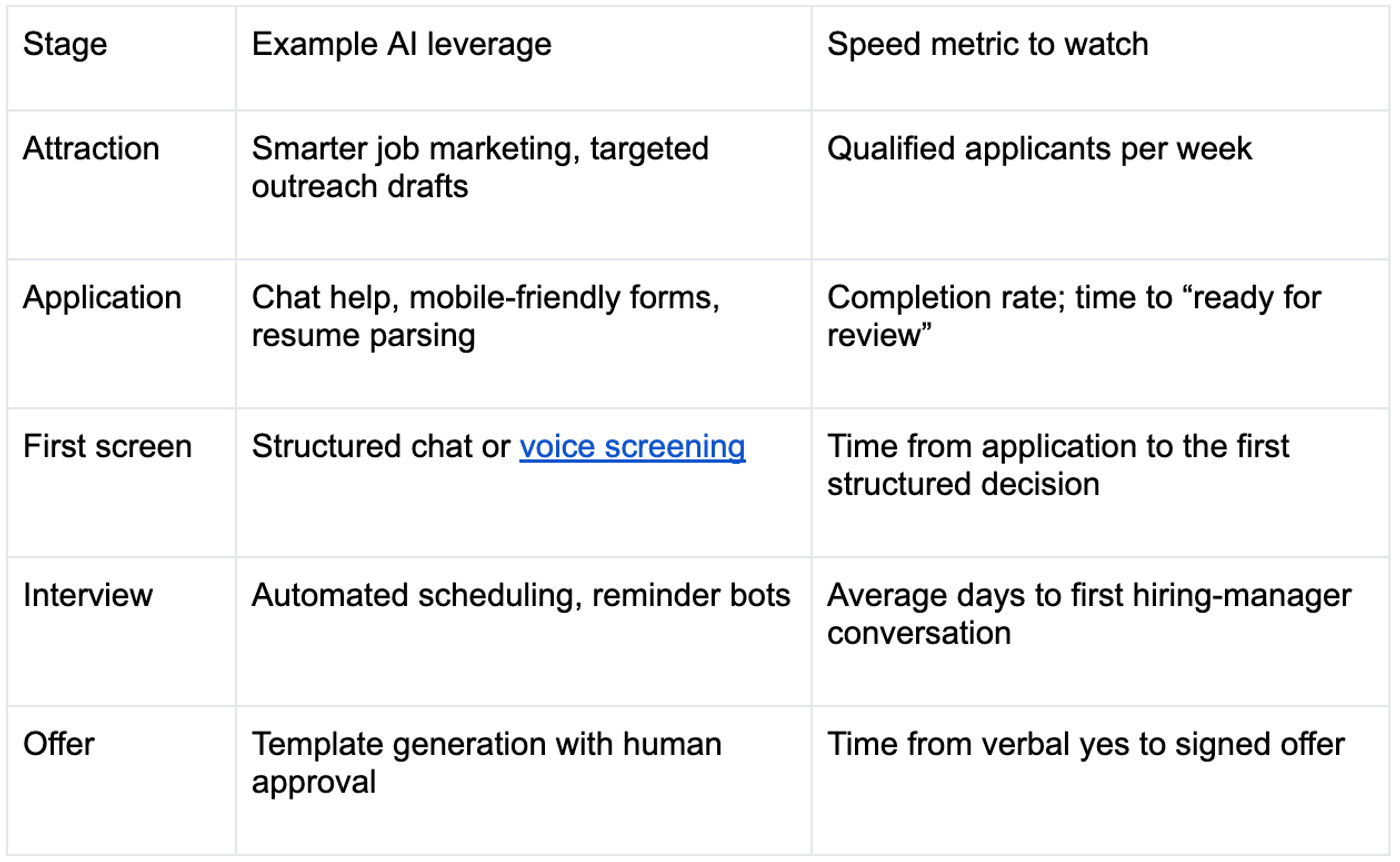
Comparison: AI leverage points when hiring candidates
Match tool categories to the bottleneck you mapped in PACE, avoid buying duplicate coverage.
Fairness and compliance when hiring candidates with AI
Speed that trades away lawful hiring practices is not savings; it is risk. The U.S. Equal Employment Opportunity Commission publishes guidance on artificial intelligence and emerging technologies in employment decisions, emphasizing that automated systems must still comply with federal equal opportunity obligations. Your practical checklist: disclose when AI is used, offer reasonable alternatives where required, retain records, and periodically audit outcomes by demographic cohort where law permits and counsel advises.
Voice and conversational AI add recording, consent, and accessibility considerations, offer a parallel path for candidates who cannot or should not use the automated channel.
A thirty-day rollout plan to hire candidates faster
Sequence matters more than budget.
Week one, instrument. Export last quarter’s time-in-stage by role family. Circle the longest gap.
Week two, design. Write knockouts on paper. Map which fields must land in your ATS. Align with legal on disclosures.
Week three, pilot. Turn on automation for a single family of roles. Keep humans on exception handling.
Week four, review. Compare median days to first interview, completion rates, and candidate survey verbatims. Expand or roll back on evidence, not vibes.
Throughout, keep one internal owner accountable for the metric you chose on day one.
FAQ: hiring candidates with AI tools
How can I hire candidates faster without lowering quality?
Compress wait time between stages, not rigor. Automate scheduling, structured knockouts, and document collection; keep human interviews for judgment-heavy decisions. Measure time-in-stage weekly and cap calendar sprawl with batch windows.
What AI tools help hire employees online?
Common categories include AI-assisted job marketing and sourcing, chatbots for apply help, resume parsing inside your ATS, async video or voice screening, calendar automation, and generative drafting for recruiter messages. Pick one bottleneck first instead of buying everything.
Is voice AI safe when hiring candidates at scale?
It can be when you document consent, retention, and accessibility alternatives; review samples for disparate outcomes; and align prompts with lawful, job-related criteria. Pair automation with periodic human audits and counsel on regional recording laws.
Will AI replace recruiters for hiring candidates?
Unlikely for full-cycle ownership. AI excels at repetitive coordination and first-pass qualification; recruiters still own stakeholder management, closing, compensation judgment, and nuanced candidate experience. The fastest teams blend both.
Where should a small team start to speed up hiring candidates?
Start where candidates stall: missed calls, slow scheduling, or incomplete applications. Pilot one role family for thirty days, map ATS fields before launch, and compare time-to-interview before and after. Expand only after metrics move.
How does Dialflo help teams hire candidates faster?
Dialflo provides AI voice agents for recruitment that can run first-touch screening, capture structured answers, and schedule interviews on your business number, including multilingual options, reducing voicemail delays while your ATS stays the system of record. Review current capabilities and pricing on dialflo.ai.
Closing: speed is a product decision
Teams that consistently hire candidates faster treat latency as a design flaw, then remove it with narrow automation, clear manager SLAs, and documented fairness controls. Start with benchmarks so you know you are not gaslighting your recruiters, pick one stage from the table above, and measure for thirty days.
If phone-based leakage is your bottleneck, explore how Dialflo fits beside your ATS. If your bottleneck is sourcing or employer brand, solve that first; no voice stack compensates for an empty funnel.


