How AI Makes Supply Chains More Sustainable

Dialflo: AI Voice Agent
May 18, 2026
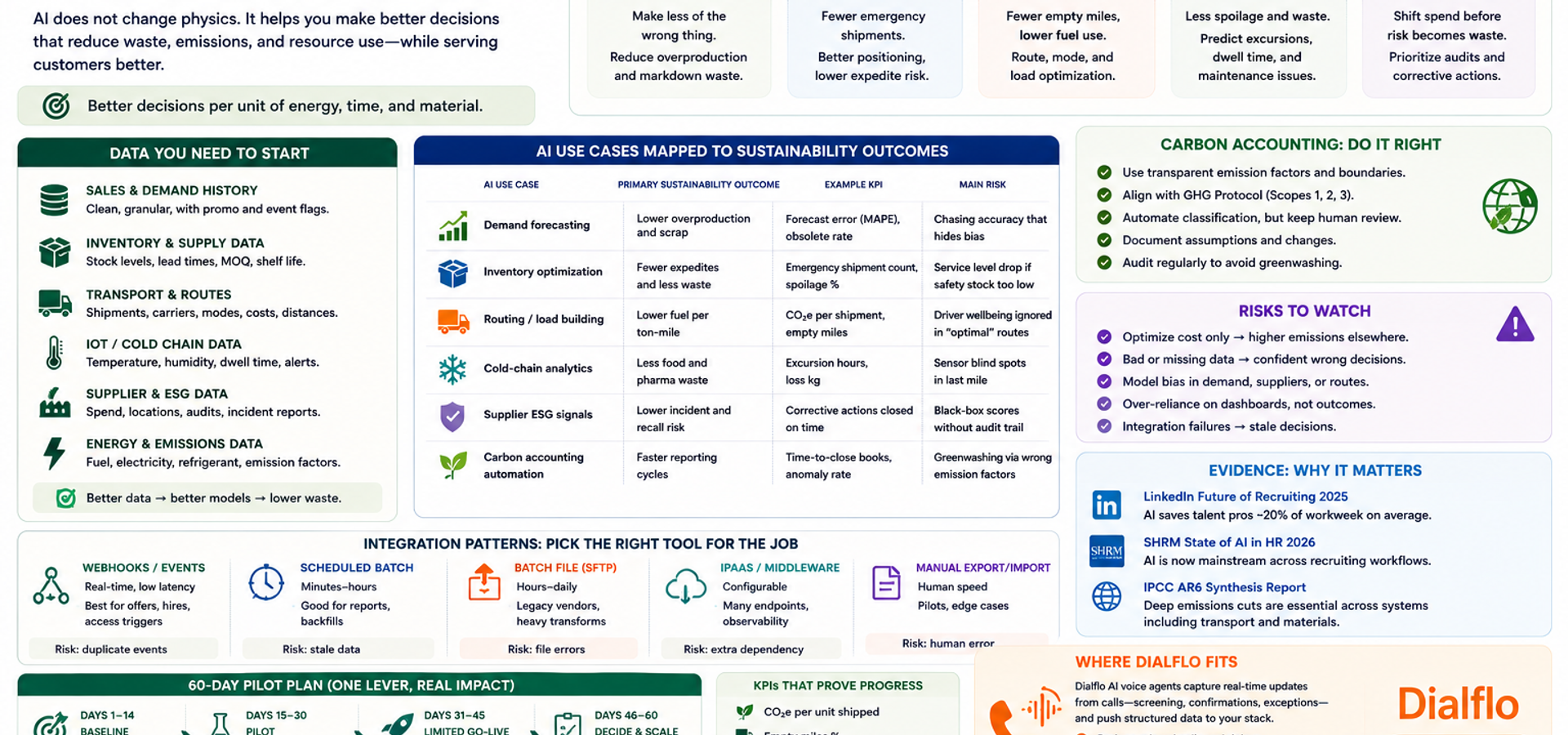
“Net-zero” roadmaps sound abstract until you sit with planners who fight the same fire every Monday: the wrong inventory in the wrong place, trucks running light, spoilage in the cold chain, and supplier data that arrives too late to reroute. If you are asking how AI can make supply chains more sustainable, the honest answer is not a magic model—it is better decisions per unit of energy, time, and material.
This guide maps where AI creates measurable sustainability outcomes, what data you need, which KPIs prove progress, and what risks create greenwashing instead of impact. For adjacent depth, read machine learning for supply chain optimization, AI supply chain technology: trends & innovations, AI inventory optimization: tools & strategies, and technology used in supply chain management. When coordination calls are the bottleneck, Dialflo can help teams capture structured updates faster—but the emissions math still belongs to your network design and carriers.
How AI can make supply chains more sustainable: the five leverage points
Think in physical units: fuel, refrigerant hours, kilograms scrapped, packaging, and megawatt-hours. AI changes sustainability when it reduces those units for the same service level.
1) Demand and production planning (make less of the wrong thing)
Overproduction is a sustainability tax: raw materials, energy, handling, and often landfill. ML forecasting that separates true demand from promotion noise reduces obsolete stock and markdown churn.
2) Inventory placement and safety stock (fewer emergency air shipments)
Expedited freight is often the hidden emissions spike. Better inventory positioning and multi-echelon optimization reduce panic moves. See AI inventory optimization for tactics and tooling patterns.
3) Transport and network design (fewer empty miles)
Route optimization, load consolidation, and mode choice models cut CO₂e per ton-mile when constraints reflect real dock hours and driver rules—not only theoretical shortest paths.
EPA’s SmartWay program frames freight efficiency metrics and partnership practices that align with lower-emissions logistics decisions; use it as a common language with carriers: EPA SmartWay.
4) Cold chain and perishables (less spoilage)
ML on temperature excursions, dwell time, and equipment health reduces spoilage—direct waste avoidance with financial payoff. Sustainability teams like these projects because the baseline is measurable in kilograms.
5) Supplier ESG and compliance (shift spend before a crisis)
Text mining on audits, incident feeds, and third-party ESG scores can prioritize site visits and corrective actions. The sustainability win is preventing disruption and recall waste—not scoring vendors for a slide deck alone.
Carbon accounting: where AI helps—and where it hurts credibility
AI can classify transactions, map spend to emission factors, and reconcile anomalies faster than spreadsheets. Credibility comes from transparent factors, boundary choices, and alignment with recognized frameworks such as the GHG Protocol.
If your model reports beautiful precision with wrong scope boundaries, you will pass finance and fail auditors. Build human review gates for category rules and capital projects.
Evidence: why climate science pushes operations to act on logistics
Global assessments emphasize rapid cuts to greenhouse-gas emissions across systems—including how energy and materials move through economies. The IPCC’s AR6 Synthesis Report summarizes the physical risk case for deeper mitigation across sectors; use it to align executives on why transport and inventory decisions matter: IPCC AR6 Synthesis Report.
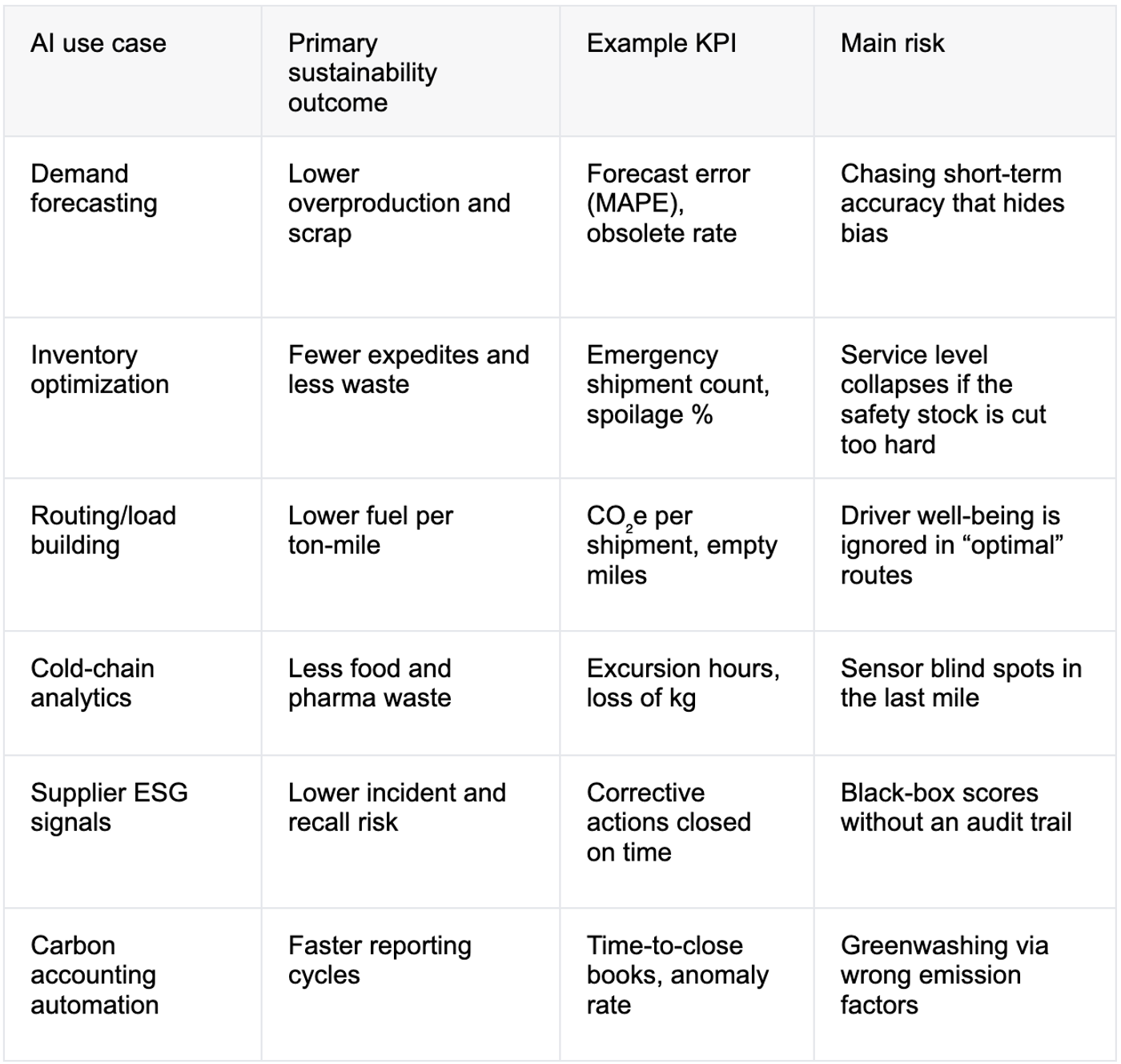
Comparison table: AI use cases mapped to sustainability outcomes
Use this table in joint ops–sustainability meetings to stop “AI for AI” projects.
A 60-day pilot plan (pick one physical lever)
Days 1–14: Baseline the lever you will move (fuel, spoilage, scrap, or electricity). Install meters and data contracts with carriers if missing.
Days 15–30: Pilot AI on a single lane, SKU family, or warehouse zone. Run shadow mode against human planners.
Days 31–45: Limited production with guardrails. Publish weekly KPIs: cost and emissions proxy.
Days 46–60: Expand or rollback with a written decision rule. Sustainability wins when finance trusts the numbers.
Unique angle: sustainability is a multi-objective optimization problem
Single-objective models (“minimize cost”) often increase emissions indirectly. How AI can make supply chains more sustainable in practice requires explicit constraints: carbon budgets per lane, caps on expedited air, or minimum fill rates.
That framing prevents the classic failure mode: the cheapest plan that quietly ships everything by overnight air.
Where Dialflo fits: faster truth when phones drive exceptions
Many sustainability decisions wait on human coordination: a carrier says a reefer failed, a supplier missed a window, a dock needs a reschedule. If your team loses hours in voicemail, your model optimizes stale reality.
Dialflo provides AI voice agents that can capture structured updates from high-volume call workflows—so planners and control towers work off fresher data. Voice automation does not replace network design, but it can reduce latency between “something broke” and “someone acted.”
FAQ: how AI can make supply chains more sustainable
How can AI make supply chains more sustainable?
By reducing wasted materials, energy, and miles through better forecasts, inventory placement, routing, cold-chain control, supplier risk signals, and auditable carbon reporting.
What data is required?
Shipment and inventory history, BOMs, energy data where available, temperature logs for perishables, returns and scrap, and supplier master data tied to spend and location.
What risks should we watch?
Greenwashing dashboards, wrong emission factors, cost-only objectives that increase emissions elsewhere, and biased supplier scoring without appeals.
Which KPIs matter most?
Emissions intensity per unit shipped, spoilage and scrap rates, empty miles, emergency shipments, warehouse kWh per unit, and supplier corrective action closure rates.
How does AI support circular supply chains?
With better returns forecasting, grading, spare-parts matching, and remanufacturing routing—assuming reverse logistics data exists.
When is Dialflo relevant?
When exception handling depends on phone-heavy coordination and structured answers need to reach planners fast.
Closing: measure tons, kilowatt-hours, and hours—not only “AI adoption”
How AI can make supply chains more sustainable is not a slide on GenAI. It is a stack of decisions that reduce physical waste and emissions per unit of customer value. Pick one lever, baseline honestly, and expand only when the planet-facing KPIs move with the business KPIs.
For deeper supply-chain AI context across planning and logistics, continue with AI supply chain technology: trends & innovations and Dialflo when voice coordination is part of your operating reality.