Machine Learning in Recruiting: How It Works

Dialflo: AI Voice Agent
May 7, 2026
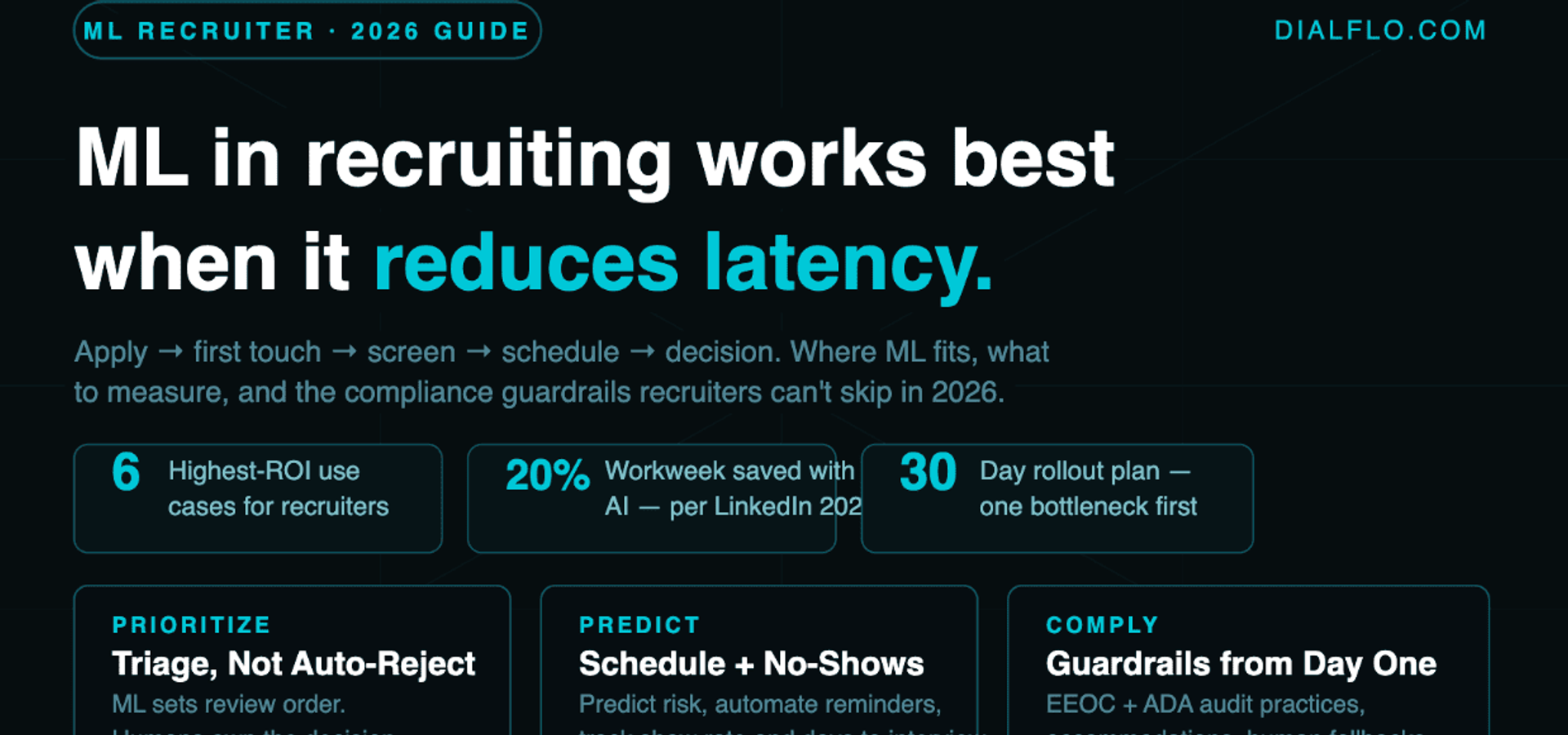
ML works best in recruiting when it reduces latency between stages, apply → first touch → screen → schedule → decision, without turning hiring into a black box.
If you’re searching machine learning recruiter, you’re probably asking one of two questions: “What does ML actually do in recruiting?” or “How do I use it without breaking candidate experience and compliance?” The right mental model is simple: machine learning is best at prioritization and prediction. It helps you decide who to contact first, which applicants need human review, and where the funnel is leaking, so your team spends more time on conversations and less time on sorting.
LinkedIn’s 2025 Future of Recruiting report suggests that talent acquisition professionals already using generative AI save about 20% of their workweek on average, roughly a day a week, time that can be reinvested into relationship-building and higher-signal assessment. See: LinkedIn: Future of Recruiting 2025.
This guide explains how machine learning works in recruiting, where it fits best (screening, matching, scheduling, analytics), what to measure, and what compliance teams expect, especially around disability accommodations and disparate impact. For phone-heavy workflows, we also reference Dialflo as one example of voice-first automation that reduces missed-call delays without replacing your ATS.
How machine learning works in recruiting (in plain English)
Machine learning models learn patterns from data and use those patterns to make predictions about new cases. In recruiting, “data” can include resumes, job descriptions, application forms, recruiter notes, interview outcomes, response rates, scheduling outcomes, and eventual hires.
A simplified ML recruiting pipeline looks like this:
1) Inputs. Resumes, job requirements, application answers, and interaction data (email opens, call outcomes, interview attendance).
2) Features. The system turns inputs into structured signals (skills, titles, tenure, certifications, location, keywords, time patterns).
3) Model prediction. The model outputs a score or probability (fit score, response likelihood, no-show risk, routing category).
4) Decision layer. Business rules translate predictions into actions (who gets reviewed first, who gets a screen call, who gets routed to which recruiter).
5) Feedback loop. Outcomes (interview passed, declined, no-show) are captured so the system can be evaluated and improved.
Most failures happen at step 4: organizations deploy scores without a clear decision policy, or they automate rejection without adequate guardrails.
Where recruiters use machine learning today (highest ROI use cases)
Think of ML recruiting use cases as “workload reducers” and “speed multipliers.” The best ones target repeatable tasks at scale.
1) Resume parsing and structured profiles
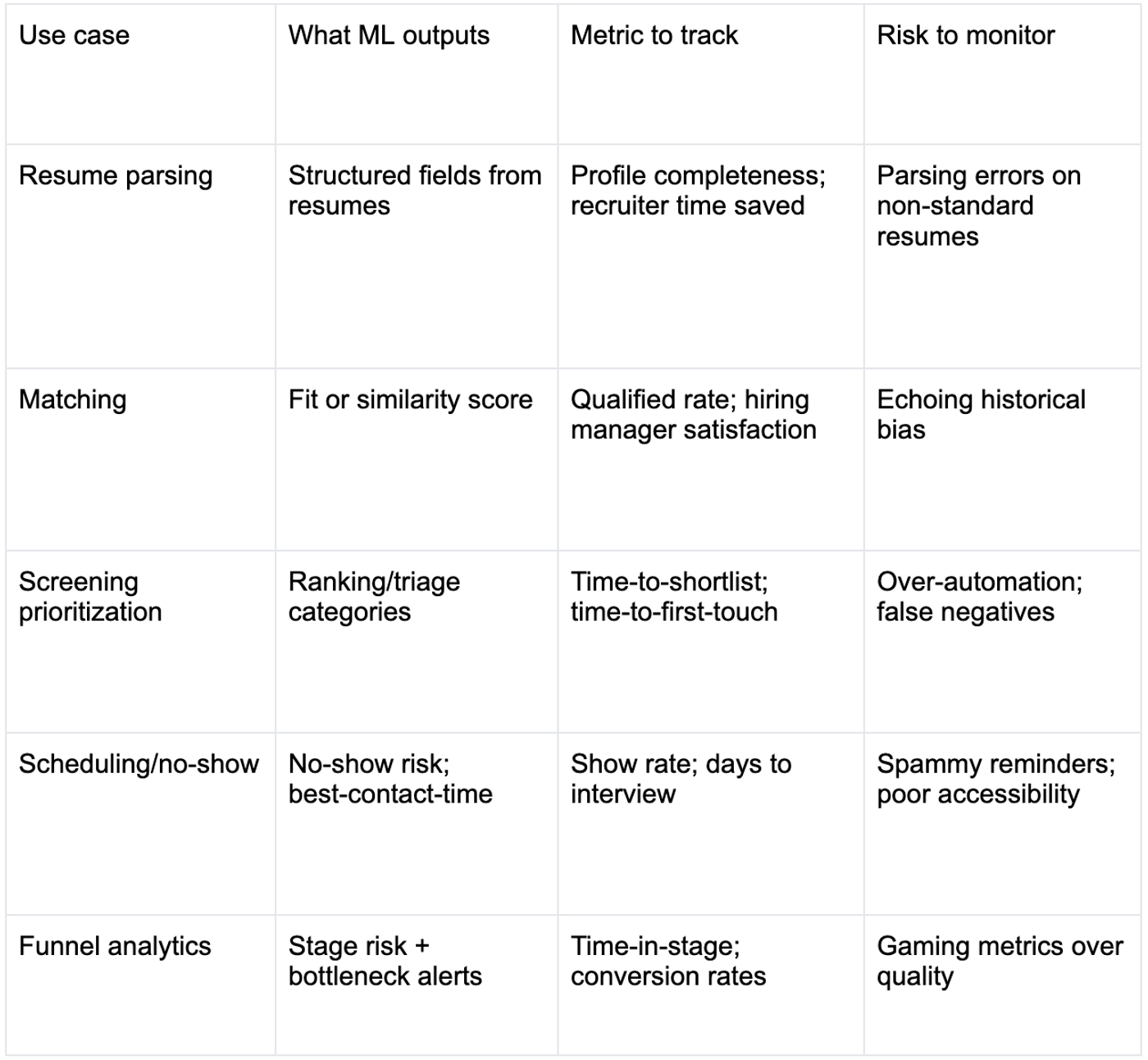
Parsing converts messy resumes into structured fields (skills, roles, dates). This is foundational because downstream matching and analytics depend on consistent data. It’s not flashy, but it’s the plumbing that makes everything else work.
2) Candidate-job matching (recommendations)
Matching models suggest which candidates are likely to fit a role based on skills, experience, and historical outcomes. The safest deployment pattern is “assistive”: suggestions for recruiters, not automated rejections.
3) Screening prioritization (who to review first)
When you have 500 applicants, the real value is triage. ML can help rank or cluster candidates so recruiters spend human time on the highest-signal profiles first. This is different from “auto-reject.” It’s “review order.”
4) Sourcing recommendations
Some tools recommend sourcing channels or similar candidates based on prior success patterns. The risk here is echoing historical bias, so you need audit practices and diverse sourcing strategies.
5) Scheduling and no-show risk prediction
Scheduling is a coordination bottleneck. ML can predict who is likely to no-show or who needs reminders, and automation can propose times and send confirmations. SHRM’s State of AI in HR 2026 report discusses AI adoption in recruiting tasks such as resume screening and communications, reflecting how much of the time savings comes from screening and scheduling automation. See: SHRM: State of AI in HR 2026.
6) Funnel analytics and bottleneck detection
ML and analytics can highlight where the funnel leaks (drop-off after a stage, slow response in one location, low-quality source). The best outputs are operational: “This stage takes 8 days; cut it to 2” rather than “here’s a dashboard.”
Comparison: ML recruiting use cases vs what to measure
What compliance teams care about (don’t skip this)
Speed that creates discrimination risk is not speed, it’s future cost. In the U.S., EEOC guidance makes it clear that AI tools used in employment decisions must comply with federal discrimination laws. For disability in particular, the EEOC highlights risks when AI tools screen out qualified applicants with disabilities and emphasizes the need for reasonable accommodations. See: EEOC: Artificial Intelligence and the ADA.
Practical guardrails many teams adopt:
- Use ML to prioritize, not to auto-reject in early deployments.
- Document criteria and ensure they’re job-related.
- Provide accommodation paths (alternative assessments, human review, accessible formats).
- Audit outcomes for disparate impact and investigate causes.
- Keep humans accountable for final decisions.
A simple 30-day rollout plan for recruiters
Week 1 , choose a bottleneck. Is your pain screening volume, slow scheduling, or weak sourcing? Pick one.
Week 2 , define success metrics. Time-to-first-touch, time-to-shortlist, show rate, or conversion to onsite.
Week 3 , pilot in one role family. Keep a human review loop. Log overrides and why they happened.
Week 4 , audit and scale carefully. Review candidate experience, compliance notes, and whether metrics improved without quality drop.
Where Dialflo fits: ML workflows for phone-first recruiting
In high-volume recruiting, the funnel often leaks at the phone stage: missed calls, voicemail, and delayed callbacks. Dialflo provides AI voice agents that can run first-touch screening, capture structured answers, and help schedule interviews, so candidates get a consistent experience even during call spikes. Dialflo is not a full ATS; it’s a voice front door that can sit alongside your system of record.
FAQ: machine learning recruiter
What does machine learning mean for a recruiter?
It usually means software that prioritizes work and predicts outcomes: ranking applicants, suggesting matches, automating scheduling steps, and surfacing pipeline insights, so recruiters spend more time on conversations and less time sorting.
How does machine learning work in recruiting?
Models learn patterns from historical data and predict things like fit, response probability, or no-show risk. The best systems use constrained outputs, clear decision rules, and regular audits.
Where is ML used most today?
Resume parsing, matching recommendations, screening triage, scheduling automation, sourcing suggestions, and funnel analytics.
What are the biggest risks?
Disparate impact, accessibility barriers, privacy/consent gaps, and bad candidate experience from over-automation. Mitigate with human fallbacks, accommodations, documentation, and audits.
What compliance guidance should teams read?
EEOC guidance on AI and the ADA is a practical starting point for disability-related considerations and reasonable accommodations.
How does Dialflo help ML recruiting workflows?
Dialflo provides AI voice agents for first-touch screening and scheduling, reducing missed-call delays while your ATS remains the system of record. Learn more at dialflo.ai.
Closing: ML should make recruiting more human, not less
When machine learning is deployed well, it doesn’t replace recruiters, it removes the repetitive coordination that prevents them from doing their best work. Use ML to prioritize and predict, keep decisions explainable, and build guardrails that protect fairness and accessibility. That’s how “machine learning recruiter” becomes a productivity advantage rather than a compliance headache.


