AI in Logistics: Use Cases, Benefits & Tools

Dialflo: AI Voice Agent
April 15, 2026
The logistics industry runs on speed, coordination, and communication. When any of those break down, deliveries get delayed, costs climb, and customers leave. AI logistics tools are changing that, by automating the repetitive, high-volume work that slows operations down and erodes already-thin margins.
This guide covers what AI in logistics actually does, where it is delivering measurable ROI right now, which tools are worth evaluating, and where voice AI fits into an industry that still relies heavily on phone calls.
The Scale of the Opportunity
The numbers tell you everything you need to know about why logistics has become one of the most active sectors for AI adoption.
According to Precedence Research, the global AI in logistics market was valued at $17.96 billion in 2024 and is projected to reach $707.75 billion by 2034, growing at a compound annual growth rate of 44.4%. In India specifically, the market is projected to grow from $756 million in FY2024 to $6.8 billion by FY2032, driven by e-commerce expansion, last-mile delivery demand, and multilingual operational complexity.
The case for action is just as compelling at the operational level. McKinsey research finds that embedding AI in logistics operations can reduce logistics costs by 5–20% and inventory by 20–30%. For last-mile delivery, the most expensive part of any shipment, accounting for up to 53% of total shipping costs according to McKinsey, AI-based route optimisation alone can cut delivery costs by 10–30%.
For Indian logistics operators running on margins of 3–5%, those percentages are the difference between a viable business and a struggling one.
What Does AI Do in Logistics?
AI in logistics covers a wide range of applications. The common thread across all of them is the same: AI takes over tasks that are too repetitive, too data-intensive, or too time-sensitive for human teams to handle efficiently at scale.
For large enterprises, the conversation often centres on warehouse robotics, global supply chain optimisation, and demand sensing. For Indian regional operators, 3PL providers, and D2C brands, the most immediate pain points are more operational: drivers missing pickups, customers unreachable for delivery confirmation, coordinators making 200 calls a day just to get status updates, and failed deliveries generating costly returns.
Both problems are real. Both are where AI is delivering results.
Key Use Cases of AI in Logistics
1. Route Optimisation
AI analyses real-time traffic data, weather patterns, delivery density, vehicle capacity, and historical route performance to generate optimal delivery sequences dynamically. Drivers are no longer given fixed routes at the start of the day, routes adjust continuously as conditions change.
McKinsey's analysis of a last-mile operator with over 10,000 vehicles found that deploying virtual dispatcher agents led to $30–35 million in savings from an initial investment of just $2 million. UPS attributes its AI-powered routing to saving over 10 million gallons of fuel annually.
2. Demand Forecasting
AI models analyse order history, seasonal trends, regional buying patterns, and external market signals to predict shipment volumes weeks or months in advance. This allows logistics companies to plan fleet capacity, warehouse staffing, and inventory positioning before demand spikes arrive, rather than reacting to them.
Oliver Wyman's analysis of 25 real-world logistics use cases found that AI-based predictive analytics can improve operational efficiency by 10–25% across last-mile delivery, sorting, and warehouse management. For operators where EBIT margins sit at 3–5%, a 1–2% improvement in EBIT is transformative.
3. Warehouse Automation
Computer vision systems scan, sort, and identify packages faster and more accurately than manual processes. AI-driven warehouse management systems optimise storage locations based on product velocity and seasonal demand, reducing picking times significantly. The same Oliver Wyman report found that AI-powered warehouse tools can unlock 7–15% additional capacity in warehouse networks without adding new real estate.
4. Delivery Confirmation Calls
Customers need to be home. Packages need to be expected. But outbound confirmation calls, ringing every customer before a delivery window, are extraordinarily labour-intensive at scale. AI voice agents make these calls automatically, confirm availability, collect rescheduling preferences when needed, and log outcomes back to the system of record.
5. RTO and Return Management
Failed deliveries are one of the biggest margin killers in Indian e-commerce logistics. Cash-on-delivery orders account for over 60% of e-commerce transactions in India, and RTO rates on COD shipments are significantly higher than prepaid orders because customers can refuse delivery without penalty.
AI tackles this in two ways. Predictive tools assess return risk at the point of order using machine learning trained on historical delivery data, Delhivery's AI-powered RTO Predictor, for example, helped over 4,800 e-commerce businesses reduce return shipments by up to 20% using insights from 2.5 billion deliveries. Voice AI tools make proactive outreach calls after a failed delivery attempt, collect the customer's reason, and reschedule, reducing the probability of a second failed attempt before the shipment is returned to origin.
6. Driver Coordination and Check-ins
Fleet coordinators spend significant portions of their day calling drivers for pickup confirmations, route updates, and exception handling. AI voice agents handle these check-in calls automatically, confirming driver availability, collecting ETAs, escalating exceptions to human coordinators only when necessary. This reduces coordinator overhead and cuts driver no-shows meaningfully.
7. Real-Time Tracking and Customer Communication
According to Statista, over 90% of consumers expect real-time tracking for their orders. AI-powered tracking systems combine IoT sensor data, GPS feeds, and machine learning to provide accurate estimated arrival windows and proactive exception notifications, reducing inbound customer service calls while improving satisfaction scores.
AI Logistics Tools Worth Evaluating
The title of this article promises tools, plural, so here is a neutral overview of the major categories and representative platforms, organised by use case.
Route Optimisation and Dispatch
Locus DispatchIQ is widely used by enterprise logistics teams across India and Southeast Asia. It handles AI-powered route sequencing, dynamic dispatch, and real-time re-routing. Its dispatch engine accounts for customer time windows, driver skills, vehicle type, and live traffic data. Best for: D2C brands and 3PLs managing large fleets with complex delivery constraints.
Onfleet is a last-mile delivery platform built around route optimisation and proof-of-delivery workflows. It is lighter-weight than enterprise platforms, making it a strong option for growing businesses that do not need a full supply chain suite. Best for: Regional last-mile operators and courier businesses.
Supply Chain Visibility and Freight Tracking
Project44 and FourKites are the two dominant global platforms for real-time shipment visibility. Both use AI to predict ETAs, flag exceptions before they become delays, and provide end-to-end freight tracking across modes. Best for: Global shippers and enterprises managing complex multimodal freight.
Demand Forecasting and Supply Chain Planning
Blue Yonder provides AI-driven demand sensing and autonomous replenishment, widely used in retail and manufacturing supply chains. Its models pull from historical order data, external signals, and machine learning to continuously revise forecasts. Best for: Large enterprises with high-SKU inventory complexity.
SAP Integrated Business Planning (IBP) offers end-to-end predictive visibility for enterprises already running SAP's ecosystem. It handles demand sensing, capacity planning, and logistics execution under a single platform. Best for: Enterprises seeking one integrated planning and execution environment.
Warehouse Management
Logiwa is a cloud-based warehouse management platform that works particularly well for e-commerce and 3PL operations. It provides real-time inventory tracking, AI-driven demand forecasting, and integrations with major marketplaces. Best for: E-commerce fulfilment centres and modern 3PL operators.
Manhattan Associates integrates warehouse management, order management, and transportation management in a unified platform. It is particularly strong for businesses that need coordination between warehouse and delivery operations. Best for: Enterprise retailers and large 3PLs.
Voice AI for Operational Communication
Dialflo occupies a distinct category: AI voice agents built specifically for the high-volume outbound and inbound call layer of logistics operations, the calls that every other platform in this list leaves to your coordination team to make manually.
Most AI logistics platforms focus on backend systems, routing algorithms, forecasting models, warehouse automation. The communication layer, the actual calls between coordinators, drivers, and customers, still runs on manual effort for most operators.
Where Dialflo Fits In
Dialflo's AI voice agents are built for operational logistics communication: delivery confirmation calls, driver check-ins, RTO follow-up calls, and customer status updates. Agents handle conversations in multiple Indian languages, including Hindi, Tamil, Kannada, and Marathi, covering the linguistic diversity that English-only communication tools consistently miss.
What distinguishes Dialflo at the conversation level is its listening-first design philosophy. Most voice AI systems fail at exactly the moment that matters: the actual exchange. They interrupt. They miss hesitation. They respond to words without reading context. Callers feel processed and disengage. Dialflo's agents are built to detect conversational cues, avoid interrupting, and handle the natural back-and-forth of a regional logistics call rather than forcing callers through rigid decision trees.
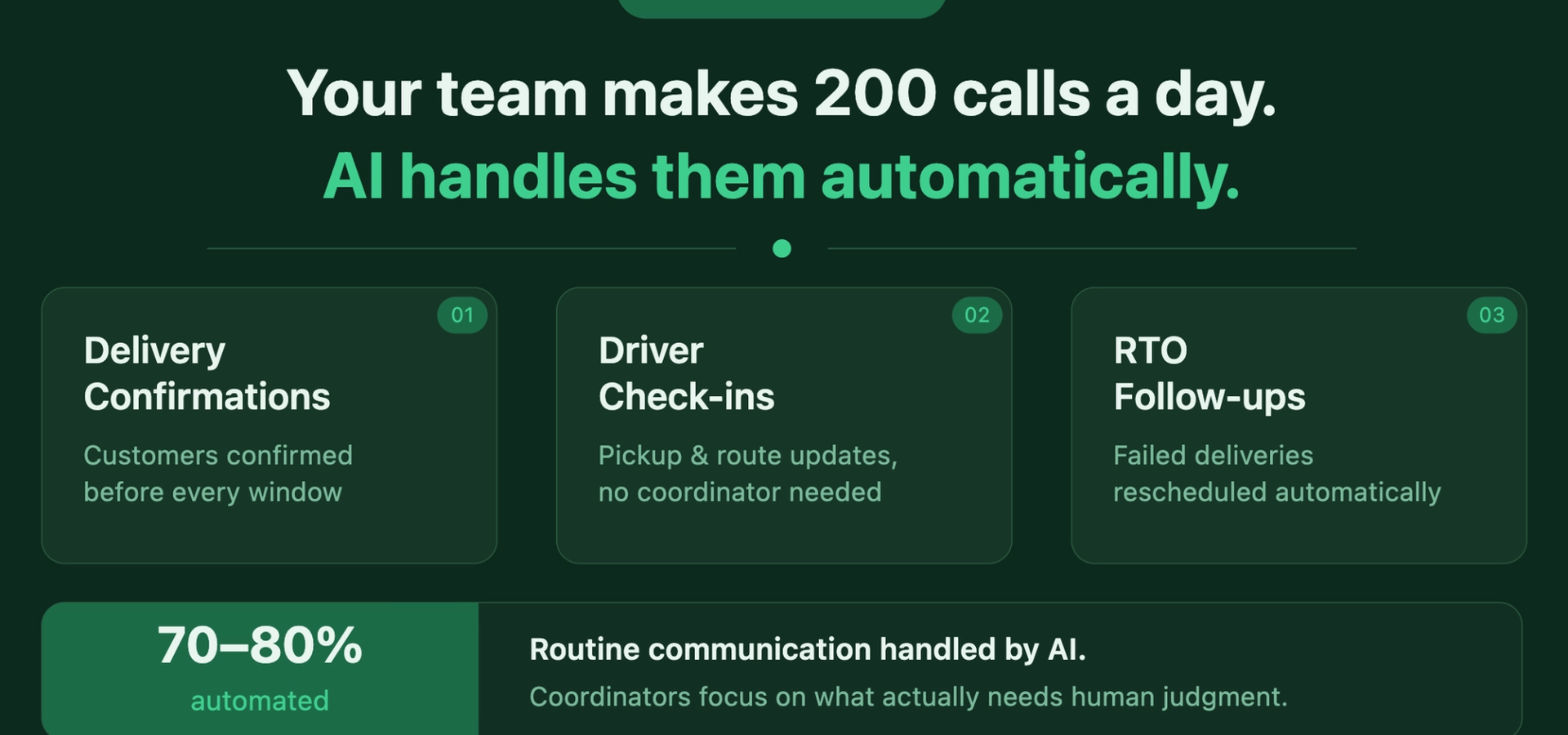
The practical result: across Dialflo's client base, spanning D2C brands, regional logistics operators, and clinic chains coordinating home visits and sample pickups, AI voice automation handles 70–80% of routine coordination call volume, freeing coordinators to focus on exceptions, escalations, and the calls that genuinely require human judgement.
For a logistics team making 200 calls a day, that number represents several hours of recovered coordinator time, every single day.
Comparing the Tool Categories at a Glance
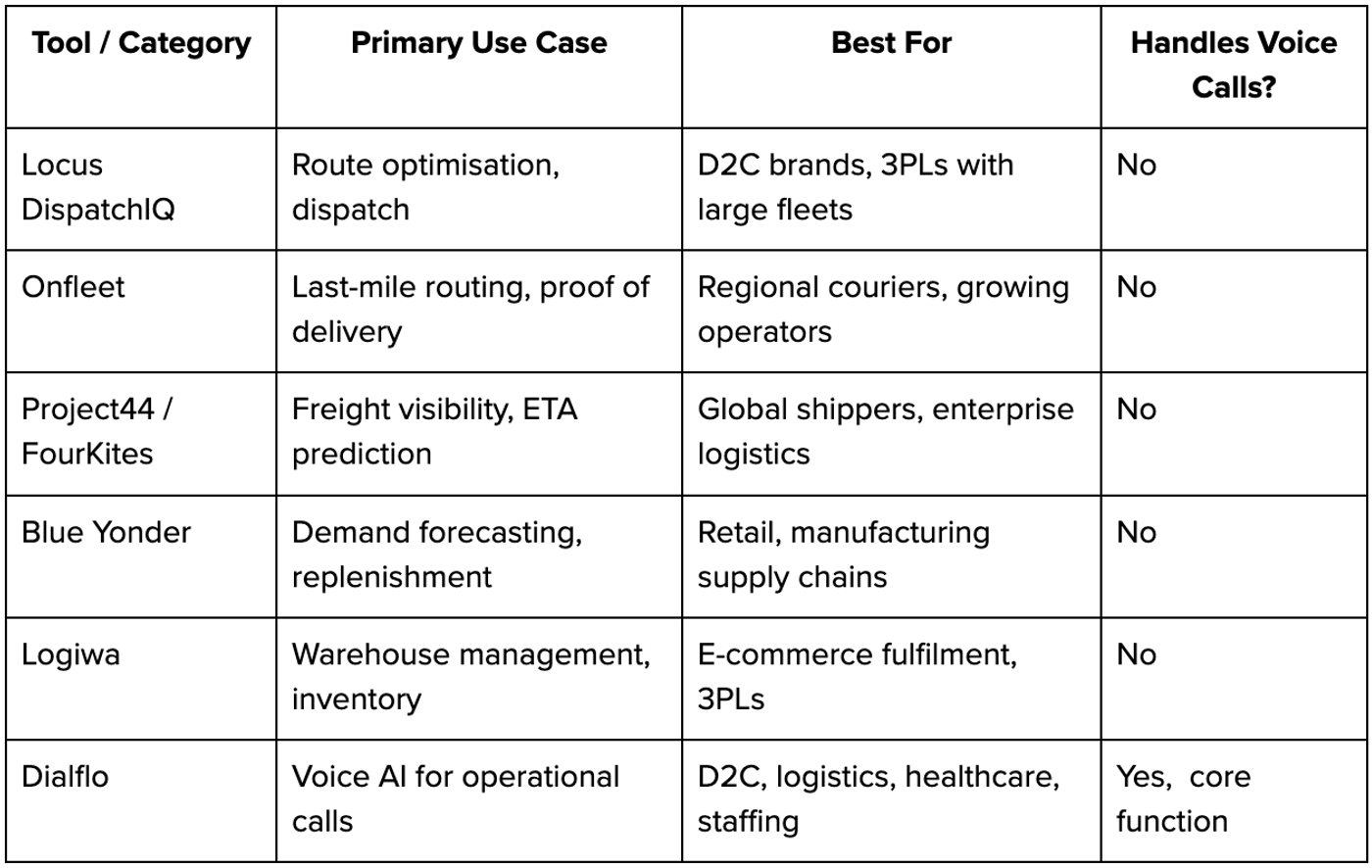
The table above illustrates something important: nearly every established AI logistics platform optimises the data layer. None of them close the gap on operational voice communication, the calls your team is still making manually today.
Benefits of AI in Logistics: What the Numbers Say
The case for AI adoption in logistics is now backed by enough real-world evidence that it is no longer speculative.
McKinsey estimates 5–20% reductions in logistics costs for companies that embed AI in operations. Oliver Wyman's analysis found that AI-powered customer service tools, including chatbots and voice agents, can handle up to 30% of delivery inquiries end-to-end and cut agent handling time by approximately 50%. For last-mile operators specifically, AI-based route optimisation reduces delivery costs by 10–30% depending on fleet size and delivery density.
For Indian D2C and e-commerce logistics, the RTO problem is the most urgent priority. With over 60% of transactions being COD, every failed delivery that converts to an RTO costs the brand both the logistics expense and the lost margin on a sale that was never collected. AI-driven confirmation calls and RTO prediction tools directly address the most expensive failure mode in the system.
The benefits compound across the operation:
- Lower coordinator overhead. Fewer human hours spent on routine check-in calls, confirmation calls, and follow-up calls. Coordinators handle exceptions rather than volume.
- Faster delivery cycles. Reduced miscommunication between coordinators, drivers, and customers means fewer delays, fewer missed windows, and fewer second delivery attempts.
- Reduced RTO rates. Proactive confirmation and failed-delivery follow-up calls keep deliveries from becoming returns.
- Better customer experience. Timely, proactive communication in the customer's preferred language builds trust, particularly important in regional markets where English-only outreach creates friction.
- Scalability without proportional headcount growth. AI handles volume increases without requiring additional coordination staff. A team of ten coordinators can effectively manage the call volume of a much larger operation.
Who Benefits Most
Not every logistics business needs every category of AI tool. The highest-impact profiles are:
D2C brands managing high delivery volumes on COD, where RTO prevention directly protects margins and every failed delivery has a measurable cost.
Regional logistics and 3PL operators running large fleets across multiple cities, where route optimisation and driver coordination automation recover hours of coordinator time daily.
Ecommerce companies with multilingual customer bases, where AI voice communication in Hindi, Tamil, Kannada, or Marathi reaches customers that English-only outreach misses entirely.
Healthcare and clinic chains coordinating sample pickups and home visits, where scheduling, confirmation, and rescheduling calls are high volume but low complexity.
Any logistics business making more than 100 operational calls a day. At that volume, manual coordination is not just a cost problem, it is a strategic bottleneck. AI does not get tired, does not miss a call because a coordinator is on another line, and does not forget to follow up.
The Bottom Line
AI in logistics is not a future concept. It is a present-day operational advantage for businesses that have moved beyond experimentation into deployment.
From route planning to warehouse automation to demand forecasting, the backend of logistics operations is being transformed by platforms that turn data into decisions. That layer is increasingly well-served by established tools.
What remains underserved, and where the most immediate ROI sits for regional Indian operators, is the communication layer. The calls your coordinators make every day. The confirmations, the check-ins, the RTO follow-ups, the multilingual outreach. This is the work that occupies hours of skilled coordinator time without requiring the judgement that makes those coordinators valuable.
Dialflo handles this layer, so your team can focus on the exceptions, escalations, and relationships that actually need human attention.
Faster deliveries. Lower costs. Fewer failed handoffs. That is what AI in logistics looks like in practice.
Frequently Asked Questions
Q1. What is AI used for in logistics?
AI handles route optimisation, demand forecasting, warehouse automation, real-time tracking, and operational communication like delivery confirmations and driver coordination. It reduces manual effort across the entire supply chain.
Q2. How does voice AI help logistics companies specifically?
Voice AI automates high-volume calls, delivery confirmations, driver check-ins, RTO follow-ups, that coordinators currently handle manually. It saves time, reduces errors, and scales without adding headcount. Tools like Dialflo also support regional Indian languages, making them effective for diverse driver and customer bases.
Q3. Is AI in logistics only for large enterprises?
No. Platforms like Locus and Onfleet are designed for growing businesses, and tools like Dialflo use usage-based pricing, meaning you pay for what you use. AI in logistics is increasingly accessible at any scale.
Q4. What is the RTO problem in Indian logistics and how does AI solve it?
Return to Origin (RTO) happens when a delivery fails and the package is sent back to the sender. With COD orders making up over 60% of Indian e-commerce transactions, RTO rates are a significant margin risk. AI addresses this through predictive RTO scoring at checkout and proactive voice follow-up calls after failed delivery attempts, both of which reduce the rate at which failed deliveries become full returns.
Q5. Which AI logistics tool is right for a regional Indian operator?
It depends on your primary bottleneck. For route optimisation and dispatch, Locus DispatchIQ is a strong option for Indian fleets. For operational communication, confirmation calls, driver check-ins, RTO follow-ups in regional languages, Dialflo is built specifically for this use case at Indian scale.
Want to start with the calls that cost you most? Book a Dialflo demo to see voice agents handle delivery confirmations, RTO follow-ups and driver coordination.