AI in Logistics Security: Risks, Threats & Solutions

Dialflo: AI Voice Agent
June 19, 2026
Dispatch gets a call: “Driver broke down, reroute load 8841 to this yard.” The voice sounds right. The TMS updates. By morning, freight is at a lot nobody recognizes and the customer is screaming. Whether the attacker used a spoofed line, a compromised portal, or an over-permissive AI agent does not matter to the shipper, only that your operation moved cargo on bad instructions. That is the stakes of security in logistics AI in 2026: automation speed without controls becomes a weapon pointed at your own network.
This guide maps the real risks and threats when AI touches routing, visibility, warehouse systems, and voice-heavy dispatch, plus practical solutions operators can implement without pausing digital transformation. If you are evaluating security in logistics AI after a pilot or incident, start with threats you can verify, not vendor fear slides.
Why logistics AI expands the attack surface
Logistics already runs on interconnected systems, TMS, WMS, ELD, load boards, customer portals. AI layers add:
- API connections that read live shipment data
- models that recommend routes, carriers, or pricing
- voice agents that speak to drivers, shippers, and brokers 24/7
- chatbots with access to order history and documents
Each connection is useful, and exploitable if credentials leak, prompts over-share data, or agents execute writes without validation. Context: AI in logistics: use cases, benefits & tools and technology used in supply chain management.
The U.S. Cybersecurity and Infrastructure Security Agency warns that supply chains are high-value targets because compromising one vendor can affect many downstream operators. Source: CISA: Supply chain risk management.
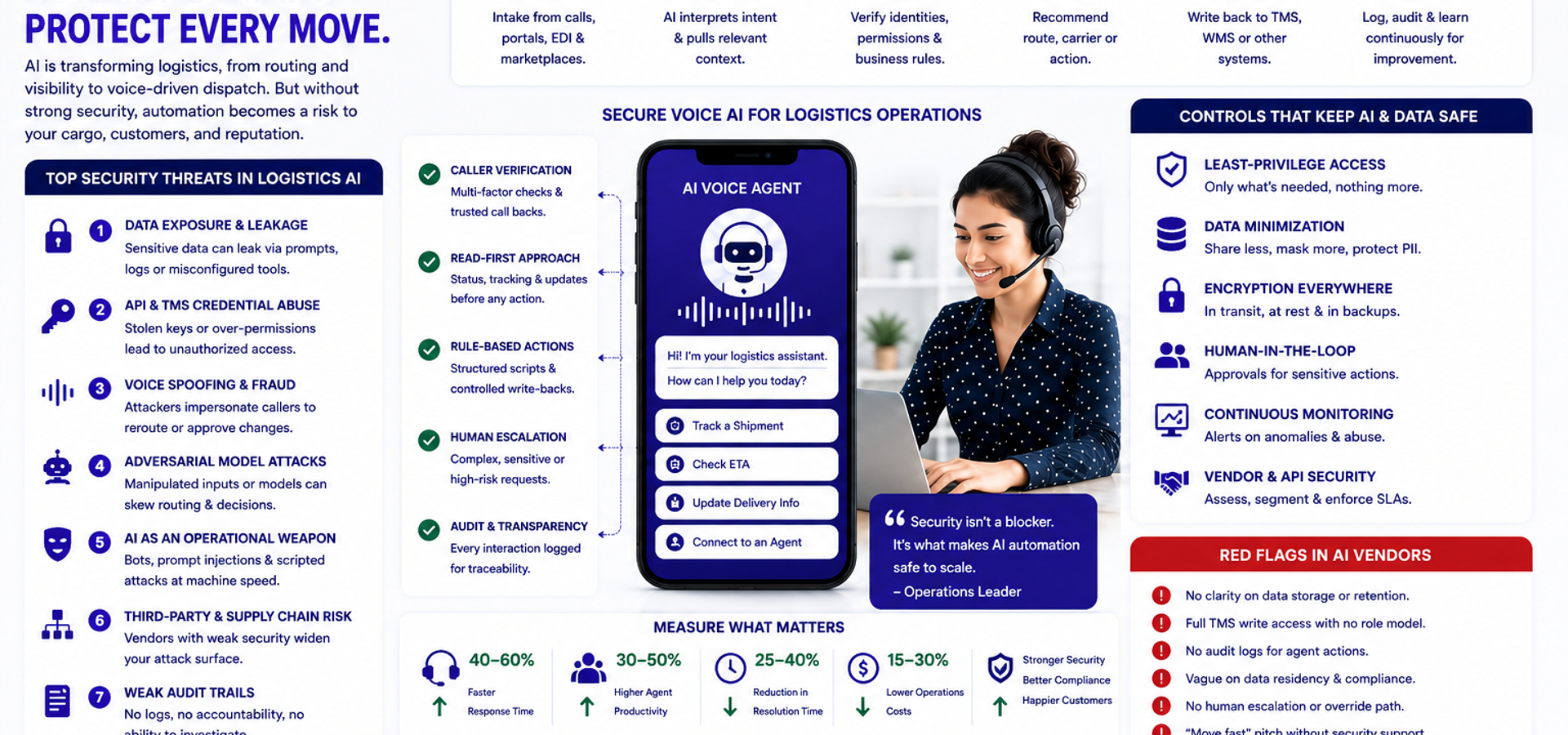
Top security threats in logistics AI
Strong security in logistics AI programs treat these threats as operational, not only IT, because freight moves on phone instructions and TMS clicks.
1) Data exposure and prompt leakage
AI tools fed full customer lists, rate tables, or bills of lading can leak sensitive data through logs, vendor staff access, or misconfigured retention. Logistics AI security starts with data classification, what the model may see vs what requires human-only access.
2) API and TMS credential abuse
Stolen API keys let attackers query loads, change appointments, or export shipper details. Over-scoped integrations, write access when read suffices, multiply damage.
3) Voice spoofing and social engineering
Deepfake or scripted voices impersonate carriers, drivers, or customers to redirect freight or approve fraudulent accessorials. Voice-heavy ops are especially exposed when “who called” is trusted without verification. Voice patterns: conversational services: what they are & use cases.
4) Adversarial model behavior
Poisoned training data, manipulated ETA inputs, or biased routing models can steer loads through risky lanes, or to preferred fraudulent carriers. ML context: machine learning in supply chain optimization.
5) AI as operational “weapon” against your desk
Attackers do not need Hollywood robots, they weaponize automation against you: bot floods on IVR lines, scripted probes through chatbots (“what is status of load…”), or prompt-injection attempts on internal copilots tied to ops data. The threat is scaled social engineering at machine speed.
6) Third-party vendor risk
Every AI SaaS vendor becomes part of your blast radius. Weak SOC practices, unclear data residency, or shadow IT pilots bypass security review. Trend backdrop: AI supply chain technology trends.
7) Weak audit trails
If an AI agent changes a delivery window and nobody can reconstruct who authorized it, incident response fails, and insurance and customer disputes get harder.
Risks vs solutions: what operators can control
Threat: stolen TMS credentials: Solution: least-privilege API scopes, key rotation, MFA on admin consoles, IP allowlists where feasible.
Threat: fraudulent reroute by phone: Solution: callback verification to known numbers, PIN or load-specific challenge questions, human approval for address changes.
Threat: data leakage via AI vendor: Solution: DPAs, data minimization, redact PII in prompts, regional storage requirements, delete retention policies.
Threat: unconstrained voice agent writes: Solution: read-only pilots first, rule-based write-back, escalation on exceptions. Decision discipline: logistics decision gap in AI operations.
Threat: model drift or bad recommendations: Solution: change control, monitoring dashboards, human override on high-value lanes.
Threat: supply chain cyber via vendor: Solution: vendor security questionnaires, incident notification SLAs, segmented network access.
NIST’s AI Risk Management Framework gives a practical lens, govern, map, measure, manage, adapted to freight and warehouse workflows. Source: NIST: AI Risk Management Framework.
Governance checklist for security in logistics AI
- Classify data: public, internal, confidential, regulated (PII, payment, customs)
- Define allowed actions: what AI may read, suggest, or write
- Human-in-the-loop rules: payment, reroute, high-value cargo, hazmat
- Log everything: prompts, tool calls, disposition, audio metadata where legal
- Test adversarial cases: spoof calls, injection strings, impossible load IDs
- Incident playbooks: who freezes TMS writes when fraud suspected
- Train dispatch and CS: AI does not remove verification discipline
Sustainability and security overlap when bad data drives waste, see how AI makes supply chains more sustainable for governance parallels on data quality.
Secure voice AI for logistics (without freezing innovation)
Voice automation solves real ops problems, after-hours coverage, check calls, status readouts, but security in logistics AI demands architecture, not hope:
- tier-one read-only status before any write-back
- structured scripts, not open-ended agents browsing TMS freely
- warm transfer to humans on instruction changes, detention disputes, payment talk
- integration middleware with approval queues for sensitive fields
- rate limits and anomaly alerts on API usage
Dialflo deploys AI voice agents for logistics phone workflows with emphasis on structured outcomes, escalation paths, and system write-back discipline, so automation accelerates tier-one calls without treating every inbound line as trusted. Security is how you scope the agent, not an afterthought slide.
Red flags when evaluating logistics AI vendors
- cannot explain what data is stored, for how long, or who accesses it
- offers full TMS write access “out of the box” with no role model
- no audit logs for agent actions or API calls
- vague answers on recording consent and cross-border data
- no escalation path to human operators
- “move fast” pitch without security questionnaire support
FAQ: AI in logistics security
What is security in logistics AI?
Protecting shipment data, systems, and operations when AI models, APIs, and voice agents automate logistics workflows, against cyber, fraud, and misuse.
Can attackers weaponize AI against freight companies?
Yes, via spoofed voices, credential theft, bot floods, and social engineering at scale. Controls must match phone and API channels.
Should AI ever change routes without human approval?
High-risk changes, address, payment, hazmat, high-value cargo, should require verification or human sign-off.
Does compliance end at cyber insurance?
No. Customer contracts, customs data, and carrier agreements may impose additional duties when AI touches their freight.
How fast should teams respond to suspected AI-related fraud?
Freeze write access, preserve logs, callback verified contacts, and invoke incident playbook, speed beats perfection.
How does Dialflo help?
Structured logistics voice AI with escalation and integration discipline, see dialflo.ai.
Closing: speed without verification is liability
AI in logistics delivers coverage, visibility, and throughput, when security in logistics AI is designed in. The threats are real: spoofed voices, stolen keys, leaky prompts, and vendors who move faster than your governance. The solutions are equally real: least privilege, logging, human escalation, and disciplined voice automation that does not treat every caller as cargo authority.
Building voice AI for freight? Explore Dialflo with security scoping from day one, not after the first bad reroute.