How 3PL Providers Achieve 4X Operational Efficiency by Automating Routine Logistics Calls

Dialflo: AI Voice Agent
July 15, 2026
Monday, 11:14 a.m. Three shippers want ETAs. A warehouse needs a dock window confirmed. A driver is calling about a POD. Your best agent is already on hold with the TMS. The queue is not a staffing problem, it is a repetition problem. That is the exact moment operational efficiency automation stops being a buzzword and becomes a survival move for third-party logistics providers.
This playbook shows how 3PLs unlock roughly 4X capacity on call-heavy desks by automating routine logistics calls, keeping humans on exceptions, and tying every outcome back to the system of record. For broader context on voice and ops AI, see AI in logistics use cases and the logistics decision gap in AI operations.
Why routine logistics calls crush 3PL efficiency
Most 3PL inbound volume is predictable: shipment status, ETA, appointment confirmation, delivery proof, and simple payment or invoice follow-ups. None of that needs a senior dispatcher. All of it burns senior minutes.
Industry contact-center research puts the cost of a human-handled call in the range of roughly $2.70–$5.60 per interaction, while automated handling can run near $0.11 per minute, a gap that compounds fast at 3PL scale. Source: CallMiner: How automated call handling improves contact center ROI.
McKinsey’s generative-AI research has long flagged large automation potential in customer operations, on the order of roughly 30% of hours in some function analyses, which is exactly where 3PL status queues live. For a desk where half the day is “Where is my shipment?”, that is hours returned every shift, not a soft productivity nudge. Source: McKinsey: The economic potential of generative AI.
What “4X operational efficiency” actually means
The 4X claim is not magic software. It is capacity math.
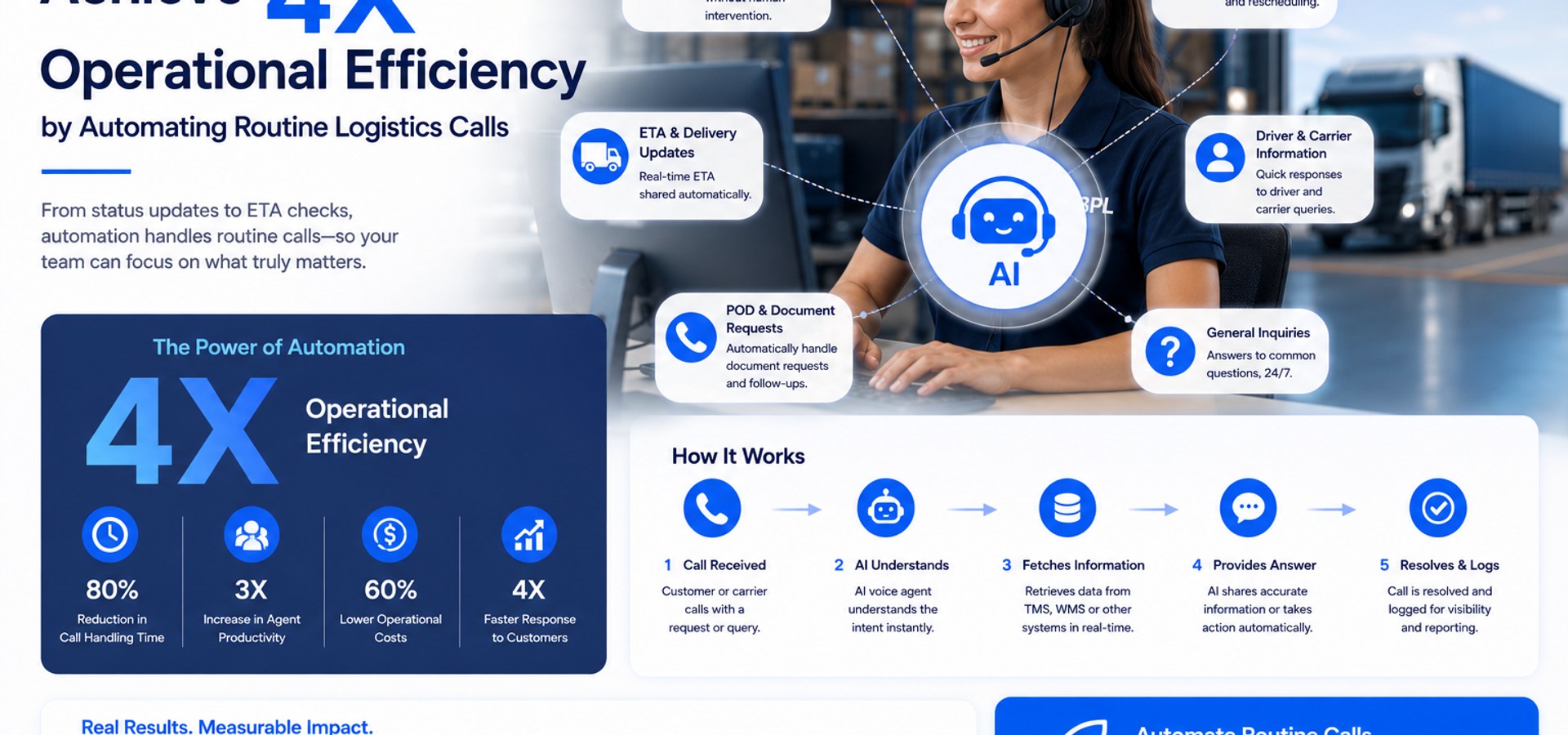
If 75% of calls are routine and voice AI resolves them with accurate TMS answers, humans keep the remaining 25%, exceptions, claims, delayed freight, VIP accounts. Suddenly the same team is not drowning in status scripts. They can run four times more exception and relationship work than when every “quick status check” landed on their headset.
That is operational efficiency automation done correctly: multiply productive output of the existing desk, do not pretend one bot replaces the entire control tower.
Gartner has projected that conversational AI will cut contact center agent labor costs by $80 billion in 2026, another signal that high-volume, scriptable intents are where efficiency compounds first.
Unique angle: automate the loop, not the judgment
3PLs that fail at voice AI try to automate “customer service.” 3PLs that win automate a closed loop:
- caller intent detected (status, appointment, POD, ETA)
- live facts pulled from TMS/WMS
- answer delivered in natural language
- outcome written back (note, disposition, ticket)
- only true exceptions escalate to a human
When write-back is missing, you bought a fancy phone tree and a second inbox. When write-back exists, you bought desk capacity. How voice fits next to other technology used in supply chain management matters as much as the model quality.
The five call types that unlock speed first
Prioritize high volume and low ambiguity:
- Shipment / order status (WISMO): Track-and-trace from TMS, your highest-volume automatable intent.
- ETA confirmation: Read current plan; escalate only when dates slipped without a posted reason.
- Dock / delivery appointments: Remind, confirm, or reschedule against the appointment system.
- POD / receipt confirmation: Confirm delivery evidence is available; escalate missing docs.
- Routine AR / paperwork nudges: Structured reminders only, never unstructured negotiation on day one.
These map cleanly to conversational services patterns: short turns, system facts, clear exit to a human.
How to measure operational efficiency automation (so 4X is real)
Do not celebrate deflection alone. Track:
- Containment rate on the five intents above (resolved without human)
- Average handle time for human-escalated calls (should fall as noise leaves the queue)
- Exceptions per agent-hour (the real 3–4X signal)
- Shipper CSAT / first-call accuracy (wrong ETAs destroy trust faster than hold music)
- Write-back completeness (% of automated calls with TMS/ticket notes)
If containment rises but write-back is empty, you have not automated operations, you have automated amnesia.
Build sequence: 30–60–90 for a 3PL phone desk
Days 1–30: Map top call intents from call recordings or wrap codes. Confirm which answers live in TMS today. Pilot one SKU or one lane. Keep humans in the loop for every escalated call.
Days 31–60: Add appointment and POD intents. Tighten escalation rules. Publish a weekly “automation accuracy” review with ops leads, not only IT. Pair voice with warehouse/inventory visibility work from AI inventory optimization where stock truths drive status answers.
Days 61–90: Expand hours (nights, weekends, peaks). Redeploy human hours into delayed freight and key accounts. Document runbooks. Decide build vs buy for the voice layer, see build vs buy voice AI stack if you are comparing platforms for India or multi-region ops.
Failure modes that kill efficiency gains
- Automating without data truth: If TMS is stale, the bot becomes a faster liar.
- Phone tree cosplay: Menu hell feels efficient to ops and hostile to shippers.
- No escalation path: Damaged freight and claims must reach humans in one hop.
- Headcount-first framing: Teams that sell “fire half CS” get sabotage; teams that sell “clear the exception pile” get adoption.
- Ignoring peak season load: Efficiency is proven when volume spikes, see why call volume planning still matters alongside AI supply chain technology trends.
Where machine learning fits (and where it does not)
ML shines at intent detection, language, and routing. It does not invent shipment truth. Pair conversational voice with the predictive stack covered in machine learning supply chain optimization, but keep status answers grounded in TMS events, not guesses.
FAQ: Operational efficiency automation for 3PLs
What is operational efficiency automation in a 3PL?
Removing repetitive, rules-based work, especially routine phone intents, so the same team clears more exceptions, shipments, and shipper relationships per hour.
How can automating logistics calls create 4X efficiency?
By containing most status and confirmation volume with voice AI, humans concentrate on judgment work. Throughput on exception and relationship tasks can approach 3–4X for the same headcount when write-back is solid.
Which logistics calls should a 3PL automate first?
WISMO/status, ETA, appointments, and POD confirmations, high volume, answerable from systems of record.
Does call automation replace dispatchers?
No. It protects their attention for delays, exceptions, and clients who need a human.
What systems must voice AI connect to?
TMS at minimum; appointment/WMS and ticketing next. No integration, no real efficiency.
How does Dialflo help 3PL operational efficiency automation?
Dialflo’s AI voice agents run the routine call loop and sync structured outcomes so ops teams scale volume without scaling hold times.
Closing: efficiency is what you stop repeating
Operational efficiency automation for 3PLs is not another dashboard. It is a decision to stop paying senior people to read the same TMS screen aloud. Automate the routine logistics call loop, measure exceptions per agent-hour, and keep humans where judgment still compounds.
Ready to reclaim desk capacity on status and confirmation volume? Explore Dialflo for voice workflows built for logistics call load, not generic call-center scripts.