New Logistics Technology: What to Adopt First

Dialflo: AI Voice Agent
July 10, 2026
Short answer: The new logistics technology that matters in 2026 is not another tracking portal, it is agentic AI that acts inside your stack, voice AI that clears shipper and driver phone queues against TMS truth, physical AI on docks and yards, and decision governance so automation stays auditable. Mid-market 3PLs and carriers should pilot the highest-frequency pain first, usually status and ETA calls, measure containment in 30 days, then expand. Buy execution. Skip slideware.
Your TMS already knows the load is late. Your WMS already knows the dock is full. Your shipper still calls, because the phone is the only interface that works when portals lag and emails die in a thread. Meanwhile, your best coordinator spends half the morning reading PRO numbers aloud instead of fixing the exception that will cost you the account.
That gap is where new logistics technology either earns its keep or becomes another unused license. 2026 is not about collecting more AI logos. It is about systems that detect, decide, and act, with humans on judgment, not on readouts.
This guide cuts the noise. You will see which technologies Gartner and operators are actually prioritizing, which ones mid-sized logistics teams should buy first, how to evaluate vendors without a six-month RFP theater, and where voice AI fits as the fastest path from trend list to booked revenue protection.
What “new logistics technology” means in 2026 (execution, not dashboards)
For a decade, logistics tech sold visibility: maps, scorecards, exception lists. Visibility without action just creates more meetings. The shift in 2026 is blunt, new logistics technology must shorten the loop from signal to outcome.
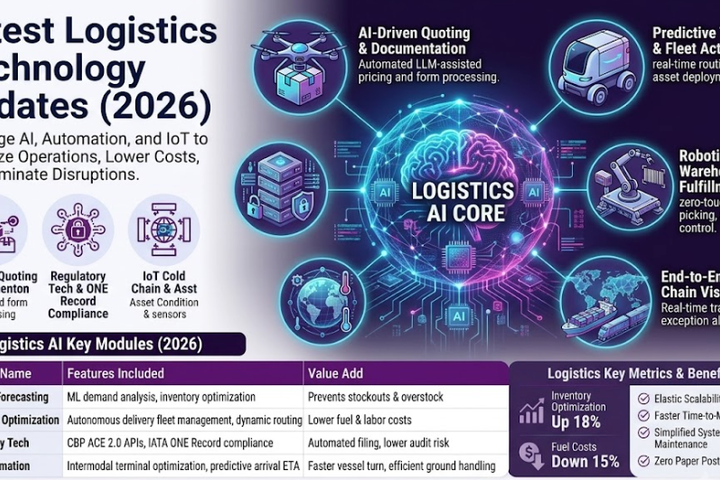
Gartner’s 2026 supply chain technology trends group the market around three themes: autonomy and agency, specialization and intelligence, and trust and governance. Agentic AI, physical AI, collaborative multiagent systems, domain-specific language models, product provenance, and decision governance sit at the center. Source: Gartner: Top supply chain technology trends for 2026.
Supply Chain Management Review frames the same shift for operators: agentic systems move from summarizing delays to executing bounded actions across ERP, WMS, and TMS, with escalation rules, not free-range autonomy. Source: SCMR: How agentic AI changes supply chain operations.
If your last “AI project” produced a prettier delay report and the same fourteen-minute hold queue, you bought insight. 2026 buyers should demand execution. Broader context: AI supply chain technology trends and technology used in supply chain management.
The six new logistics technologies worth your attention
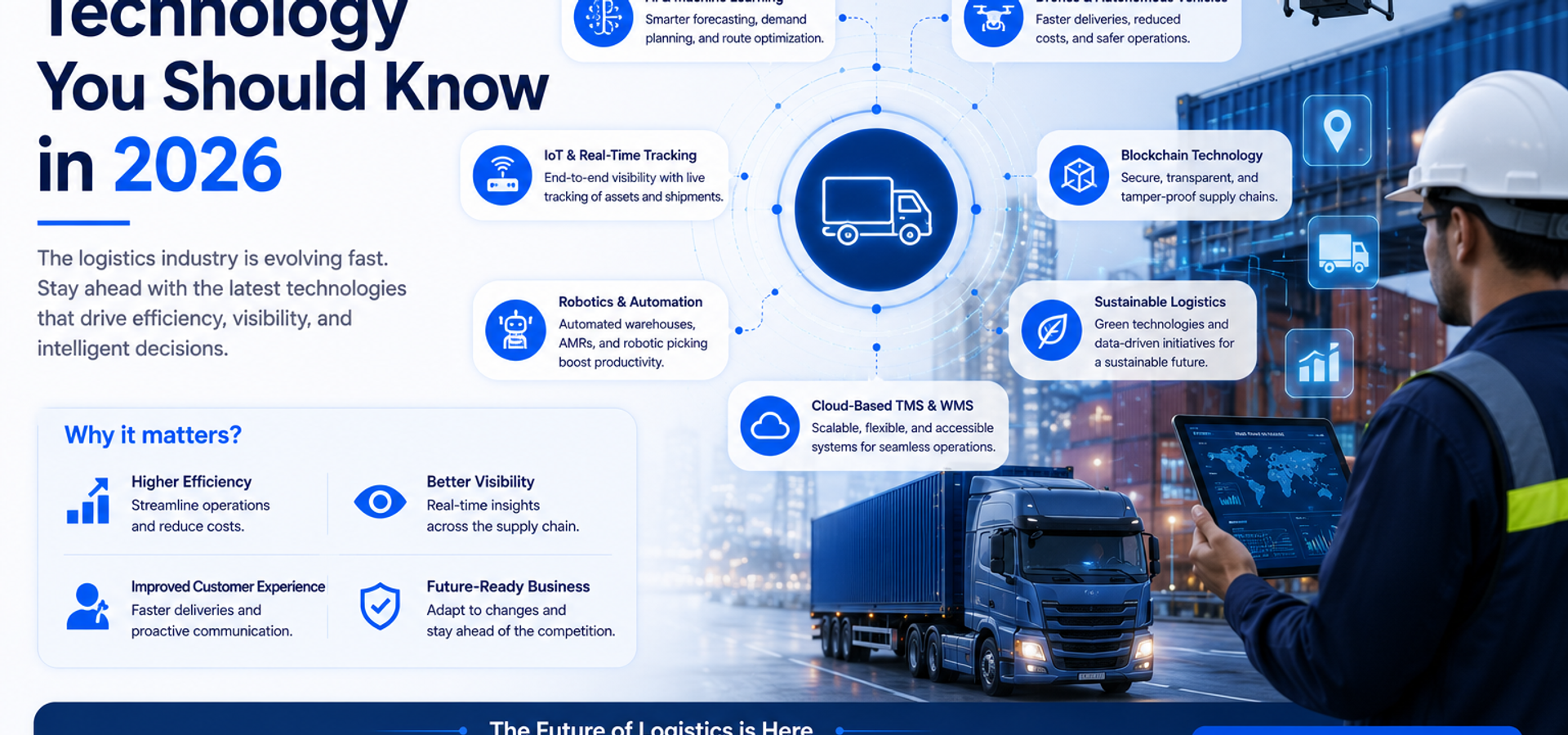
Ignore vendor taxonomy wars. For freight, 3PL, and warehouse leaders, these six categories of new logistics technology change how work gets done:
1. Agentic AI on operational systems: Agents that plan and act inside approved workflows: flag a delay, propose a rebook path, open a task, notify the shipper, log the outcome. Not a chatbot that explains why you are late. Bounded autonomy with clear escalation. Gartner notes agentic capabilities will spread across supply chain solutions, and also that many agentic projects will fail without clear value and risk controls. Start narrow.
2. Conversational voice AI tied to TMS: The phone is still the default interface for shippers, receivers, and drivers. Voice agents that look up PRO/BOL, read ETA windows, confirm appointments, resend tracking, and write notes back to TMS are among the highest-ROI deployments for mid-market operators. Fundamentals: conversational services: what they are & use cases.
3. Physical AI and polyfunctional robots: AI combined with sensors, robotics, and automation for real-time sensing and action in warehouses and yards. Useful when labor scarcity and dock throughput are the binding constraint, not when your real bleed is missed calls after 6 p.m.
4. Domain-specific language models: Models trained on logistics language, documents, and workflows outperform generic chat for BOL extraction, compliance Q&A, and exception classification. Pair them with retrieval from your own SOPs, not the open internet.
5. Intelligent simulation and ML planning: Better forecasting and scenario planning when demand, weather, and capacity collide. Valuable for network design and inventory posture. See: machine learning in supply chain optimization and AI inventory optimization tools & strategies.
6. Decision governance and product provenance: As agents act, you need audit trails, role-based authority, and explainability. Provenance tech tracks product history for compliance and trust. These are not optional add-ons if you scale autonomy, they are the license to operate.
Sustainability pressure also shapes stack choices, fewer wasted miles when ETAs and appointments are accurate the first time: how AI makes supply chains more sustainable.
Why voice AI is the new logistics technology most operators underfund
Trend decks lead with robots and digital twins. Your P&L often leads with phones.
Industry analyses still put WISMO-style contacts, “where is my shipment?”, at a huge share of logistics customer inquiries. Coordinators burn hours on check-calls and exception loops that portals were supposed to eliminate. When networks tighten, every load generates multiple status checks. Portals lag. Callers call.
That is why new logistics technology that ignores the voice channel fails the mid-market test. You can have a world-class TMS and still lose a shipper because nobody answered at 9:40 p.m. with a truthful ETA.
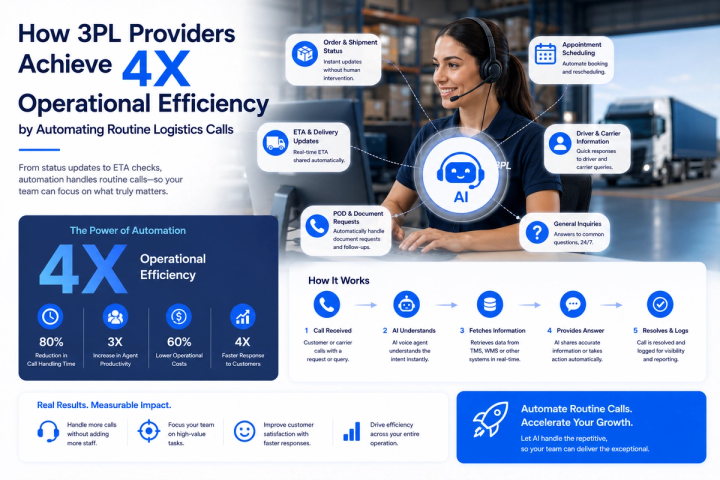
Voice AI earns a place on the 2026 shortlist when it does five things:
- answers immediately on tier-one lines, no hold music as a strategy
- retrieves live or near-live TMS events by PRO, BOL, or reference
- completes simple workflows, confirm appointment, resend tracking, log a reschedule request
- escalates detention, OS&D, and key-account anger to humans with full transcript context
- writes outcomes back so the next call does not restart from zero
McKinsey’s work on AI-enabled customer service is consistent: automation wins on high-volume, integration-backed intents, not on every emotional dispute. Source: McKinsey: AI-enabled customer service. Logistics use cases: AI in logistics: use cases, benefits & tools.
The decision gap between knowing and acting is where most AI spend dies. Frame it clearly: logistics decision gap in AI operations.
How to choose new logistics technology without wasting a budget cycle
Buyers lose years chasing “platform of platforms.” Use this filter instead:
Start from a measurable bleed. Missed after-hours calls? Peak-season hold times? Detention disputes eating mornings? Inventory forecast error? Pick one metric your CFO already believes.
Prefer systems that write back. If the tool cannot update TMS notes, WMS tasks, or CRM outcomes, you bought a conversation, not an operation.
Demand bounded autonomy. Agents need situational awareness, constrained decision rights, and clean escalation. Unbounded “do anything” demos are a liability.
Sequence CapEx by payback speed. Voice automation on one queue often proves value in weeks. Robotics and yard automation often need quarters. Both can be right, order them by cash and risk.
Build vs buy with eyes open. Voice stacks especially: latency, telephony, India/US routing, and maintenance cost matter more than model brand names. See: build vs buy voice AI stack, best Retell alternative for India, and Vapi alternatives for India.
Pilot for 3–4 weeks, not 3 days. Containment by intent, average speed to answer, repeat-call rate, and CSAT on escalations beat demo applause.
A practical 90-day adoption plan for new logistics technology
Days 1–15: Instrument the pain. Pull call logs, top intents, peak hours, missed-call rate, and morning callback depth. Identify the one queue that hurts most, usually inbound shipper status or after-hours overflow.
Days 16–45: Pilot execution on that queue. Connect read access to TMS. Deploy voice AI for tier-one intents. Keep humans on detention, claims, and key accounts. Shadow mode first if your risk tolerance is low.
Days 46–75: Add proactive outbound. When TMS flags delay, call or message before the panic inbound. Measure inbound reduction on those lanes.
Days 76–90: Expand or stop. If containment and answer rate move, expand to appointment confirms or driver check-ins. If not, fix retrieval and escalation before buying the next shiny category on the Gartner list.
Already on a voice vendor that is not fitting production ops? Migration without downtime is a process, not a panic: migrate from Retell to Dialflo without downtime. Pricing discipline: Retell vs Dialflo India pricing.
What to ignore (even if it is trendy)
- Chat-only tools for phone-heavy freight: Shippers and drivers call. Chat deflection without voice leaves the real queue untouched.
- Agentic pilots with no write-back: You will re-enter the same PRO every hour.
- Full autonomy on day one: Start with status and ETA. Earn the right to automate rebooking.
- Multi-year TMS rip-and-replace to “enable AI”: Reliable lookup, even scheduled exports, beats a two-year rewrite for a first pilot.
- Buying robots to fix a customer service problem: Wrong layer. Match technology to the bottleneck.
Where Dialflo fits in your 2026 logistics technology stack
Dialflo is production-grade AI voice agents for logistics teams drowning in routine phone work, the practical layer of new logistics technology that sits between your TMS and the people who still call.
Dialflo answers tier-one shipment inquiries with TMS-aware lookup, runs proactive outbound ETA updates on delayed lanes, escalates exceptions to humans with full context, and writes outcomes back so operations does not restart the thread. 3PLs, brokers, and carriers use Dialflo when hold times threaten renewals, and when the best coordinators should protect key accounts instead of reading tracking for the fortieth time today.
If your 2026 roadmap lists agentic AI, digital twins, and warehouse automation, but your shippers still learn about delays on hold, you are missing the technology that protects revenue this quarter.
FAQ: new logistics technology in 2026
Is agentic AI ready for mid-sized logistics companies?
Ready for bounded workflows, status, notifications, task creation, with clear escalation. Not ready as unsupervised network control. Start with one process and governance rules.
Will new logistics technology replace dispatchers?
It replaces readout loops and after-hours voicemail. Dispatchers stay on judgment, negotiation, and exception recovery. That is the point.
How much should we budget for a first voice AI pilot?
Model against agent-hours spent on tier-one status calls and missed-call risk, not against a full contact-center rebuild. Compare seasonal hire cost to automation that scales with December and shrinks with January. Pricing context: Retell AI pricing vs Dialflo pricing.
Do we need perfect TMS APIs before we start?
No. Reliable load lookup, API or scheduled export, beats voicemail. Deepen integration after containment proves on one queue.
How does Dialflo compare to building our own voice stack?
Building owns latency, telephony, and maintenance forever. Most operators buy a production voice layer and keep TMS as system of record. See build vs buy guidance linked above.
What is the fastest win from new logistics technology this year?
Automate the highest-volume phone intent with live data and warm escalation. Prove answer rate and containment. Then expand.
Closing: buy the technology that answers the phone and moves the load
New logistics technology in 2026 is a crowded category. The winners will not be the teams with the longest trend checklist, they will be the teams that turn signals into actions before shippers churn and docks idle.
Agentic AI, physical AI, domain models, and governance all matter. For most operators reading this, the fastest path from article to outcome is still the phone queue: voice agents that know your TMS, clear tier-one volume, and hand humans the exceptions that decide renewals.
Ready to put 2026 technology to work on the calls that burn your team today? Talk to Dialflo about a pilot on one logistics queue, inbound shipper status, after-hours overflow, or proactive outbound ETA, with TMS-aware voice agents, warm escalation, and write-back to the systems you already run. Measure containment at day 30. Expand only what pays.