Latest Logistics Technology Updates (2026)

Dialflo: AI Voice Agent
July 30, 2026
Your TMS can reroute a load. Your WMS can slot a SKU. Your control tower can light up red. And then a shipper calls at 9:40 p.m. asking where the truck is, and the whole “digital transformation” waits on a human with three screens open.
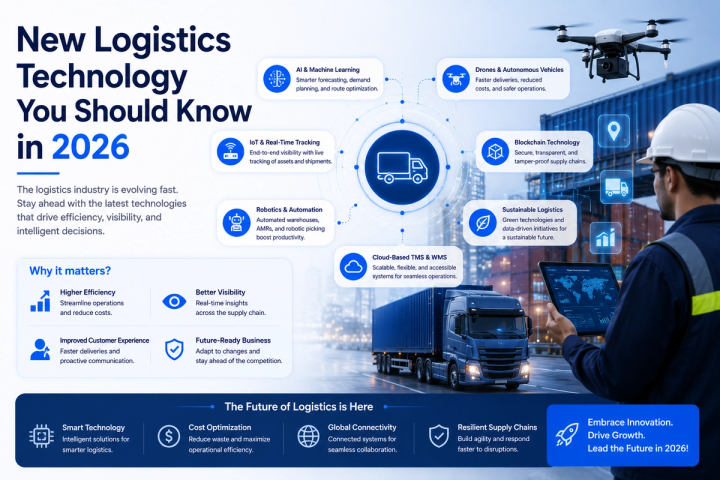
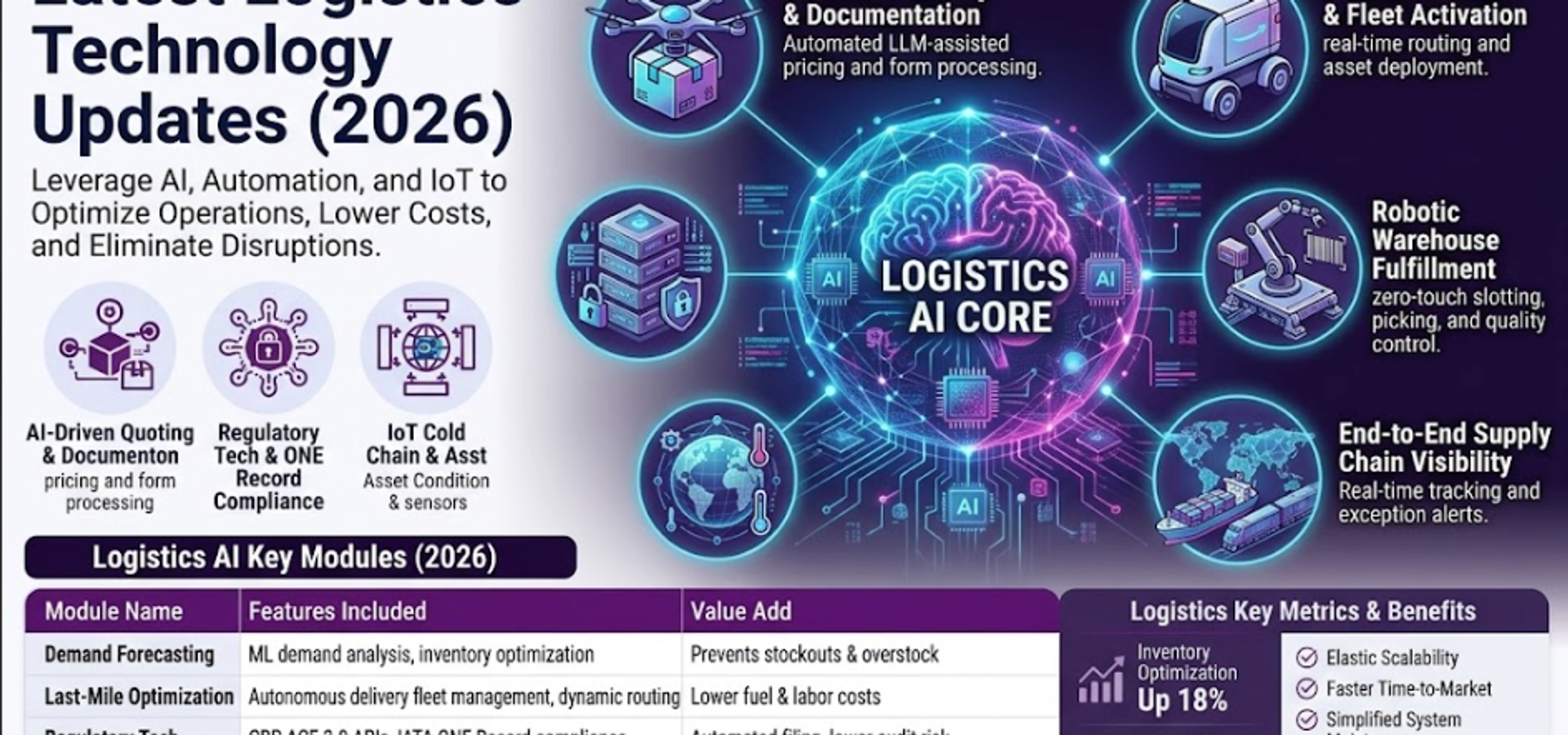
That is the real story behind logistics technology updates in 2026: AI is moving from slides into operational layers, warehouses are orchestrating mixed fleets, and visibility is finally expected to trigger action. The teams that win will pair those stack upgrades with exception handling that does not depend on heroics.
For foundations, see technology used in supply chain management and AI supply chain technology trends.
What changed heading into 2026
Logistics IT demand is still accelerating. Inbound Logistics’ 2026 provider survey reports strong year-over-year sales growth for many vendors, with AI now offered by 77% of respondents, up sharply from two years prior, and cost reduction still the top customer challenge. Source: Inbound Logistics: 2026 logistics IT perspectives.
Analyst framing is shifting too. Gartner’s 2026 supply chain technology trends put autonomy, specialized intelligence, and trust/governance at the center, agentic AI, physical AI, polyfunctional robots, multiagent systems, intelligent simulation, domain-specific models, provenance, and decision governance. Source: Supply Chain 24/7 coverage of Gartner’s 2026 trends.
Translation for operators: stop buying “AI features.” Buy closed loops.
Unique angle: the stack that ships vs the stack that answers
Most 2026 roadmaps fund planning, warehouse robots, and track-and-trace. Fewer fund the phone and chat exceptions that still burn dispatcher hours when ETAs slip.
That gap is why tech can look modern on a deck and feel broken on a Friday peak. Digitize movement, and digitize the conversations about movement. Otherwise you automate the happy path and staff the chaos.
We call this the decision gap in logistics ops, more in the logistics decision gap.
Update 1: AI becomes an operational layer
In 2026, AI is less a chatbot bolted onto a portal and more a layer inside TMS, WMS, and procurement workflows, scoring alternates when a route fails, sequencing warehouse tasks around congestion, flagging supplier risk earlier.
Practical test: does the model change a work queue or only generate a paragraph? If it cannot write back and trigger next steps, it is content, not operations technology.
For applied examples, browse AI in logistics use cases.
Update 2: Agentic AI and multiagent workflows
Agentic systems plan, act, and adapt, not just recommend. Multiagent setups split work: one agent monitors exceptions, another proposes carrier swaps, another drafts customer updates, with humans approving high-risk moves.
Governance is the price of admission. If nobody owns escalation rules, agentic AI becomes expensive improvisation.
Update 3: Physical AI and flexible warehouse automation
Physical AI pairs sensors, robotics, and models so equipment senses and responds on the floor. Polyfunctional robots aim to cover more task types as labor stays tight.
The mature pattern for 2026 is orchestration: WES/WCS coordinating humans and mixed robot fleets, plus digital twins to test peak scenarios before you buy more steel. Automation is becoming engineering discipline, not a robot demo day.
Update 4: Visibility that triggers action
Customers still rank visibility near the top of pain points. The update is not another map pin, it is a control tower that behaves like an action center: delay detected → playbook started → customer or carrier notified → exception owned.
If your “visibility” only paints dashboards red, you bought a scoreboard.
Update 5: Machine learning for planning and inventory
ML continues to move into demand sensing, inventory positioning, and transport optimization, especially where SKU proliferation and omnichannel promises punish static safety stock.
Start where forecast error is expensive and data is already clean enough. Deeper reading: machine learning for supply chain optimization and AI inventory optimization tools.
Update 6: Domain-specific models and provenance
Generic LLMs struggle with tariff rules, hazardous handling notes, and carrier contracts. Domain-specific models and retrieval over your SOPs reduce confident nonsense.
Provenance and traceability also keep rising, customers and regulators want clearer product journeys. Treat data lineage as product, not afterthought.
Update 7: Decision governance finally gets funded
As AI takes more actions, leaders need policies: what can auto-execute, what needs human sign-off, what gets audited. Gartner explicitly flags decision governance as a 2026 theme for a reason, speed without accountability creates silent operational debt.
Write the playbooks before you scale the agents.
Update 8: Sustainability tech stays selective
ESG urgency cooled in some buyer surveys, but emissions reporting, empty-mile reduction, and network redesign still matter for customers who measure Scope 3 and for carriers optimizing fuel.
Pair green goals with cost and service, or they get cut in the next budget cycle. Context: how AI makes supply chains more sustainable.
Update 9: Voice AI for logistics exceptions (the overlooked layer)
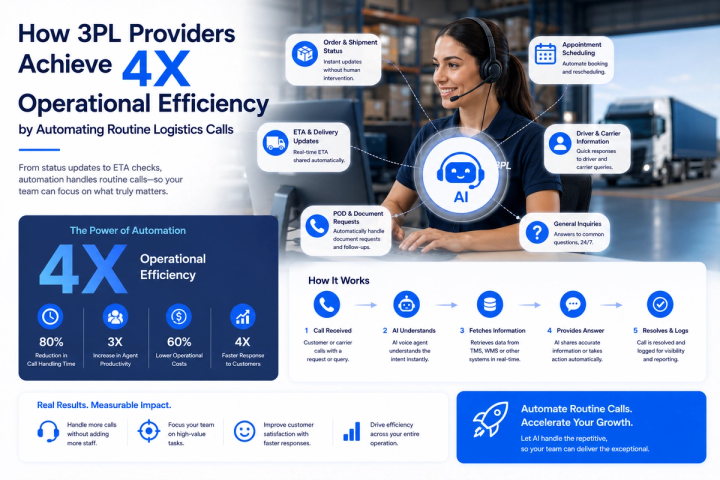
Here is the update most trend lists underweight: conversational voice AI for shipment status, appointment changes, driver check-ins, and after-hours exceptions.
When AI can read TMS state and answer the phone, your 2026 stack stops leaking value into missed calls and overtime. That is not a replacement for WMS, it is the connective tissue customers still use when portals fail.
Category framing: conversational services.
A practical 2026 adoption order
- Fix data and integration for one lane or warehouse
- Add visibility that triggers a playbook
- Automate one high-volume exception loop (status / appointments / OTIF questions)
- Then expand warehouse orchestration or agentic planning where ROI is proven
Buying everything in the Gartner list at once is how mid-market teams stall. Sequence beats spectacle.
FAQ: logistics technology updates
What are the latest logistics technology updates for 2026?
Agentic and physical AI, orchestrated warehouse automation, action-oriented visibility, ML planning, domain-specific models, provenance, decision governance, and stronger automation of exception conversations on phone and chat.
Is AI still optional in logistics stacks?
No. Provider surveys show AI as a mainstream offering. The decision is where AI is allowed to act and how humans supervise it, not whether it exists in the roadmap.
What warehouse updates matter most?
Orchestration across humans and robots, WES-led balancing, digital twins for peak testing, and AI task sequencing tied to live constraints.
Why do logistics tech projects still fail?
Fragmented systems, weak data, AI without write-back, and ignoring the phone/chat exceptions that still run the customer relationship when ETAs slip.
What should mid-market 3PLs prioritize first?
One painful execution loop with measurable cycle-time and cost impact, plus visibility that triggers action, before a full automation theater build.
How does Dialflo fit these updates?
Dialflo targets the phone-ops layer: voice agents that resolve routine logistics questions, write outcomes back, and escalate cleanly so planning and warehouse investments are not undone by missed calls.
A short closing note
Logistics technology updates in 2026 favor closed loops over shiny pilots. Make AI operational. Make visibility actionable. Make exceptions answerable at scale.
If your roadmap still leaves after-hours shipment calls to voicemail, talk to Dialflo about a production voice AI pilot that plugs into the stack you already bought.