AI in Logistics Safety: Technologies & Use Cases

Dialflo: AI Voice Agent
July 16, 2026
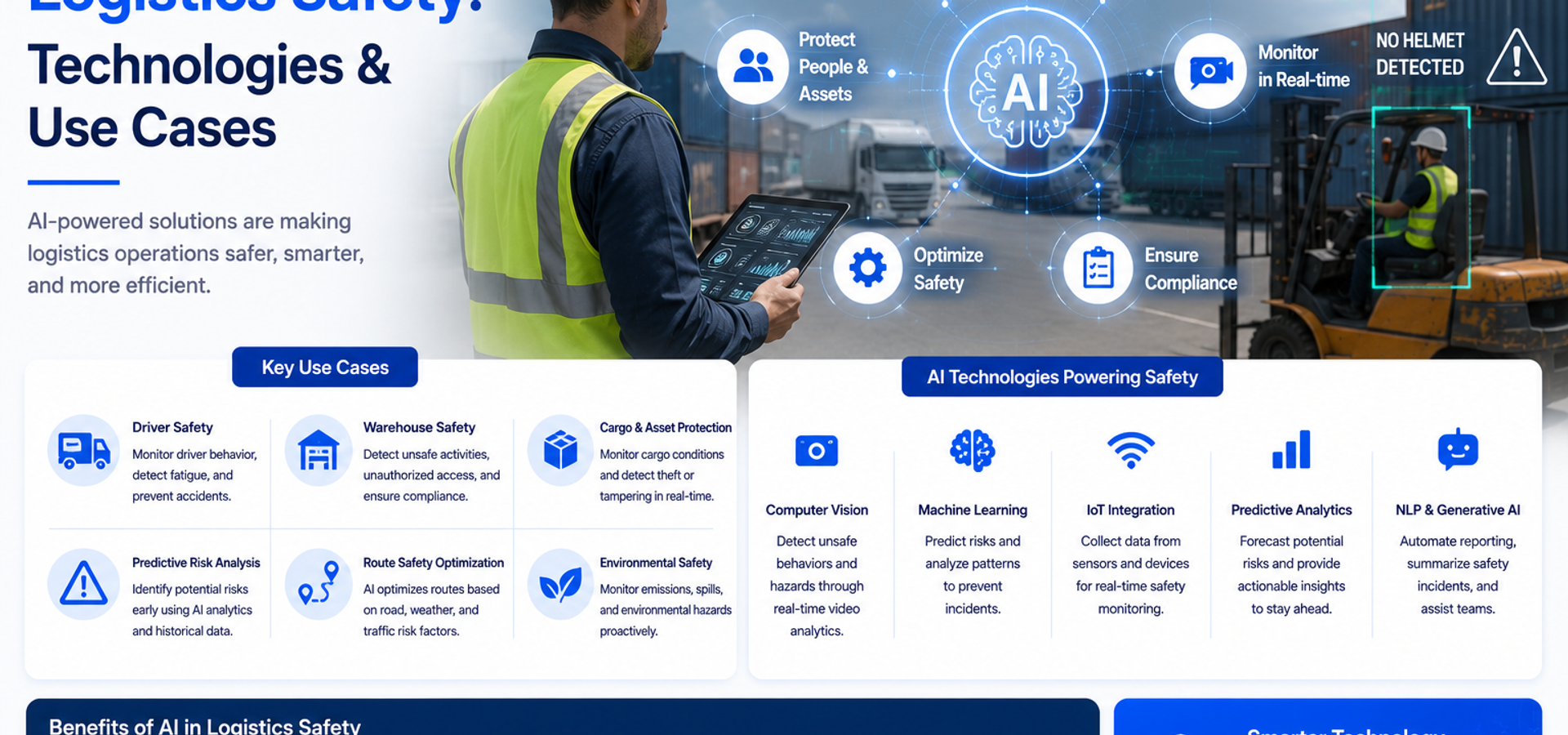
It is 2:17 a.m. A forklift crosses a pedestrian lane. A camera flags it. The alert hits a dashboard nobody is watching. By morning, you have a near-miss report, or worse. That gap between detection and response is where most safety programs quietly fail.
This guide maps logistics safety technology AI that actually moves the needle: what to buy, which use cases pay back first, and where voice automation turns alerts into accountable action. For the broader ops picture, start with AI in logistics use cases and the logistics decision gap in AI operations.
Why logistics safety still lags behind logistics speed
Warehousing and transport move faster every year. Safety processes often still run on clipboards, delayed calls, and cameras that only help after an incident.
Warehousing remains a high-injury sector versus all private industry averages in U.S. Bureau of Labor Statistics–based benchmarks, operators feel that gap every peak season. Source: OSHA/BLS recordable rates by industry (2026 cycle).
Forklifts alone are repeatedly linked to thousands of injuries and roughly a hundred fatalities a year in U.S. reporting summaries, proof that “we trained them last quarter” is not a control system. Source: Warehouse safety statistics overview (OSHA/BLS-cited).
Speed without a safety loop is just a larger blast radius. That is the business case for logistics safety technology AI, not a shiny pilot for the board deck.
What “logistics safety technology AI” actually includes
AI in safety is a stack, not a single SKU:
- Computer vision: PPE gaps, forklift–pedestrian proximity, blocked exits, spill/slip risk
- Fleet telematics + ML: harsh braking, fatigue proxies, route risk, collision patterns
- Predictive maintenance: equipment failure before it becomes a struck-by or dock incident
- Wearables / proximity: zone alerts for people and machines
- Conversational / voice AI: incident intake, after-hours escalation, driver check-ins when phones are the real control tower
Most teams over-invest in detection and under-invest in response. Detection without a human (or a voice agent that can reach one) is theater. How this fits next to broader technology used in supply chain management and AI supply chain technology trends matters as much as model accuracy.
Unique angle: safety AI fails at the last mile of attention
Cameras and sensors create volume. Night supervisors, dispatchers, and CS desks create scarcity.
When a hazard needs a phone call, wake a manager, confirm a driver is safe, log an incident, pull a dock door status, your “AI safety program” becomes a person with a headset and a sticky note. That is why high-performing operators treat voice as part of the safety stack, not a separate CX project. See how conversational services map to real workflows.
Dialflo’s place: AI voice agents that answer, qualify, escalate, and write back, so safety and ops alerts do not die in a queue. You keep your WMS/TMS and cameras; you stop losing the night to missed calls.
High-ROI use cases for AI in logistics safety
1) Forklift and pedestrian proximity (computer vision)
Real-time alerts when vehicles enter walkways or ignore exclusion zones. Best when alerts route to a named on-duty role, not a shared inbox.
2) Loading dock and trailer hazards
Dock locks, trailer creep, and door status errors create some of the most expensive “we thought it was secured” incidents. Pair vision or IoT with a clear stop-work escalation path.
3) Driver risk and fatigue signals (telematics + ML)
Harsh events and schedule pressure predict tomorrow’s claim. Coaching beats punishment, use scores to trigger check-ins, not only scorecards. Related: machine learning in supply chain optimization.
4) Predictive maintenance on material handling equipment
A failed brake or hydraulic leak is a safety event wearing a maintenance costume. Predict failure windows; schedule downtime before peak.
5) After-hours incident and hazard intake (voice AI)
Third shifts and weekends are when policies go soft. A voice agent can capture who/what/where, severity, and whether to wake a human, then open a ticket with a structured note. This is often the fastest paid pilot for teams drowning in night phones.
6) Driver and contractor safety check-ins
Missed arrivals, weather holds, and “are you okay?” loops burn dispatch. Automate the routine confirmation; escalate only exceptions. Same pattern logistics teams already use for status volume, now applied to safety-critical confirmations.
7) PPE and zone compliance at scale
Vision flags missing PPE or wrong-zone entry. Pair with coaching workflows so it improves culture instead of becoming a gotcha camera.
How to buy logistics safety technology AI without shelfware
Use this sequence so the budget survives quarter-end:
- Pick one site and one hazard class (e.g., forklift–pedestrian or after-hours incident calls).
- Define the response owner before you buy sensors, who acts in under five minutes?
- Require write-back to your ticket/TMS/WMS. Dashboards that do not update systems create a second inbox.
- Measure leading indicators: near-miss capture rate, alert-to-ack time, false-positive rate, incident rate trend.
- Pilot voice where phones already fail , nights, peaks, multi-site on-call. Compare build vs buy for the voice layer in build vs buy voice AI stack.
If a vendor cannot run a live scenario on your floor or your call queue, they are selling slides.
Failure modes that kill safety ROI
- Alert fatigue: too many low-value pings; humans mute the system
- No escalation path: AI sees risk; nobody answers
- Camera theater: recording without real-time action
- Punitive culture: workers hide near-misses; your data goes blind
- Ignoring the phone: sensors scream while the on-call line rings out
Safety AI is also an operations design problem. Pair it with clearer decision rights, the same theme as closing the logistics decision gap.
Where sustainability and safety meet
Fewer wrecks, idling spikes, and emergency reroutes also cut waste. If ESG is on the same steering committee as EHS, connect the dots with how AI makes supply chains more sustainable, without pretending one dashboard fixes both.
Conversion path: from reading this to a 30-day pilot
If your team already bought cameras or telematics and still loses nights to missed calls, you do not need another dashboard. You need a response layer.
Week 1: Map the top three safety-related phone workflows (incident intake, on-call escalation, driver check-in).
Week 2–3: Pilot Dialflo on one workflow with clear escalation rules and write-back fields.
Week 4: Review alert-to-human time, missed-call rate, and supervisor hours recovered. Expand only what moved a KPI.
That is how readers become customers: not a feature tour, proof on your queue.
FAQ: Logistics safety technology AI
What is logistics safety technology AI?
Machine learning plus sensors and voice that detect hazards earlier and route action faster across warehouses, docks, and fleets.
Which technologies matter most?
Computer vision, telematics, predictive maintenance, and a response layer, often voice, so alerts do not die unread.
Can AI replace safety managers?
No. It extends their reach. Judgment and culture stay human.
How do voice agents help safety?
They catch after-hours reports, qualify severity, escalate on-call staff, and log structured outcomes when every second of attention is scarce.
What should we measure?
Near-miss capture, alert-to-acknowledgment time, false positives, and incident/claim trends, not vanity AI scores.
How does Dialflo fit?
As the voice execution layer beside your safety and ops systems, so detection becomes a completed call and a written record, not a blinking tile.
Closing: detect less theater, respond more
Logistics safety technology AI only earns its keep when someone, or something, acts. Buy detection for the floor. Buy response for the moments humans cannot watch every screen. Close that loop and you protect people, margin, and the brand shippers trust with freight.
Ready to stop losing safety-critical calls on nights and peaks? Book a Dialflo pilot and put AI voice agents on the workflows your cameras and TMS cannot answer alone, start at dialflo.ai.