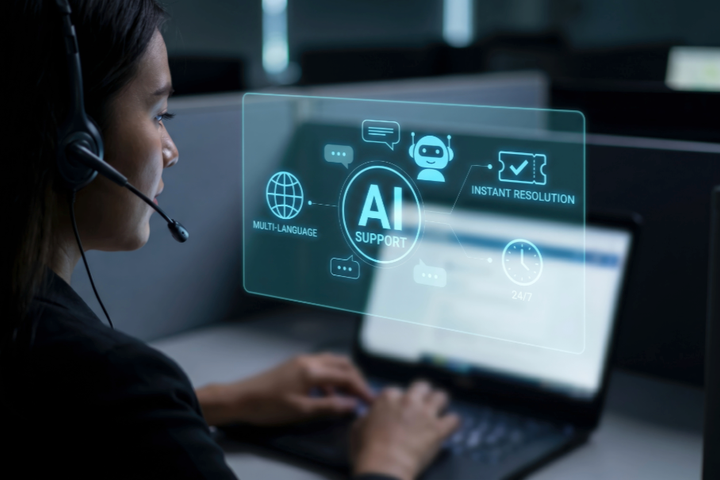
AI Receptionist for Service Businesses: Book Jobs 24/7

Dialflo: AI Voice Agent
September 4, 2026

For service businesses, the phone is often one of the most important channels for generating revenue.
A customer calls because they need a service, want an appointment, need an update, or have a question about an existing job. But there is a problem: the business may not always have someone available to answer.
Employees may be:
- Working with customers
- Driving between jobs
- Handling operations
- Managing dispatch
- Taking another call
- Working after normal business hours
- Dealing with a sudden increase in call volume
When calls go unanswered, the business can lose potential customers before anyone has a chance to follow up.
An AI receptionist for service businesses provides another approach. Instead of allowing calls to go unanswered, an AI voice agent can answer calls, understand what the customer needs, collect information, schedule appointments, provide basic updates, and transfer important conversations to the right employee.
For logistics and service-oriented businesses, this creates a 24/7 communication layer without requiring someone to sit beside the phone all day.
What Is an AI Receptionist for Service Businesses?
An AI receptionist is a voice AI system that handles incoming phone conversations on behalf of a business.
Unlike a traditional voicemail system, an AI receptionist can have a conversation with the caller.
For example, a customer might call to schedule a delivery for the following day. Instead of sending the caller to voicemail, the AI can ask for the delivery location, gather the necessary details, check available options when connected to business systems, and either schedule the service or transfer the request to an employee.
A typical AI receptionist can identify the caller's intent, collect the required information, resolve routine requests, schedule jobs, update business systems, and escalate conversations when human assistance is required.
This turns the phone from a simple communication channel into an automated business workflow.
Why Service Businesses Need 24/7 Call Coverage
Service businesses often operate around customer schedules rather than traditional office hours.
Customers may call:
- Before work
- After work
- During weekends
- During holidays
- Outside business hours
- During emergencies
- While employees are already busy
If nobody answers, the customer may simply call another provider.
This is particularly problematic when the call represents a new job. A potential customer may call, reach voicemail, wait for a response, and then contact a competitor instead.
An AI receptionist provides an immediate first response. The customer can speak with the AI, explain what they need, provide their information, and potentially schedule an appointment or callback.
This creates a stronger first response and reduces the likelihood of losing opportunities simply because nobody was available to answer the phone.
Answer Every Eligible Call
The simplest use case for an AI receptionist is answering calls that would otherwise be missed.
The AI can handle calls when:
- Employees are busy
- The office is closed
- Call volume spikes
- Staff is unavailable
- Customers call outside normal hours
This is especially useful during periods of seasonal demand.
Dialflo discusses this broader problem in How to Handle Peak Call Volume With AI Call Overflow.
Instead of forcing every caller into voicemail, businesses can use AI as an additional capacity layer.
Identify What the Caller Needs
A receptionist does not simply answer the phone. They determine why the customer is calling.
AI can perform the same initial classification and identify the caller's intent.
New Service Request
The AI can collect customer details and information about the requested service.
Existing Customer
The system can identify the customer and retrieve relevant account or order information when connected to the appropriate business systems.
Delivery Question
The AI can help retrieve shipment information or route the request to the appropriate team.
Appointment Request
The AI can check scheduling options and help arrange an appointment.
Billing Issue
The call can be routed to the billing or accounts team.
Complaint
The AI can capture the relevant details and escalate the conversation to the appropriate employee.
This intent-based routing prevents every call from being handled in exactly the same way.
Book Jobs Without Human Intervention
For many service businesses, one of the most valuable AI receptionist capabilities is appointment scheduling.
A customer may call and say that they need someone to come out the following afternoon.
Instead of simply taking a message, the AI can potentially:
- Identify the requested service.
- Collect the customer's location.
- Determine availability.
- Offer available appointment windows.
- Confirm the booking.
- Send the appointment information to the relevant system.
This reduces the amount of manual coordination required from employees and can make it easier for customers to schedule services outside traditional business hours.
Qualify New Customers Before Booking
Not every caller is necessarily a good fit.
An AI receptionist can ask qualification questions before creating a job or scheduling an appointment.
For example:
- What service do you need?
- Where is the service required?
- When do you need it?
- Is this a new or existing customer?
- What type of equipment is involved?
- Is the request urgent?
For logistics-related businesses, qualification could include:
- Shipment type
- Pickup location
- Delivery location
- Load details
- Required delivery date
- Existing carrier
- Special handling requirements
The employee receives a more complete request instead of starting from scratch.
Provide Shipment and Service Updates
AI receptionists are not limited to new customers. They can also help existing customers get routine information.
For logistics businesses, common questions include:
- Where is my shipment?
- When will the driver arrive?
- Has the delivery been scheduled?
- Can I change the appointment?
- What is the current ETA?
These questions can consume significant employee time when repeated throughout the day.
AI voice automation can potentially answer routine status questions when connected to the relevant systems.
Dialflo covers related workflows in AI Voice Agents for Logistics Routine Calls.
Reduce Missed Calls
Missed calls are not simply a customer service problem. They can represent lost revenue.
Imagine a service company receives 500 calls per month and misses 100 of them. If even a portion of those missed calls represent new jobs, the revenue impact can be significant.
The problem becomes even worse when customers expect immediate responses.
An AI receptionist can answer calls even when the human team is occupied. This creates a hybrid operating model where the human team handles complex conversations while AI handles routine conversations and overflow.
This can improve phone coverage without requiring proportional headcount growth.
Handle Peak Call Volume
Service businesses rarely experience perfectly consistent call volume.
Demand can increase because of:
- Seasonal events
- Weather
- Promotions
- Shipping peaks
- Product launches
- Operational disruptions
- Service outages
When call volume suddenly increases, employees may struggle to keep up.
An AI receptionist can provide additional capacity during those periods. It can support the existing receptionist during normal demand, handle overflow during peak periods, and provide coverage after business hours.
This allows the business to absorb temporary increases in demand without immediately hiring additional staff.
Dialflo also explores Reducing Hold Times Without Expanding Headcount.
Provide After-Hours Customer Communication
A customer does not necessarily care whether the business is officially open. They care about getting an answer.
For logistics and service businesses, after-hours calls can involve:
- Shipment status
- Delivery updates
- Appointment requests
- Urgent issues
- Service requests
- Driver communication
Instead of sending callers directly to voicemail, an AI receptionist can provide a first layer of support.
For routine requests, the AI can potentially resolve the issue. For urgent issues, it can follow predefined escalation rules. For new service requests, it can collect details and schedule a callback or appointment.
This can extend customer communication beyond traditional working hours.
Route Calls to the Right Employee
Not every conversation should be automated.
A good AI receptionist needs clear escalation rules so that important calls reach the appropriate employee.
Sales Requests
Sales-related calls can be routed to the sales team.
Billing Questions
Billing-related conversations can be routed to the accounts team.
Operational Issues
Operational requests can be sent to the operations team.
Delivery Problems
Delivery-related issues can be routed to dispatch.
Emergencies
Urgent situations can be escalated to the appropriate on-call employee.
The AI acts as the first layer of communication while employees remain responsible for complex decisions.
This is particularly useful in logistics, where different calls may need to reach dispatchers, operations managers, customer service representatives, or billing teams.
Capture Caller Information Automatically
One advantage of AI over voicemail is structured data collection.
Instead of asking customers to leave their name and number after a beep, the AI can ask targeted questions and capture the information in a structured format.
For example, a call could capture:
- Name: John Smith
- Company: ABC Distribution
- Phone: 555-123-4567
- Request: Delivery rescheduling
- Shipment: #49281
- Preferred time: Tomorrow morning
- Priority: High
That information can then be passed into the CRM, TMS, help desk, or another business system.
Keep the CRM Updated
An AI receptionist becomes significantly more valuable when conversations result in structured CRM activity.
A typical workflow can include an inbound call, an AI conversation, customer identification, intent detection, a generated call summary, a CRM update, and the creation of a follow-up task.
For example:
- Outcome: New service request
- Customer: ABC Logistics
- Requirement: Recurring delivery support
- Priority: High
- Next action: Operations callback
- Due: Today
The employee does not need to listen to the entire conversation to understand what needs to happen next.
Automate Routine Follow-Ups
An AI receptionist can also support outbound communication.
For example, after a customer requests a service, the AI can make a reminder call before the appointment, ask the customer to confirm, and update the relevant business system.
This can be useful for:
- Appointment confirmations
- Delivery reminders
- Rescheduling
- Service follow-ups
- Customer notifications
For logistics companies, automated communication can also be used for recurring operational calls.
Dialflo discusses Automated Carrier Check Calls and Logging as an example of how voice automation can support logistics workflows.
Reduce Repetitive Calls for Operations Teams
Operations teams can lose significant time answering the same questions repeatedly.
For example, a dispatcher may receive calls asking:
- Where is the shipment?
- What is the ETA?
- Has the driver arrived?
- Can we reschedule delivery?
Individually, each call seems small. Across hundreds of calls, the workload becomes significant.
AI can handle predictable conversations while employees focus on exceptions and decisions.
This is one reason voice automation is increasingly relevant to logistics operations.
AI Receptionist vs. Traditional IVR
Traditional IVR systems typically work through predefined menus.
Customers may be asked to press one for sales, two for support, or three for billing.
The customer has to navigate the menu before reaching the appropriate destination.
An AI receptionist can instead understand natural language.
For example, a caller can simply explain that their delivery has not arrived yet. The AI can identify the likely intent and determine what information is needed.
This creates a more conversational experience and can reduce the friction associated with traditional phone trees.
For a broader comparison, see AI Voice Assistant vs. IVR.
AI Receptionist vs. Human Receptionist
The comparison should not necessarily be "AI or human."
A hybrid approach is often more practical.
An AI receptionist can provide 24/7 availability, answer routine calls, book appointments, handle basic FAQs, and manage high-volume repetitive conversations.
Human employees can continue handling complex complaints, negotiations, sensitive situations, and conversations that require judgment.
The AI provides additional capacity while the human team provides judgment and handles higher-value interactions.
Track the Right AI Receptionist Metrics
Simply measuring the number of calls handled is not enough.
Businesses should track several metrics to determine whether their AI receptionist is actually improving operations.
Call Answer Rate
What percentage of incoming calls were answered?
Resolution Rate
How many calls were resolved without human intervention?
Transfer Rate
How many calls required an employee?
Appointment Rate
How many calls resulted in booked jobs?
Missed Call Rate
How many calls still went unanswered?
Average Handle Time
How long did AI-assisted conversations take?
Customer Satisfaction
How did customers respond to the experience?
Revenue per Call
How much business did qualified calls generate?
These metrics provide a clearer picture of the operational and financial impact of an AI receptionist.
Calculate the Business Impact
Suppose a service business receives 5,000 calls per month and 20% are missed.
That represents 1,000 missed calls.
If an AI receptionist can successfully handle a significant portion of those calls, the business may be able to:
- Recover missed opportunities
- Reduce employee interruptions
- Book more appointments
- Reduce repetitive workload
- Improve response times
- Extend after-hours coverage
The right calculation is not simply AI cost versus receptionist salary.
Businesses should consider the combined impact of recovered opportunities, additional labor capacity, faster response times, and improved customer experience compared with the cost of AI, telephony, and implementation.
Common Use Cases for Service Businesses
An AI receptionist can support many service-oriented organizations.
Logistics
Common applications include:
- Shipment status
- Delivery scheduling
- Carrier communication
- Customer updates
- Dispatch requests
Home Services
AI can handle:
- New service requests
- Appointment scheduling
- Technician availability
- Job confirmations
Field Services
Potential applications include:
- Dispatch
- Job scheduling
- Customer updates
- Rescheduling
Automotive Services
AI can assist with:
- Service appointments
- Vehicle status
- Pickup scheduling
Professional Services
Common use cases include:
- Lead qualification
- Consultation scheduling
- Appointment reminders
The common pattern is a combination of high call volume, repetitive conversations, and appointment or service workflows.
How Logistics Companies Can Use an AI Receptionist
For logistics companies, the AI receptionist can become a front-line communication layer.
The system can identify the caller, determine the reason for the call, and then handle the request based on its intent.
Shipment Questions
The AI can retrieve shipment information when connected to the appropriate systems.
New Shipment Requests
The AI can collect shipment details and route the request to the appropriate team.
Delivery Appointments
The system can help schedule or route delivery-related requests.
Operational Problems
Issues can be escalated to dispatch or operations.
Billing Issues
Billing-related calls can be routed to the accounts team.
This reduces the number of routine calls reaching operational employees.
Dialflo also explores Why Logistics Operators Are Replacing Phone Trees With Conversational Voice AI.
What to Look for When Choosing an AI Receptionist
Before selecting an AI receptionist, evaluate more than voice quality.
Natural Conversation
Can callers speak naturally without following rigid menu options?
Business Integrations
Can the system connect with your CRM, TMS, scheduling software, or help desk?
Appointment Booking
Can it schedule jobs automatically?
Call Routing
Can it transfer calls based on intent?
Knowledge Management
Can the AI answer questions using approved business information?
Analytics
Can you measure resolution, transfer, and booking rates?
Scalability
Can it handle sudden increases in call volume?
Human Escalation
Can callers reach a person when needed?
Security and Compliance
Does the platform provide the controls your business requires?
These factors are often more important than simply choosing the AI with the most natural-sounding voice.
How Dialflo Fits Into the AI Receptionist Workflow
Dialflo can act as an AI voice layer for business conversations across customer communication, sales, and operations.
For a logistics or service business, the system can support customer calls, identify intent, qualify requests, answer questions, schedule appointments, route conversations, update business systems, and escalate conversations when human assistance is required.
This creates a communication layer that can operate alongside the existing team rather than requiring the business to completely replace its existing phone infrastructure.
For businesses looking at broader voice automation use cases, Best Use Cases for AI Voice Agents provides additional examples.
A Practical AI Receptionist Implementation Plan
Step 1: Analyze Your Calls
Identify the most common types of inbound calls and determine which requests consume the most employee time.
Step 2: Separate Routine From Complex
Determine which conversations can safely be automated and which require human judgment.
Step 3: Create Conversation Flows
Define what the AI should ask, what information it should collect, and how it should respond to different customer situations.
Step 4: Connect Business Systems
Integrate the CRM, scheduling system, TMS, help desk, or other relevant tools.
Step 5: Define Escalation Rules
Specify which calls must be transferred to humans and which employees or teams should receive them.
Step 6: Launch With a Limited Workflow
Start with a small number of predictable use cases rather than automating every type of call immediately.
Step 7: Measure Results
Track answer rate, resolution rate, transfer rate, appointment bookings, missed calls, and customer outcomes.
Step 8: Expand Automation
Once the initial workflows perform reliably, add additional call types and business processes.
Final Takeaway
An AI receptionist for service businesses can do much more than answer the phone.
It can become the first layer of customer communication by answering calls 24/7, understanding customer intent, collecting information, qualifying requests, booking jobs, providing routine updates, routing complex calls, updating business systems, and supporting follow-ups when needed.
For logistics and other service businesses, this creates a scalable communication model where AI handles predictable conversations while employees focus on operational decisions, exceptions, and high-value customer interactions.
The objective is not to remove humans from customer communication. It is to ensure that every routine call does not require a human and that every important call reaches the right person quickly.
Frequently asked questions
What does an AI receptionist do for a service business?
It answers every call, works out what the caller needs, books jobs or appointments, qualifies new customers, routes urgent calls to the right person, and logs the details in your CRM.
Is an AI receptionist better than a human receptionist?
It is better at volume, consistency, and after-hours coverage. A human is still better for complex, sensitive, or high-value conversations, so most businesses use AI as the first layer and transfer when needed.
Can an AI receptionist book jobs directly into my calendar?
Yes, if it is connected to your scheduling system or CRM. It can check availability, book the slot, and send a confirmation without a person stepping in.
How does Dialflo work as an AI receptionist?
Dialflo answers inbound calls, identifies intent, books appointments, updates your systems, and escalates calls to your team with full context when a human is needed.