Handle Peak Call Volume with AI Call Overflow

Dialflo: AI Voice Agent
July 27, 2026
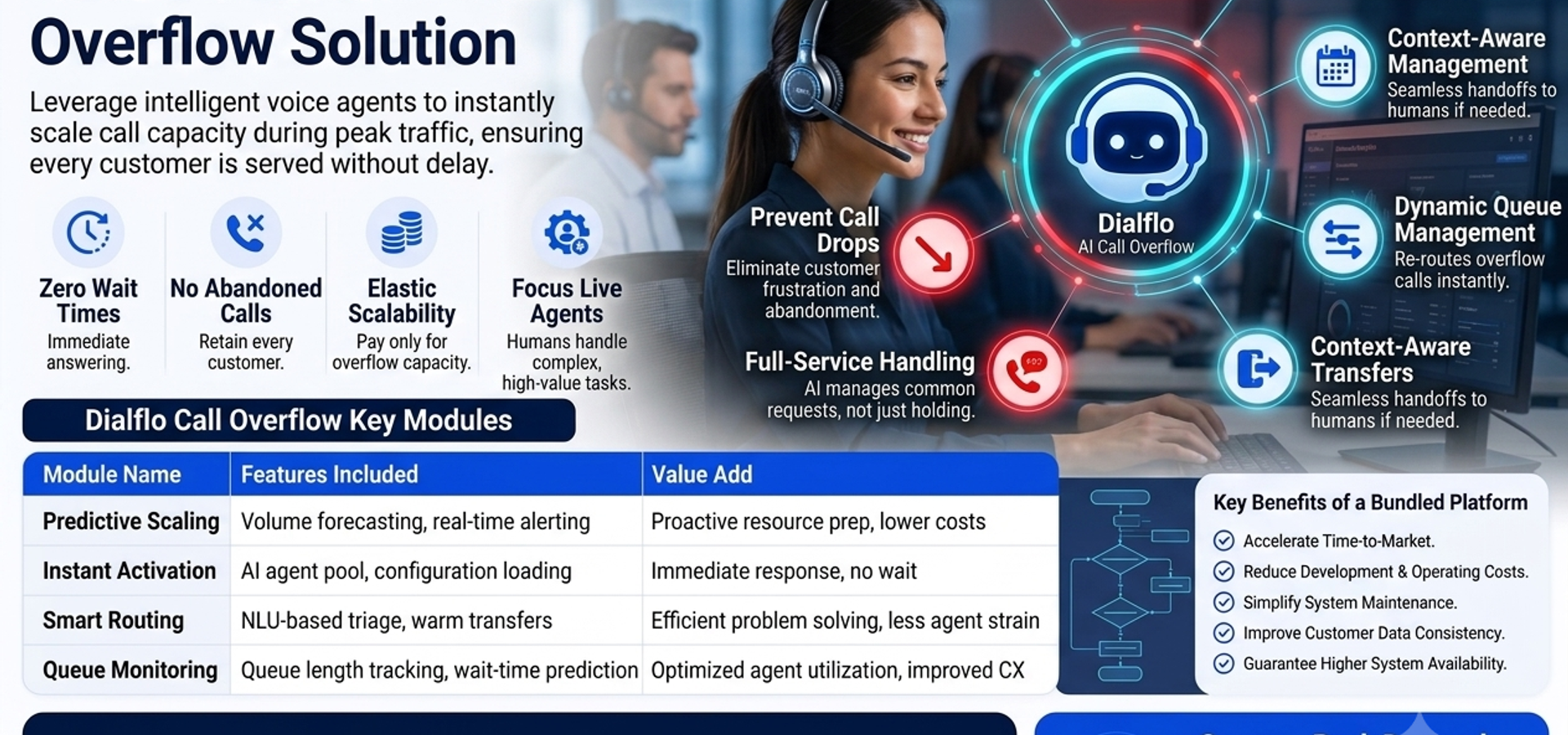
Peak day looks the same in every ops Slack: red queue, abandoned calls climbing, supervisors begging for overtime. Hiring for that one hour of chaos is how contact centers go broke. Smart teams use AI call overflow—voice agents that take the surge when humans are saturated—so you can finally handle peak call volume without a standby army.
This guide shows when overflow pays, which intents to route first, how to design escalation, and which KPIs prove it worked. For stack context, see conversational services and build vs buy voice AI.
What AI call overflow actually means
AI call overflow is not “replace the contact center.” It is a parallel lane that activates when live capacity hits a threshold—or when the clock says after-hours.
Typical triggers:
- queue wait exceeds X seconds
- all agents busy / skill group full
- campaign or festival surge
- after-hours and weekend coverage
- abandoned-call callback lists
The agent answers (or dials out), resolves scriptable intents, writes the outcome to your system of record, and warm-transfers the rest. That closed loop is what separates overflow from a smarter hold message.
Why peaks break traditional staffing math
Analysts expect conversational AI to take a growing share of contact-center interactions as routine volume moves off human headsets. Source: CX Today on conversational AI in contact centers.
McKinsey similarly notes generative AI can automate a meaningful share of customer-operations hours—exactly the repetitive calls that explode during peaks. Source: McKinsey: The economic potential of generative AI.
Staffing for the 95th percentile means idle cost most days. Staffing for the average means abandoned calls on peak days. Overflow is the third option: elastic capacity for the intents that do not need a human every time.
Unique angle: overflow the “boring majority,” not the hard cases
Most surge volume is boring: “Where is my shipment?”, “Confirm my interview”, “Are you still hiring?”, “Reschedule my slot.” Those calls share three traits—high volume, low ambiguity, and a system that already knows the answer.
Overflow those first. Keep complaints, disputes, and irreversible actions with humans. That single rule prevents the classic failure mode: a bot in over its head during the worst hour of the month.
Where AI call overflow pays fastest
Recruiting and staffing spikes
Job posts go viral; inboxes and phones melt. Overflow can screen applicants, confirm slots, and capture structured dispositions while recruiters stay on high-intent conversations. See AI in recruitment and hire candidates faster with AI.
Logistics and 3PL status storms
Weather, festivals, and delayed hubs create identical “where is my order?” loops. Overflow agents fetch TMS truth and close the loop so humans handle exceptions only. Context: AI in logistics use cases and logistics decision gap.
Lead and campaign surges
Ads do not wait for your dialer capacity. Overflow qualifies, books, and writes CRM fields so speed-to-lead survives the spike. Related reading: lead qualification calls.
After-hours and abandoned-call recovery
Peaks often continue when the floor is empty. Overflow answers nights and weekends, then works abandon callbacks at dawn before competitors do.
How to design AI call overflow that does not create chaos
- Pick one surge intent with clean data and a clear success definition.
- Set a hard trigger (wait time, occupancy, or schedule window)—not “bot answers everything.”
- Script containment and stop conditions so the agent knows when to transfer.
- Require write-back to CRM, ATS, or TMS—no orphan transcripts.
- Warm-transfer with context so humans do not restart the call from zero.
- Staff a thin escalation lane during the pilot peak window.
- Review failure reasons weekly and kill bad prompts fast.
If your platform cannot prove those layers, you are buying hold music with better marketing. Compare stacks via Vapi vs Bland vs Retell for India and Retell vs Dialflo vs Vapi, or start from build vs buy voice AI.
KPIs that prove you can handle peak call volume
- Abandon rate during known peak windows vs baseline
- Average speed of answer for overflow-eligible intents
- Containment rate on overflow traffic (resolved without human)
- Warm-transfer rate and CSAT on escalations
- Callback completion for abandoned-call recovery
- Cost per resolved contact in the spike hour—not vanity minute price
Finance will not care that the bot “sounded natural.” They will care that Monday’s festival surge no longer needs emergency overtime.
What not to overflow (yet)
- Angry complaint and retention saves
- Medical, legal, or regulated advice without human approval
- Refunds, cancellations, or money movement without strong auth
- Anything where wrong answers create irreversible harm
Overflow fails when teams automate the emotionally hardest 5% instead of the repetitive 60%.
A 30-day peak-volume pilot plan
Week 1: Pick one intent, map data fields, define transfer rules.
Week 2: Shadow mode or limited hours; compare transcripts to agent truth.
Week 3: Turn on trigger-based overflow for one peak window.
Week 4: Review KPIs, fix prompts/data gaps, decide scale or stop.
Ship one spike-proof workflow before you dream of “AI runs the floor.”
FAQs
What is AI call overflow?
It is a voice-agent lane that answers or dials when live agents are at capacity—peaks, campaigns, after-hours, or abandon callbacks—so routine intents do not die in queue.
How does it help handle peak call volume?
By absorbing parallel, scriptable demand while humans keep judgment calls. That cuts waits, abandons, and overtime without permanent headcount for rare spikes.
Which calls should overflow first?
Status checks, screens, confirmations, FAQs, and lead qualification—high volume, low ambiguity, system-of-record answers. Keep disputes and irreversible actions with humans.
Will this replace my agents?
No. Hybrid wins. AI clears the surge; humans handle empathy and exceptions. Design warm transfer before go-live.
What KPIs matter?
Abandon rate, speed of answer, overflow containment, transfer quality, callback completion, and cost per resolved contact in peak windows.
How does Dialflo help?
Dialflo runs production overflow and callback agents with CRM/ATS/TMS write-back and human escalation—so peaks stop becoming hiring fires.
A light next step
If your next peak is already on the calendar, do not staff for panic—design AI call overflow for the boring majority of that surge. When you want a production pilot with write-back and warm transfer, talk to Dialflo and pick one intent before the queue turns red again.