Why Logistics Operators Are Replacing Phone Trees with AI

Dialflo: AI Voice Agent
June 8, 2026
“Press 1 for tracking. Press 2 for billing. Press 3 for, ” The driver hung up. The shipper redialed your competitor. The prospect never left a message. Traditional phone trees were built for cost containment, not for freight moving at midnight. That is why more operators are evaluating voice AI for logistics as a real logistics IVR replacement, not another layer of hold music.
Traditional IVRs frustrate customers and drivers because logistics calls are messy, urgent, and context-heavy. This guide explains why phone trees fail in transportation, what transportation call automation should look like in natural language, how dispatch automation fits broker and 3PL desks, and why conversational voice improves logistics customer experience without pretending AI runs your network.
Why phone trees break in logistics first
Retail IVR annoys shoppers. In logistics, a bad menu costs detention, lost loads, and compliance gaps. Callers are often:
- Drivers on the road: hands busy, need dock codes now.
- Shippers under SLA pressure: will not map your tree to their panic.
- Brokers racing spot markets: hang up if the third prompt is wrong.
- Warehouse staff at the door: calling about access, not “billing.”
Phone trees assume callers know your taxonomy. Freight reality is “my PRO ends in 4421 and the gate code failed”, not press 4 for exceptions. J.D. Power publishes annual cargo and transportation satisfaction research showing service and communication quality shape shipper loyalty, see J.D. Power business research for sector benchmarks. When the first touch is a maze, logistics customer experience loses before a human answers.
Logistics IVR replacement vs “smarter voicemail”
Logistics IVR replacement is not swapping digits for slightly longer greetings. It is transportation call automation that:
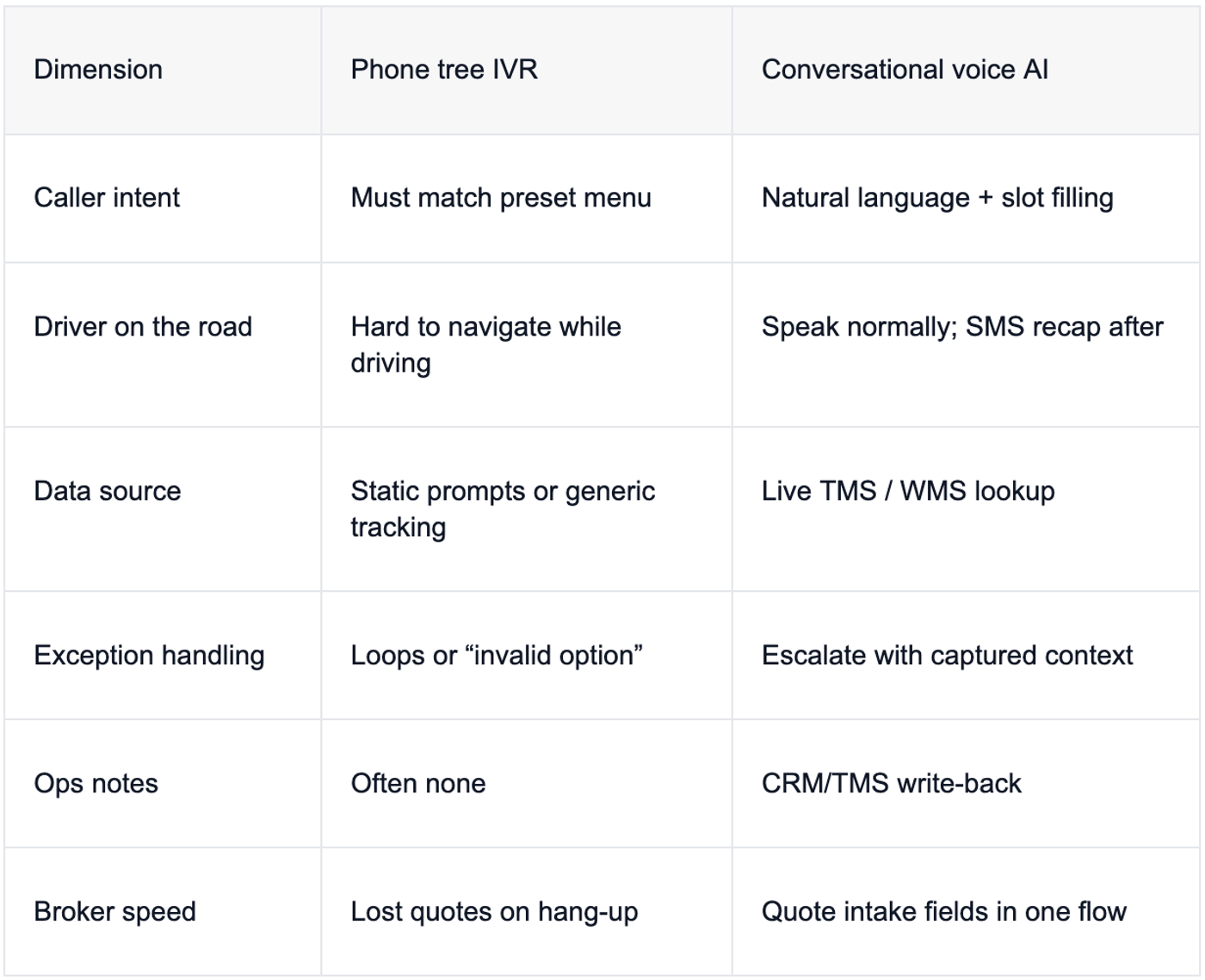
- understands intent in plain language (“where’s my load,” “need to reschedule”)
- looks up PRO, BOL, MC, or account before re-asking
- answers from TMS truth, or escalates when data is stale
- logs disposition and notes automatically
- offers instant warm transfer with transcript context
That is conversational voice, not an IVR with extra steps. Definitions and patterns: conversational services use cases.
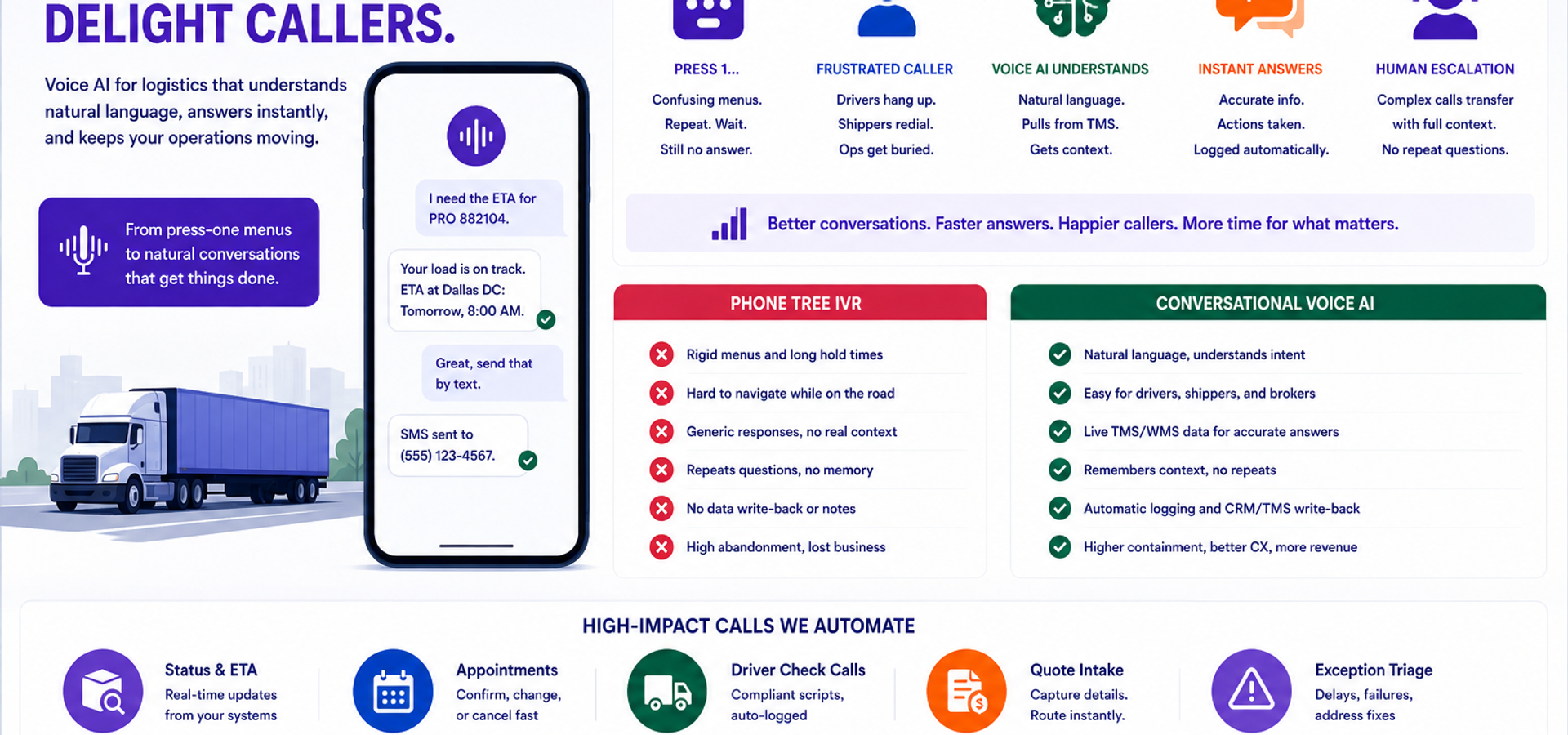
Phone tree vs conversational voice AI (comparison)
What voice AI for logistics should handle on day one
Prioritize high-volume, low-judgment intents, the same tier that buries desks in where is my shipment calls:
- Status and ETA: Honest windows; escalate if stale.
- Appointment confirm or change: Within your access rules.
- Driver check calls: Script + log for compliance.
- Quote intake: Lane, weight, equipment, for freight broker technology stacks.
- Exception triage: Delay, failed attempt, address fix, before ops; see reducing delivery exception calls.
Broader automation map: AI in logistics use cases. Voice sits at the edge while planning tools improve upstream, the logistics decision gap explains why dashboards alone do not stop the phone from ringing.
Dispatch automation without burning coordinators
Dispatch automation through voice AI should shrink readout work, not remove judgment. Coordinators keep:
- carrier negotiation and detention fights
- safety and hazmat escalations
- key-account saves and claims over threshold
- routing exceptions that need map and relationship context
Automation absorbs tier-one transportation call automation so humans answer when the call actually needs a human. Peak weeks multiply the benefit, read handling peak season call volume without hiring dispatchers. After-hours gaps still leak revenue when trees send callers to voicemail, the hidden cost of missed calls in logistics.
Freight broker technology: speed beats menus
Spot freight is call-sensitive. A broker IVR that ends in “leave a message” is a load you never book. Modern freight broker technology pairs load boards and TMS with voice that can:
- capture lane, commodity, weight, and timing in one conversational pass
- qualify shipper or carrier with MC/DOT checks where integrated
- route hot quotes to the right rep with priority flags
- send SMS confirmation so the caller does not redial
That is how logistics customer experience becomes a competitive moat, not a compliance checkbox. Supply-chain tech context: technology used in supply chain management and AI supply chain technology trends.
Natural language conversations instead of button menus
The Dialflo thesis for operators is simple: callers should describe the problem; the system should understand and act within policy. That means:
- No digit hunting: “I need the ETA for PRO 882104” works first try.
- Clarifying questions: One follow-up, not a new menu branch.
- Honest limits: “I do not have a fresh scan, connecting you now” beats guessing.
- Easy human escape: Say “agent” or “representative” and transfer with context.
- Written recap: SMS or email after the call reduces repeat rings.
Pew Research tracks how Americans use phones for information and service, voice remains primary for urgent, high-stakes tasks. Source: Pew Research Center internet and technology research. Logistics fits that pattern: when freight is late, people call.
Integration: conversational voice must write back
Replacing a phone tree fails if morning dispatch replays every question. Before cutover:
- map dispositions to TMS/CRM fields
- define which flows are read-only vs write-enabled
- set escalation rules for claims, safety, and rate exceptions
- test warm transfer so agents see PRO, intent, and transcript
Forecasting ML does not answer the driver at the gate, pair machine learning supply chain optimization with voice at the edge. Build vs buy matters for telephony maintenance: build vs buy voice AI stack.
Metrics that prove logistics IVR replacement worked
- IVR abandon rate vs conversational containment
- average time to first useful answer
- repeat caller rate within two hours
- tier-one calls reaching human coordinators (should drop)
- morning callback queue depth
- quote-to-book ratio on broker lines
- OTIF and customer satisfaction on pilot lanes
The Bureau of Transportation Statistics publishes freight indicators useful for year-over-year call benchmarking, BTS statistical products and data.
Compliance and brand voice on automated lines
Disclose automation where required. Follow call recording consent rules in your states. Never let voice AI commit on claims, hazmat, or rate concessions outside policy. Sustainability and service expectations also push better coordination, how AI makes supply chains more sustainable.
Where Dialflo fits
Dialflo gives logistics operators voice AI for logistics with natural language conversations instead of button menus, TMS-aware answers, structured dispatch automation, and write-back to your ops stack. It is not a TMS; it is the conversational layer that replaces phone trees frustrating drivers and customers.
Pilot one inbound line, measure repeat callers and coordinator readout hours, then expand. Confirm integrations and languages on dialflo.ai.
FAQ: voice AI for logistics
Why replace logistics IVR phone trees?
Menus break on real freight intents, frustrate drivers, and push callers to competitors or voicemail.
What is voice AI for logistics?
Conversational automation that understands natural language and pulls answers from operations systems.
Does it replace dispatchers?
No, tier-one automation plus human judgment on exceptions and high-stakes calls.
What calls go first?
Status, ETA, appointments, check calls, quote intake, routine exception triage.
How fast to pilot?
Often 2–4 weeks on one queue with read-only TMS first.
How does Dialflo help?
Natural language voice AI with logistics workflows and write-back, see dialflo.ai.
Closing: the best phone tree is the one callers never notice
Logistics operators are replacing phone trees because freight communication is too urgent for “invalid option.” Voice AI for logistics delivers logistics IVR replacement that respects how drivers and shippers actually talk, while transportation call automation and dispatch automation give coordinators their time back for work that moves loads.
Ready to retire press-one menus on your busiest line? Explore Dialflo for conversational voice built for freight broker technology stacks and 3PL desks, and a logistics customer experience that answers in plain language, not button mazes.